

Shonen TCG · Guides
Digimon Card Game Guide 2026: Rules, Sets, and Meta
Learn the memory gauge, pick one engine, and skip the Royal Knights that are losing.
Our callLearn memory before anything else, then build Examon: it's the deck winning after EX-13.
If you're starting the Digimon Card Game now, learn the shared memory gauge before you buy anything, then pick one deck. After EX-13, the deck we'd pick is Examon. The game itself is a two-player trading card game about building a stack, spending memory carefully, and turning a small rookie into a board-changing Digimon. Below are the rules, deck construction, the two newest sets and what's winning right now.
The game rewards a different kind of patience from most anime TCGs. You can spend nearly all of your memory in one explosive turn, but the last effect may hand your opponent a huge amount of room. A cheap evolution that leaves the marker on your side can be better than a flashy play that crosses the gauge. Once that rhythm makes sense, the Raising Area, Digi-Eggs, security stack, and inherited effects start to fit together.
TL;DR: Digimon uses a 50-card main deck, a separate Digi-Egg deck of up to 5 cards, and one shared memory gauge. You win by reducing the opponent's security to zero and landing a final attack, while evolving Digimon to inherit effects from the cards underneath them. Timeless Bonds (BT-26) came out September 4, 2026 and Chivalrous XIII (EX-13) followed on October 2. Since EX-13, Examon, Glowing Dawn and Data Squad lead tournament results.
What is the Digimon Card Game?
The Digimon Card Game is a card battler where the cards under a Digimon matter as much as the card on top. A rookie can evolve through several levels, drawing a card each time it digivolves and carrying inherited effects forward. The top card gives the stack its current name, level, DP, and active effects, while the cards beneath it remain available as inherited text when the top card allows it.
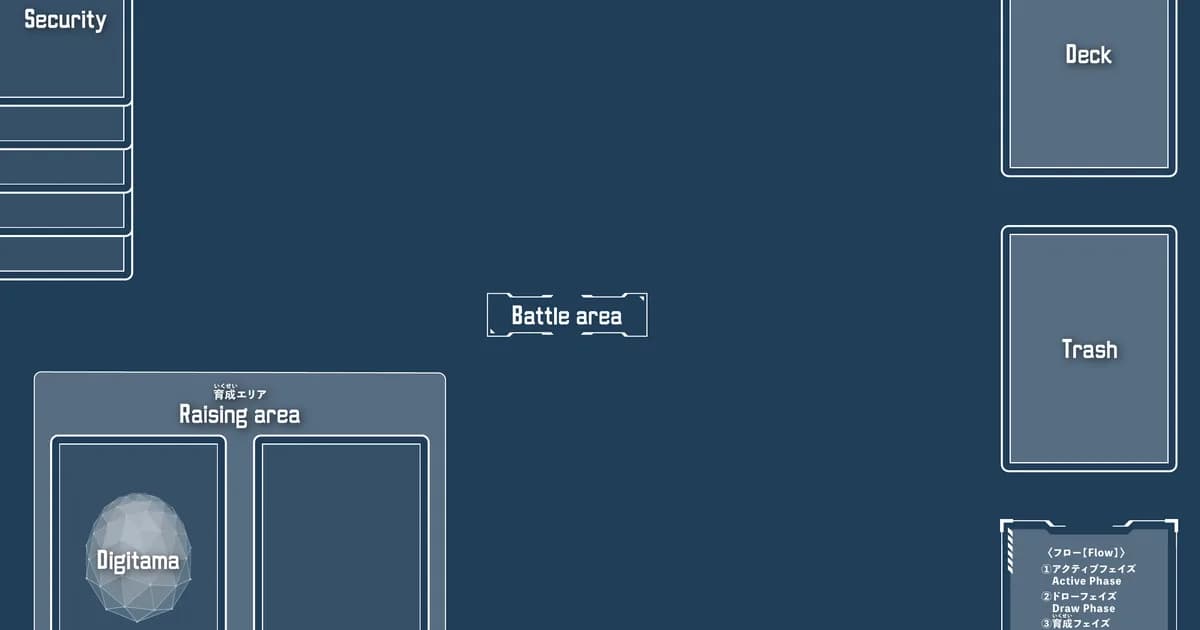
Each player begins with a main deck, a Digi-Egg deck, a five-card security stack, and a hand. The Battle Area holds Digimon and Tamers. The Raising Area is where a Digi-Egg can hatch safely before the stack enters the Battle Area. The shared memory gauge sits between both players and decides how long a turn can continue.
The win condition is easy to state. Attack the opponent's security until it is gone, then connect with a later attack against the player. A Digimon can also attack one of the opponent's suspended Digimon. DP decides the battle, and a Digimon that loses a battle or is deleted by an effect goes to the trash unless another effect saves it. Security checks can delete the attacking Digimon, trigger a security effect, or simply remove a card from the stack.
The official Digimon Card Game rules page is the best place to check the current rule manual, comprehensive rules, and the latest restriction notices. Rules matter more here than in a casual kitchen-table game because newer keywords such as Link, Succession, and Assembly interact with older timing rules.
The closest comparison on this site is the Union Arena beginner guide, which also asks you to preserve resources for a later turn. Digimon's resource marker is more visible, though. You always know exactly where your turn will end if you spend one more memory.
How to Play: Memory, Evolution, and Digi-Eggs
Every turn runs four phases. The comprehensive rules call them the unsuspend, draw, breeding and main phases; the official play sheet prints them as Active, Draw, Raising and Main, which is why you'll hear both sets of names. You unsuspend cards, draw one (the first player skips that draw on turn one), decide whether to hatch or move a stack out of the Raising Area, and then play cards, digivolve, use effects, and attack during the Main Phase.
Memory is the timing engine. Costs appear as memory numbers. If you start at 3 memory and play a card that costs 4, the marker moves to the opponent's side at 1. You finish resolving that play, then your turn is over. An effect that gains memory can pull the marker back and let you continue. The best turn is often the one that gets your stack ready while leaving the opponent at a small number instead of handing them a full turn.
Digivolution usually costs less than playing a high-level Digimon directly. The new card goes on top of the existing stack, you draw one card, and the new Digimon gains access to inherited effects from underneath. The cost, level, color, and trait printed in the digivolution requirements still matter. Some newer cards use alternate paths such as DNA Digivolution, Blast Digivolve, Assembly, Succession, or Link, so read the exact bracketed text before assuming two effects work the same way.
Digi-Eggs begin face down in the Digi-Egg deck. During the Raising Phase, you may hatch the top egg into the Raising Area if that area is empty. A hatched level 2 Digimon can evolve into a level 3 from your hand, usually at a low cost. You can keep the stack in the Raising Area for safety, or move it into the Battle Area when you need it to attack, use a Battle Area effect, or start building pressure.
- Digimon Card Game Rules: Memory, Evolution, and Digi-Eggs: A first-match walkthrough of memory, evolution, Digi-Eggs, Raising Area, and security checks.
Bandai's own rule trailer covers the same turn in a few minutes if you'd rather watch than read:
Deck Building Basics
A legal Digimon deck has exactly 50 cards in the main deck and up to 5 cards in the separate Digi-Egg deck. The comprehensive rules manual allows up to 4 copies of a card with the same card number in a deck. That limit is based on the card number, so two cards with the same name but different numbers are separate records for deck construction.
Color requirements shape the first version of every list. A Digimon can usually digivolve only onto a card that meets the color and level conditions printed on it, although effects can open alternative lines. Start with one clear family, then add support cards that either search for the family, gain memory, recover security, protect the stack, or remove an opposing Digimon.
The main deck usually contains a progression of rookies, champions, ultimates, and megas, plus Tamers and Options. The exact ratio changes by archetype. A stack-heavy deck wants enough lower-level Digimon to begin evolving every game. A strategy built around wide boards, hand trashing, or low-level attacks may devote more slots to cards that create immediate field presence instead.
Tamers stay in the Battle Area and support the plan over several turns. Options are one-shot effects that can search, remove, protect, or change the memory exchange. Security effects make some Options useful even when they are not the card you wanted to draw. A good list has a reason for every high-cost card because a hand full of unplayable finishers creates no pressure while your opponent develops.
The One Piece TCG complete guide is a useful contrast for deck builders coming from another Bandai game. One Piece uses DON!! cards as a separate resource system, while Digimon makes the same resource visible on one shared gauge and turns overspending into the opponent's opening.
- Purple Shambala Digimon Deck Guide: BT-26 Build 2026: a public-list walkthrough of the Shambala shell that led BT-26 before EX-13.
Timeless Bonds (BT-26) Set Guide
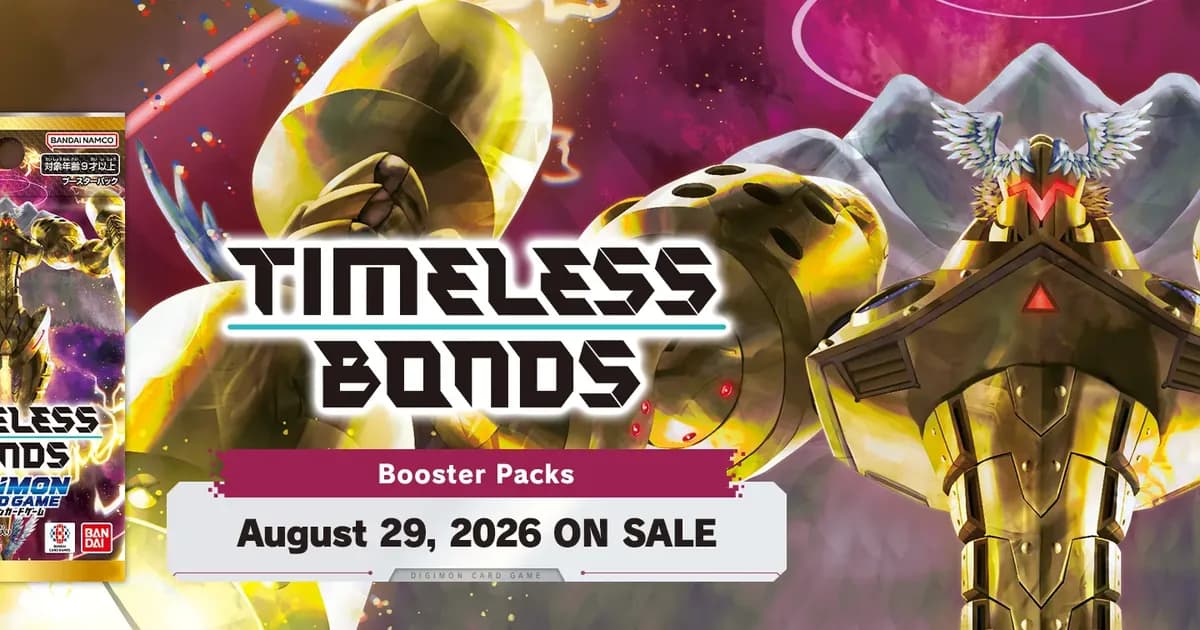
Timeless Bonds is the newest main booster. Bandai's global English page, for the version sold in the US and Europe, lists pre-release events on August 28, 2026, a store release on September 4, 2026 and 108 card types, and presents cards from Digimon Story Time Stranger, the Olympos XII, Digimon Beatbreak, Digimon Data Squad, and the Seven Code Appmon group. The set also includes four official strategy recipes, which gives new players a more useful starting point than a raw spoiler checklist.
The official BT-26 product page shows the set's featured cards and deck recipes. The Chronomon recipe returns cards from trash to the bottom of decks, uses that deck growth to unlock its effects, and ends on a removal-heavy Chronomon line. <span class="tcg-card-ref" data-card="BT26-016" data-slug="chronomon-holy-mode-bt26-016" tabindex="0" role="button" aria-label="View card BT26-016"><img class="tcg-card-thumb" src="/_next/image?url=%2Fimages%2Fcards%2Fbt26%2FBT26-016.webp&w=96&q=75" alt="" aria-hidden="true" width="18" height="25"><span class="tcg-card-id">BT26-016</span><span class="tcg-card-popup" aria-hidden="true"><img class="tcg-card-full" src="/images/cards/bt26/BT26-016.webp" alt="BT26-016 card art" loading="lazy" width="220" height="308"><a class="tcg-card-label" href="/cards/chronomon-holy-mode-bt26-016" tabindex="-1">BT26-016</a><a class="tcg-card-shop" href="https://partner.tcgplayer.com/c/5694715/1830156/21018?u=https%3A%2F%2Fwww.tcgplayer.com%2Fproduct%2F709919&subId1=card-BT26-016" target="_blank" rel="sponsored noopener" tabindex="-1">Shop on TCGplayer</a></span></span> Chronomon: Holy Mode has deletion, Recovery +1, and a leave-the-Battle-Area replacement that returns the top security card to the bottom of the deck.
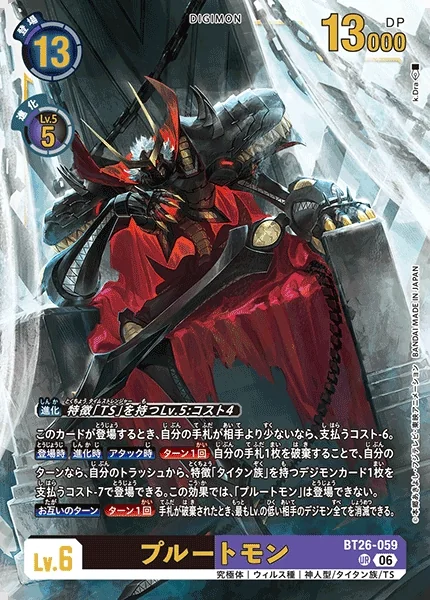
The set's second headline package is built around <span class="tcg-card-ref" data-card="BT26-059" data-slug="plutomon-bt26-059" tabindex="0" role="button" aria-label="View card BT26-059"><img class="tcg-card-thumb" src="/_next/image?url=%2Fimages%2Fcards%2Fbt26%2FBT26-059.webp&w=96&q=75" alt="" aria-hidden="true" width="18" height="25"><span class="tcg-card-id">BT26-059</span><span class="tcg-card-popup" aria-hidden="true"><img class="tcg-card-full" src="/images/cards/bt26/BT26-059.webp" alt="BT26-059 card art" loading="lazy" width="220" height="308"><a class="tcg-card-label" href="/cards/plutomon-bt26-059" tabindex="-1">BT26-059</a><a class="tcg-card-shop" href="https://partner.tcgplayer.com/c/5694715/1830156/21018?u=https%3A%2F%2Fwww.tcgplayer.com%2Fproduct%2F707320&subId1=card-BT26-059" target="_blank" rel="sponsored noopener" tabindex="-1">Shop on TCGplayer</a></span></span> Plutomon and the Titan trait. Plutomon can turn a discarded card into a reduced-cost play from the trash, then punish hand trashing by deleting the opponent's lowest-level Digimon. The official recipe pairs it with ZombiePlutomon and Dark Field, giving the purple shell a way to pressure both the opponent's hand and Battle Area.
The other two official recipes point in different directions. Jupitermon uses security manipulation, Raid, Alliance, and Engage to attack while its protection effects keep Time Stranger cards on the board. The Seven Code recipe fills the field with Appmon, then uses a seven-card assembly requirement to reach Dantemon and turn linked cards into removal and security pressure.
Approach BT-26 by choosing the recipe whose play pattern you actually want. Chronomon is a graveyard and deck-control line. Plutomon is a hand-pressure and Titan line. Jupitermon spends security for tempo. Seven Code asks you to assemble a wide Appmon board before committing to its finisher. Buying a few cards from every theme produces a pile; choosing one engine produces a deck.
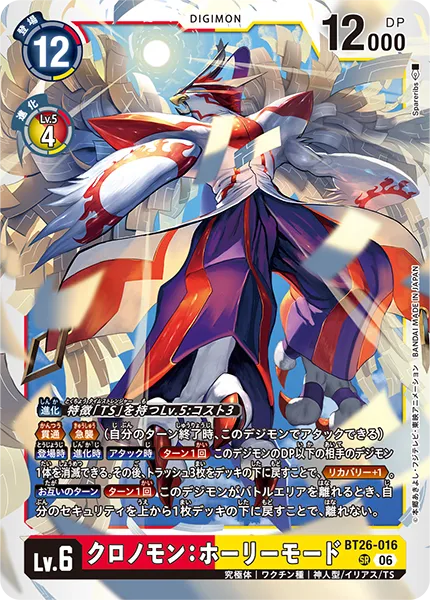 Image: Bandai, Timeless Bonds product page. BT26-016 Chronomon: Holy Mode, one of the set's featured removal and recovery cards.
EX-13 Chivalrous XIII followed on October 2, 2026. It's an extra booster of 81 card types built around the 13 Royal Knights, and it's the set that reshaped the meta below: its Examon turned an old dragon deck into the best deck in the game, while most of the other Knights are still losing.
- Digimon BT-26 Timeless Bonds Set Guide 2026: Cards: Release facts, featured cards, official recipes, and a dated public meta snapshot for BT-26.
- Digimon EX-13 Card List: Chivalrous XIII Set Guide 2026: Official EX-13 card types, Royal Knight routes, and confirmed release details.
Best Decks and the Current Meta
Three decks lead the Digimon Card Game since EX-13: Examon, Glowing Dawn and Data Squad. We counted every Limitless Play event from October 3 to 19, 2026, the first stretch after Chivalrous XIII came out in English. Examon had the best match record and beat both of the others every time it met them; on Reddit, u/Carbohydrateman summed it up as "Examon has been revived as a deck." Glowing Dawn was the most played deck, and Data Squad matched Examon's three event wins. DigimonCard.io's two-week tier list, which scores placements from more organizers, puts the same three on top.
The BT-26 picture from September is gone. Shambala, which led that old tracker, still has a winning record but only one small event win. Jupitermon is the best deck outside green. Plutomon, the Titan card Bandai built a BT-26 recipe around, turned up in only five of the 237 published lists. Of the new Royal Knights decks, UlforceVeedramon, Gallantmon and Dynasmon are all losing more matches than they win.
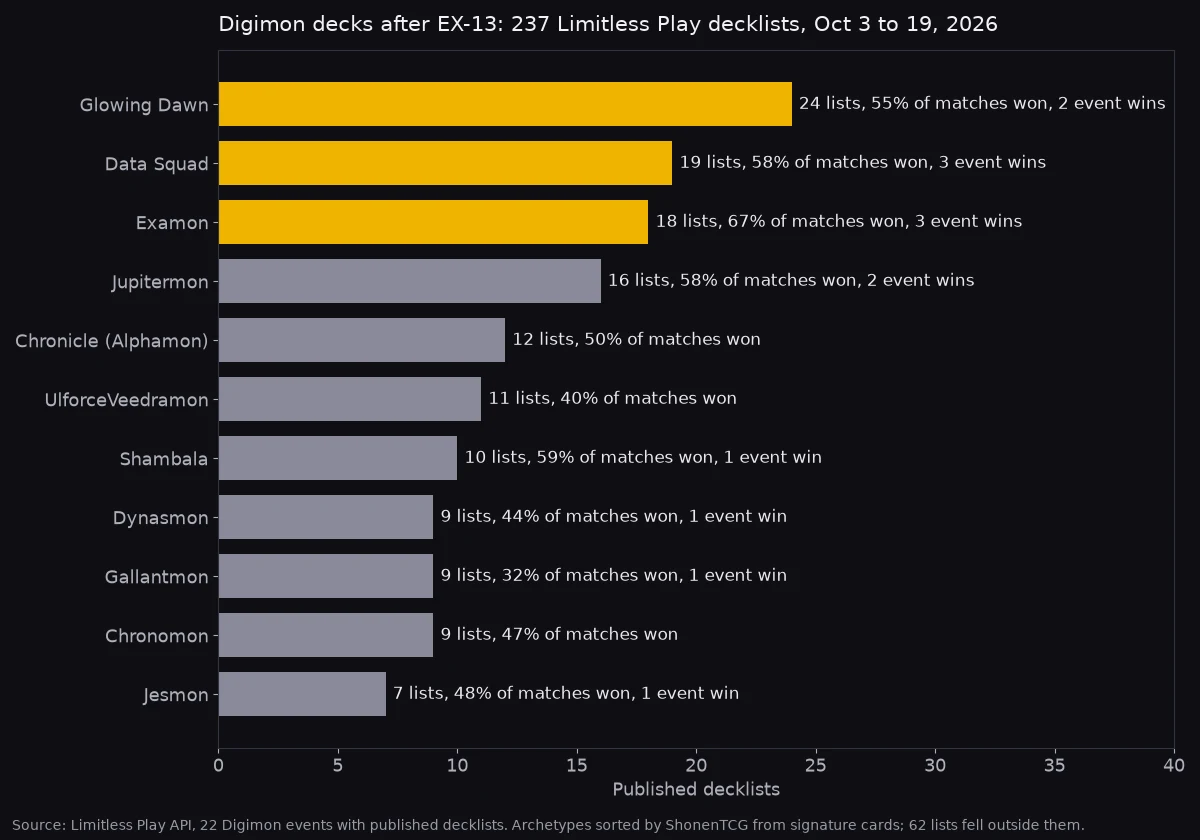 Chart: ShonenTCG. Source: Limitless Play API, October 3 to 19, 2026. Gold bars are the top three decks.
We'd build Examon if you're picking a first competitive deck today. If you already own Data Squad, keep playing it; we just wouldn't buy into it fresh. Most of these events had fewer than 20 players, so one strong pilot can move a deck up or down. Check the tier list again before a Store Championship.
- Digimon Card Game Tier List: Best Decks After EX-13: the current ranking from post-EX-13 tournament results, with Examon, Glowing Dawn and Data Squad on top.
All Digimon Card Game Guides
- Pokemon TCG Pocket Complete Guide 2026: a useful comparison if you are learning a digital card game with a separate resource system.
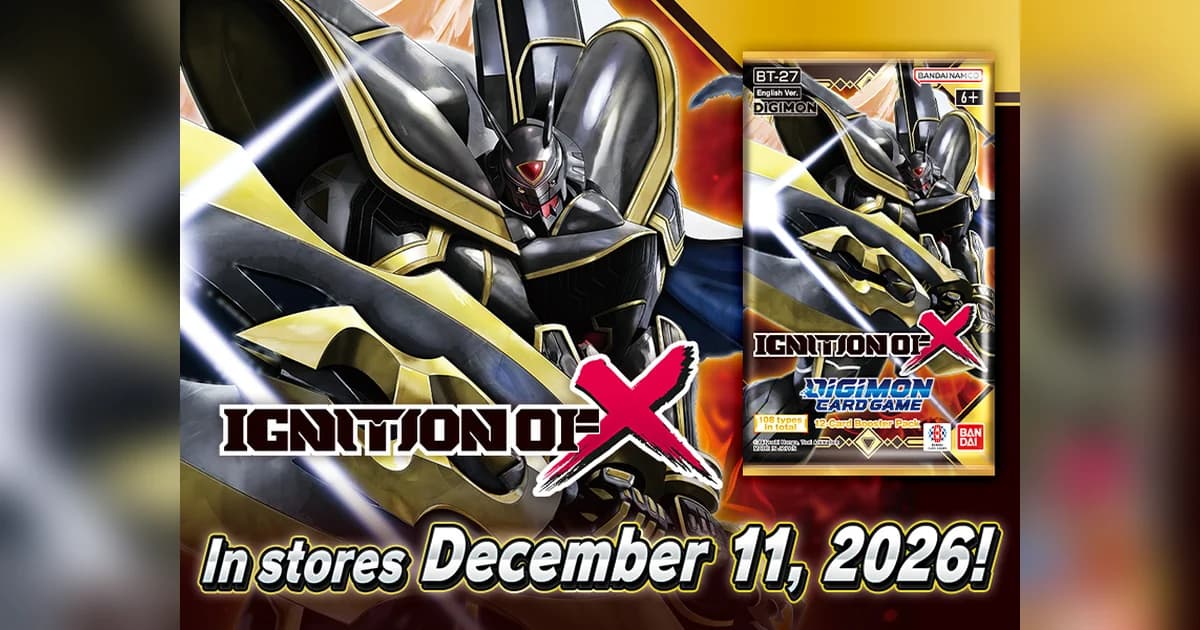
- Digimon BT-27 Ignition of X: Release Date and Card List: dates, rarities, the three official reveals and which decks they fit.
Use the Digimon guides in a deliberate order instead of jumping straight to a finished list. Start with the rules article and play a few open-hand practice turns. Ask when you should hatch, when a stack is safe enough to move out of the Raising Area, and how much memory you are willing to give away for a stronger board. Those decisions teach more than memorizing an evolution line because every archetype eventually asks you to trade present pressure for a better next turn.
Move to the set guides once the turn structure feels familiar. Read the official recipe descriptions first, then compare them with the deck guides and the current tier list. An official recipe shows the intended engine. A tournament result shows what players are actually winning with. The two answer different questions, so neither should replace the other.
When you test a list, write down its 50-card skeleton, Digi-Egg count, main color requirements, memory curve, and realistic first winning turn. Track which cards search for rookies, which cards recover from the trash, and which effects matter in security. If the deck loses because it cannot start evolving, change the opening consistency before adding another expensive finisher. If it reaches the board but cannot close, inspect its security pressure and inherited effects instead. Check the official rules and restriction notices again before an event, especially when a list was copied from an older format.
Use the rules article to learn the timing, the set guides to choose an engine, and the tier list to see which engines are winning right now.
How we checked this: on October 20, 2026 we re-read Bandai's comprehensive rules and the BT-26 and EX-13 product pages, and built the meta section from every published decklist in 22 Limitless Play events (October 3 to 19) with our script scripts/sims/digimon-ex13-meta-limitless.py, then compared the order with DigimonCard.io's two-week tier list. On October 24 we rechecked the release dates on Bandai's global English product pages.
Correction (October 24, 2026): an earlier version gave BT-26's release as August 29, 2026 and EX-13's as October 3. Those are the dates on Bandai's Asia English site. The English version sold in the US and Europe released BT-26 on September 4 (pre-release events August 28) and EX-13 on October 2, per Bandai's global English product pages.
Frequently Asked Questions
What is the Digimon Card Game?
The Digimon Card Game is a two-player trading card game built around evolving Digimon and managing one shared memory gauge. Each player uses a 50-card main deck, a separate Digi-Egg deck, and a five-card security stack. You win by clearing security and connecting with a later attack against the opponent.
How many cards are in a Digimon Card Game deck?
A constructed list has exactly 50 main-deck cards and may include up to 5 Digi-Egg cards in its separate deck. The normal copy limit is 4 cards with the same card number. Always check the current restriction announcement before registering a list for an official event.
How does memory work in Digimon?
Memory is a shared marker that pays for cards and effects. You can keep acting while it remains on your side. Once a cost or effect pushes it to the opponent's side, you finish resolving the current effect and pass the turn. Memory gain effects can extend your turn or make a large play safer.
What is the current Digimon Card Game set?
The newest English release is EX-13 Chivalrous XIII, an extra booster built around the Royal Knights, out October 2, 2026. The newest main booster is Timeless Bonds (BT-26), released September 4, 2026 with 108 card types. BT-27 Ignition of X is due in December.
Are Digi-Eggs part of the 50-card deck?
No. Digi-Eggs sit in a separate deck of up to 5 cards and enter the Raising Area when you hatch one. They provide the starting point for your evolution line, while the 50-card main deck holds the Digimon, Tamers, and Options you draw during the match.
References
- Digimon Card Game official product list (global English): current release calendar for the version sold in the US and Europe, including BT-26 and EX-13.
- Timeless Bonds BT-26 official product page: release dates, set features, featured cards, strategy text, and official recipes.
- Chivalrous XIII EX-13 official product page: release date, card types and the Royal Knights theme.
- Digimon Card Game official rules page: Rule Manual 6.0, Comprehensive Rules 4.3, memory gauge files, and restrictions.
- Limitless Play Digimon tournaments: standings, decklists and pairings behind the meta section, October 3 to 19, 2026.
- DigimonCard.io tournament tier list: the two-week placement ranking we compared against.
Cards in this article
About the author
Deck guides and meta
Pen name for the Shonen TCG desk's One Piece TCG deck guides, tier lists and meta reports.
- Lists averaged from public tournament results, sample size stated
- Card text quoted from Bandai's official card list
- Opinions marked as ours, with the reason
Keep reading

Digimon EX-13 Card List: Chivalrous XIII Set Guide 2026
Guides · 6 min

Digimon BT-26 Timeless Bonds Set Guide 2026: Cards
Guides · 6 min

Digimon Card Game Tier List: Best Decks After EX-13
Guides · 8 min

Digimon Shambala Deck List and Matchups After EX-13
Guides · 7 min
Digimon Card Game Rules: Memory, Evolution, and Digi-Eggs
Guides · 11 min
Digimon BT-27 Ignition of X: Release Date and Card List
Guides · 8 min
EB-05 Matchup Chart: Who Beats Red/Green Luffy? (Nov 2026)
Guides · 8 min
OP18 Meta Predictions: The Field After the Mihawk Ban
Guides · 9 min
Disclaimer
This article is published for informational and entertainment purposes. It does not constitute professional financial, legal, or technical advice. Game performance, online services, patch schedules, and store listings change. Verify critical details (pricing, system requirements, regional availability) with publishers and storefronts before you buy. Affiliate links, where present, help support our editorial work and are labelled in our affiliate disclosure.