

Shonen TCG · Guides
Union Arena TCG Beginner Guide: How to Start (2026)
This Union Arena TCG beginner guide starts with the rule that causes the most confusion: Energy Line cards do not create a simple one-per-turn counter. They generate energy continuously. Once that clicks, the table setup, five phases, and first practice games become much easier to follow.

Union Arena looks familiar if you have played another anime card game, but its lines, Life Area, AP cards, and source material codes work differently. The guide below uses Bandai's North American rule manual and FAQ, then turns those rules into a small practice plan you can use with a borrowed deck.
TL;DR: Build a 50-card deck and bring three AP cards separately. Set up seven cards in the Life Area, learn the Start, Movement, Main, Attack, and End phases, and treat the Energy Line as a continuous source rather than a spending pile. Pick a title your local group can test with, then verify the printed card text before buying.
Union Arena TCG beginner guide: quick answer
Union Arena is a two-player game where you develop characters across a Front Line and Energy Line, attack through the five official phases, and win by emptying the opponent's Life Area or making them fail a draw during their Start Phase. Your first lesson should be line movement and energy generation, not card prices or a supposed universal starter ranking.
The current official setup is a 50-card deck plus three AP cards, with seven cards in the Life Area. Different source material codes cannot share a deck, but the Deck Construction FAQ allows several colors when the cards otherwise belong together. Those details correct the old beginner shortcut that called every deck single-color and gave every player a fictional Key Card.
Overview: the Union Arena learning path
Learn the table in this order: setup, Energy Line, phase order, combat, then deck choice. That sequence matters because a deck recommendation is hard to judge while the player is still treating energy as a one-per-turn counter or putting AP cards into the main deck.
The official rules and FAQ are the useful baseline here. Product pages can tell you which titles and products are available, but they do not replace the game rules. If a community post, translation, or older guide disagrees with Bandai's current North American FAQ, use the official ruling and check the card's printed English text before changing a list.
Key Takeaways
- Bring a 50-card deck and three AP cards outside the deck.
- Set seven cards in the Life Area and keep the AP Area separate.
- Energy Line cards generate energy continuously, even while rested.
- The five phases are Start, Movement, Main, Attack, and End.
- Different source material codes cannot share a deck, while colors can mix when allowed.
- Equal BP in a battle favors the attacking Character.
How the Union Arena deck and field are set up
Start with the physical layout, because many early mistakes come from putting cards in the wrong place.
Each player has a 50-card deck and three AP cards outside that deck. The official manual's playmat shows a Front Line that holds up to four cards, an Energy Line that holds up to four, a Life Area that starts with seven cards, and an AP Area that holds up to three AP cards. The table also includes a Sideline and a Removal Area. Use the mat or draw these zones on paper for a practice game.
The Front Line is where your active board develops. The Energy Line is not a discard pile and not a stack of counters. Cards there generate energy, and their position matters because line space is limited. The Life Area is the opponent's main victory target. AP cards sit apart from the deck and should be easy to count.
Deck construction has two rules worth memorizing before you sleeve anything:
- A deck contains 50 cards. The three AP cards are extra.
- Cards with different source material codes cannot be included together. The code is the three-letter code after the slash in a card number.
- You may use several colors when the source material rule allows them.
- You can include up to four copies of a card number, even if cards share a name but have different card numbers.
- Special, Color, and Final triggers have a four-copy limit. Other trigger types follow the official FAQ's separate rules.
This is why a deck can feel title-focused without being locked to one color. Check the card number and source code first, then worry about the color curve.
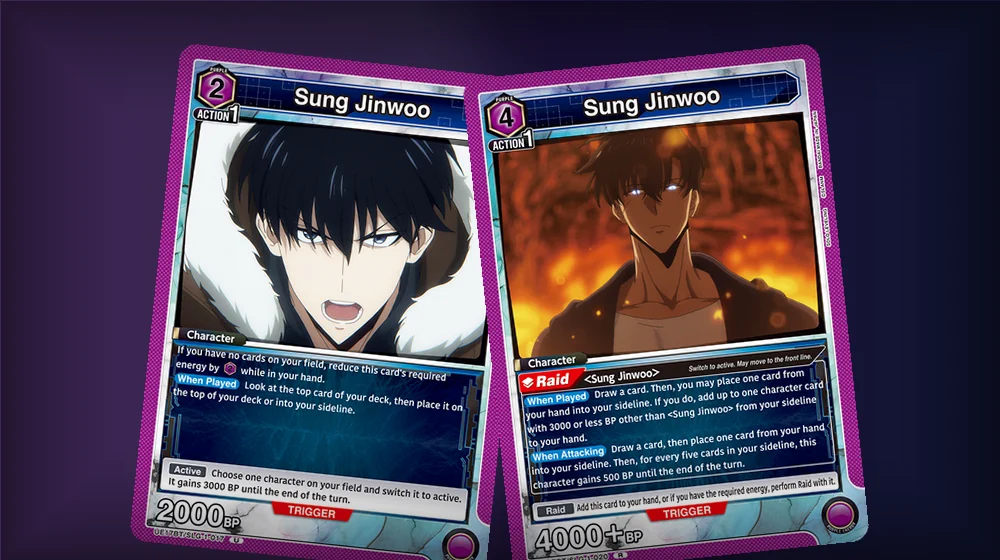 These real English cards are representative examples from one Union Arena title, not a generic starter deck.
How Energy Line works in Union Arena
The Energy Line is the mechanic to learn before you judge a hand. Cards there generate energy continuously, even when they are rested. Playing a card does not remove energy from a spendable counter. Instead, the card's required energy is checked against what your Energy Line can generate at the moment you play it.
That changes the usual resource habits. You are not waiting for an automatic energy token at the start of each turn, and you are not spending a mana pool that vanishes after use. You are managing which cards occupy the line, which cards can move, and whether your field has enough generation for the next play.
Movement rules create the important edge case. During the Movement Phase, cards can move between the Front Line and Energy Line, but only a Character card with Step can move from the Front Line to the Energy Line. You choose the movement before proceeding to Main. If several characters move, the official FAQ says to choose them and resolve the movement together. If the destination line is full, excess cards go to the Removal Area before the movement takes place.
Resting a card does not switch off its energy generation. That means a rested Energy Line card can still contribute to the required energy for a later play. It also means you should not judge a board by counting only upright cards.
For a first practice game, say the required energy out loud before each play. Ask two questions: how many cards are generating energy, and which line will have space after this play? That habit catches more beginner errors than trying to memorize a list of expensive finishers.
GODEEPER: Once the line rules make sense, use our deck-building walkthrough to plan card counts and a playable energy base. Union Arena Deck-Building Guide →
The five Union Arena phases in order
A Union Arena turn follows five phases: Start, Movement, Main, Attack, and End. Keeping the order visible beside the playmat is useful for the first few games, especially because moving a card and playing a card happen in different parts of the turn.
Start Phase. Resolve the start-of-turn instructions and draw according to the rules. The official FAQ also has a specific ruling about the extra draw and Player One's first turn, so do not import a first-player rule from another game.
Movement Phase. Move cards between the Front Line and Energy Line as allowed. A Character with Step is the special case that can move from the Front Line to the Energy Line. If a line cannot hold every selected card, follow the official order that sends excess cards to Removal before the move.
Main Phase. Play Characters and Events, and use abilities that can be used in this phase. If the Front Line or Energy Line is full, the FAQ explains when an existing card must go to Removal before a new Character can enter. Rested cards still generate energy, so a rested board can remain useful even when it cannot attack.
Attack Phase. Declare attacks and resolve battles, blockers, BP comparisons, and trigger checks. Do not rush to the next phase while a trigger is still being resolved. The Attack Phase FAQ has separate rulings for ties, higher-BP blockers, and Final triggers.
End Phase. Complete the cleanup required by the rules. AP cards do not automatically switch to active here, and the hand does not use an eight-card limit at every point of the turn. The End Phase FAQ places that hand-size check in the End Phase, which is another detail that is easy to misremember.
This sequence also gives you a clean way to review a loss. Mark the phase where the decision happened. If you lost because you had no room for a Character, it was a line-management error in Movement or Main. If you lost a battle you expected to win, check the Attack Phase ruling rather than changing the whole deck.
How combat and winning work
Combat is a BP comparison, but the tie ruling is not the one many new players expect. If the attacking and blocking Characters have equal BP, the attacking Character wins. The blocking Character is sidelined while the attacker stays. If the blocking Character has higher BP, neither Character is sidelined. Read that aloud before your first practice attack so both players use the same result.
Trigger checks need their own pause. The Attack Phase FAQ says that when a trigger activates, other abilities on that same card do not also activate just because the trigger happened. Resolve the trigger, apply any relevant Final behavior, and then continue with the game state the ruling describes. This is a good reason to keep a reference page open for the first few matches.
Union Arena has two victory conditions:
- You win when your opponent has no cards left in their Life Area.
- You win when your opponent has no cards in their deck and cannot draw during their Start Phase.
Failing to draw at another point in the turn does not automatically lose the game. If a trigger sequence reduces a player's Life Area to zero, the loss check occurs after the abilities activated during that trigger check resolve. A Final trigger can therefore matter even when the Life Area appears empty for a moment.
The practical lesson is simple: count the opponent's Life Area, deck, and likely Start Phase draw separately. Do not treat every empty deck event as an immediate loss, and do not stop reading a trigger sequence at the first number that reaches zero.
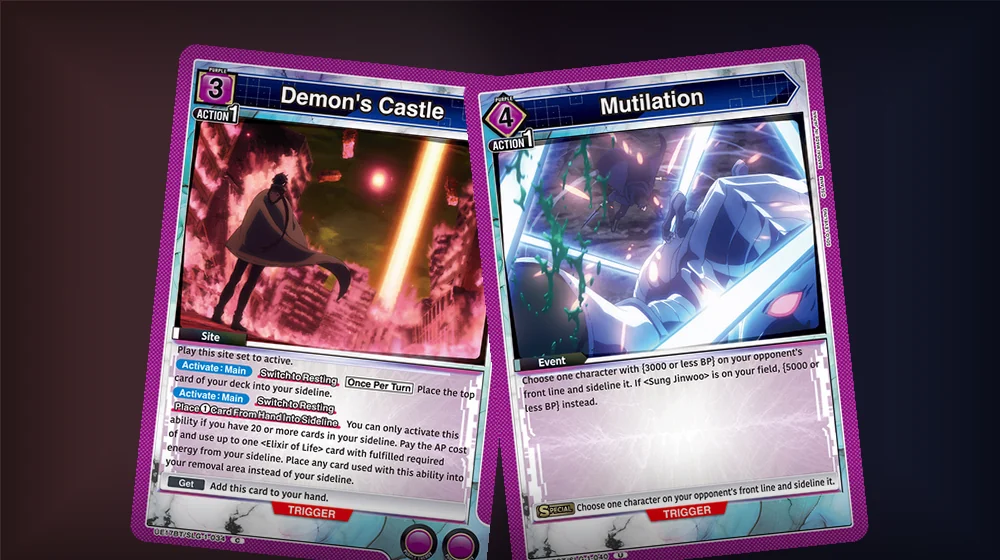 Demon's Castle and Mutilation are real English cards used here to illustrate printed card text, not a rules diagram.
Choosing a first title and building a practice list
There is no single beginner title that wins the decision for everyone. Start with a title you already care about and a local group that can lend cards or play a test game. Familiar characters help you remember effects, but access to opponents matters more than a ranking copied from an old starter-deck article.
Use Bandai's current North American products page to check whether your chosen title has a Starter Deck, a Booster Pack, or another product. Then open the matching official card list and confirm the English card text. Do not assume that a popular title has a ready-to-play starter or that a booster release includes one.
For the first list, keep the plan small:
- Choose one title and one main line of play.
- Make the first few turns easy to repeat. A hand that can establish the Front Line and place cards in the Energy Line is more useful for learning than a pile of expensive finishers.
- Record which plays need a specific source code, color, line position, or trigger condition.
- Test the same list against a friend several times before buying upgrades.
- Change one group of cards at a time so you can tell whether a change helped.
If you are also considering One Piece TCG, compare the resource and turn structures directly in this Union Arena versus One Piece TCG breakdown. The choice is easier when you know which kind of decision you want to make each turn, not when you rely on a claim that one game is automatically simpler.
Union Arena TCG beginner guide: first-game plan
Your first game should teach the table, not prove that your deck is good. Set a reference card or printed phase list beside the mat. Before each play, say which phase you are in, how much energy your Energy Line generates, and which line will have room afterward.
For the first three games, use this narrow focus:
- In game one, practice setup and movement. Put the seven Life Area cards down correctly, keep AP cards separate, and move only when the rules allow it.
- In game two, practice the full phase order. Pause before Main and Attack so you do not play a card during the wrong phase.
- In game three, practice combat and triggers. Announce BP, resolve a tie using the attacker-wins rule, and finish every trigger before checking whether a player has lost.
Do not replace the deck after one awkward opening hand. First ask whether the problem was a rules error, a line-space error, or a list-construction problem. A new player often calls a legal but unfamiliar movement sequence a bad card, then creates a less playable deck while trying to fix it.
After the third game, write down three concrete observations: the card you wanted earlier, the line that ran out of space, and the phase where you lost the most decisions. Those notes give you a better upgrade plan than a generic list of expensive cards. If your group plans to attend an event, read the Union Arena tournament guide after the rules are comfortable.
Tips for your first Union Arena sessions
Keep the first practice games deliberately plain. Use a phase reference, announce the Energy Line count before a play, and leave enough table space that Front Line, Energy Line, Life Area, and AP Area cannot be confused. A clean layout prevents rules arguments before they start.
When a play fails, record the exact reason instead of writing down only that the hand was bad. Common causes are a full line, a missing Step ability, an illegal source material code, or a trigger that was resolved in the wrong order. Each one points to a different fix, so replacing random cards will not solve all four.
Keep the official FAQ open while learning. The tie result, rested energy generation, simultaneous movement, and End Phase AP ruling are small details, but each can change a turn. Once those interactions feel normal, switch to testing a title-specific list and review the cards that actually caused decisions.
GODEEPER: When trigger timing is the part that keeps slowing games down, use this focused rules explanation before your next match. Union Arena Trigger System Explained →
Step-by-Step: Your first Union Arena game
1. Set up the zones. Place the 50-card deck, seven-card Life Area, three AP cards, Front Line, Energy Line, Sideline, and Removal Area so both players can identify them.
2. Check the deck rule. Confirm that the deck has 50 cards, the AP cards are separate, and every card shares the permitted source material code. Check colors and copy limits before shuffling.
3. Start with the official phase order. Keep Start, Movement, Main, Attack, and End visible. Say the phase name before taking an action until the order feels automatic.
4. Practice one movement decision. During Movement, identify which cards can change lines, then check capacity. Remember that Step is required for a Character moving from Front Line to Energy Line.
5. Announce combat clearly. State the attacker, blocker, and BP values. For an equal comparison, apply the official attacker-wins ruling, then resolve any trigger before checking the result.
6. Review the game state. At the end, note your Life Area, deck, AP cards, and line space. Use those observations to change one part of the list for the next game.
Frequently Asked Questions
How many cards are in a Union Arena deck? A standard game uses a 50-card deck plus three AP cards outside the deck. Each player begins with seven cards in the Life Area. The deck is not a Key Card pile, and the AP cards are a separate resource area. Confirm tournament-specific setup on the official rules page.
How does Union Arena energy work? Energy is not a one-per-turn counter. Cards in the Energy Line generate energy continuously, including while rested, and playing a card does not spend that generated energy. You use the Energy Line to meet a card's required energy when playing it, so movement and line space matter.
What are the Union Arena turn phases? A turn has five phases in this order: Start, Movement, Main, Attack, and End. The Start Phase handles drawing, Movement changes line positions, Main handles plays and abilities, Attack resolves battles and triggers, and End handles the cleanup listed in the rules.
Can I mix different anime titles or colors in one deck? Cards with different source material codes cannot be included in the same deck, so check the three-letter code after the slash in a card number. Colors can be mixed when the source material rule allows the cards together. The official Deck Construction FAQ is the final reference.
How many AP cards does each player need? Each player needs three AP cards in addition to the 50-card deck. They begin in the AP Area, not in the deck. AP cards are part of the game's setup and do not simply switch to active during the End Phase, so track them separately from your Life Area.
Which Union Arena title should a beginner choose? Choose a title you can actually test with friends or a local group, then use the official products and card-list pages to check whether a starter deck or only booster product is available. A familiar cast helps, but a nearby player and a usable list matter more than a fixed ranking.
What happens when battle BP is tied? If the attacking character and blocking character have the same BP, the attacking character wins the comparison. The blocking character is sidelined and the attacker is not. If the blocker has higher BP, neither character is sidelined. This ruling is easy to miss in a first game.
Related Reading
- Union Arena NIKKE Precious Booster: Price and Contents: Check the official UP01BT pack configuration before buying premium product.
- Union Arena Card Rarities Explained: Understand the card treatments before deciding whether to buy packs or singles.
- Union Arena Current Meta Tier List: Check competitive context after you understand the core rules.
- Union Arena Solo Leveling Guide: See how a real title-specific card pool becomes a tested build.
- Union Arena Beginner Mistakes: Troubleshoot common play errors after your first few matches.
- Union Arena 100 Girlfriends EN Launch Guide: Use a set-specific example to practice product and card-list checks.
References
Was this guide helpful?
About the author
Beginner guides and anime crossover
Pen name for the Shonen TCG desk's beginner guides, starter decks and anime-to-card-game explainers.
- Rules checked against the official rulebook and card text
- Every claim traced to a cited source
- Opinions marked as ours, with the reason
Keep reading
Union Arena Solo Leveling Guide: Cards and Builds (2026)
Guides · 13 min

All Union Arena Sets: Complete EN Release Schedule (2026)
Guides · 12 min

Union Arena Bleach Guide: Best Decks & Cards (2026)
Guides · 13 min

Union Arena JJK Guide: Jujutsu Kaisen Best Decks (2026)
Guides · 14 min
Union Arena vs One Piece TCG: Which Anime TCG to Play
Guides · 10 min
Union Arena vs Dragon Ball Super Card Game: 2026 Guide
Guides · 11 min
Union Arena Beginner Deck Tier List: Four EN Picks 2026
Guides · 11 min
Union Arena Card Rarities Explained: C, U, R, SR, Parallels
Guides · 12 min
Disclaimer
This article is published for informational and entertainment purposes. It does not constitute professional financial, legal, or technical advice. Game performance, online services, patch schedules, and store listings change. Verify critical details (pricing, system requirements, regional availability) with publishers and storefronts before you buy. Affiliate links, where present, help support our editorial work and are labelled in our affiliate disclosure.