

Shonen TCG · Guides
Digimon Card Game Rules: Memory, Evolution, and Digi-Eggs
Digimon Card Game rules look dense because the cards talk about levels, colors, inherited effects, security and memory at the same time. The first match gets much easier once you split the turn into its four phases and treat the memory gauge as the point where the turn changes hands. This guide walks through that sequence and the two zones that make Digimon different from most card games: the breeding area and the security stack.
You do not need to memorize every keyword before playing. Learn how to hatch a Digi-Egg, digivolve a stack, move it into the battle area, and stop spending before the marker gives your opponent a full turn. Then add the more specialized effects one card at a time.
TL;DR: A Digimon turn has Unsuspend, Draw, Breeding and Main phases. Both players share one memory gauge, and your turn ends once a cost leaves memory at 1 or more on your opponent's side. Hatch Digi-Eggs into the breeding area, where effects can't touch them, move a Digimon with DP to the battle area when it needs to attack, and win by attacking your opponent when they have no security cards left.
Updated October 12, 2026: Re-checked every rule against Bandai's Official Rule Manual ver. 6.0 and Comprehensive Rules ver. 4.3. Changed the phase and zone names to the rulebook's English terms (Unsuspend, Breeding, breeding area), and corrected four points: the first player skips their first draw, the Breeding Phase allows only one action, digivolving happens in the Main Phase, and a Digimon moved out of the breeding area can attack that turn. Added the official turn chart, Bandai's rule trailer and player comments.
Digimon Card Game rules: quick answer
The Digimon Card Game rules have you build an exactly 50-card main deck plus a Digi-Egg deck of 0 to 5 cards, set five cards face down as security, and use a shared memory gauge to play and digivolve Digimon. The turn player unsuspends, draws, takes one breeding action, then acts freely in the Main Phase. Once memory sits at 1 or more on the opponent's side and everything has resolved, the turn ends.
Your Digimon can attack the opponent or an opposing Digimon. Each attack on the opponent checks a security card, and a Security Digimon can fight back. When the opponent has no security left, a successful attack wins. The game is about building enough pressure to make that last attack safe while keeping the memory exchange from handing your opponent a better turn.
Key Takeaways for Digimon Card Game Rules
- The main deck has exactly 50 cards. The separate Digi-Egg deck can have 5 or fewer, including none.
- Every turn runs Unsuspend, Draw, Breeding and Main phases. The first player skips the draw on their first turn.
- The memory gauge is shared. Your turn ends once memory is at 1 or more on your opponent's side and all processing has resolved.
- Digivolving places a new card on top of a Digimon and draws 1 card.
- The breeding area protects one Digimon from effects, but it can't attack from there.
- A security check can trigger an effect or start a battle with a Security Digimon. Security Digimon are never deleted.
- Bandai's Digimon Card Game rules page lists the current Official Rule Manual ver. 6.0 and Comprehensive Rules ver. 4.3.
Digimon Card Game rules overview: zones, cards, and memory
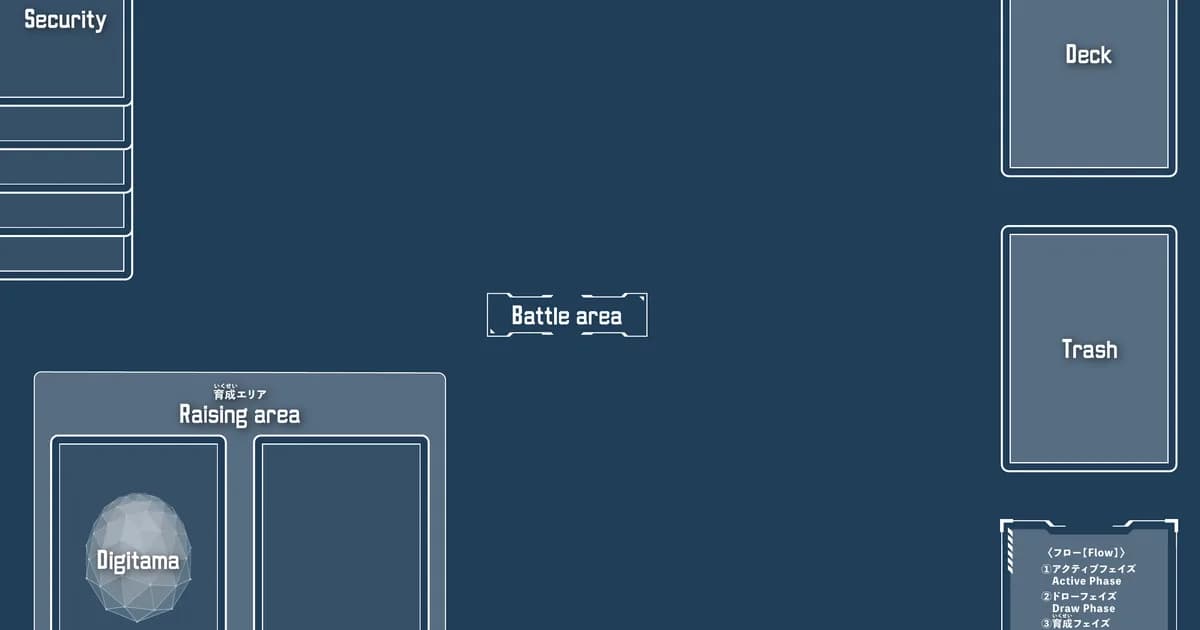
The field has a few areas worth learning first. The deck is where your 50 main-deck cards start. The trash receives deleted Digimon, used Options and discarded cards. The security stack holds five cards at setup, placed face down from the top of your deck. The battle area is where your active board lives. The breeding area is the separate space where a hatched Digi-Egg sits; it holds only one card.
A note on names: Bandai's English rulebooks say "Unsuspend Phase", "Breeding Phase" and "breeding area", and that is the wording on English cards. The official play sheet, which is the hero image above, prints the phases as Active, Draw, Raising and Main. They are the same thing.
Digimon cards have a level and DP. Tamers stay on the field and provide ongoing effects. Option cards are used from the hand and resolve once, though some also have a security effect. Digi-Egg cards go in their own deck and are level 2.
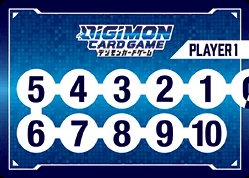 Image: Bandai, official Digimon Card Game memory gauge. One gauge and one marker are shared by both players.
Memory is the part that deserves the most attention. The gauge has 0 in the center and 1 to 10 on each side. Suppose you have 4 memory and play a card costing 3: the marker moves to 1 on your side, so you can still act. If you instead play a card costing 7, the marker moves to 3 on your opponent's side. You finish resolving that play, then the turn passes. A memory-gain effect may pull the marker back, but you cannot assume it will. You can also pass on purpose, which moves memory straight to 3 on your opponent's side.
Digivolving is a Main Phase action. You pay the digivolution cost, place a Digimon card from your hand on top of one of your Digimon on the field, and draw 1 card. The new top card sets the Digimon's level, DP, name and effects. Read the exact requirement on the new card: a requirement for any level 4 Digimon is different from one that needs a red level 4 or a specific trait.
The breeding area is a protected development zone. Cards there can't be affected by effects, and can't be chosen by them, unless the effect names the breeding area. Effects on cards there also can't trigger or activate unless they reference it, so a [When Digivolving] effect does nothing while the Digimon is in the breeding area. Moving out exposes the Digimon, so move it when you have a reason.
GODEEPER: The complete Digimon Card Game guide 2026 puts these rules beside deck construction, BT-26 coverage, and the current public meta snapshot.
Step-by-Step: How a Digimon Card Game turn works
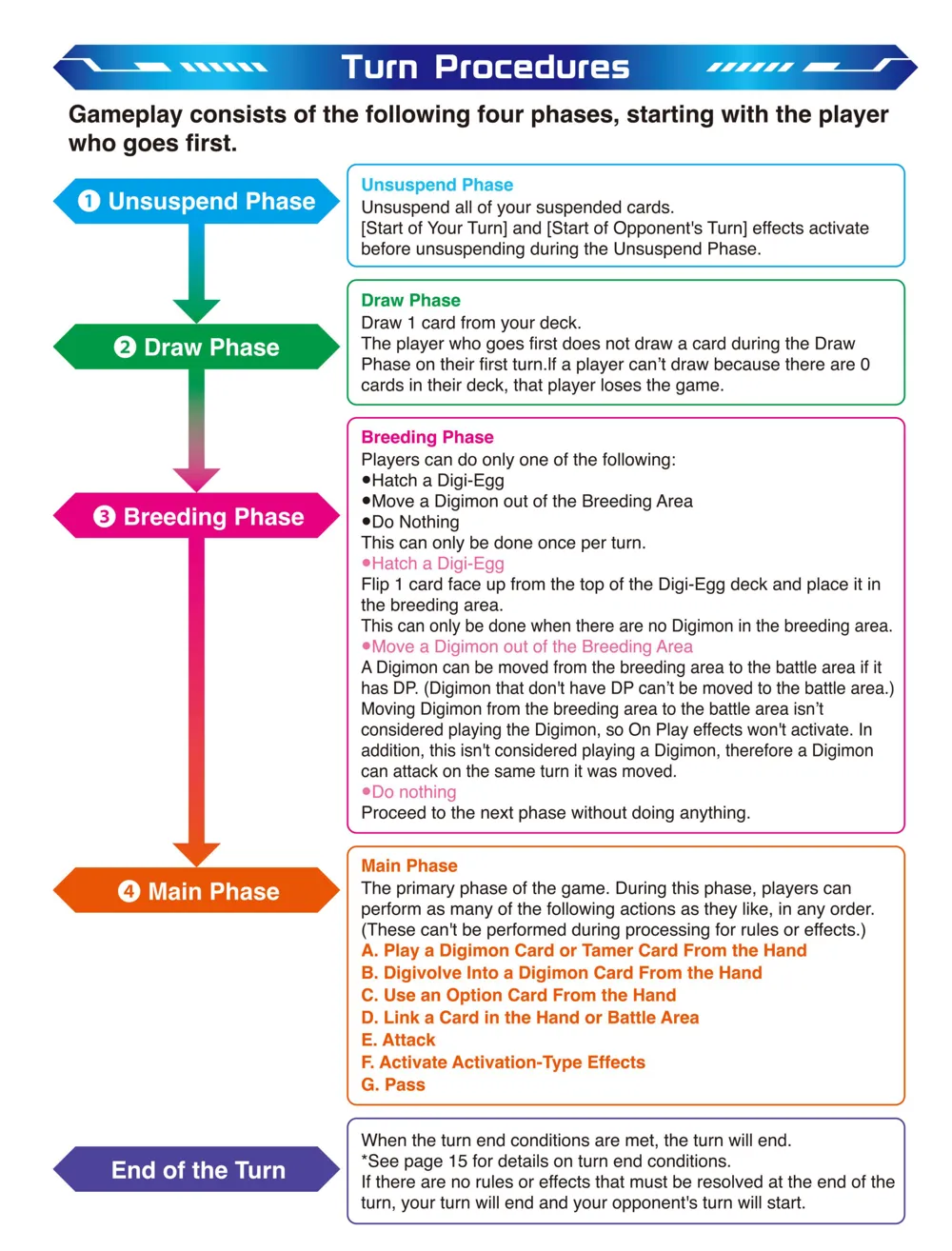 Image: Bandai, Digimon Card Game Official Rule Manual ver. 6.0, page 7 "Turn Procedures". The Breeding Phase box lists the three choices and confirms a moved Digimon can attack that turn.
1. Unsuspend Phase. Unsuspend all of your suspended cards. [Start of Your Turn] effects trigger and activate before the unsuspending happens.
2. Draw Phase. Draw 1 card. The player who goes first doesn't draw on their first turn. If you have to draw and your deck is empty, you lose the game.
3. Breeding Phase. Do exactly one of three things: hatch a Digi-Egg, move a Digimon out of the breeding area, or do nothing. You can hatch only when the breeding area is empty: flip the top card of your Digi-Egg deck face up into it. You can move a Digimon to the battle area only if it has DP, so a bare level 2 Digi-Egg has to digivolve first. Moving isn't playing, so On Play effects don't activate.
4. Main Phase. Play a Digimon or Tamer from your hand, digivolve, use an Option card, link a card, attack, activate effects, or pass, in any order and as many times as you like. Each cost moves memory, and each action may trigger effects. Resolve them fully before the next action.
5. Know which Digimon can attack. A Digimon or Tamer can't attack on the turn it was placed on the field, unless an effect such as Rush says otherwise. A Digimon you moved out of the breeding area this turn can attack, because moving isn't playing. Digivolving doesn't change whether a Digimon can attack: one that has been on the field since an earlier turn can still attack after it digivolves.
6. Declare an attack. Suspend the attacking Digimon and choose the opponent or one of their suspended Digimon. Attacks are made one at a time. The defender can switch the target to a Digimon with Blocker, once per attack. An attack on the opponent performs a security check.
7. Stop when memory passes. The turn ends once memory is at 1 or more on your opponent's side and all processing has resolved. You don't get to keep playing just because you still have cards in hand. If the turn ends with memory at 3 on the opponent's side, they start their turn with 3 memory.
The most common first-game mistake is to treat the breeding area as a place where your cards work normally. It is safe because it is isolated: effects can't touch a Digimon there, but its own effects don't trigger either, and it can't attack. Move it out when protection has stopped being worth the lost pressure.
Bandai's official rule trailer above covers the basics on video.
How Digimon Card Game rules handle evolution and Digi-Eggs
The digivolution loop begins with a Digi-Egg. During the Breeding Phase, hatch the top card of your Digi-Egg deck into the breeding area. In the Main Phase you can digivolve it into a level 3 Digimon by paying the cost printed on that card. From there, keep going up the line if you have the memory and the cards. Every digivolution draws 1 card, which keeps a stack from emptying your hand as fast as a series of normal plays would.
 BT26-001
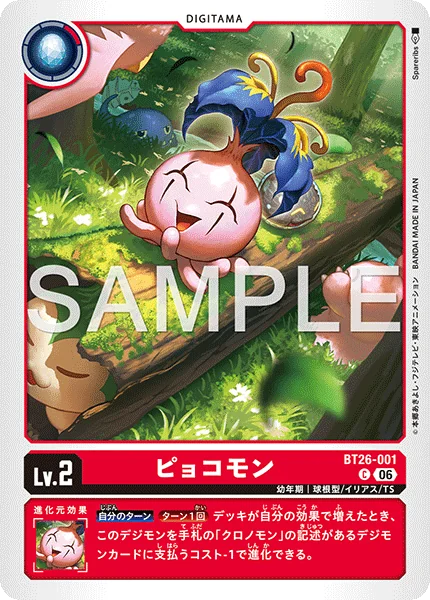 BT26-001Shop on TCGplayer Yokomon shows what a Digi-Egg can do beyond starting a stack. Its text reads: "[Your Turn] [Once Per Turn] When your effects add to decks, this Digimon may digivolve into a Digimon card with [Chronomon] in its text in the hand with the cost reduced by 1." You do not need this card to learn the rule, but reading one Digi-Egg shows how egg text differs from main-deck text.
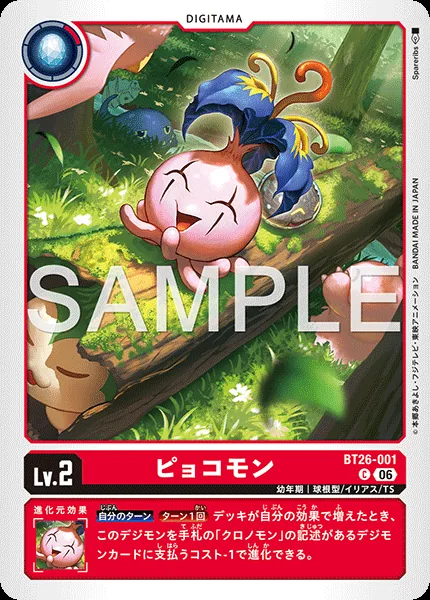 Image: Bandai official card list, BT26-001 Yokomon (shown with Bandai's sample watermark) as a Digi-Egg example.
The cards underneath a Digimon are its digivolution cards. The top card determines what the Digimon is, while inherited effects printed on lower cards can still apply. Some effects trash, return or reorder those cards. When a card says it gains an effect from a specified card underneath it, check the exact name and level requirement instead of using a similar card from memory.
Leaving a Digimon in the breeding area is usually right when you need one more turn to digivolve or when the opponent has strong removal. Moving it out is right when it must attack, provide a battle-area effect, or make room for a new egg, since you can only hatch into an empty breeding area. If you never move anything out, your opponent gets time to build a board.
The official rule manual PDF covers newer mechanics such as Linking, Assembly, DNA Digivolution and Burst Digivolve, and the comprehensive rules handle edge cases. Bandai also has an official rules song, if you want the basics in a catchier form.
GODEEPER: Once the turn loop makes sense, use the BT-26 Timeless Bonds set guide to compare the Chronomon, Plutomon, Jupitermon, and Seven Code recipes.
Tips for managing memory and security
Plan the marker before the card. Look at your current memory, find the action that ends your turn, and decide whether the payoff is worth handing your opponent that number. A 7-cost play at 4 memory gives them 3. That may be correct if it stabilizes the board, but rarely just because the card looks powerful.
Use the breeding area as a safe clock. A Digimon there can't be removed by ordinary effects, so an egg that waits a turn and digivolves keeps building without risk. Move it out when an attack or effect changes the board enough to justify exposing it.
Count security before attacking. A security check is not free damage. The revealed card may be a Security Digimon with enough DP to delete your attacker, and on equal DP your attacker is deleted too while the Security Digimon is not. If you need one more attack later, keep a smaller Digimon back rather than sending every body into a dangerous check.
Treat inherited effects as part of the curve. A low-level card with a useful inherited effect may be better than a higher-DP replacement. Read the whole stack before choosing a line, especially when a card draws, gains memory or changes DP.
Keep one answer for the opponent's next turn. A hand of expensive finishers is not a plan. Save a blocker, removal Option, Tamer search or memory effect when the board allows it.
What new players say
Local stores tend to help with the rules. On an r/DigimonCardGame2020 thread about learning turn order, one player wrote: "My first time, I forgot to put out security. They let me just put them out and go from there." Another described a local habit: "when we know we have a beginner in a tournament, we bring two decks: one beginner-friendly deck and one meta/decent deck."
Our take
Based on Bandai's manual and comprehensive rules, the two things that trip up new Digimon players are the shared memory gauge and the breeding area's limits. Count memory out loud before every play until it is automatic, and remember that the breeding area allows only one action per turn: hatch, move, or nothing. Setup is the other easy miss, as the comment above shows. Put out your five security cards before the first turn, and the rest can be learned at the table.
How we checked this: 32 facts checked on October 12, 2026 against Bandai's Official Rule Manual ver. 6.0, Comprehensive Rules ver. 4.3, the official rules page, play sheet and card list, Bandai's rule trailer, and the r/DigimonCardGame2020 comments quoted above; the full source table is kept with our editorial notes. Last reviewed: October 12, 2026.
Frequently Asked Questions
What are the phases of a Digimon Card Game turn?
Unsuspend, Draw, Breeding and Main. You unsuspend your cards, draw one (the first player skips this on their first turn), take one breeding action, then play cards, digivolve, use effects and attack in the Main Phase. The official play sheet labels the same phases Active, Draw, Raising and Main.
How does the memory gauge work?
Both players share one gauge with 0 in the center and 1 to 10 on each side. Costs move the marker toward your opponent. Your turn ends once memory is at 1 or more on your opponent's side and all processing has resolved. Passing moves memory straight to 3 on their side.
What happens when a Digimon digivolves?
Pay the digivolution cost, place the new card on top of the existing one, and draw 1 card. The top card sets the level, DP, name and effects, while inherited effects from lower cards can still apply. Digivolving is a Main Phase action and works in the battle area or breeding area.
Can you attack from the breeding area?
No. Move the Digimon to the battle area during your Breeding Phase first. Only a Digimon with DP can move, so a bare Digi-Egg has to digivolve first. Moving isn't playing, so a Digimon moved out this turn can attack, but its On Play effects don't activate.
How many Digi-Egg cards can you use?
Five or fewer, including none. The Digi-Egg deck is separate from the 50-card main deck. You hatch the top egg in your Breeding Phase when the breeding area is empty, then digivolve it with a legal card from your hand in the Main Phase.
How do you win a Digimon match?
Make a successful attack on your opponent while they have 0 security cards, with a Digimon that can perform a security check. You also win if your opponent can't draw in their Draw Phase because their deck is empty.
Related Reading
- Pokemon TCG Pocket rules guide: compare Digimon's shared memory gauge with a digital TCG that generates Energy automatically.
- One Piece TCG rules and mechanics: another Bandai card game with a separate resource system and a very different turn-ending rule.
- Union Arena beginner guide: a quick introduction to another anime TCG before you compare deck construction and combat.
- Purple Shambala Digimon deck guide: see how memory, breeding area timing, and Digi-Egg decisions shape a current BT-26 list.
References
- Digimon Card Game official rules page: current rule files, memory gauge downloads, and restriction notices.
- Official Rule Manual ver. 6.0: turn procedures, zones, digivolution, security and passing.
- Comprehensive Rules ver. 4.3: deck construction, breeding area, turn end conditions, battles and victory conditions.
- Digimon Card Game play sheet: official zone layout used in the hero image.
- Digimon Card Game Rule Trailer Ver.4.0: Bandai's video walkthrough of the rules.
Was this guide helpful?
Cards in this article
About the author
Beginner guides and anime crossover
Pen name for the Shonen TCG desk's beginner guides, starter decks and anime-to-card-game explainers.
- Rules checked against the official rulebook and card text
- Every claim traced to a cited source
- Opinions marked as ours, with the reason
Keep reading

Digimon Shambala Deck List and Matchups After EX-13
Guides · 7 min

Digimon Card Game Tier List: Best Decks After EX-13
Guides · 8 min

Digimon BT-26 Timeless Bonds Set Guide 2026: Cards
Guides · 6 min

Digimon EX-13 Card List: Chivalrous XIII Set Guide 2026
Guides · 6 min

Digimon Card Game Guide 2026: Rules, Sets, and Meta
Guides · 13 min

Digimon BT-27 Ignition of X: Release Date and Card List
Guides · 8 min

How to Play Pokemon TCG Pocket: Full Beginner Rules Guide
Guides · 14 min

How to Play Riftbound: Full Beginner Rules Guide 2026
Guides · 13 min
Disclaimer
This article is published for informational and entertainment purposes. It does not constitute professional financial, legal, or technical advice. Game performance, online services, patch schedules, and store listings change. Verify critical details (pricing, system requirements, regional availability) with publishers and storefronts before you buy. Affiliate links, where present, help support our editorial work and are labelled in our affiliate disclosure.