

Shonen TCG · Guides
One Piece TCG Beginner Guide 2026: How to Play and Rules
One Piece TCG beginner guide for 2026: official setup, DON!! timing, turn phases, colors, starter choices, and a first-game practice plan for new players.
This One Piece TCG beginner guide uses the current official Play Guide and Rules page checked on September 16, 2026. The game starts with one Leader, a 50-card deck, and a separate 10-card DON!! deck. You draw five cards, may mulligan once, set Life cards from your Leader's printed value, and then learn the resource rhythm one phase at a time.
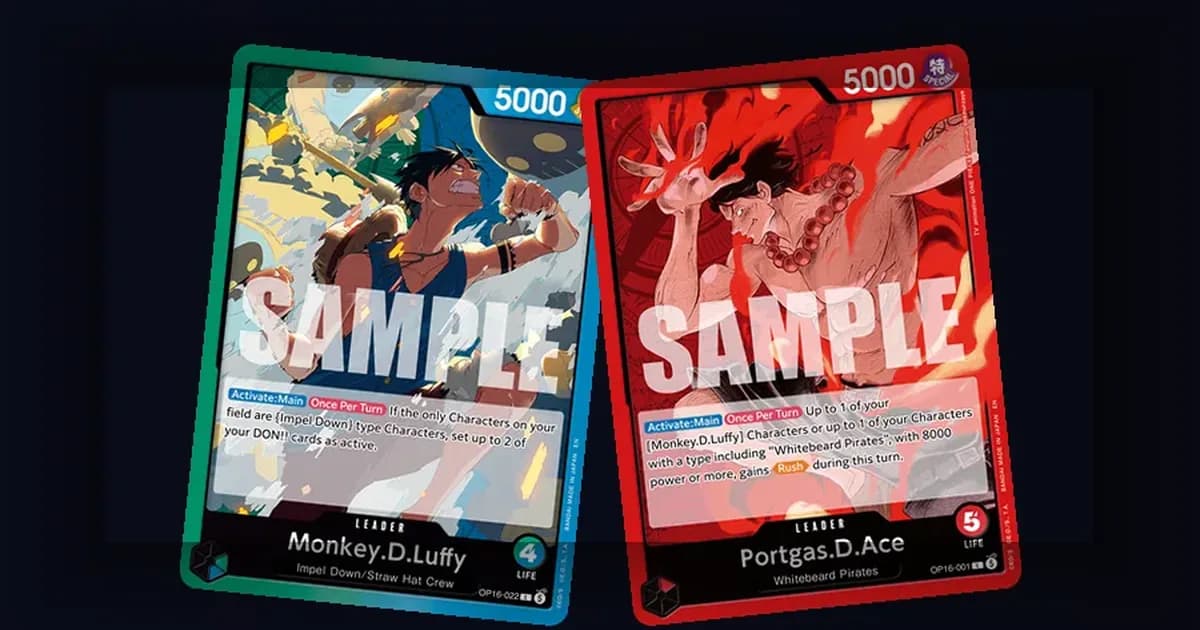
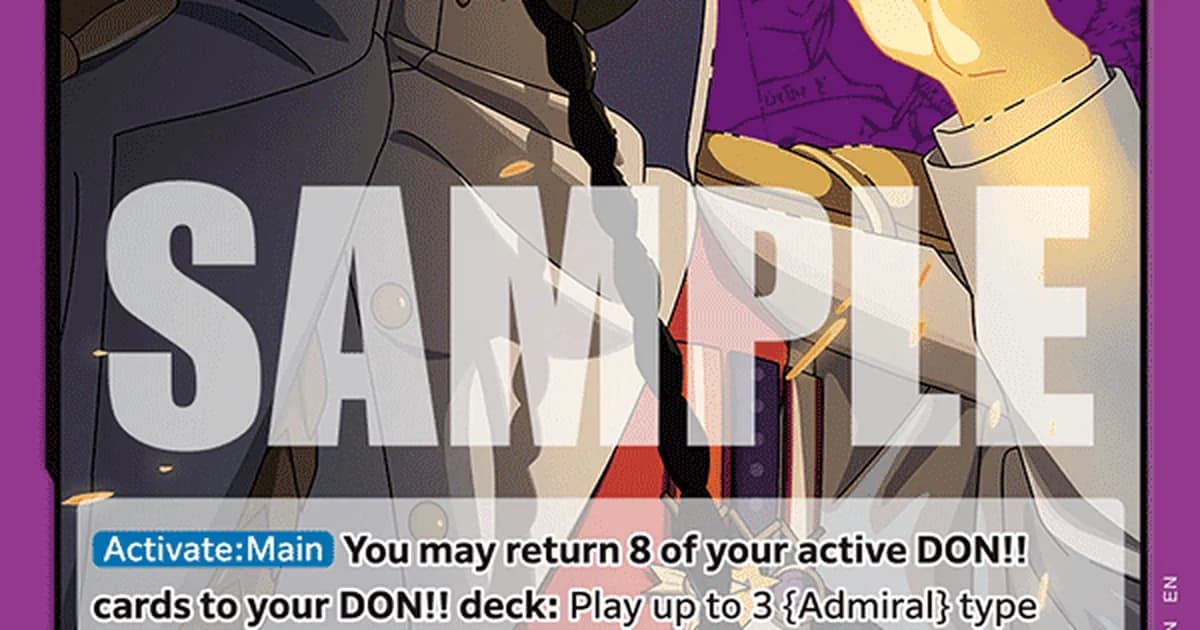
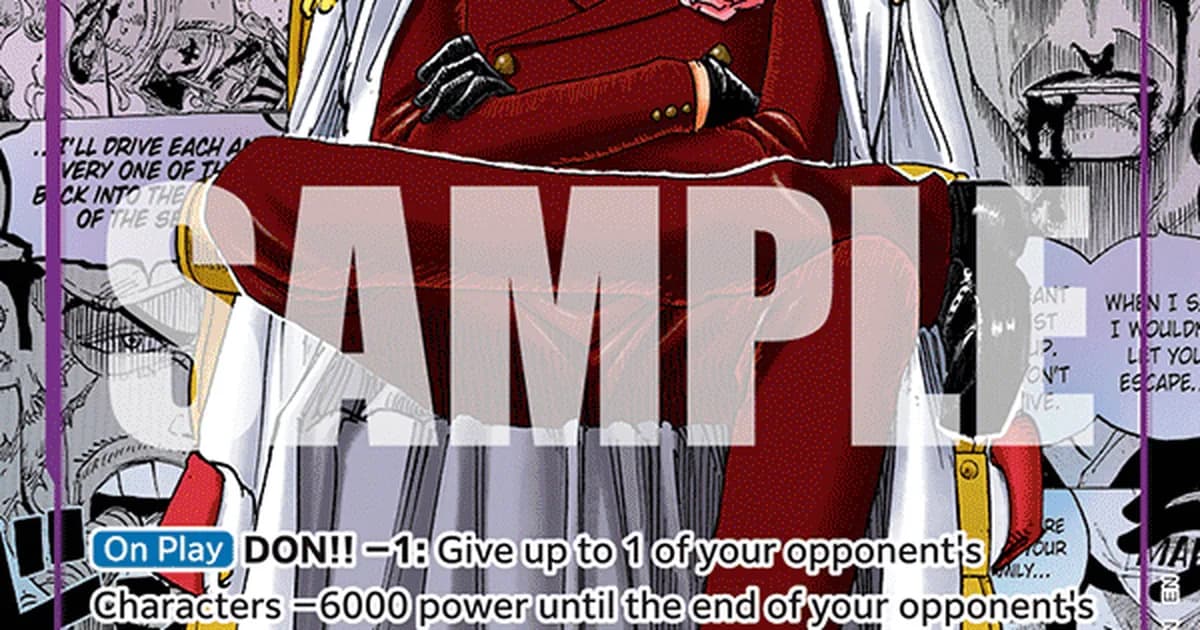
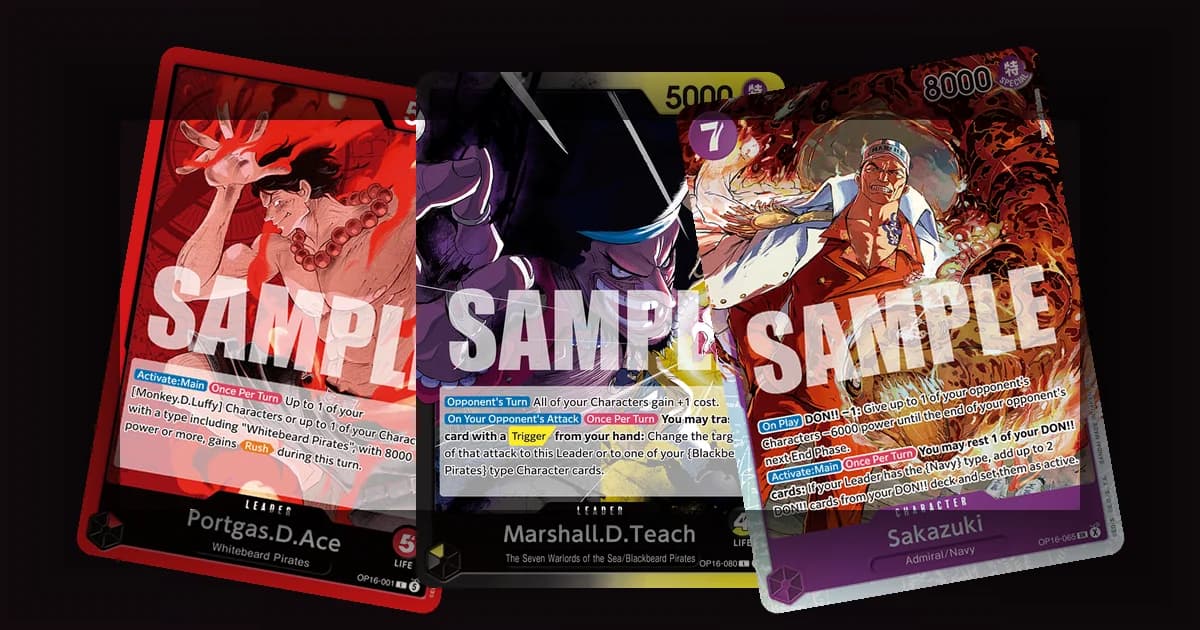
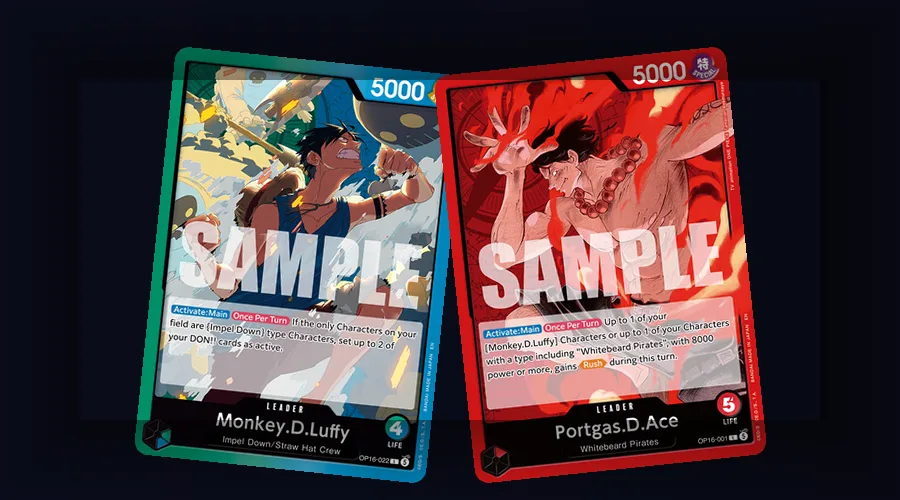 Real OP-16 Leader cards illustrate card text and color choices; the rules below apply to the game system, not only this set.
TL;DR: Build around one Leader's color, a 50-card main deck, and 10 DON!! cards. The five phases are Refresh, Draw, DON!!, Main, and End. You gain two DON!! each turn after the first-player exception, use them to pay costs or attach them for power, and take Life cards into hand when damage resolves. Start with a currently listed starter, learn the official sequence, and keep your first upgrades focused.
One Piece TCG beginner guide: what you need
The official One Piece Card Game Play Guide defines the basic setup:
- One Leader card stays face-up in the Leader area.
- The main deck contains exactly 50 cards.
- The DON!! deck contains exactly 10 DON!! cards.
- The main deck must match the Leader's color or colors.
- You can include up to four copies of a single card number.
The official Rules page also links the current rule manual, comprehensive rules, tournament rules, and official updates. Use those pages when an erratum or a card-specific ruling conflicts with a beginner summary.
You do not need a perfect competitive list to learn. You need a complete legal deck, sleeves, a way to track power and costs, and an opponent willing to explain timing. A starter deck is convenient because the cards already fit together, but it is not a promise that every card will remain a staple after new sets release.
Choosing a current starter deck
The official deck products catalog checked for this update lists current starter options including:
- ST-31 Red Monkey.D.Luffy
- ST-32 Green Roronoa Zoro
- ST-33 Blue Kuzan
- ST-34 Purple Charlotte Katakuri
- ST-35 Red/Black Sabo
- ST-36 Yellow Eustass "Captain" Kid
The list is a snapshot, not a permanent ranking. Product availability and legality can change, and a newer deck is not automatically easier to learn. Read the Leader text and choose the play pattern you actually want to practice:
- Red usually teaches proactive attacks and pressure.
- Green usually teaches board positioning, resting, and active or rested timing.
- Blue usually teaches bounce, hand control, and careful removal.
- Purple usually teaches DON!! acceleration and large-cost sequencing.
- Black usually teaches cost reduction and efficient removal.
- Yellow usually teaches Life management and Trigger timing.
These are learning heuristics, not rules for every Leader. Two Leaders of the same color can play very differently. If you already know that you prefer attacking, start with a Leader that rewards early pressure. If you like planning several turns ahead, choose a deck whose text asks you to manage DON!! or board states rather than simply curve out.
Game setup, opening hand, and mulligan
Follow this order before the first turn:
- Place your Leader face-up, shuffle the main deck, and place the 10-card DON!! deck in its own area.
- Draw five cards.
- Decide whether to mulligan. If you do, return the entire opening hand, shuffle, and draw five new cards once.
- After the mulligan decision, place Life cards equal to the number printed on your Leader.
- Decide who goes first using the method required by the rules or event.
A new player should evaluate the opening hand by function, not by character popularity. Ask three questions:
- Do I have an affordable early play?
- Do I have a card that helps find, draw, or develop the deck's plan?
- Can I spend my first few turns without losing every defensive option?
Do not keep a hand only because it contains a high-rarity card. Do not automatically mulligan because a hand lacks the perfect curve. Your Leader, color, and deck plan determine what a keepable hand looks like.
Life cards are set after the mulligan decision because they are not part of the opening hand. When a Leader takes damage, the Life card is normally added to hand, although card text and Trigger timing can alter what happens. Keep Life decisions separate from mulligan decisions.
One Piece TCG beginner guide: the five turn phases
The official Play Guide states that every turn follows five phases in order.
Refresh Phase
Set your rested cards to active. Attached DON!! cards return to your Cost Area. The exact first-turn exceptions are part of the official rules, so use the current Play Guide when teaching a new player rather than relying on a shortcut from an older article.
Draw Phase
Draw one card from the top of your main deck. Effects can change how you draw, but the normal phase is one card. If a card effect or a future rule update changes the normal sequence, read the exact text and consult the official FAQ.
DON!! Phase
Place cards from the DON!! deck into your Cost Area. The official Play Guide says you gain two DON!! each turn, with the first player receiving one on the first turn. You can use active DON!! to pay costs, or attach it to a Leader or Character to increase power.
Main Phase
This is where most decisions happen. You can play Characters, Events, and Stages by paying their DON!! costs. You can use abilities whose timing allows it, and you can declare attacks with eligible Leaders and Characters. Plan the complete turn before resting every DON!! card.
During an attack, announce the attacking card and target, then follow the official battle sequence. The defending player can use legal effects, counter cards, blockers, or other responses before the battle resolves. Card text controls the timing, so do not assume that every effect works during every attack.
End Phase
Resolve effects that last until the end of the turn, then pass play. A careful end-of-turn check prevents missed cleanup: count the cards in your hand, confirm which cards are active or rested, and note which DON!! cards will be available after the next Refresh Phase.
The DON!! system in practice
DON!! is both a payment resource and a power resource. That split is the first major decision a new player learns.
Use DON!! to pay a Character, Event, or Stage cost when the card's effect advances your plan. Attach DON!! when increasing a Leader or Character's power changes an attack, forces a counter, or protects a key trade. You cannot maximize both every turn, so decide what the opponent must answer.
A simple turn-planning routine helps:
- Count active DON!! before you play anything.
- Identify the most important card or attack for the turn.
- Reserve enough DON!! for the effect or counter plan you expect to need.
- Attach DON!! only after checking the attack target and likely response.
- Recount your hand and board at the end of the turn.
“Playing on curve” means using available DON!! efficiently, but it does not mean tapping every card. A turn that spends all DON!! on a flashy play can be worse than a smaller play that leaves an Event or counter available. Your deck's Leader text may reward a different balance, so treat the curve as a guide rather than a command.
How Life cards and victory work
The official Play Guide lists two ways to lose:
- You take a successful attack against your Leader while you have no Life cards remaining.
- You are required to draw but have no card left in your deck.
A Life card is therefore both a defensive buffer and a future hand card. Taking damage can give you more options, but it also brings you closer to the loss condition. Do not treat every attack as equally good for the opponent. Consider the Leader's Life value, the counter cards in your hand, Trigger effects, and whether the hit removes a card you needed to keep hidden.
You win by forcing the opponent into one of those loss conditions. Some decks attack the Leader repeatedly. Others control the board, build a larger hand, or make the opponent spend DON!! defensively. The correct win route depends on the Leader, not only on the color.
Color identities for a first deck
The six colors are useful labels, but they are not rigid classes. Use this table as a first question when browsing Leaders:
| Color | Common learning focus | Questions to ask |
|---|---|---|
| Red | Attack pressure and power checks | Can I force counters early? |
| Green | Rested or active board states | Which card should be rested or protected? |
| Blue | Bounce, hand management, and tempo | When is returning a card better than K.O.? |
| Purple | DON!! growth and expensive turns | What do I gain by accelerating now? |
| Black | Cost reduction and removal | Which opposing card is worth answering? |
| Yellow | Life and Trigger decisions | When should I keep or expose a Life card? |
A color does not guarantee a specific speed or difficulty. Read the Leader text, sample deck list, and current legality before buying a full set of upgrades. A color guide can help with vocabulary, but your first games should focus on one Leader's actual lines.
Step-by-Step: Play your first three games
1. Play the first game open-handed. Keep both decks visible and talk through setup, DON!! placement, attacks, and Life resolution. The goal is to learn the sequence, not to hide every mistake.
2. Use the second game to track DON!!. Before each play, say how much active DON!! you have and what will remain. Practice the difference between paying for a card and attaching DON!! for power.
3. Use the third game to practice mulligans. Keep a hand that has a playable early plan, then write down what you wished you had. If you mulligan, compare the new hand with the original without judging the result only by whether you won.
4. Review one decision after each game. Ask whether you spent DON!! too early, attacked the wrong target, held a counter unnecessarily, or missed a Leader effect. One specific adjustment is more useful than changing the entire deck.
5. Play a fourth game before buying upgrades. Test against a different Leader if possible. An upgrade that looks strong in isolation may not solve the problem your deck actually has.
Keywords and card text
Start with the words that change the legal timing of a card:
- Rush affects whether a Character can attack on the turn it is played.
- Blocker can redirect an attack when its condition is met.
- Counter adds the printed power value during an eligible defensive window.
- Trigger describes an effect that can be used when a card is revealed from Life by an attack.
- Double Attack changes the damage a successful Leader attack can deal.
- Banish changes where a defeated card goes and can prevent some effects tied to the normal result.
Always read the full sentence around a keyword. A Character can have a keyword and still be limited by another condition in its effect. Costs, power, counter, color, type, and timing words matter just as much as the keyword itself.
Beginner habits that actually help
Keep your deck at the legal count and track the number of copies of important cards. Practice shuffling and use sleeves that fit the official card size. Bring a way to mark power changes and ask an opponent to pause when you need to read a timing window.
Do not reveal every plan by attaching DON!! before choosing a target. Do not spend all active DON!! before checking whether your deck needs a defensive Event. Do not assume the opponent's Life cards are safe just because a hit gives them another card. These are habits to test, not absolute rules.
The fastest route to improvement is repetition with one deck. Changing Leaders after every loss prevents you from learning the lines that make the deck work. Play enough games to identify whether a problem is a rules error, a sequencing error, a weak opening hand, or a deck-building gap.
Related Reading
- One Piece TCG How to Play, Rules, and Mechanics: a deeper phase and battle walkthrough.
- One Piece TCG Deck Building Guide: turn a Leader choice into a legal 50-card list.
- One Piece TCG Mulligan Guide: evaluate opening hands after learning the setup.
- One Piece TCG Keywords Explained: keep the keyword timing terms in one reference.
- One Piece TCG Tournament Guide 2026: prepare for a first local event.
Frequently Asked Questions
What cards are required to play?
You need one Leader, a 50-card main deck, and a separate 10-card DON!! deck. The main deck must match the Leader's color or colors and can contain up to four copies of one card number. Sleeves and counters make play easier, but they do not change the legal deck structure.
How many cards are in the opening hand?
Draw five cards. You can return the entire opening hand, shuffle, and draw five again once. Then set Life cards equal to the number printed on your Leader. Make the mulligan decision before looking at the Life area.
What are the phases of a turn?
Refresh, Draw, DON!!, Main, and End. Refresh makes rested cards active and returns attached DON!! to the Cost Area. Draw adds one card. DON!! adds resources. Main contains plays and attacks. End finishes temporary effects and passes the turn.
Which starter is best for a beginner?
There is no permanent best starter. Choose a currently listed product whose Leader matches how you want to learn, then verify the official card list and current legality. Red can teach pressure, Green board timing, Blue hand control, Purple resource growth, Black removal, and Yellow Life decisions.
Can I put any color into my deck?
No. Your deck follows the color or colors permitted by the Leader. Some Leaders are multicolor, so read the exact Leader rather than assuming every deck is single-color. A card's popularity does not override the Leader's deck-construction restriction.
How do I win?
Force a successful attack against a Leader with no Life cards remaining, or leave the opponent unable to draw when required. Some decks pursue combat pressure, while others win by controlling resources and extending the game. Learn your Leader's plan before copying a generic color label.
What should I do after the first game?
Write down one rules question and one decision you would change. Then check the official Rules page or FAQ, play the same deck again, and only buy upgrades after you know whether the problem was a missing card or a sequencing mistake.
Where can I learn online?
Start with Bandai's official Play Guide, Rules page, and teaching app. A local store or experienced player can answer timing questions faster than a long comment thread. Use community guides as explanations, but return to the official manual and card text for a final ruling.
References
- ONE PIECE CARD GAME Play Guide: official setup, deck structure, DON!! cards, zones, and turn phases
- ONE PIECE CARD GAME Rules: current rule manuals, comprehensive rules, tournament rules, and updates
- ONE PIECE CARD GAME Products: Decks: current starter products and listed MSRP
- ONE PIECE CARD GAME Learn the Rules to Play: official beginner materials, teaching app, and starter overview
- Official interactive tutorial: practice resource linked from the official site
About the author
Beginner guides and anime crossover
Pen name for the Shonen TCG desk's beginner guides, starter decks and anime-to-card-game explainers.
- Rules checked against the official rulebook and card text
- Every claim traced to a cited source
- Opinions marked as ours, with the reason
Keep reading
Best Starter Decks One Piece TCG 2026: Which to Buy
Guides · 6 min
OP-16 Paramount War Leaders & Factions Guide (2026)
Guides · 12 min

One Piece TCG Colors: All 6 Colors and Deck Rules (2026)
Guides · 11 min

One Piece TCG How to Play: Rules & Mechanics (2026)
Guides · 16 min
OP-16 All 6 Leaders Explained: Colors & Which to Build
Guides · 12 min
One Piece TCG OP-16 Guide: Set Review & Leaders (2026)
Guides · 20 min
One Piece TCG Manga Rare Cards: Guide & Values (2026)
Guides · 12 min
OP-16 Chase Cards: Best to Pull & Value Guide (2026)
Guides · 12 min
Disclaimer
This article is published for informational and entertainment purposes. It does not constitute professional financial, legal, or technical advice. Game performance, online services, patch schedules, and store listings change. Verify critical details (pricing, system requirements, regional availability) with publishers and storefronts before you buy. Affiliate links, where present, help support our editorial work and are labelled in our affiliate disclosure.