Loading…


Shonen TCG · Guides
One Piece TCG Complete Guide 2026: Rules, Colors, Sets
One Piece TCG complete guide covers how to play, all 6 colors, deck building, Standard format, and the current OP-16 to OP-17 set transition.
Reviewing
One Piece TCG
If you want one place to learn One Piece TCG, from your very first game to your first competitive deck, this is it. This guide covers how to play, the six color identities, deck building fundamentals, the Standard format's rotation rules, and where the game stands right now with OP-17 settled in and OP-18 confirmed for November.
TL;DR: One Piece TCG is a 1v1 card game where you build a 50-card deck around a single Leader, fuel it with a separate 10-card DON!! deck, and win by stripping your opponent's 5 Life cards to zero and landing one more hit. Six colors each have a distinct identity, Red (aggression), Green (control), Blue (tempo), Purple (ramp), Black (removal), Yellow (utility), and every deck is one or two of them. The current EN-legal set is OP-16, live since June 12, 2026; OP-17 follows with a Japan release August 22 and EN wide release August 28, 2026.
Key Takeaways
- Win by reducing the opponent's 5 Life cards to zero and landing one more hit, or by making them unable to draw.
- Deck is 1 Leader + 50 main deck cards + 10 DON!! cards, max 4 copies of any card name.
- DON!! is the resource system: gain 1 on turn one, then 2 per turn up to 10; rest to pay costs, attach for +1000 power.
- Six colors, each a distinct playstyle: Red (aggression), Green (control), Blue (tempo/removal), Purple (ramp), Black (removal/sacrifice), Yellow (healing/utility).
- Standard format runs the Block Icon System (since April 1, 2026), currently Block 2 through 4, roughly OP-05 through OP-16.
- OP-16 is the current EN-legal set (June 12, 2026); OP-17 launches Japan August 22, EN wide release August 28, 2026, as the first Block 5 set.
One Piece TCG Overview: What Kind of Game Is It?
One Piece TCG is Bandai's card game built on the One Piece manga and anime, one of two card games the company runs alongside Dragon Ball Fusion World. Two players each build a deck around a Leader card, a specific One Piece character that sets the deck's color identity and provides a passive or activated ability, then battle to reduce the opponent's Life total to zero.
The game's appeal is a short, readable turn structure with real decision points packed into it: how much DON!! to commit to an attack, when to hold a Counter card, whether to trade your Blocker now or save it. A full match runs 25 to 35 minutes at a casual pace, fast enough to play several games in an evening but with enough sequencing depth to reward experience. If you're comparing it against other anime card games before committing, the One Piece TCG vs Yu-Gi-Oh vs Pokemon comparison breaks down how the systems differ, and Best Anime TCG to Play in 2026 ranks it against the wider field including Union Arena and Disney Lorcana.
The set line has been running since OP-01 in 2022, with a new main booster roughly every 2 to 3 months. As of writing, OP-17 "The World's Strongest Warriors" is the current EN-legal set, and OP-18 "The Dominance of God" is confirmed next for November 2026, covered in full further down this guide.
How to Play One Piece TCG
The rules fit on one page, which is part of why the game onboards new players quickly.
The goal. Reduce your opponent's Life to zero, then land one more attack that connects with their Leader. Alternatively, if a player is forced to draw from an empty deck, they lose immediately.
Setup. Each player has a 50-card main deck (matching their Leader's color or colors), a separate 10-card DON!! deck, and 5 Life cards set face-down from the top of their main deck. You draw a starting hand of 5, with a one-time mulligan.
DON!!, the resource system. DON!! is not shuffled into your main deck. The first player gains 1 DON!! on their first turn (a rare exception; every other turn grants 2), building toward a cap of 10. You can rest a DON!! card to pay for a card's cost, or attach it to a character or Leader already in play for a flat +1000 power. All DON!! return to active during your Refresh phase, so the resource resets every turn rather than accumulating permanently in play.
A turn's phases. Draw, then Don (gain and optionally set DON!! active), then Main (play Characters, Events, and Stages), then your Attack step, where you declare attacks with ready Characters and your Leader. Life cards trigger effects when they're taken as damage, some carry a Trigger ability that fires on that hit, adding an extra layer to combat math beyond raw power totals.
Blocking and countering. A Blocker-keyword Character can intercept an attack aimed at your Leader or another Character, redirecting the hit. Separately, in the Counter step, either player can play Counter-timing Events or DON!! from hand to add power to the defender before damage is calculated. This is where hand management and bluffing live, and honestly it's the single skill that separates a first-week player from someone who's actually good. The One Piece TCG how to play rules and mechanics guide walks through a full worked turn, and the DON!! card system explainer goes deeper on resource sequencing by color.
GODEEPER: Want the full breakdown of attack sequencing, blocking, and when ties favor the attacker? One Piece TCG Attack and Battle Rules →
New players consistently trip on the same handful of things: forgetting a Blocker can redirect an attack, over-committing DON!! early and having nothing left for Counter step, and misreading which cards match their Leader's color identity. The common beginner mistakes guide covers the full list, and keeping a weak opening hand out of hope is its own separate, equally common mistake.
The Six Colors
Every One Piece TCG Leader is one or two of six colors, and the color identity tells you more about how a deck plays than the specific Leader does.
- Red: straightforward aggression. Cheap, efficient attackers and direct damage tools built to close games fast.
- Green: control and board dominance. Big bodies and board-state tools that grind out an advantage over a longer game.
- Blue: tempo removal and disruption. Bounce, hand disruption, and efficient trades that deny the opponent's plan rather than racing it.
- Purple: resource acceleration and ramp. DON!! generation and cost reduction that lets a Purple deck do more, faster, than its raw card count suggests.
- Black: advanced removal and self-sacrifice. KO effects and trash-synergy tools, often at the cost of your own board resources.
- Yellow: healing, recovery, and utility. Life-gain and Trigger-adjacent tools that grind through the attrition-heavy matchups other colors struggle with.
Two-color Leaders combine identities: a Blue-Yellow Leader, for instance, typically plays tempo disruption backed by recovery tools. The One Piece TCG colors explained guide has the full breakdown plus a matchup chart, and there are dedicated deep dives for each color: One Piece TCG Red Deck Guide: Full Aggro Strategy 2026, Green, Blue, Purple, Black, and Yellow.
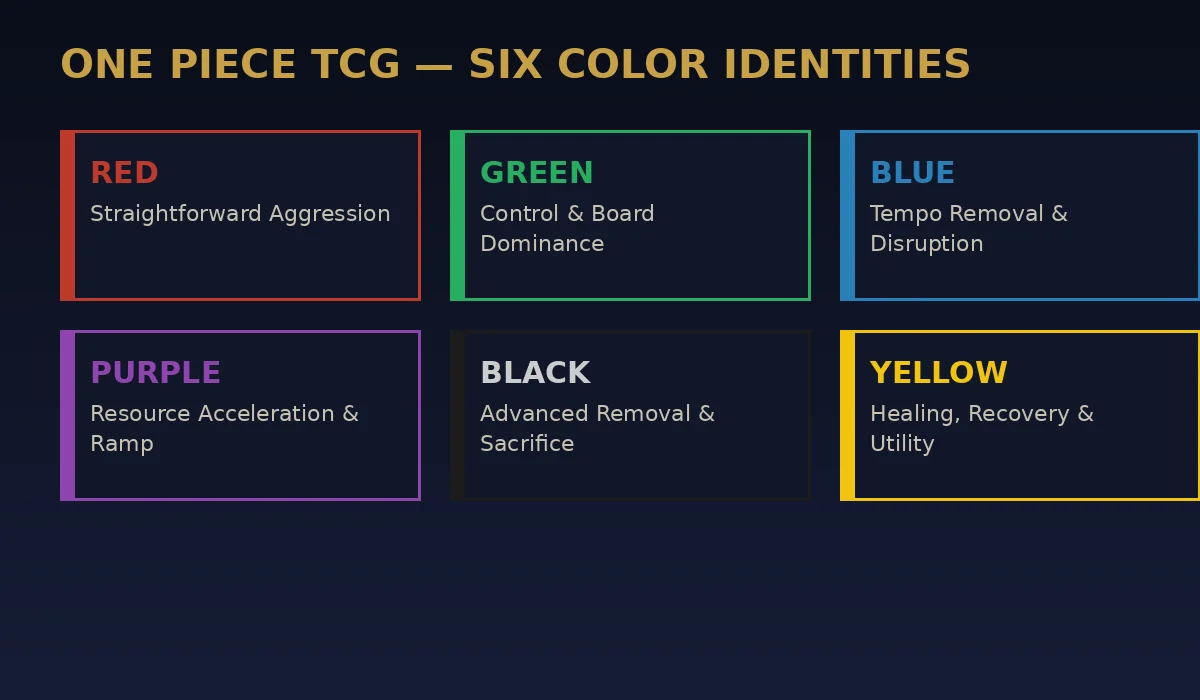 Each of the six colors has a distinct playstyle identity; two-color Leaders blend two of these plans into one deck.
Deck Building Basics
A legal deck is exactly 1 Leader, 50 main deck cards matching that Leader's color identity, and a separate 10-card DON!! deck, with a maximum of 4 copies of any card by name. Beyond the legality rules, the actual build process comes down to picking a Leader whose ability and color identity you want to play, then filling the curve around it.
Newer players get the most value from starting with a pre-constructed starter deck, every set ships several, built around one Leader with a coherent 51-card list out of the box. From there, singles purchases become targeted rather than a guess. The One Piece TCG deck building guide walks through curve theory and card-slot allocation from scratch, Best One Piece TCG Decks for Beginners picks the 5 best starting points by playstyle, and the budget competitive guide covers how to build toward a real tournament deck for under $100 without chasing chase cards first.
SHOP: Building your first competitive One Piece TCG deck? Check current singles prices on TCGPlayer. Shop TCGplayer →
Standard Format and Legality
One Piece TCG's competitive format runs on the Block Icon System, which took effect April 1, 2026 and replaced the game's earlier rotation approach. Standard Regulation currently covers Block 2 through Block 5, roughly OP-05 through OP-17; sets from OP-01 through OP-04 dropped to Extra Regulation only and are no longer tournament-legal in Standard. A separate ban and restriction list, reviewed around Championship Season milestones rather than a fixed calendar, manages power level within the currently legal pool.
OP-16 has been Standard-legal since its June 12, 2026 release as part of Block 4. OP-17 released in Japan August 22, 2026 (EN wide release August 28, 2026) as the first Block 5 set, expanding the legal pool without an announced rotation, so nothing currently legal dropped out when it arrived. Always verify the current block requirements and ban list directly before a sanctioned event, both can shift on short notice. The Standard format guide has the complete legal-set breakdown, the banlist guide covers exactly what's currently banned or restricted, and the meta rotation guide covers when and how to time selling older-block cards.
The Current Set and Meta Analysis: OP-17, and the OP-18 Launch Window
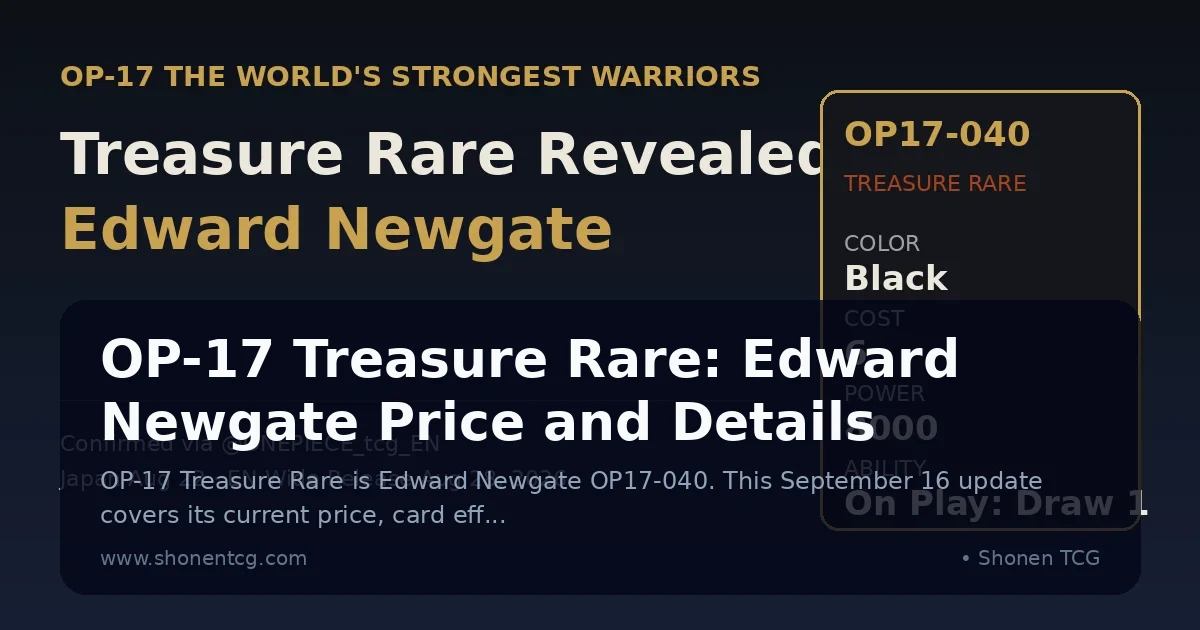
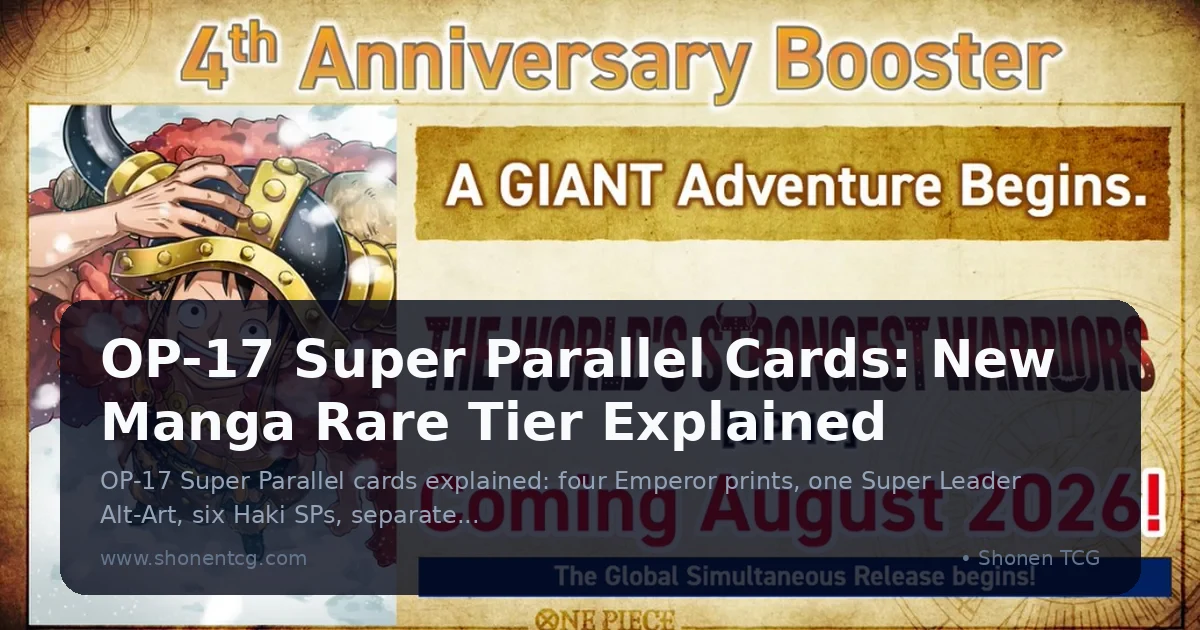
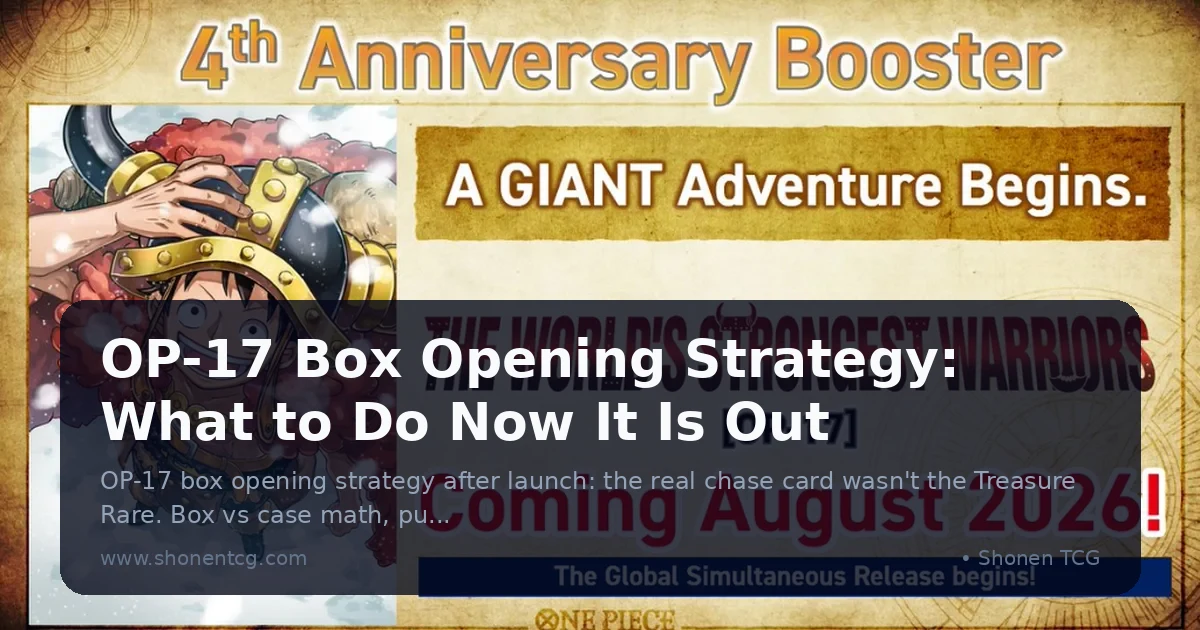
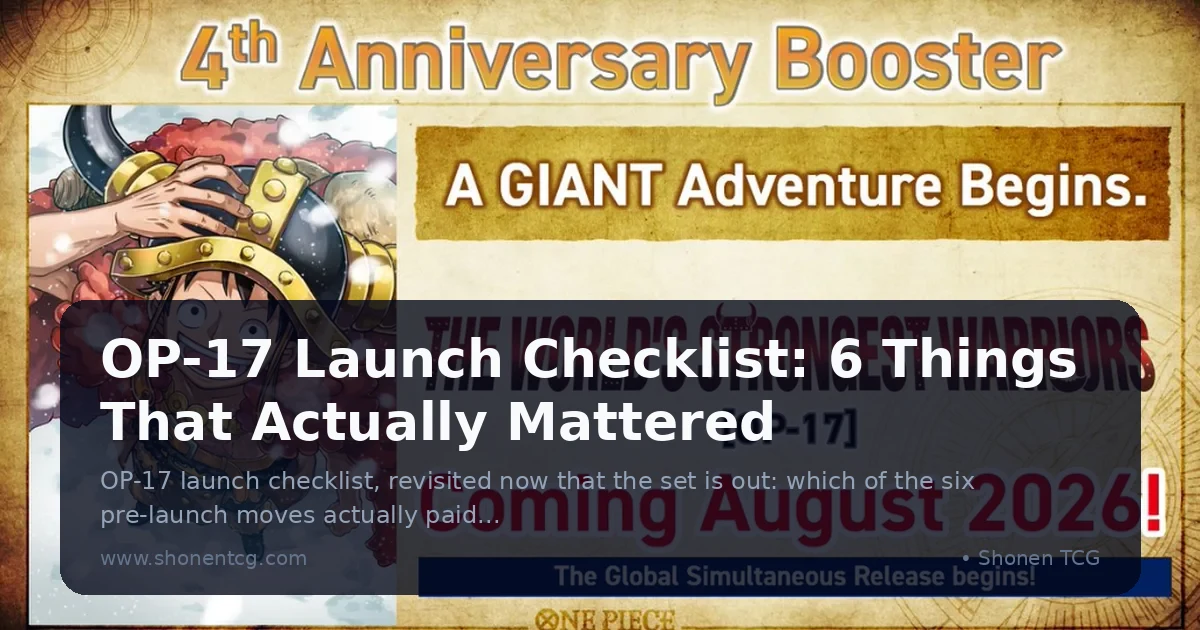
OP-17 "The World's Strongest Warriors" is the set actually shaping the competitive meta right now. It's Bandai's 4th Anniversary Booster Pack, built around an Elbaf and Yonko (Four Emperors) theme, with all six leaders confirmed: Edward Newgate/Whitebeard (Red), Monkey D. Luffy (Black), Shanks (Green), Kaido (Purple), Charlotte Linlin/Big Mom (Yellow), and Rocks D. Xebec (Blue). It also introduced a new top rarity, Treasure Rare, a single concentrated chase card rather than OP-16's three-way Admiral Manga Rare split. Three weeks into the blended EN metagame, Purple Enel and Green Dracule Mihawk lead the tracked field, with GU Luffy close behind; the OP-17 meta tier list has the full S-to-B breakdown, sourced from 1,265 tracked tournament results. The OP-17 World's Strongest Warriors set guide is the dedicated pillar for everything about the set, and the OP-17 to OP-16 crossover format guide covers what the six new leaders did to the old OP-16 top tier.
OP-18 "The Dominance of God" is the set to watch next, confirmed by Bandai's official English account for a November 2026 release. Bandai has also confirmed illustrator Yoshitaka Amano (known for Final Fantasy and Vampire Hunter D character design) painted two special cards for the set. Beyond that, Bandai hasn't named a specific release day, a leader, or a JP-to-EN gap yet; community sources report a leaked Franky leader card and other unconfirmed details, but none of that is official as of this writing. The OP-18 release date tracker keeps the confirmed-versus-rumor split current as Bandai reveals more.
For what six new OP-17 leaders did to the prior OP-16 meta specifically, and how fast that changeover moved compared to past set transitions, the crossover format guide linked above has the full breakdown.
Best Cards and Collector Value
One Piece TCG's rarity structure runs from Common up through Secret Rare, with special print treatments (alternate art, Manga Rare, and now Treasure Rare) sitting above the standard tier chart. Collector demand concentrates hard at the top: a set's highest-rarity Leaders and iconic Characters routinely trade far above their standard-print counterparts, while the exact same card text is available at a fraction of the cost in its base printing for players who just want to compete.
If you're deciding whether a chase card is worth pursuing, whether as a competitive piece or a pure collectible, the card rarities explained guide covers the full 7-tier structure, the Manga Rare cards guide explains the alternate-art tier that's defined the last two sets' collector value, and One Piece TCG's most expensive cards tracks the all-time price ranking across every set. If you're weighing whether to send a card off for professional grading, the card grading guide breaks down the PSA versus CGC cost math specifically for this game. Collector-exclusive promos exist outside the booster print run entirely, the ongoing Round1 x One Piece TCG promo card collaboration is one current example, and Bandai's own Heroines Special Set is another, a Premium Bandai-exclusive accessory box built around a single promo card rather than a booster.
Common Beginner Mistakes
A handful of errors show up in almost every new player's first few games, and they're worth knowing before you sit down for your first match rather than after:
- Forgetting Blocker exists. A Blocker-keyword Character can redirect an attack away from your Leader; new players often just take the hit instead.
- Spending all your DON!! in the Main phase. If you commit everything before combat, you have nothing left to add during the Counter step, and a well-timed attack can blow you out.
- Misreading color legality. Every card in your main deck must match your Leader's color identity; it's an easy mistake to build a list that isn't actually legal.
- Keeping a bad mulligan hand out of hope. The mulligan guide covers exactly when a 5-card hand is worth shuffling back.
- Not reading Life card Triggers before committing to an attack. A Trigger effect on the Life card your opponent is about to reveal can swing a combat math decision you thought was settled.
All One Piece TCG Guides
This complete guide is the hub for our full One Piece TCG coverage. Start here, then branch out to the guides below as you move from your first game to competitive deckbuilding:
- One Piece TCG Beginner Guide 2026: the friendliest first walkthrough of the game and its products.
- One Piece TCG How to Read a Card: every symbol and stat box explained, for players staring at their first physical card.
- One Piece TCG Keywords Explained: Rush, Blocker, and every other keyword ability defined in one place.
- One Piece TCG Life Cards Explained: damage, Triggers, and what happens at zero Life.
- One Piece TCG Tournament Guide 2026: how to find and compete in your first sanctioned event.
- One Piece TCG Locals Etiquette Guide: how to play right at in-store events.
- One Piece TCG Trade Guide: how to trade cards fairly with other players.
- One Piece TCG Sleeves and Accessories: what to buy first to protect your cards.
- One Piece TCG How to Play Online for Free: digital options while there's no official app yet.
- One Piece TCG Best Leaders of All Time: the top 10 Leaders across every set, ranked.
- All One Piece TCG Sets OP-01 to OP-16: the complete set list and release history.
- One Piece TCG Nami Deck Guide: the current format's top-performing Leader, built out in full.
- Purple Enel Deck Guide: the format's highest meta-share Leader by deck count.
Related Reading
- One Piece TCG Blue Yellow Guide: Pairing and Nami Strategy: a full deep dive on one specific two-color identity, Nami's draw condition, and Zeus timing.
- OP-16 Price Guide: What Every Card Is Worth (2026): live-tracked prices for every card in the current set, useful once you're past the "which color" stage and buying singles.
- OP-16 Full Card List & Spoilers: the complete card-by-card breakdown of what's actually in the current set.
- OP-16 Collectors Guide: SEC, Manga Rare, Alt-Art Cards: how the rarity tiers stack up for anyone chasing the top of the print run.
- OP-16 vs OP-15 Power Level: Is There Powercreep Now?: whether the newest sets are actually getting stronger, or just different.
Frequently Asked Questions
How do you win a game of One Piece TCG? You win by reducing your opponent to zero Life cards and landing one more hit on their Leader, or by making them unable to draw a card. Each player starts with 5 Life cards face-down; every unblocked hit that connects with the Leader removes one.
What are the 6 colors in One Piece TCG? Red (straightforward aggression), Green (control and board dominance), Blue (tempo removal and disruption), Purple (resource acceleration and ramp), Black (advanced removal and self-sacrifice), and Yellow (healing, recovery, and utility). Every deck is built around a single-color or dual-color Leader.
What is the DON!! system in One Piece TCG? DON!! is a separate 10-card resource deck, not shuffled into your main 50. You gain 1 DON!! on the first player's first turn, then 2 per turn up to 10. Rest DON!! cards to pay costs, or attach them to a character for +1000 power each.
What is the current Standard format in One Piece TCG? Standard runs on the Block Icon System (effective April 1, 2026), currently covering Block 2 through Block 5, roughly OP-05 through OP-17. OP-17 released in Japan August 22, 2026 and EN wide August 28, 2026 as the first Block 5 set; OP-18 is confirmed for November 2026 and stays within Block 5 too.
Is One Piece TCG good for beginners? Yes. The core loop, attack, block, counter, is simple to learn in one game, and starter decks are pre-built around a single Leader so you never have to build from scratch to start playing. The depth comes later, in DON!! timing and counter-play sequencing.
How many sets are in One Piece TCG as of 2026? OP-17 The World's Strongest Warriors is the current EN-legal set, released in Japan August 22 and EN wide August 28, 2026, the 17th main booster in the line. OP-18 The Dominance of God is confirmed next for a simultaneous worldwide release in November 2026.
References
- Official One Piece Card Game EN site: rules reference and official card database
- One Piece TCG Standard format rules: Block Icon System and current Regulation Marks
- TCGPlayer One Piece Card Game: card pricing reference
About the author
KT
Competitive TCG Analyst
Competitive One Piece TCG player and deck builder with 3 years of tournament experience. Covers meta analysis, tier lists, and leader builds.
- 3 years competitive OPTCG tournament experience
- Regional top 8 finisher
- Deck builder and meta analyst
- Covers every set since OP-01
Disclaimer
This article is published for informational and entertainment purposes. It does not constitute professional financial, legal, or technical advice. Game performance, online services, patch schedules, and store listings change. Verify critical details (pricing, system requirements, regional availability) with publishers and storefronts before you buy. Affiliate links, where present, help support our editorial work and are labelled in our affiliate disclosure.