

Shonen TCG · Guides
How to Play Pokemon TCG Pocket: Full Beginner Rules Guide
I've been opening booster packs since the base Pokemon TCG set was new on shelves, and figuring out how to play Pokemon TCG Pocket still took me a full evening of confused test matches, because DeNA's mobile version keeps the Pokemon and mostly guts the systems around them. If you know the anime's battles, hard counters, status conditions, evolution lines, you already know the vocabulary. What's different is everything happening underneath: no Energy cards, a hard 20 card deck, and a 3 point race instead of the tabletop game's Prize card pile. This guide walks the real turn order, explains the Energy Zone in plain terms, and flags the mistakes that cost me my first few matches.
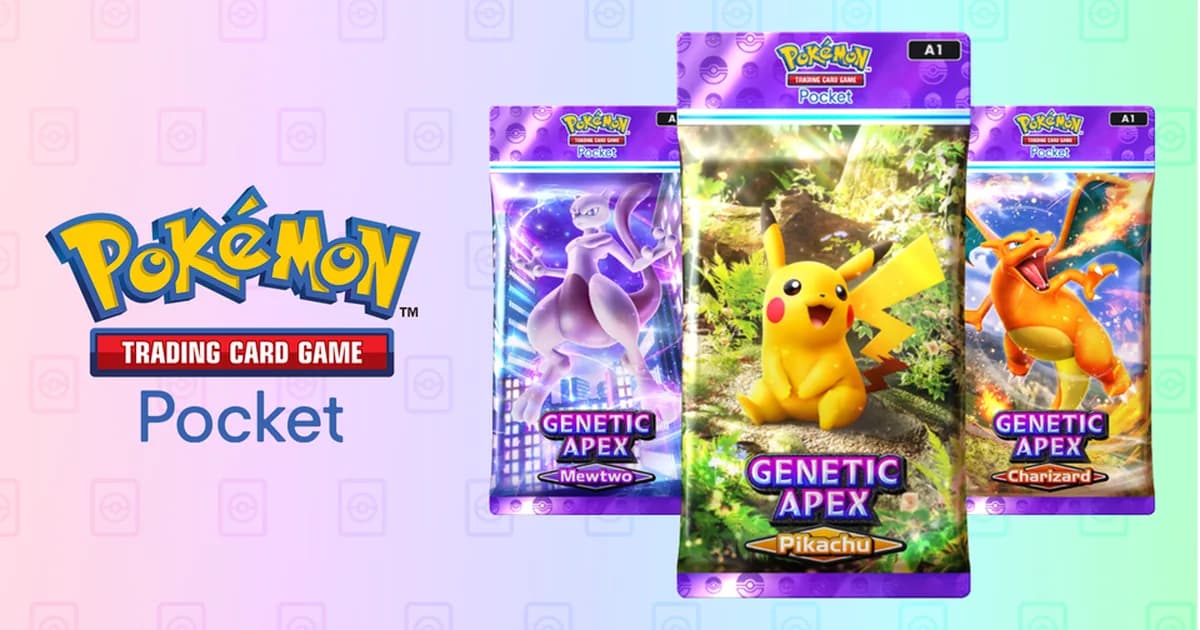
TL;DR: Pokemon TCG Pocket decks are exactly 20 cards, with no Energy cards at all, your Energy Zone auto-generates 1 Energy every turn from up to 2 types you chose while deck building. You win by reaching 3 points first: a regular Pokemon Knocked Out scores 1, an ex Pokemon scores 2. Each turn follows the same shape, draw, update the Energy Zone, play your cards, attack once, then a Pokemon Checkup resolves any Poison, Burn, or other status still active on your Active Pokemon.
How do you play Pokemon TCG Pocket? (quick answer)
You build a 20 card deck around a single Basic Pokemon opener, no Energy cards required, and then race your opponent to 3 points across a match capped at 20 minutes. Every turn you draw, get 1 free Energy to attach, develop your board of up to 4 Pokemon (1 Active plus a 3 slot Bench), and attack once if your Active Pokemon has enough Energy attached. Points come from Knocking Out your opponent's Pokemon, and the game ends the instant either side hits 3.
Key Takeaways
- Decks are exactly 20 cards, max 2 copies per exact card name, and Pokemon ex versions count as a separate name from their regular counterpart.
- There are no Energy cards in the deck. The Energy Zone generates 1 Energy per turn from up to 2 types you picked when building.
- Win by reaching 3 points: a regular Pokemon KO is worth 1, an ex Pokemon KO is worth 2.
- The Bench holds up to 3 Pokemon, one Active spot does the attacking, and only 1 evolution per Pokemon per turn is allowed.
- Five special conditions exist: Poison, Burn, Asleep, Paralysis, and Confusion, checked every turn during the Pokemon Checkup.
- For deck archetypes, card pulls, and set coverage as they land, our complete Pokemon TCG Pocket guide is the hub to bookmark.
Pokemon TCG Pocket Overview: Card Types, Deck Rules, and the Board
Every card you'll see falls into one of two buckets: Pokemon cards, and Trainer cards, which split further into four classes. Items can be played any number of times in a turn and go straight to the discard pile after use. Supporters are limited to 1 per turn, but unlike the physical Pokemon TCG, Pocket lets you play a Supporter on turn 1, no waiting required. Fossil Items are placed like a Basic Pokemon and evolve into real Pokemon later, though you can't start the game with one in your Active spot or on your Bench. Tools attach to a Pokemon and stay there, you can play as many Tools as you want in a turn, but never more than 1 per Pokemon at a time.
Deck construction is where Pocket trims the physical game down hardest: exactly 20 cards, no more, no less, with a maximum of 2 copies of any card that shares the same exact name. Here's the detail that trips people up first: a Pokemon's regular printing and its ex printing are treated as different names entirely. That means 2 copies of a regular Charizard and 2 copies of Charizard ex can sit in the same 20 card deck, 4 total copies of what feels like "one card" to a new player.
The board itself is simple. You get 1 Active spot, and only your Active Pokemon can attack. Behind it sits a 3 slot Bench, then your Energy Zone, then a shared Discard pile. Setup is fast: both players draw a hand of 5, and you're guaranteed at least 1 Basic Pokemon in that opening hand, so you always have something legal to place face-down in your Active spot. Both players flip together, the score starts at 0 to 0, and a 20 minute match timer begins ticking down.
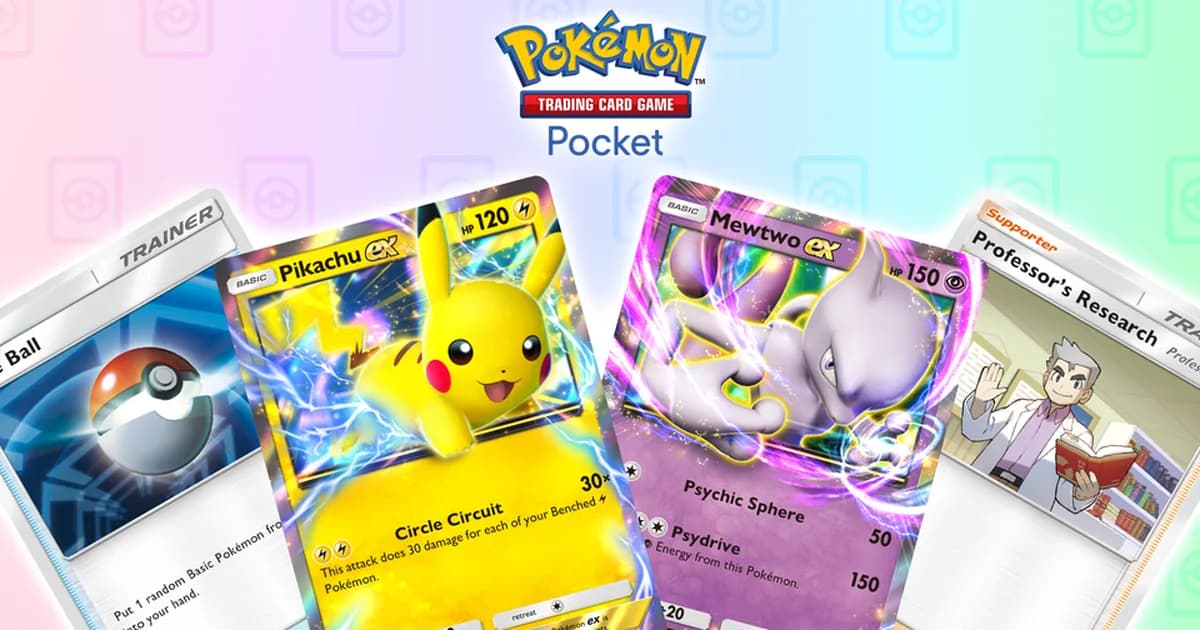
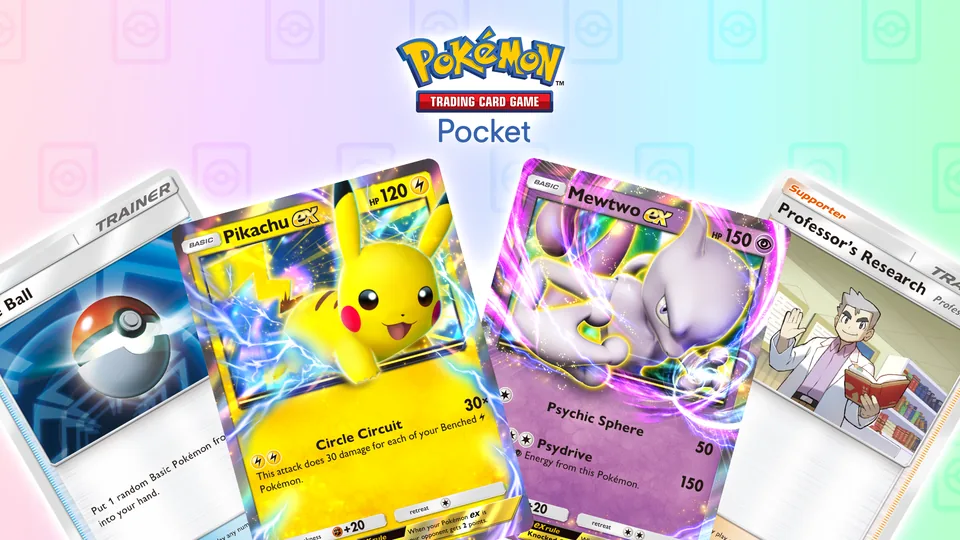 A Poke Ball Item, Pikachu ex and Mewtwo ex Pokemon cards, and a Professor's Research Supporter, the card classes described above.
If you've played One Piece TCG, the DON!! system is the closest comparison for what Pocket deliberately avoids. DON!! cards live in their own 10 card pile you manage every turn, and you're actively choosing how to spend them. Pocket strips that decision-making layer out entirely and just hands you 1 free Energy per turn from a type you already committed to at deck building. It's a real design difference, not a downgrade, more a bet that mobile players want fewer resource decisions and more Pokemon on screen.
GODEEPER: A stripped-down resource system isn't unique to Pocket. Union Arena runs its own beginner-friendly take on turn structure that's worth comparing once the basics here click. Union Arena TCG Beginner Guide →
Step-by-Step: How a Pokemon TCG Pocket Turn Actually Works
Here's the full turn loop, in the order you'll hit it once your opening hand is down and the match begins.
1. Draw your card for the turn. This is mandatory, you can't skip it, and it happens before anything else each turn including your very first one as the second player.
2. Update the Energy Zone. If your Energy stand is empty, the previewed Energy type promotes onto it and becomes available to attach this turn, while a new preview appears for next turn in the small inner circle. The player who goes first does not get an Energy on their opening turn at all, which exists specifically to offset the advantage of moving first.
3. Develop your board with Basics, evolutions, and Items. Play any number of Basic Pokemon to your Bench, up to the 3 slot cap, and evolve any eligible Pokemon from Basic to Stage 1 or Stage 1 to Stage 2. A Pokemon can't evolve the same turn it was played, and it can only evolve once per turn even if you somehow have the cards to chain further. Play as many Item cards as you want in this window too.
4. Attach Energy, retreat, or play a Supporter. You get exactly 1 Energy attachment per turn, to any Pokemon you choose, and if you don't use it, it's discarded when your turn ends. You may also retreat your Active Pokemon once per turn by paying its printed retreat cost in attached Energy, promoting a Bench Pokemon into the Active spot, and you may play 1 Supporter card. Abilities that say "once per turn" can be used here too, most are capped at once per Pokemon per turn.
5. Attack with your Active Pokemon. If it has enough Energy attached to pay the attack's cost, resolve it. Damage always lands in multiples of 10, and a Pokemon dropped to 0 HP or below is Knocked Out immediately, ending the turn the instant the attack resolves. Choosing not to attack also ends your turn right away.
6. Resolve the Pokemon Checkup. After each turn ends, any special condition on the Active Pokemon triggers: Poison deals 10 damage automatically, Burn deals 20 with a coin flip chance to shake it off, Asleep and Paralyzed both block attacking and retreating, and Confusion forces a coin flip on the Active Pokemon's next attack, tails and the attack fails outright. Asleep, Paralyzed, and Confused never stack with each other, whichever was applied most recently is the only one active, but Poison and Burn can sit on top of any of them at the same time.
7. Check for a win before the next turn starts. The moment either player reaches 3 points, the match ends immediately. It also ends early if a player's Active Pokemon is Knocked Out and they have no Bench Pokemon left to promote, a result players in the community just call a "bonk."
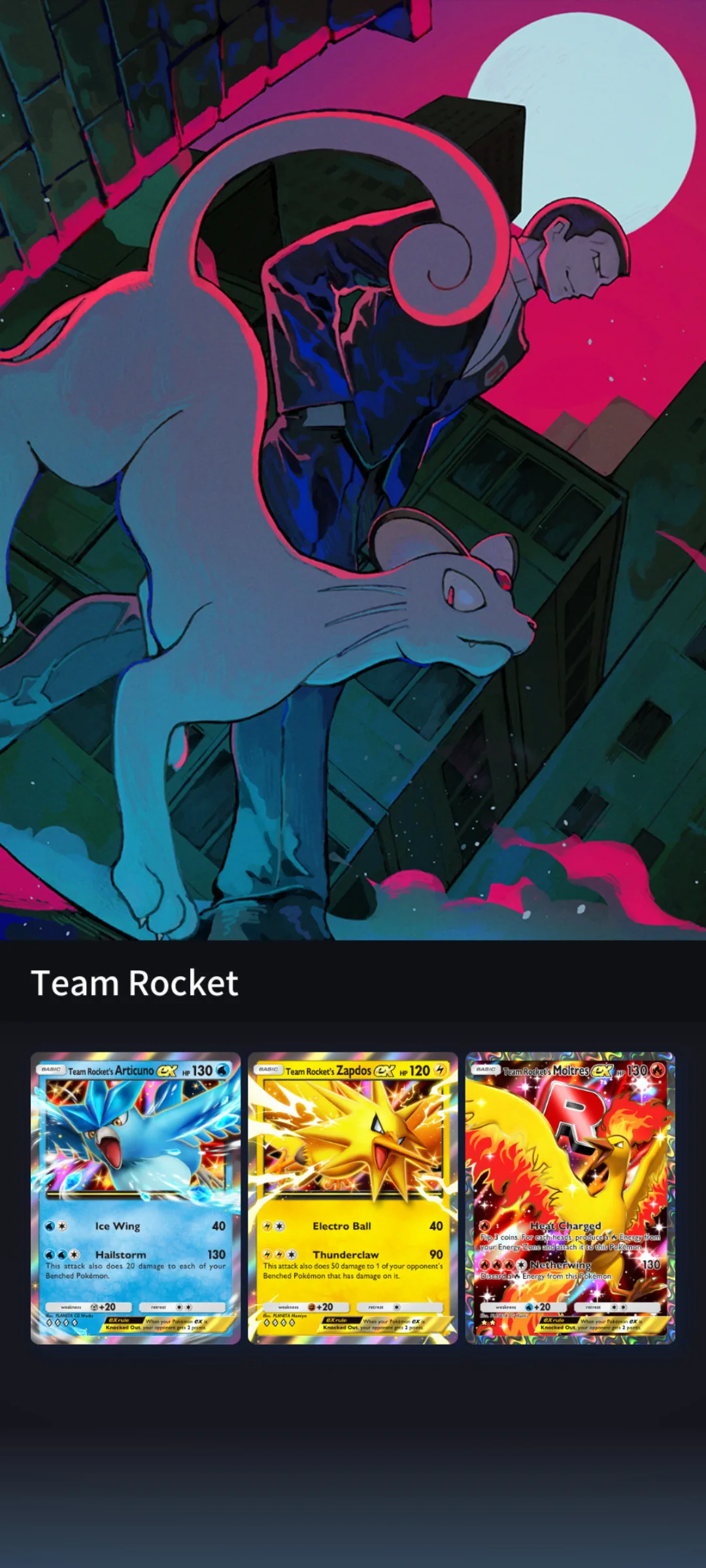 Team Rocket's Articuno ex, Zapdos ex, and Moltres ex, each showing the HP and attack damage numbers printed on a real Pokemon TCG Pocket card.
The Energy Zone is genuinely the one system worth slowing down for, since it replaces an entire deck category the physical game has always had. You never draw an Energy card, never get flooded, never get starved. Instead you commit to up to 2 Energy types when you build your deck, and every turn exactly 1 Energy of one of those types appears on the stand for you to attach, while the type coming next turn is already visible in the small preview circle so you can plan a turn ahead. Run 2 types and generation alternates between them randomly, there's no way to force which type shows up on a given turn, which is exactly why a deck built around a single Energy type feels far more consistent in practice than a 2 type list, even though 2 types theoretically covers more attack costs.
Weakness adds one more wrinkle worth knowing before your first real match: any damaging attack against a Pokemon's printed Weakness type adds a flat 20 bonus damage on top of whatever the attack normally deals. A 50 damage attack becomes 70 against a Weakness. Non-damaging attacks and status effects never trigger it, only direct damage does, so don't expect a bonus from an attack that only inflicts Confusion.
Tips for Your First Games
A few habits saved me from repeat losses once I understood the rules but kept misplaying them anyway.
- Build around 1 Energy type before you touch 2. Consistency beats coverage for a beginner deck, since the Energy Zone can't be steered, only previewed a turn ahead.
- Don't dump your whole hand on turn 1. Supporters being legal from turn 1 is tempting to use immediately, but the strongest ones are often better held for the turn they actually swing a fight.
- Track your opponent's ex Pokemon like they're worth double, because they are. Leaving an ex Pokemon alive on their board costs you more if it attacks, and Knocking it out is worth twice the progress toward your own 3 points.
- Watch the Bench count before you commit to an attack. If your Active Pokemon is close to being Knocked Out and your opponent has an empty Bench, that single KO can end the match outright, a "bonk" win, regardless of the score.
- Remember Fossil Items can't start the game as your Active or Bench Pokemon. They're placed like a Basic later on, so don't build an opening hand plan that assumes a Fossil is available turn 1.
Common Mistakes New Players Make
Forgetting the first turn has no Energy attachment. New players draw, look for their Energy stand, and find it empty if they went first. This is intentional, not a bug, and it means your opening turn is entirely about board development, not attacking.
Misreading the "different name" rule on ex Pokemon. A regular Pokemon and its ex version share a name in casual conversation but not in deck building. Players regularly assume they've hit the 2 copy cap on a Pokemon when they've actually only used 2 of 4 legal copies across both versions.
Overcommitting Energy to a Pokemon that's about to retreat or get Knocked Out. Since Energy discards from the stand if unused but stays attached once played, moving it onto a Pokemon you're planning to bench anyway wastes a turn's worth of resource for nothing.
Ignoring stacked status conditions. New players see Poison and assume any other status replaces it. Poison and Burn both persist alongside Asleep, Paralyzed, or Confused, so a Pokemon can be both Poisoned and Asleep at once, taking checkup damage while also unable to act.
Misjudging the turn 30 draw. Some players assume running out of cards loses the game the way it does in the physical Pokemon TCG. It doesn't here. You simply stop drawing once your hand reaches 10 cards, and an unresolved match is forced to a draw at turn 30 instead of anyone losing on a deck-out.
GODEEPER: Once the turn loop and status conditions feel automatic, seeing how a totally different win condition plays out is a good next step. Disney Lorcana races toward a card count instead of points. How to Play Disney Lorcana →
Related Reading
- One Piece TCG vs Yu-Gi-Oh vs Pokemon: Which Anime TCG: a side-by-side cost and learning curve breakdown if you're deciding what to play next.
- Dragon Ball Fusion World vs Pokemon TCG: Which to Play: compares deck building and format pacing against the physical Pokemon card game.
- One Piece TCG Beginner Guide 2026: a full onboarding walkthrough for the site's other flagship beginner cluster.
- How to Play Riftbound: another 2026 beginner rules guide, useful if you want to compare how a third new TCG paces its own turn structure.
- Pokemon TCG Pocket Meta Tier List: once you know the rules, see which decks are actually winning right now.
Frequently Asked Questions
How do you win in Pokemon TCG Pocket? Be the first to reach 3 points. A regular Pokemon Knocked Out is worth 1 point, an ex Pokemon is worth 2. You also win instantly if your opponent's Active Pokemon is Knocked Out and they have no Bench Pokemon left to promote into that spot.
Do you need Energy cards in a Pokemon TCG Pocket deck? No. Energy is never a card in your 20 card deck. You pick up to 2 Energy types when you build the deck, and the Energy Zone generates 1 of those types automatically every turn for you to attach.
How many cards go in a Pokemon TCG Pocket deck? Exactly 20, with a maximum of 2 copies of any card sharing the same exact name. A Pokemon's regular version and its ex version count as different names, so 2 regular Pikachu plus 2 Pikachu ex is a fully legal 4 card line.
What are the special conditions in Pokemon TCG Pocket? Poison, Burn, Asleep, Paralysis, and Confusion, all applied only to your Active Pokemon and checked during the Pokemon Checkup after each turn. Poison and Burn can stack together, but Asleep, Paralyzed, and Confused can never stack, only the most recently applied one is in effect.
Does Weakness matter in Pokemon TCG Pocket? Yes. A damaging attack against a Pokemon's printed Weakness type adds a flat 20 bonus damage. Non-damaging attacks, status moves, and abilities never trigger the Weakness bonus, only attacks that deal direct damage do.
How long does a Pokemon TCG Pocket match last? Each match runs on a 20 minute clock with a 90 second timer per individual turn. If nobody reaches 3 points by turn 30, the match is forced to a draw instead of anyone losing for running out of cards.
Does going first give you an advantage in Pokemon TCG Pocket? Less than you'd think. The player who goes first skips their first Energy Zone attachment entirely, no Energy is generated for their opening turn, specifically to offset the tempo advantage of moving first. Everyone is fully caught up by turn 2.
References
Was this guide helpful?
About the author
Beginner guides and anime crossover
Pen name for the Shonen TCG desk's beginner guides, starter decks and anime-to-card-game explainers.
- Rules checked against the official rulebook and card text
- Every claim traced to a cited source
- Opinions marked as ours, with the reason
Keep reading

Pokemon TCG Pocket Guide 2026: Rules, Decks, and Meta
Guides · 14 min
Pokemon TCG Pocket Meta Tier List: Altaria Espeon Leads
Guides · 10 min

Mega Lucario ex Deck Guide: 3,971 Matches, 49% Win Rate
Guides · 13 min
Pokemon TCG Pocket Pack Points Guide: F2P Pack Strategy
Guides · 13 min

Mega Altaria ex Espeon Deck Guide: Sleep Meta Build
Guides · 11 min

Miraidon ex Magnezone Deck Guide: Pokemon TCG Pocket
Guides · 14 min
Suicune ex Baxcalibur Deck Guide: Pokemon TCG Pocket
Guides · 15 min
Mega Sceptile ex Greninja Deck Guide: Pokemon TCG Pocket
Guides · 13 min
Disclaimer
This article is published for informational and entertainment purposes. It does not constitute professional financial, legal, or technical advice. Game performance, online services, patch schedules, and store listings change. Verify critical details (pricing, system requirements, regional availability) with publishers and storefronts before you buy. Affiliate links, where present, help support our editorial work and are labelled in our affiliate disclosure.