

Shonen TCG · Guides
How to Play Riftbound: Full Beginner Rules Guide 2026
I picked up a Riftbound Proving Grounds box with zero card game background beyond a couple of anime TCGs, and figuring out how to play Riftbound took me longer than it should have, not because the game is hard, but because the official rules throw Domains, Runes, and Showdowns at you before you've drawn a single card. This guide walks through deck construction, the ABCD turn loop, and how a fight actually resolves, in the order you'll hit them at the table, so the terminology stops being the obstacle.

TL;DR: Riftbound is a 2 to 4 player trading card game where you win by reaching 8 points first, scored by conquering or holding Battlefields. You build a deck around one Legend with two Domains: 40 Main Deck cards, 12 Runes, and 3 Battlefields, all restricted to those two Domains. Every turn follows the same ABCD pattern: Awaken, Beginning (score, Channel 2 Runes, draw), then a free form Action Phase where you play cards and start Showdowns. Combat adds up total Might on both sides and only the losing side's units die, so a good Showdown plan matters more than raw stats on a card.
How do you play Riftbound? (quick answer)
You play Riftbound by building a 40 card deck around one Legend and its two Domains, then racing an opponent to 8 points. Each turn runs through Awaken, Beginning, and Action Phase (the ABCD loop), and points come from conquering a Battlefield in a fight or simply holding one you already occupy when your turn starts. Most games are decided by whoever manages their Runes and their Showdowns better, not by whoever has the single strongest card.
Key Takeaways
- The win condition is 8 points, usually reached by holding Battlefields, not conquering them.
- A deck is exactly 1 Legend, 40 Main Deck, 12 Rune Deck, and 3 Battlefield cards, all locked to your Legend's two Domains.
- Every turn opens with the same ABCD loop: Awaken, Beginning, Channel, Draw, then a free form Action Phase.
- Moving units onto a Battlefield starts a Showdown, and Combat only kills the side that runs out of units.
- Reactions resolve before the thing they're responding to, which is the single trickiest rule for a first time player.
- For every Legend, Domain, and set covered so far, our complete Riftbound guide is the hub to bookmark.
Riftbound Overview: Legends, Domains, and What You're Building
Riftbound is Riot Games' trading card game built on League of Legends, and it launched with an Origins base set plus starter products aimed squarely at players who have never touched a TCG before. That's who this guide is for. If you already play another card game, a lot of this will click fast; if you don't, stick with me, because I didn't either.
Every deck starts with a single Legend, your commander card, and that Legend fixes two Domains that act like colors or factions. Master Yi, for example, uses the Calm (green) and Body (orange) Domains. Everything else in your deck, all 40 Main Deck cards, all 12 Runes, has to match one of those two Domains. At least one card in your Main Deck must be a Champion Unit tied to your specific Legend. You also pick 3 Battlefield cards, which are the locations you'll actually be fighting over.
If you've played One Piece TCG, this will feel familiar: a Leader locks your deck to its colors the same way a Legend locks Riftbound to its Domains. The difference is that Riftbound splits that restriction into two separate decks, Main and Rune, both bound by the same two Domain rule, which is the first thing that confused me until I actually built a list and saw how tight the two Domain limit really is.
Setup itself is quick. Reveal your Legend, pick a Chosen Champion from your deck (it sits face up beside your hand and can be played anytime), shuffle your two decks separately, and in a 2 player game, secretly pick and reveal a Battlefield. Draw 4 cards, with one mulligan allowed: bottom up to 2 cards and draw replacements, all at once rather than card by card.
 Riftbound's launch key art. The game draws its Legends and Champion Units straight from League of Legends' existing character roster, which is part of why the card pool already feels familiar even on your first read-through.
GODEEPER: Deck restriction by color is one of the most common sticking points across TCGs, and Disney Lorcana handles the same tension with a completely different resource system. How to Play Disney Lorcana →
Step-by-Step: How to Play Riftbound From Turn One
Here's what actually happens once cards are on the table, in the order you'll play through it.
1. Reveal your Legend and set aside your Chosen Champion. Show your Legend card to the table, then pick one Champion Unit from your deck as your Chosen Champion. It sits face up beside your hand and can be played at any point during the game, exactly as if it were still in hand.
2. Shuffle both decks, reveal a Battlefield, and draw your opening hand. Shuffle your Main Deck and Rune Deck separately, since they never mix, reveal your chosen Battlefield in a 2 player game, then draw 4 cards. You get one mulligan: bottom up to 2 cards and draw replacements, choosing everything you're swapping at once.
3. Awaken by readying every card you control. At the start of your turn, flip every Exhausted (sideways) card you have back to Ready (upright). This covers units, Runes, and Gear, and it's the reset that the rest of your turn is built on.
4. Score, Channel 2 Runes, and draw during the Beginning Phase. You gain 1 point for every Battlefield where you already have a unit sitting, capped at 1 point per Battlefield per turn even if you swap a unit out and a new one in. Then take the top 2 cards of your Rune Deck face up and Ready, 3 instead if you're going second on turn one, and draw 1 card from your Main Deck.
5. Spend Energy and Power to play units, spells, and Gear during the Action Phase. Exhaust Runes to pay a card's Energy cost, and Recycle Runes matching the card's Domain to pay any Power cost underneath it. A single Rune can cover both costs at once. Units enter play Exhausted and can't act the turn they're played; Gear enters Ready and always goes to your Base.
6. Move units to a Battlefield to start a Showdown, then resolve Combat. Both sides trade Action Spells, Attacker first, until both pass in a row. Add up each side's total Might and deal it to the opposing units, and whichever side still has units left standing wins the Showdown. If only the Attacker does, they conquer the Battlefield, score a point, and draw a card, unless that point is the one that wins the game outright.
7. Repeat every turn and close the game out at 8 points. Keep alternating turns, holding what you control and contesting what you don't, until someone reaches 8. Watch for the exception: your 8th point can't come from conquering unless you also scored from every other Battlefield that same turn, which is why most winning points come from holding a Battlefield quietly rather than fighting for the last one.
Here's the Combat math on a real example, since the wording alone didn't make it click for me the first time I read it. Say you attack with two 5 Might units, 10 total, and your opponent defends with one 8 Might unit. You deal 8 damage, which destroys their unit and leaves you with 2 damage spare, but there's nothing left to apply it to. Their unit deals 5 Might back, destroying one of your two units, and the fight is over because a destroyed defender can't hit back. You keep your surviving unit and conquer the Battlefield. After the fight, that unit heals back to full. Damage never carries between separate Showdowns.
Combat is math, not vibes. Once that sinks in, counting Might before you attack becomes second nature instead of a guess.
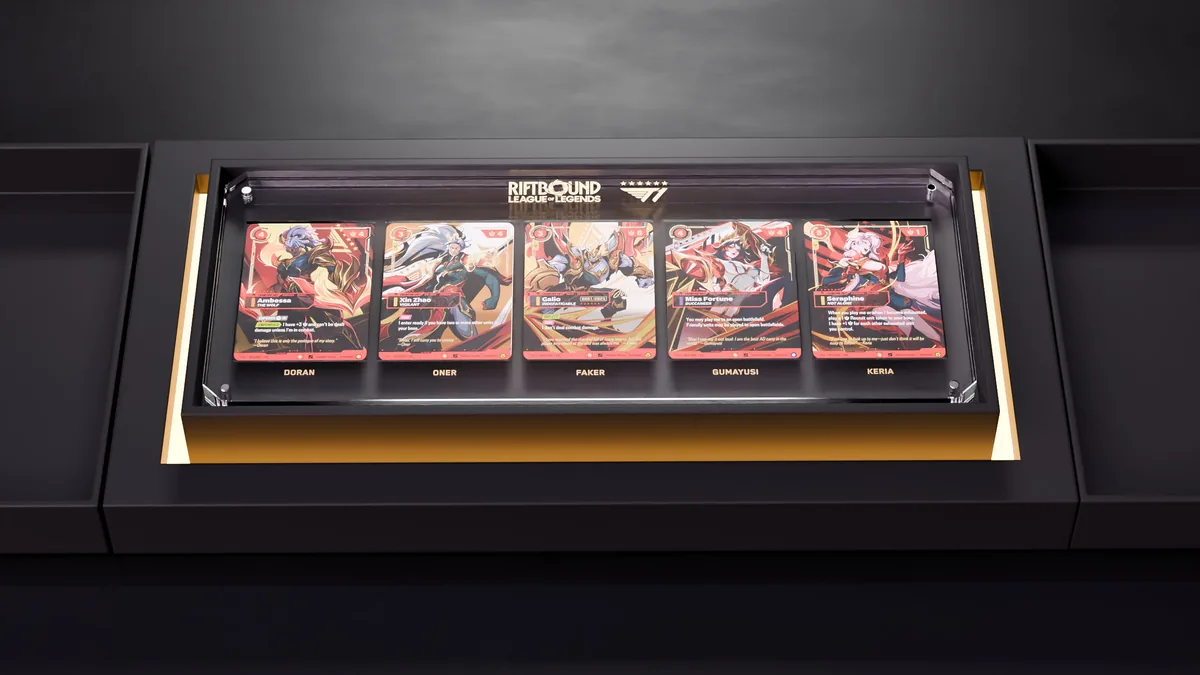 A real Riftbound card layout: the number in the top left is the Energy cost, the number in the top right is Might, and the box below holds the ability text you'll be reading constantly once games get going.
Note: Read a Battlefield's printed ability before you commit units to it. Conquering one often triggers an effect, discarding a card or granting a bonus, and walking into a bad one because you were only thinking about the point is an easy way to lose a game you were winning.
Tips for Your First Games
A few habits saved me repeated losses while I was still learning how to play Riftbound, even after the ABCD loop clicked and I kept losing Showdowns anyway.
- Don't spend every Rune the moment you Channel it. Holding a couple Ready Runes lets you play an Action Spell mid Showdown, which is often how you actually win a fight rather than losing units for nothing.
- Watch what your opponent leaves Ready at the end of their turn. A stack of untouched Runes usually means they're sitting on a trick, and attacking into it blind is how a winning board turns into a losing one.
- Save your Chosen Champion for the moment it matters, not turn one. It can be played anytime from off to the side, so there's rarely a reason to commit it early when holding it lets you swing a close Showdown later.
- Track lethal before you commit to a big attack. If your opponent is one point from 8 and holding two Battlefields, racing them on tempo instead of denying a Battlefield is usually the wrong plan.
- Remember Reactions resolve first, not the thing they respond to. If you buff a unit's Might and your opponent answers with a Reaction, that Reaction checks the unit's stats before your buff applied, so a card that should have dodged a removal effect sometimes doesn't.
Common Mistakes New Players Make
Forgetting units enter Exhausted. A freshly played unit can't move, attack, or start a Showdown the turn it lands. New players plan an attack around a unit they just played and then remember, too late, that it's not available until their next Awaken Phase.
Misreading the Reaction timing rule. This is the single most common misplay in the source guide's own worked example: you buff a 3 Might unit to 6, your opponent plays a Reaction that only hits units with 3 or less Might, and it still bounces your unit, because the Reaction checks your unit's stats before your buff resolves. Play around this by assuming any pending Reaction sees your board as it was before your last spell, not after.
Over committing to a Battlefield that isn't worth it. Sending your whole board to conquer one Battlefield can leave your other one, or your Base, completely open. Since you only need to hold a Battlefield at the start of your turn to score from it, spreading pressure is frequently better than stacking it all in one place.
Ignoring the final point rule and misreading lethal. Players sitting at 7 points sometimes attack a Battlefield expecting the win, forgetting that an 8th point from conquering only counts if every other Battlefield scored that same turn. Check whether you're about to hold your way to 8 before you commit to a risky attack that might not actually close the game, a physical point counter at the table makes this kind of misread much less likely.
GODEEPER: Once the ABCD loop and Showdowns feel automatic, comparing how a different card game paces its own turn structure is a fast way to see what's universal versus Riftbound specific. Union Arena TCG Beginner Guide →
Related Reading
- One Piece TCG How to Play: Rules & Mechanics: a deeper mechanical breakdown of another Leader locked deck building system.
- Disney Lorcana Ink Colors Explained: how a different game's two color deck restriction plays out across six possible colors.
- Union Arena: How to Play, Rules Explained: a third beginner rules breakdown if you want to compare turn structures side by side.
- Riftbound Meta Tier List: once the rules click, see which Legends and Domains are actually winning right now.
- Riftbound Domains Explained: All Six Colors and Deck Roles: a focused reference for choosing the two Domains your Legend allows.
Frequently Asked Questions
How do you win at Riftbound? You win by being the first player to reach 8 points. You score by conquering a Battlefield, winning a fight there, or by holding one you already control when your turn begins. Your winning 8th point almost always comes from holding, since conquering can't provide it unless every other Battlefield scored that same turn too.
What do I need to build a Riftbound deck? Exactly one Legend, 40 Main Deck cards including at least one Champion Unit matching your Legend's Domains, 12 Rune Deck cards also matching those Domains, and 3 different Battlefield cards. Your Legend's two Domains are the hard limit on what you can include anywhere else in the deck.
What does ABCD mean in Riftbound? It's the turn structure. Awaken means ready your cards, Beginning means score, Channel 2 Runes, and draw a card, and then you move into the open ended Action Phase where you actually play cards and start fights. New players use ABCD as a checklist until the order becomes automatic.
Can you play Riftbound with more than 2 players? Yes, Riftbound supports 2 to 4 players. A 3 player game uses 3 Battlefields instead of 2, and the first player skips their turn 1 draw. A 4 player game also uses 3 Battlefields, and the first player neither draws on turn 1 nor picks a preferred Battlefield.
What is a Showdown in Riftbound? A Showdown starts the moment you move units onto a Battlefield. Both players can play Action Spells back and forth, Attacker first, until both pass in a row. If units remain on both sides, Combat resolves. Total Might is dealt as damage, and whichever side still has units standing keeps or takes the Battlefield.
What do I need to start playing Riftbound? The fastest entry point is the Proving Grounds starter set, built for 2 to 4 players with 4 preconstructed decks, a rulebook, playmats, and tokens. Booster packs and single preconstructed Champion Decks, Jinx, Viktor, and Lee Sin at launch, are the other ways in once you know the rules.
Do units act the turn they're played in Riftbound? No. Units enter play Exhausted, so they can't move, attack, or start a Showdown the turn you play them. They become Ready again during your next Awaken Phase, which is a common early mistake: planning a Showdown around a unit that isn't actually available yet.
References
Was this guide helpful?
About the author
Beginner guides and anime crossover
Pen name for the Shonen TCG desk's beginner guides, starter decks and anime-to-card-game explainers.
- Rules checked against the official rulebook and card text
- Every claim traced to a cited source
- Opinions marked as ours, with the reason
Keep reading
Riftbound Meta Tier List: Irelia, Master Yi Lead Post-Ban
Guides · 15 min

Riftbound Guide 2026: How to Play, Domains, Deck Building
Guides · 17 min
Riftbound Kennen Deck Guide: Tier 2 After Stacked Deck Ban
Guides · 15 min

Riftbound vs One Piece TCG vs Lorcana: Full 2026 Comparison
Guides · 14 min

Riftbound Radiance Release Date: Set 5 Ships October 23
News · 5 min
Riftbound Card Values: Chase Promos to Playable Prints
Guides · 13 min
Riftbound Vendetta Set Guide: Legends, Mechanics, Release
Guides · 11 min
Riftbound Rengar Deck Guide: Won Los Angeles, Now Tier 2
Guides · 15 min
Disclaimer
This article is published for informational and entertainment purposes. It does not constitute professional financial, legal, or technical advice. Game performance, online services, patch schedules, and store listings change. Verify critical details (pricing, system requirements, regional availability) with publishers and storefronts before you buy. Affiliate links, where present, help support our editorial work and are labelled in our affiliate disclosure.