Loading…
Loading…
Shonen TCG · Guides
Reviewing
Disney Lorcana
If you have a starter deck and no idea where to begin, this guide covers how to play Disney Lorcana from the very first turn: the goal, the turn sequence, inking, questing, challenges, and the handful of keywords you will meet right away. Lorcana is a two-player card game from Ravensburger where you summon glimmers of Disney and Pixar characters and race to collect lore.
TL;DR: To play Disney Lorcana, each turn you ready your cards, draw, optionally ink one card for resources, then spend ink to play characters and quest them for lore. First to 20 lore wins. You can challenge opposing characters but never attack the player directly. Decks are 60+ cards in up to two ink colors. Learning to quest only when it is safe is the whole skill.
You play Disney Lorcana by taking turns building a board of character cards and sending them on quests to collect lore, aiming to reach 20 before your opponent. Each turn you can turn one card from your hand into a resource (inking), spend those resources to play characters, items, and songs, and then either quest for lore or challenge the opponent's characters to clear the way. The game is a race, not a slugfest, so most of your decisions come down to whether questing now is worth the risk of leaving a character exposed.
Was this guide helpful?
About the author
Beginner Guides & Crossover Writer
Anime fan turned TCG content creator. Bridges the gap between anime fandom and card game strategy. Covers beginner guides, anime-to-TCG crossover content, and Union Arena.
Disclaimer
This article is published for informational and entertainment purposes. It does not constitute professional financial, legal, or technical advice. Game performance, online services, patch schedules, and store listings change. Verify critical details (pricing, system requirements, regional availability) with publishers and storefronts before you buy. Affiliate links, where present, help support our editorial work and are labelled in our affiliate disclosure.
Attack of the Vine Lore Rush Guide: Win Fast in Set 13
Guides · 9 min
Here is a full turn, in order. Once you have done this a few times it becomes automatic.
1. Ready. Turn all your exerted (tapped) cards upright again and resolve any "at the start of your turn" effects.
2. Set. This is a beat for start-of-turn triggers. New players can treat Ready and Set as one step early on.
3. Draw. Draw one card. The player who goes first skips their draw on the very first turn to balance the advantage.
4. Ink (optional). Put up to one card with the golden inkwell symbol face down into your inkwell. It becomes generic ink and normally stays there unless another effect moves it.
5. Main phase. Now you act. Spend ink to play Characters, Items, Songs, Actions, and Locations. Quest with ready characters to gain lore. Challenge opposing exerted characters. Move characters to Locations. Sing Songs by exerting a character of the right cost instead of paying ink.
6. Pass. End your turn and hand over to your opponent.
The two actions you will use most are questing and challenging. Questing exerts a character to bank its lore value. Challenging exerts a character to fight an opposing exerted character, with both dealing their Strength to each other.
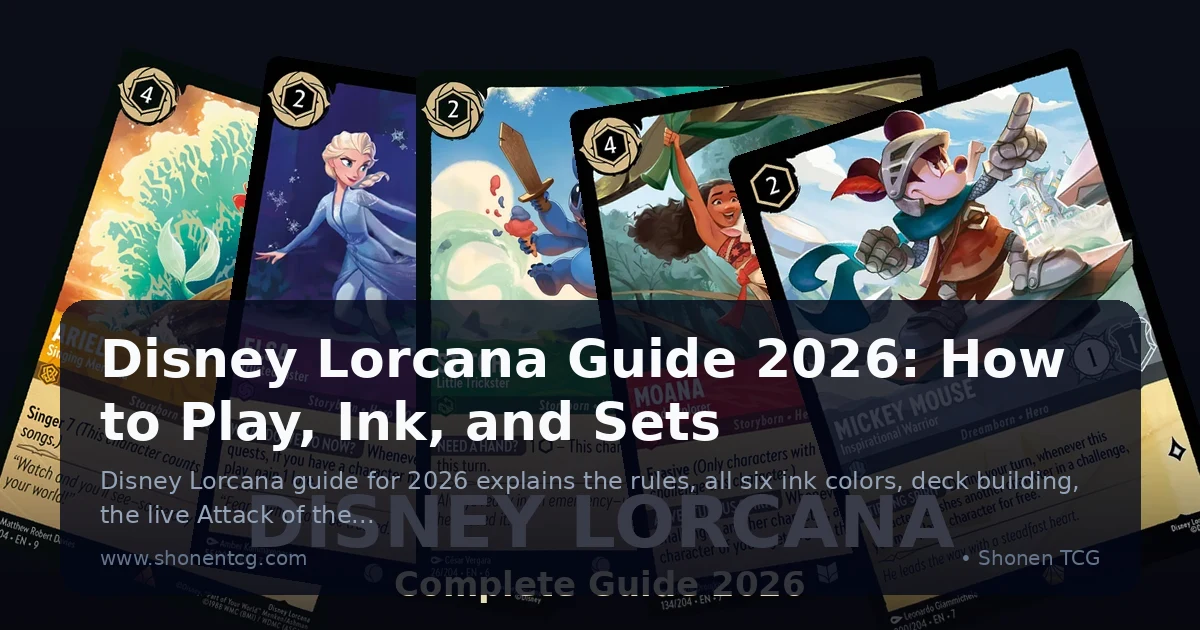
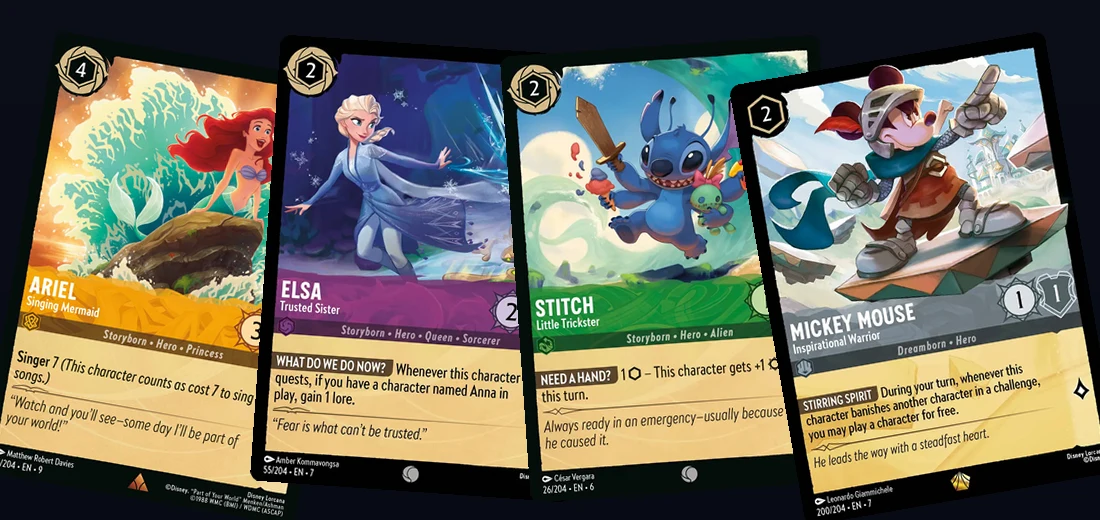 Caption: A turn is mostly about playing characters like these, then deciding which ones quest and which ones stay back to defend.
Inking is the engine of the whole game, and it is the part new players underuse. Your inkwell starts empty. Each turn you may add one card, so by turn three you have three ink, by turn five you have five, and so on. That ramp is what lets you play bigger characters later.
The catch is the trade-off. Every card you ink is a card you cannot play, and only cards with the golden circle around their cost are inkable in the first place. So deckbuilding and in-game choices both revolve around the same question: is this card more valuable as a resource now or as a play later? A good rule of thumb for a first deck is to run at least 45 inkable cards out of 60 so you are rarely stuck unable to ramp.
Questing is how you win. A character with a lore value (the diamond icon) exerts to bank that lore. The risk is that an exerted character can be challenged, so questing into an open board can cost you the character.
Challenging is how you fight. Your ready character exerts to challenge an opposing exerted character. Both deal Strength to each other as damage, and a character is banished when its damage meets or exceeds its Willpower. You generally cannot challenge a character that is still ready, which is why timing matters so much: a fresh character is safe until it does something.
A few keywords show up immediately:
Understanding the six Disney Lorcana ink colors and how each one uses these keywords differently is the natural next step once the turn loop clicks.
Here is the decision that comes up every game. Say you have a 3-cost character with 2 lore and 3 Willpower, and your opponent has an exerted 2-Strength character sitting across from you. The Wilds Unknown best decks guide provides a historical example of this kind of challenge-and-quest sequencing in Core lists. If you quest, you bank 2 lore but you are now exerted and can be challenged next turn. If instead you challenge their 2-Strength character, you trade your exert for tempo and deny them a future quester, but you gain no lore this turn. Early on, lean toward questing when your character clearly survives or has Evasive, and lean toward challenging when the opponent is about to out-race you or when removing one body protects three of yours. There is rarely one correct answer, which is exactly why the game stays interesting past your first week. Write down the board state if you have to; experienced players are simply running this check faster, not skipping it.
GODEEPER: Once the turn loop clicks, the next thing to understand is which ink colors do what, since your two-color pairing shapes your whole strategy. Disney Lorcana Complete Guide →
A few habits will save you a lot of losses while you learn how to play Disney Lorcana:
If you are coming from another card game, the inking trade-off will feel familiar from games with face-down resources, and the leader-and-board pacing rhymes with the One Piece TCG beginner guide and the Union Arena beginner guide. Once you understand the basics, the Core vs Infinity format guide explains which event format your cards are legal in. Wondering how Lorcana compares to those other games before you commit? The Disney Lorcana vs Magic vs One Piece TCG breakdown runs a direct comparison of cost, complexity, and competitive play. Wilds Unknown also brought Pixar characters into the game for the first time; the Disney Lorcana Pixar Characters Wilds Unknown guide covers which franchises debuted and how those glimmers play.
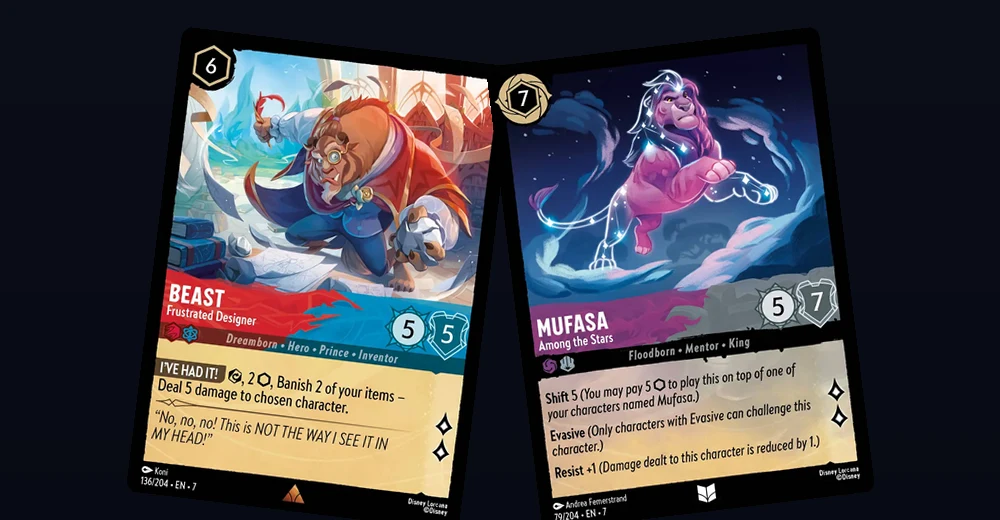 Caption: These card examples show the Strength and Willpower values you compare during a challenge.
GODEEPER: Ready to pick a deck instead of using a starter? This budget-friendly build is a common first competitive deck. Disney Lorcana Budget Decks 2026 →
How do you win at Disney Lorcana? You win by being the first player to reach 20 lore. You gain lore mostly by questing, which means exerting a character that has a lore value so it banks that many lore for you. The first player to 20 wins immediately, even mid-turn.
What does inking a card do? Once per turn you may put one card from your hand face down into your inkwell, where it becomes a generic resource that pays for anything. Only cards with the golden circle around their cost can be inked, and the card normally stays there unless another effect moves it.
Can you attack the other player directly in Lorcana? No. You cannot deal damage to your opponent directly. You challenge their characters, not them. The pressure comes from removing their questers and racing the lore counter, not from reducing a life total.
How long does a game of Disney Lorcana take? Game length varies with the players, matchup, and board state. Games end when someone reaches 20 lore, and learning when to quest or challenge usually matters more than memorizing a turn-count target.
What do I need to start playing Disney Lorcana? Two decks of at least 60 cards, something to track lore (the game includes counters, or use dice), and a flat surface. The easiest entry is a two-player starter set, which comes with two ready-to-play decks and everything you need to learn.
Do I have to ink a card every turn? No, inking is optional, but skipping it slows your ramp and most turns you will want to ink. The trade-off is real though: a card you ink is a card you cannot play, so part of learning the game is choosing which cards become resources.
Related
Union Arena Tokyo Ghoul Deck Guide: Purple Kaneki 2026
8 min read
Union Arena Fullmetal Alchemist Deck Guide: Blue 2026
8 min read
Union Arena Attack on Titan Vol.2: New Yellow Color
8 min read
OP-17 Mihawk Deck Guide: Green Dracule Mihawk 2026
13 min read
Dragon Ball Fusion World FB11 Leaders: All 5 Revealed
8 min read