

Shonen TCG · Guides
Riftbound Banned Cards: Current Banlist Explained 2026
Reviewing
Riftbound
Riftbound banned cards are currently split between a Standard Constructed list and one additional Constructed 2v2 Legend ban. This guide checks Riot's live Rules Hub and each official announcement, then matches every named entry to the official card gallery so the set and collector ID are clear.
TL;DR: Standard Constructed currently bans seven cards and five Battlefields. The bans took effect in three waves: March 31, July 24, and September 18, 2026. Constructed 2v2 uses the full Standard list plus Master Yi, Wuju Bladesman. Riot has announced Radiance for October 23, but has not announced another ban update or a new rotation rule.
Riftbound banned cards? (quick answer)
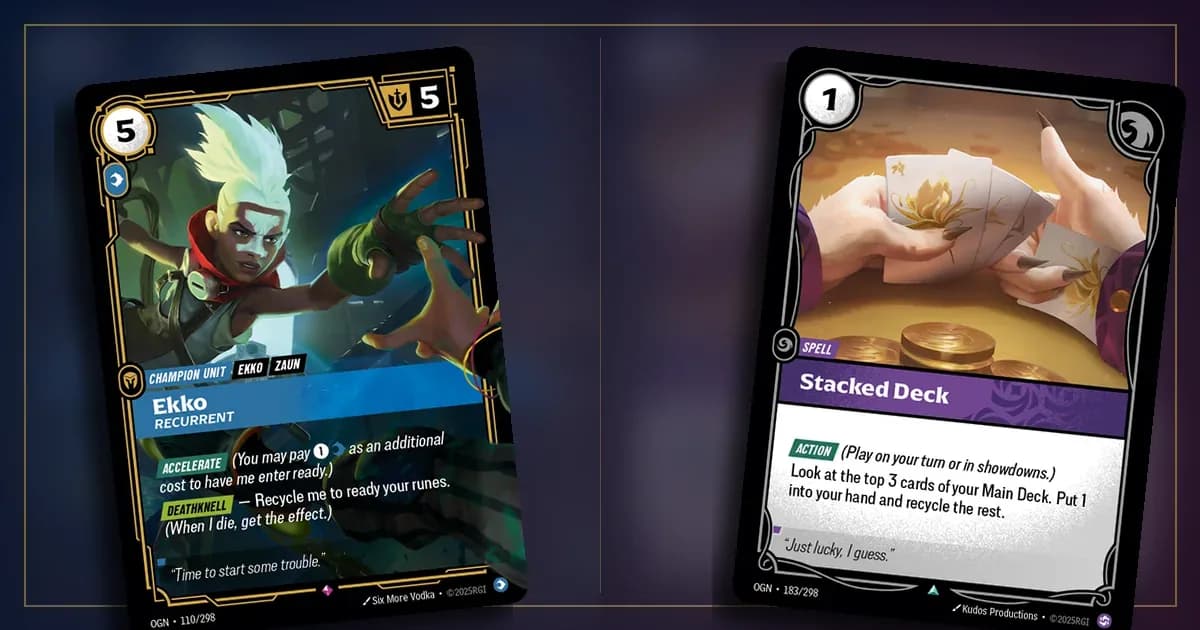
The current Standard Constructed list has seven banned cards and five banned Battlefields. Constructed 2v2 uses those entries plus Master Yi, Wuju Bladesman, which is legal in 1v1. The newest additions are Ekko, Recurrent and Stacked Deck, both effective September 18, 2026.
Key Takeaways from the Riftbound banned cards list
- Called Shot, Draven, Vanquisher, Fight or Flight, Scrapheap, The Dreaming Tree, Obelisk of Power, and Reaver's Row became illegal on March 31, 2026.
- Stealthy Pursuer, The Arena's Greatest, and Aspirant's Climb became illegal in Standard Constructed on July 24, 2026.
- Ekko, Recurrent and Stacked Deck became illegal in both Standard and Constructed 2v2 on September 18, 2026.
- Master Yi, Wuju Bladesman is the only entry listed as a 2v2-only Legend ban. It remains legal in 1v1 Standard Constructed.
- Riot's current Rules Hub does not show a restricted list. Ban announcements use a clear cannot-play intervention rather than a one-copy limit.
- Radiance releases October 23, 2026. Riot has not published a ban change connected to the set.
Overview of the current Riftbound banlist
Riot's official Rules Hub was last updated September 18, 2026. It says all sets currently produced are legal in sanctioned tournaments and lists bans under Constructed Format Legality. The same page says Riot intends to introduce rotation for Standard Constructed starting in 2028. That means a new set release is not, by itself, a reason to remove Origins, Spiritforged, Unleashed, or Vendetta from the legal card pool today.
Read the list by card type. Cards go in the Main Deck, Battlefields are the locations chosen for a game, and Legends define the deck's identity. A banned name cannot be registered in the format named by Riot, even when the same card has a useful old tournament result attached to it.
The official card gallery fills in the printed set and collector number. Those numbers are included below for decklist cleanup. Riftbound has multiple products and alternate treatments, so a collector ID is more reliable than a character or card-name search alone.
GODEEPER: If you need the turn structure, deck construction rules, and Battlefield scoring before checking legality, start with the Riftbound Complete Guide 2026 →
Standard Riftbound banned cards by effective date
Standard Constructed has seven banned cards and five banned Battlefields in the current Rules Hub. The table uses the official card-gallery set code and collector number. The reason column summarizes Riot's own explanation, rather than a community theory about why each card was strong.
March 31, 2026
| Entry | Type | Set and ID | Riot's stated reason |
|---|---|---|---|
| Called Shot | Spell | Spiritforged, SFD-122/221 | Its filtering and repeatable draw helped Miracle decks gain cards too efficiently and contributed to long tournament rounds. |
| Draven, Vanquisher | Champion Unit | Spiritforged, SFD-020/221 | Draven's strong turn-two access, combined with a powerful Legend, Champion, card pool, and Battlefields, produced an unhealthy power and presence level. |
| Fight or Flight | Spell | Origins, OGN-168/298 | Its hand or Hidden modes could negate combat or protect a unit, making it too flexible and crowding out other Chaos designs. |
| Scrapheap | Gear | Origins, OGN-182/298 | It was one of the free, efficient filtering and card-advantage pieces that made Miracle packages too successful and time consuming. |
| The Dreaming Tree | Battlefield | Origins, OGN-292/298 | Its ability to create card flow on both players' turns distorted deckbuilding and gave the format too much consistency. |
| Obelisk of Power | Battlefield | Origins, OGN-284/298 | It was ubiquitous in powerful decks and let players bypass first-player and second-player energy breakpoints, narrowing deckbuilding decisions. |
| Reaver's Row | Battlefield | Origins, OGN-285/298 | It encouraged retreating instead of meaningful Showdowns and was especially strong in Draven decks and conquer-focused domains. |
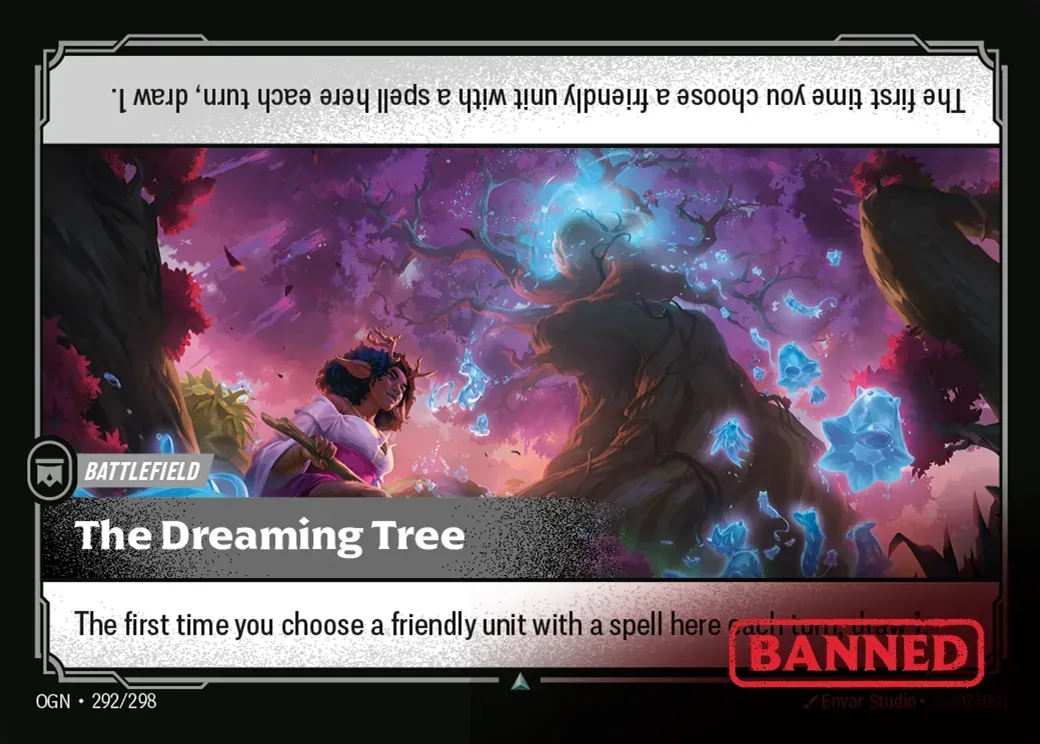 The Dreaming Tree appears in the official gallery with Riot's banned treatment.
Riot published the first ban announcement on March 30, 2026, with an effective date of March 31. It grouped Called Shot and Scrapheap around the Miracle strategy, treated Draven as a power outlier, and addressed Fight or Flight as a broader Chaos problem. The Battlefield decisions were structural. Those locations begin in play and can be used by every deck, so Riot judged their effect on repetition and game incentives separately from a Main Deck card.
The announcement also explains why Riot did not use a restricted-list compromise. Riot wrote that limiting a problem card can make the problem sharper because the game becomes more dependent on who draws a lone copy. For this game, “you can't play that anymore” was described as clearer than a conditional one-copy rule. That is the policy context behind the current all-or-nothing list.
July 24, 2026
| Entry | Type | Set and ID | Riot's stated reason |
|---|---|---|---|
| Stealthy Pursuer | Unit | Origins, OGN-177/298 | Riot identified a potential infinite Recruit combo with Eye of the Herald and Renata Glasc, Industrialist, possibly starting on turn three with narrow interaction windows. |
| The Arena's Greatest | Battlefield | Origins, OGN-290/298 | Its extra point was particularly strong for the first player and made Battlefield selection depend too heavily on who started. |
| Aspirant's Climb | Battlefield | Origins, OGN-276/298 | The extra point needed to win also increased round length, which was unhealthy for tournament time. |
Riot published the July ban update on July 17, 2026, with an effective date of July 24. It introduced the separate Constructed 2v2 list at the same time and added one more entry there:
| Entry | Type | Set and ID | Format |
|---|---|---|---|
| Master Yi, Wuju Bladesman (gallery: Wuju Bladesman, STARTER label) | Legend | Proving Grounds, OGS-019/024 | Constructed 2v2 only, effective July 24, 2026 |
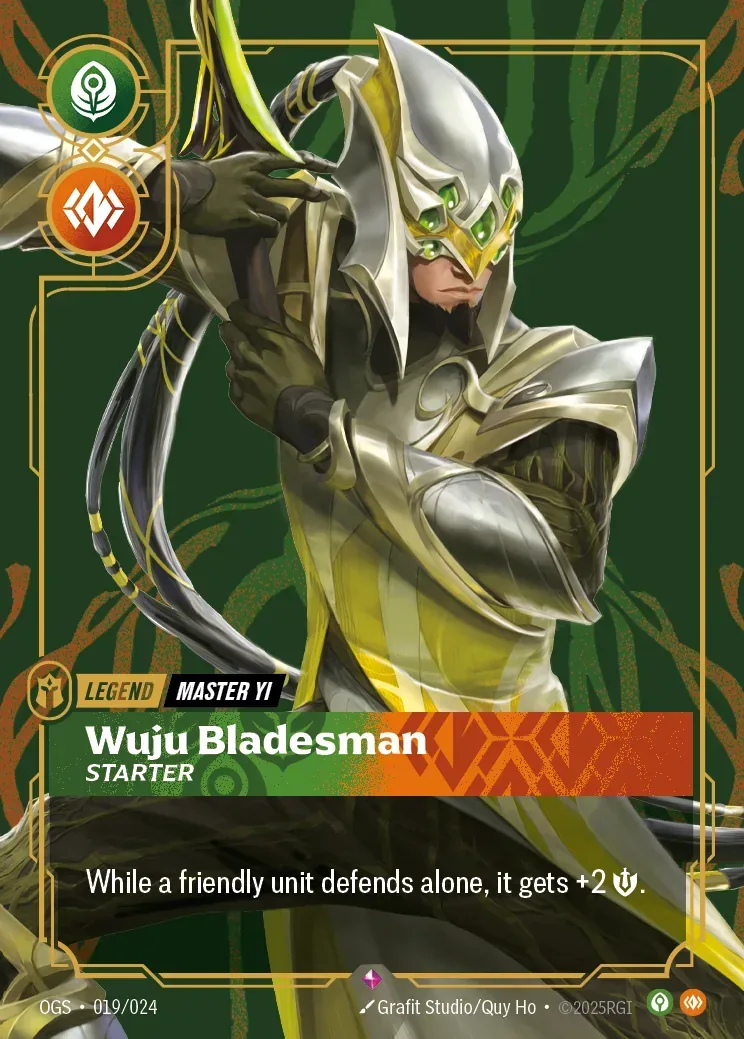 The official gallery shows OGS-019/024 as Wuju Bladesman with a STARTER label; Riot's ban notice calls it Master Yi, Wuju Bladesman.
Riot's reason was specific to team play. Master Yi's defensive bonus extended to a teammate, so the Legend supplied more starting stats than Riot considered healthy and appeared too often among top 2v2 teams. A 1v1 player should not treat the 2v2 line as a Standard ban. The Riftbound meta tier list and dated deck pages may still show Master Yi results because those records can come from 1v1 events.
September 18, 2026
| Entry | Type | Set and ID | Format and Riot's stated reason |
|---|---|---|---|
| Ekko, Recurrent | Champion Unit | Origins, OGN-110/298 | Standard and 2v2 Constructed. Riot cited the Lux infinite, limited interaction windows, and a solitaire-like play pattern. |
| Stacked Deck | Spell | Origins, OGN-183/298 | Standard and 2v2 Constructed. Its low-cost consistency became more powerful with Kennen and Lightning Rush, finding Nocturne while filling the trash for Rhasa the Sunderer and Last Rites. |
The September announcement was published September 15 and made both entries effective September 18. Riot said Ekko effectively grants an extra turn and recycles itself, which created infinites with too few windows for the opponent to interact. For Stacked Deck, Riot described the ban as targeted. The intent was to slow Kennen's engine and reduce consistency while leaving the core strategy playable.
Old lists need a date beside them. The Riftbound Kennen deck guide explains the pre-ban Stacked Deck and Lightning Rush line because it documents a dated strategy. A list from before September 18 is evidence of what a player used, not a legal decklist for a current sanctioned event. Remove the banned cards and recheck every replacement against the live Rules Hub.
Why Riot banned these Riftbound cards instead of restricting them
Riot's published ban philosophy uses three questions: whether a card is overrepresented in an unhealthy way, whether its problems are likely to worsen as the card pool grows, and whether it creates an unhealthy play pattern. The three announcements apply those questions differently. Miracle cards and Ekko raised time and interaction concerns, Draven and Stacked Deck raised power and consistency concerns, and several Battlefields changed incentives before a player even drew a card.
The thirteen entries affect three different parts of a game. A Main Deck ban removes a tool from every deck that could use it. A Battlefield ban changes the opening menu of locations for the whole table. The Master Yi ban changes only the team format. Keeping those categories separate makes Riot's decisions easier to follow.
There is no new restricted entry in the September update, and the live Rules Hub does not publish a separate restricted section. There is also no errata announcement in that update. Errata is a separate rules-text process, so a changed card text does not automatically mean a card is banned. Use Riot's current Rules Hub and errata archive when a printed card and the official text disagree.
How Radiance affects the Riftbound banned cards picture
Riot's Radiance overview confirms Pre-Rift events from October 16 through October 22, followed by a worldwide release on October 23, 2026. The article describes new mechanics including Deploy, Show Off, and Disarm, along with nine new Legends. Those facts do not answer whether any existing card will be unbanned or whether a new card will be banned.
For legality, the Rules Hub says all sets currently produced are legal in sanctioned tournaments, with rotation intended to begin in 2028. Radiance therefore enters the existing legal pool when it releases unless Riot publishes a separate legality announcement. As of this research pass, Riot has not announced a Radiance ban update, a next-ban date, or a rotation change tied to Set 5.
Players preparing for Pre-Rifts should check the Rules Hub again immediately before registering. That is a timing recommendation, not a prediction. The Radiance release date preview tracks the confirmed product window and is the better companion for set dates; this guide stays focused on legality.
GODEEPER: For the confirmed Radiance schedule, product scope, and preview window, see the Riftbound Radiance Release Date Preview →
Step-by-Step: check a Riftbound deck against the banlist
1. Identify the format before checking cards. Decide whether the event is Standard Constructed or Constructed 2v2. The 2v2 list includes all Standard entries plus Master Yi, Wuju Bladesman, so the same deck can be legal in one format and illegal in the other.
2. Separate the Legend, Main Deck, and Battlefields. Look at the one Legend first, then the 40-card Main Deck, then the three Battlefields. This prevents a banned location from being missed because it is not mixed into the main card list.
3. Compare names and collector IDs with the official Rules Hub and gallery. Use the printed set code and number when a decklist site has multiple versions of a card. A card's art treatment can change, but the official legality entry is keyed to the named card.
4. Check the effective date against the event date. A future announcement is not the same as a current ban. For the present list, March 31, July 24, and September 18 are the relevant effective dates. A sanctioned event on or after those dates must use the corresponding list.
5. Replace illegal entries, then run the check again. Do not assume that removing one banned card makes the rest of a copied list current. Old decklists can also use a banned Battlefield or a card from a different rules snapshot. Recheck the complete list after every replacement.
6. Ask the organizer about low-level preconstructed exceptions. Riot's tournament rules describe an exception for the exact configuration of a preconstructed product at low organized-play levels. If you change that decklist, the exception no longer applies. A casual kitchen-table game can use house rules, but that is separate from sanctioned legality.
Tips for using the Riftbound banlist before an event
Keep a dated copy of any decklist you test. That small habit makes it obvious whether a high finish happened before September 18 and whether it includes Stacked Deck or Ekko, Recurrent. The same approach helps with Master Yi because a decklist from a 1v1 Regional is not evidence of 2v2 legality.
When you tune a post-ban Kennen list, replace the role rather than the card name. Stacked Deck provided cheap selection and trash setup. A replacement that only draws one card may preserve hand flow but fail to fill the trash for the same payoff. Riot said the strategy should remain intact with lower consistency, so test the full sequence instead of treating the ban as a one-for-one swap.
For Battlefield choices, look at the first-player question. The July bans removed two point locations because they made the opening choice too deterministic. If a new Battlefield appears in Radiance previews, evaluate its incentive in the actual format rather than assuming it is legal or illegal from its text alone. The Rules Hub is the authority.
Finally, avoid making win-rate claims from a banlist alone. Riot referenced tournament monitoring in its announcements, but the official ban pages do not publish a complete numerical dataset for every card. The site's current Riftbound meta tier list is useful for dated competitive context, while the official legality page should decide what you can register.
Frequently Asked Questions
Which cards are banned in Riftbound Standard Constructed?
The current Standard list has seven cards: Called Shot, Draven, Vanquisher, Fight or Flight, Scrapheap, Stealthy Pursuer, Ekko, Recurrent, and Stacked Deck. Riot also bans five Battlefields, but those are a separate category. Check the official Rules Hub for the live list before every sanctioned event.
When did Ekko and Stacked Deck become banned?
Riot announced both bans on September 15, 2026, with an effective date of September 18. Ekko was targeted for the Lux infinite and limited interaction windows. Stacked Deck was targeted because its consistency compounded Kennen's Chaos engine, especially alongside Lightning Rush, Nocturne, Rhasa the Sunderer, and Last Rites.
Is Master Yi banned in Riftbound?
Master Yi, Wuju Bladesman is banned only in Constructed 2v2, effective July 24, 2026. Riot said the defensive bonus also benefited an ally and had become too common among top teams. The Legend remains legal in 1v1 Standard Constructed under the current Rules Hub.
Does Riftbound have a restricted list?
The live Rules Hub does not show a separate restricted category, and the September update added bans rather than one-copy restrictions. Riot's first ban announcement explained that restricting a problem can make games more dependent on who draws a lone copy. Future policy can change, so treat the Rules Hub as the current authority.
Will Radiance change the Riftbound banlist?
Radiance Pre-Rift events run October 16 through October 22, and the worldwide release is October 23, 2026. Riot has not announced a Radiance ban change or a next-ban date. The Rules Hub also says rotation is intended to begin in 2028, so Radiance does not automatically rotate earlier sets.
Can I use a banned card at a casual Riftbound event?
Sanctioned Constructed events use the published format list. Riot's tournament rules allow an exact preconstructed deck configuration to retain banned cards at low organized-play levels, but changing that configuration removes the exception. Ask the organizer whether the event is casual, sanctioned, Standard, or 2v2 before submitting a list.
Related Reading
- Riftbound Domains Explained: Review Domain Identity and Rune Deck legality before rebuilding a list after a ban.
- Riftbound Card Values Price Guide: See how the site's dated card-value coverage separates market information from competitive legality.
- Riftbound Vendetta Set Guide: Revisit the current set context behind the Vendetta-era bans and deck choices.
References
- Riftbound Rules Hub, current Constructed and 2v2 legality
- Riot's first Riftbound bans, effective March 31, 2026
- Riot's July ban update, effective July 24, 2026
- Riot's September ban update, effective September 18, 2026
- Official Riftbound card gallery
- The Radiance Overview, official release and Pre-Rift dates
- Riot's Riftbound Tournament Rules
Was this guide helpful?
About the author
Competitive TCG Analyst
Competitive One Piece TCG player and deck builder with 3 years of tournament experience. Covers meta analysis, tier lists, and leader builds.
- 3 years competitive OPTCG tournament experience
- Regional top 8 finisher
- Deck builder and meta analyst
- Covers every set since OP-01
Keep reading
Riftbound Rek'Sai Deck Guide: Fury Order Tunnels 2026
Guides · 12 min
Riftbound Vex Deck Guide: Gloomist Control Build 2026
Guides · 15 min
Riftbound Fiora Deck Guide: Grand Duelist Build 2026
Guides · 16 min
Riftbound Azir Deck Guide: Emperor of the Sands Build
Guides · 13 min
Riftbound Ornn Deck Guide: Fire Below the Mountain
Guides · 13 min
Riftbound Domains Explained: All Six Colors and Deck Roles
Guides · 9 min
Riftbound Akali Deck Guide: Rogue Assassin Vendetta Plan
Guides · 14 min
Riftbound Irelia Deck Guide: Blade Dancer Vendetta Plan
Guides · 14 min
Disclaimer
This article is published for informational and entertainment purposes. It does not constitute professional financial, legal, or technical advice. Game performance, online services, patch schedules, and store listings change. Verify critical details (pricing, system requirements, regional availability) with publishers and storefronts before you buy. Affiliate links, where present, help support our editorial work and are labelled in our affiliate disclosure.