

Shonen TCG · Guides
Riftbound Master Yi Deck Guide: Tier 1 After the Bans
Master Yi still converts better than the field after the bans. We priced SWAGALISK's Los Angeles Top 8 list at $205.57 and ran the draw odds.
Our callPlay it. Build the Los Angeles Top 8 list, and plan your games around the Legend's +2 Might, not around drawing Zhonya's Hourglass.
The Riftbound Master Yi deck is still Tier 1 after the September 18 bans, and the numbers back it up. riftbound.gg's post-ban report has Master Yi, Wuju Bladesman at 2 wins and 15 top cuts in third-party events, and at RQ Los Angeles 22.7% of its pilots made Day 2 against 18.9% for the whole field. We'd build SWAGALISK's Los Angeles Top 8 list. It cost $205.57 on TCGplayer when we priced it, and three cards make up 78.8% of that.

How we checked this: on October 13, 2026 we read Riot's Los Angeles recap and Rules Hub, the Core Rules (updated October 9), riftbound.gg's tier list and the card text for every card in the list, priced each card at TCGplayer market, and ran draw odds for the list with the official mulligan.
Updated October 13, 2026: We added the full Los Angeles Top 8 list with prices, Day 2 conversion numbers and draw odds. We also fixed two errors: Master Yi, Tempered doesn't "guarantee an early curve" (it costs 4 and starts in your Champion Zone), and Master Yi, Wuju Master is a separate Legend, not a non-Legend print.
Riftbound Master Yi deck results after the bans
riftbound.gg's tier list, updated October 6, puts two Legends in Tier 1: Irelia and Master Yi, Wuju Bladesman. Master Yi's line reads "2 Wins / 15 Top cuts" and "Top 8 at Los Angeles RQ." The report notes that many expected Master Yi to lose a step after the bans, then concludes that "this remains a very competitive legend."
Riot's Los Angeles recap gives the raw numbers. Master Yi, Wuju Bladesman had 75 players on Day 1 (3.8% of the field) and 17 on Day 2 (4.6%). We added up the recap's table: 1,962 Day 1 players and 371 Day 2 players, so the field converted at 18.9% and Master Yi at 22.7%. It was the ninth most played Legend on Day 1 and still beat the field's conversion rate.
The Top 8, per Riot, was "2 Irelia, 2 Azir, 1 Master YI, Wuju Bladesman, 1 Akali, 1 Ornn, and 1 Rengar." The Master Yi in it was SWAGALISK, listed at Overall Ranking #6. That follows a win in June, when Riot wrote that "RQ Hartford saw Master Yi, Wuju Bladesman, finally victorious after making Top 8 in the previous two Regional Qualifiers."
One legality note: Riot's Rules Hub lists Master Yi, Wuju Bladesman as banned in 2v2 Constructed (last updated September 18). It's legal in Standard.
What the Legend actually does
The Legend has one line of text: "While a friendly unit defends alone, it gets +2 Might." That's the whole engine. Players on r/RiftboundTCG point out that combat "typically happens on a 1:1 basis," so a lone defender that's 2 Might bigger wins fights it has no business winning. The same player explained the card choices: "orange has a bunch of ambush tools that work well with Yi’s passive. Rengar in particular surprise defense for 8." Rengar, Trophy Hunter has 6 Might and Ambush, so it can drop in as a reaction and defend at 8.
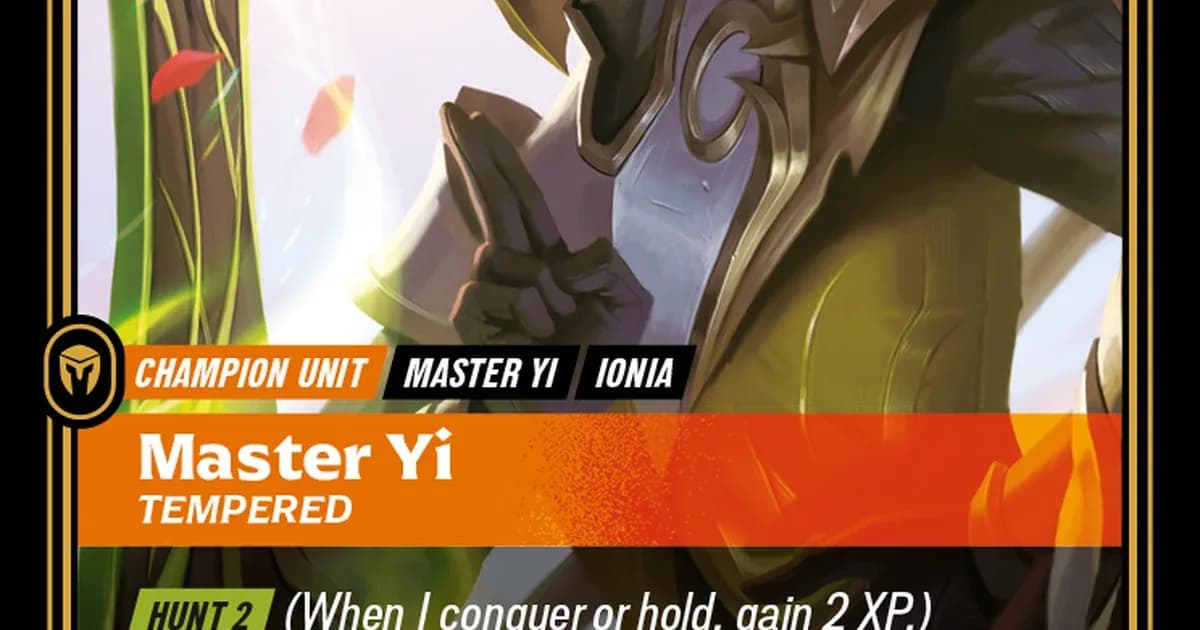
 Image: TCGplayer product image, Master Yi, Tempered (Unleashed)
The Chosen Champion is Master Yi, Tempered. It costs 4 energy, has 4 Might and Hunt 2, and at Level 6 gains Deflect and Ganking. Our older version said it "guarantees an early curve." That's wrong. What it guarantees is access: the Core Rules put your Chosen Champion in the Champion Zone at the start of the game, and it "can be played from here as normal." You'll always have a 4-drop, but it isn't an early play.
The Riftbound Master Yi deck list we'd play
This is SWAGALISK's Top 8 list from Riot's recap, 40 cards with the Champion, priced on October 13 at the cheapest TCGplayer printing of each card:
| Card | Copies | Role |
|---|---|---|
| Master Yi, Wuju Bladesman (Legend) | 1 | Calm and Body |
| Master Yi, Tempered (Chosen Champion) | 1 | Body |
| Rengar, Trophy Hunter | 3 | Ambush defender |
| Charm, Defy, Discipline, Punch First, Sabotage, Scuttle Crab, First Mate, Pit Rookie | 3 each | Core |
| En Garde, Lonely Poro, Rampage, Zhonya's Hourglass | 2 each | Support |
| Akali, Silent; Legion Marauder; Onslaught; Ruin Runner | 1 each | Flex |
| Battlefields: Emperor's Dais, Seat of Power, Star Spring | 1 each | |
| Runes | 7 Body, 5 Calm |
The sideboard was Alpha Strike, Decree of Focus, 2 Decree of Strength, 3 Disarming Rake, Repulse, Ruin Runner and Unyielding Spirit.
Where the money goes: three Rengar at $29.11 each ($87.33), three Sabotage at $13.51 and two Zhonya's Hourglass at $17.09 come to $162.04, which is 78.8% of the $205.57 total. Everything else costs $43.53. The Legend's starter print is $16.50. If you're on a budget, those three cards are the ones to borrow first.
Don't plan around Zhonya's Hourglass
We ran the odds with the official setup: draw 4, then set aside up to two cards and redraw (Core Rules 116 and 117), from a 39-card library because the Champion starts outside it. With the best mulligan for each card:
- Zhonya's Hourglass (2 copies): in hand after the mulligan 28.7% of the time, 37.4% after two more draws.
- Charm or Rampage (5 copies): 58.7% after the mulligan, 70.5% after two draws.
Put the other way, in 62.6% of games you still haven't drawn the Hourglass after two draws. That's fine, because the deck doesn't need it. The +2 Might is always on. Spend your early turns putting one unit where it'll defend alone, and treat Zhonya's Hourglass and Charm as bonuses when they show up.
 Image: TCGplayer product image, Zhonya's Hourglass (Origins)
Lion Roar Gamer's video covers Master Yi's Vendetta upgrades:
Buying the right Master Yi
There are two Master Yi Legends, and they aren't the same deck. Master Yi, Wuju Master (Unleashed 191/219) is the other one: "Your units have +1 Might" at Level 6 and "Your units enter ready" at Level 11. It sells for $0.18, had 22 players in Los Angeles with 2 reaching Day 2, and riftbound.gg puts it in Tier 5. Make sure the card in your cart says Wuju Bladesman.
For the Bladesman itself, the October 13 TCGplayer prices were $16.50 for the Proving Grounds starter print and $39.53 for the Organized Play promo. The Metal prints are trophies: the Prize Wall Metal at $2,222.91 and the Best Of Metal at $1,581.58. Riot also stopped offering Best Of prizes for Origins and Proving Grounds Legends when Vendetta arrived, and Wuju Bladesman is a Proving Grounds Legend.
 Image: TCGplayer product image, Rengar, Trophy Hunter (Unleashed)
Our take
The Riftbound Master Yi deck is the easiest Tier 1 deck to pick up, and Los Angeles showed it still beats the field after the bans. We'd buy the Los Angeles list, borrow Rengar if $87 is too much, and practice one thing: making the opponent attack into a lone defender. Another player summed up the matchup math: "the matchup is more Yi favoured the worse the players are." Against strong pilots it's closer, so your sideboard matters more than at a local event.
Frequently Asked Questions
Is the Riftbound Master Yi deck still good in the Vendetta meta? Yes. It's Tier 1 on riftbound.gg with 2 wins and 15 top cuts, and 22.7% of its Los Angeles pilots made Day 2 against 18.9% for the field.
What domains does the Riftbound Master Yi deck use? Calm and Body. The Top 8 list ran 7 Body Runes and 5 Calm Runes.
Is the Riftbound Master Yi deck a combo deck? No. The Legend gives a lone defender +2 Might, and the deck wins fights one unit at a time.
What cards define the Riftbound Master Yi deck's game plan? Master Yi, Tempered as Chosen Champion, three Rengar, Trophy Hunter, Charm and Rampage for fights, and Sabotage and Zhonya's Hourglass for disruption and protection.
How much does the Master Yi Legend card cost? $16.50 for the starter print and $39.53 for the promo on October 13, 2026. The Metal prints sell for $1,581.58 and $2,222.91.
Is there a full Riftbound Master Yi decklist available? Yes. The Los Angeles Top 8 list is above, priced at $205.57.
Related Reading
- Riftbound Meta Tier List: Every Legend Ranked: where Master Yi sits next to every other Legend.
- Riftbound Kennen Deck Guide: the combo deck Master Yi trailed before the bans.
- Riftbound Azir deck guide: Azir put two decks in the Los Angeles Top 8.
- Riftbound Fiora deck guide: another combat-focused shell built on Might thresholds.
- How to Play Riftbound: Full Beginner Rules Guide 2026: start here if you're still learning the turn structure and domains.
Was this guide helpful?
About the author
Deck guides and meta
Pen name for the Shonen TCG desk's One Piece TCG deck guides, tier lists and meta reports.
- Lists averaged from public tournament results, sample size stated
- Card text quoted from Bandai's official card list
- Opinions marked as ours, with the reason
Keep reading

Riftbound Rengar Deck Guide: Won Los Angeles, Now Tier 2
Guides · 15 min

Riftbound Vendetta Set Guide: Legends, Mechanics, Release
Guides · 11 min
Riftbound Card Values: Chase Promos to Playable Prints
Guides · 13 min

Riftbound Radiance Release Date: Products, Prices, Card List
News · 6 min
Riftbound vs One Piece TCG vs Lorcana: Full 2026 Comparison
Guides · 14 min

Riftbound Guide 2026: How to Play, Domains, Deck Building
Guides · 17 min
How to Play Riftbound: Full Beginner Rules Guide 2026
Guides · 13 min
Riftbound Meta Tier List: Irelia, Master Yi Lead Post-Ban
Guides · 15 min
Disclaimer
This article is published for informational and entertainment purposes. It does not constitute professional financial, legal, or technical advice. Game performance, online services, patch schedules, and store listings change. Verify critical details (pricing, system requirements, regional availability) with publishers and storefronts before you buy. Affiliate links, where present, help support our editorial work and are labelled in our affiliate disclosure.