

Shonen TCG · Guides
Riftbound vs One Piece TCG vs Lorcana: Full 2026 Comparison
Three games, three different clocks. Pick the one whose turn you'd enjoy taking a thousand times.
Our callLorcana if you've never played a TCG, One Piece TCG for fast games with no resource screw, Riftbound for the deepest board fight. All three ship a new main set roughly every three months.
Riftbound vs One Piece TCG vs Lorcana really comes down to how you want a game to end. One Piece TCG is a race: burn through your opponent's Life cards, then land one more hit. Lorcana is a straight sprint for lore with one deck and one resource. Riftbound is a fight over Battlefields where the last point is the hardest one to get. We'd hand Lorcana to someone who has never shuffled a deck, One Piece to anyone who wants short, tense games, and Riftbound to players coming from Magic or League who want more decisions per turn.
Updated October 19, 2026: rewritten against each game's current rulebook. We fixed the One Piece deck line (the old table's card counts didn't add up), corrected starting Life (it's your Leader's Life value, not a flat five), fixed who gets one DON!! on turn one, removed a first-person claim we can't back up, and dropped tier-list results that had gone stale. Sets and prices are dated October 19, the week before Riftbound's Radiance and Lorcana's Hyperia City release.
Riftbound vs One Piece TCG vs Lorcana: which one to pick
- Never played a TCG: Lorcana. Your resource comes out of your own hand, there's no leader card to build around, and the score is a single lore total, so it's always obvious who's ahead.
- You want quick games and hate mana screw: One Piece TCG. DON!! comes from its own deck on a fixed schedule, so you always know what next turn looks like. The skill is in how you spend it.
- You come from Magic or League and want the most decisions per turn: Riftbound. Two decks, two kinds of cost, and a scoring rule that rewards holding the board over racing.
- You mostly want to collect: pick the world you love. Booster-box prices below differ a lot, and that matters more to a collector than any rule.
Side-by-side comparison (October 19, 2026)
| Riftbound | One Piece TCG | Disney Lorcana | |
|---|---|---|---|
| Publisher | Riot Games | Bandai | Ravensburger |
| First English set (TCGplayer date) | Origins, Oct 31, 2025 | Romance Dawn (OP-01), Dec 2, 2022 | The First Chapter, Aug 18, 2023 |
| What you bring | 1 Champion Legend, a Main Deck of at least 40 (Chosen Champion included), a 12-card Rune Deck, 3 Battlefields | 1 Leader, a 50-card deck, a 10-card DON!! deck | A deck of at least 60 |
| Copies per card | Up to 3 | Up to 4 | Up to 4 |
| Color limit | The Legend's Domains (six exist) | The Leader's colors (six exist) | Up to two of six inks |
| Resource | Channel 2 runes a turn from the Rune Deck | 2 DON!! a turn from the DON!! deck | Ink 1 card from hand a turn |
| You win by | Reaching 8 points from Battlefields | Damaging the Leader when its owner has 0 Life cards | Reaching 20 lore |
| Starting Life | None (points start at zero) | Your Leader's Life value | None (lore starts at zero) |
| Current set | Vendetta; Radiance out Oct 23 (Pre-Rifts Oct 16-22) | OP-17 The World's Strongest Warriors (Aug 28); OP-18 due Nov 20 | Attack of the Vine!; Hyperia City everywhere Oct 23 (prerelease Oct 16) |
| Rules checked | Core Rules, updated Oct 9, 2026 | Comprehensive Rules 1.2.1 (Aug 28, 2026) | Comprehensive Rules 2.0.1 (Feb 5, 2026) |
Resources: runes vs DON!! vs ink
This is where the three games feel most different turn to turn. Here's how much each one gives you by your sixth turn, assuming you never recycle a rune in Riftbound and ink every turn in Lorcana:
| Your turn | 1 | 2 | 3 | 4 | 5 | 6 |
|---|---|---|---|---|---|---|
| One Piece, going first | 1 | 3 | 5 | 7 | 9 | 10 |
| One Piece, going second | 2 | 4 | 6 | 8 | 10 | 10 |
| Riftbound, going first | 2 | 4 | 6 | 8 | 10 | 12 |
| Riftbound, going second | 3 | 5 | 7 | 9 | 11 | 12 |
| Lorcana, either seat | 1 | 2 | 3 | 4 | 5 | 6 |
Riftbound. Your runes sit in a separate Rune Deck, and you channel two every turn; the player going second channels one extra on their first turn. A rune pays two ways: exhaust it for Energy, which covers the number in a card's cost, or recycle it back into the Rune Deck for Power of its Domain, which covers the colored part. That second option is the catch. Paying a colored cost shrinks your board of runes for later turns, so real games run below the table. It's the closest of the three to a land base, with a built-in tax on greedy colored turns. Our Riftbound beginner rules guide walks through a full first game.
One Piece TCG. DON!! comes from a 10-card DON!! deck that's never shuffled into anything. You add two a turn, except the player going first, who gets only one on their first turn. Every DON!! does double duty: rest it to pay a cost, or give it to your Leader or a Character for +1000 power during your turn. There's no variance in what you get, so the whole game is about spending it well. The One Piece TCG rules breakdown covers DON!! timing and the Counter step in detail.
Lorcana. Once a turn you can put one card with the inkwell symbol from your hand into your inkwell, facedown. That card is now ink for the rest of the game, not a card you'll play. So every Lorcana deck is a balance between inkable cards and the cards you actually want to cast, and a hand of uninkable bombs on turn two is the Lorcana version of mana screw. Our Lorcana beginner guide has the full turn order.
How each game ends
Riftbound: hold the map. You score a Battlefield by conquering it (taking control of it) or holding it (still controlling it at the start of your turn), and you can score each Battlefield only once a turn. First to eight wins. The last point has a guard on it: if you're one point away and conquer a Battlefield, you only get the point if you've scored every Battlefield that turn. Otherwise you draw a card instead. In a 1v1 game each player brings three Battlefields and uses one, so two are in play. You can't steal the game with one lucky fight; you have to own the board. That's why Riftbound plays slower and why a lone aggressive turn rarely closes it.
One Piece TCG: race the Life cards. At the start of the game you put cards face-down into your Life area equal to the Life value printed on your Leader, and effects can push it higher. Each point of damage to your Leader moves your top Life card into your hand. You lose when your Leader takes damage with no Life cards left, or when your deck runs out. The neat part: getting hit refills your hand, so the player who's behind usually has cards to defend with. Games swing hard.
Lorcana: count to the finish. Characters quest to gain lore equal to their lore value, and the first player to 20 lore wins. Challenges deal damage, a character with damage equal to its Willpower is banished, and you also lose if your turn ends with an empty deck. It's the most linear of the three: you're counting to a number, not defending ground or protecting a life total.
Sets and what a booster box costs
All three keep a steady schedule. In the twelve months up to this month's releases each has put out five main sets, with gaps of about ten to sixteen weeks; One Piece runs the tightest, every ten to twelve weeks. The next ones are close together: Riftbound's Radiance set preview and Lorcana's Hyperia City preview both land on October 23, and OP-18 The Dominance of God follows on November 20.
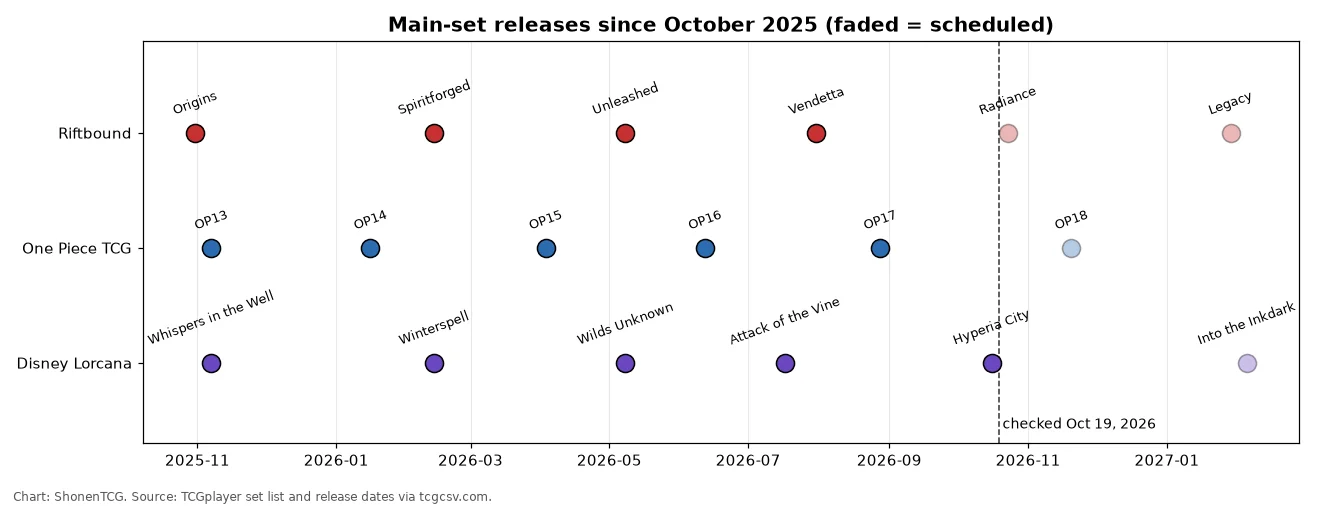 Chart: ShonenTCG. Source: TCGplayer set list and release dates via tcgcsv.com, checked October 19, 2026. TCGplayer dates Hyperia City from its October 16 prerelease.
If you're buying in, sealed product is where the games split. On October 19 a Vendetta booster display sold for about $136 on TCGplayer, an Attack of the Vine! box about $192, and an OP-17 box about $307. Preorders follow the same order: Radiance at about $143, Hyperia City at about $183, OP-18 already about $355. Boxes don't hold the same number or size of packs, so this isn't a price per card. It does tell you One Piece sealed is the expensive habit right now.
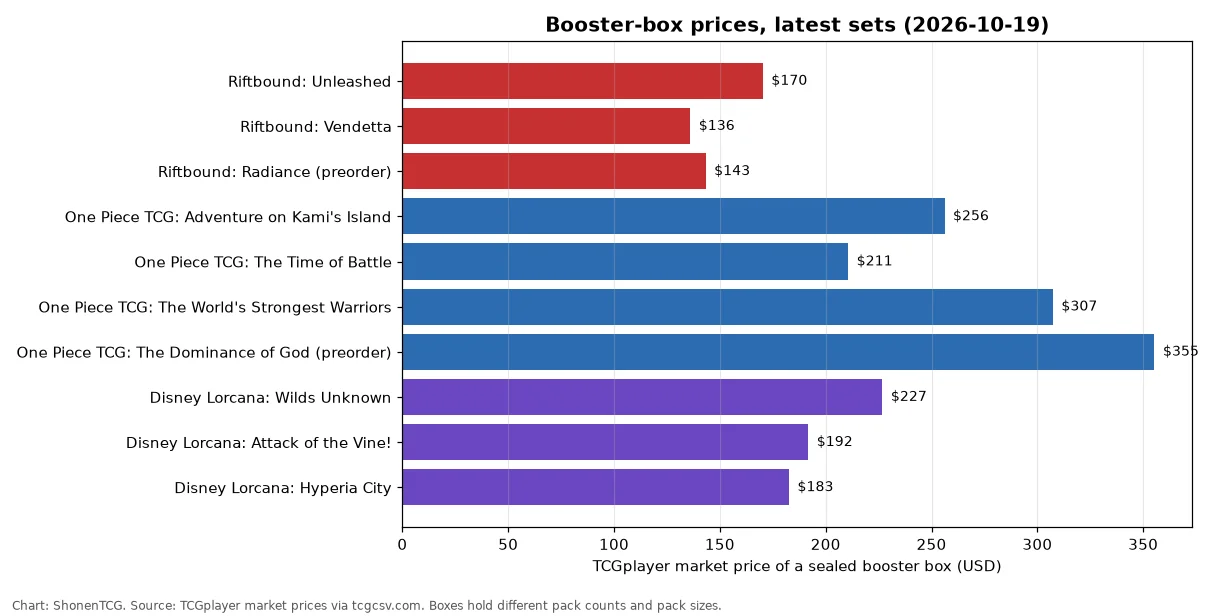 Chart: ShonenTCG. Source: TCGplayer market prices via tcgcsv.com, October 19, 2026.
What players who play more than one say
A July thread on r/Riftbound asked exactly this question for Riftbound against Lorcana, and the players who play both split them by mood rather than quality. u/heysteb put it plainly: "Riftbound is a super complex high skill cap game. Sometimes I just want to play a non-sweaty casual game and Lorcana fills that need for me." u/ringthree pushed back on the idea that Lorcana is shallow: "Riftbound has more moment to moment considered gameplay, and more flexibility based on deck building and draws," while Lorcana, in the same comment, has "more strategic decisions and wait vs. go considerations."
For a quick look at all three side by side, SuperDuper HENG's round-up gives each one its own chapter:
When the other game wins
- Riftbound over One Piece if you want the board to matter more than the burst turn. The Final Point rule means you can't win off one big swing.
- One Piece over Riftbound if you want fewer rules to learn and a resource you can plan around exactly. Two decks and two kinds of cost is a lot for a first card game.
- Lorcana over both if you're teaching a friend or a kid, or you want a game you can play while chatting. You'll still find depth in the inkable-versus-playable choice.
- One Piece or Riftbound over Lorcana if you like your deck built around one card. Lorcana has no Leader or Legend; you're choosing two inks, not a commander.
Our take
If you can only pick one, we'd start with One Piece TCG: the rules are short, the resource is predictable, and the Life-to-hand rule keeps games close. Pick Lorcana instead if nobody at your table has played a card game before, and save Riftbound for when you want a second game that asks more of you every turn. Skip buying sealed to "get started" in any of them; a starter deck and a few singles will teach you more than a box.
How we checked this: on October 19, 2026 we read the deck-building, resource and win rules in all three current rulebooks, worked out the resource table from them, and pulled TCGplayer's set list and booster-box prices with a script.
Related Reading
- Riftbound Complete Guide 2026: every set, Legend and format in one place.
- Disney Lorcana vs Magic vs One Piece TCG: the same question with Magic as the fourth option.
References
- Riftbound Core Rules, last updated October 9, 2026 (Riot Games)
- ONE PIECE CARD GAME Comprehensive Rules 1.2.1 (Bandai)
- Disney Lorcana Comprehensive Rules 2.0.1 (Ravensburger)
- The Radiance Overview (Riot Games)
- OP-17 product page and OP-18 product page (Bandai)
- Hyperia City product page (Ravensburger)
- TCGplayer set lists and prices via tcgcsv.com
About the author
Pen name for the Shonen TCG desk's tournament coverage, format analysis and cross-game comparisons.
- Results taken from event pages and standings
- Other games checked against their own official rules
- Opinions marked as ours, with the reason
Keep reading
Riftbound Radiance Release Date: Products, Prices, Card List
News · 6 min
Riftbound Card Values: Chase Promos to Playable Prints
Guides · 13 min
Riftbound Vendetta Set Guide: Legends, Mechanics, Release
Guides · 11 min
Riftbound Rengar Deck Guide: Won Los Angeles, Now Tier 2
Guides · 15 min
Riftbound Guide 2026: How to Play, Domains, Deck Building
Guides · 17 min
How to Play Riftbound: Full Beginner Rules Guide 2026
Guides · 13 min
Riftbound Meta Tier List: Irelia, Master Yi Lead Post-Ban
Guides · 15 min
Riftbound Master Yi Deck Guide: Tier 1 After the Bans
Guides · 8 min
Disclaimer
This article is published for informational and entertainment purposes. It does not constitute professional financial, legal, or technical advice. Game performance, online services, patch schedules, and store listings change. Verify critical details (pricing, system requirements, regional availability) with publishers and storefronts before you buy. Affiliate links, where present, help support our editorial work and are labelled in our affiliate disclosure.