

Shonen TCG · Guides
Riftbound Guide 2026: How to Play, Domains, Deck Building
Riftbound guide 2026: Riot's League of Legends TCG explained. Rules, all six Domains, deck building, the live Vendetta set, and the post-ban meta.
Riftbound is Riot Games' first physical trading card game, built directly on the League of Legends universe, and this Riftbound guide walks through everything a new player needs in one place: the rules, all six Domains, deck building, the live Vendetta set, and where the competitive meta stands after the September 18 bans. Unlike most of the card games covered on this site, Riftbound isn't anime. It's still worth a serious look because of how fast the competitive scene has grown and because Riot has already locked in a multi-year set roadmap.
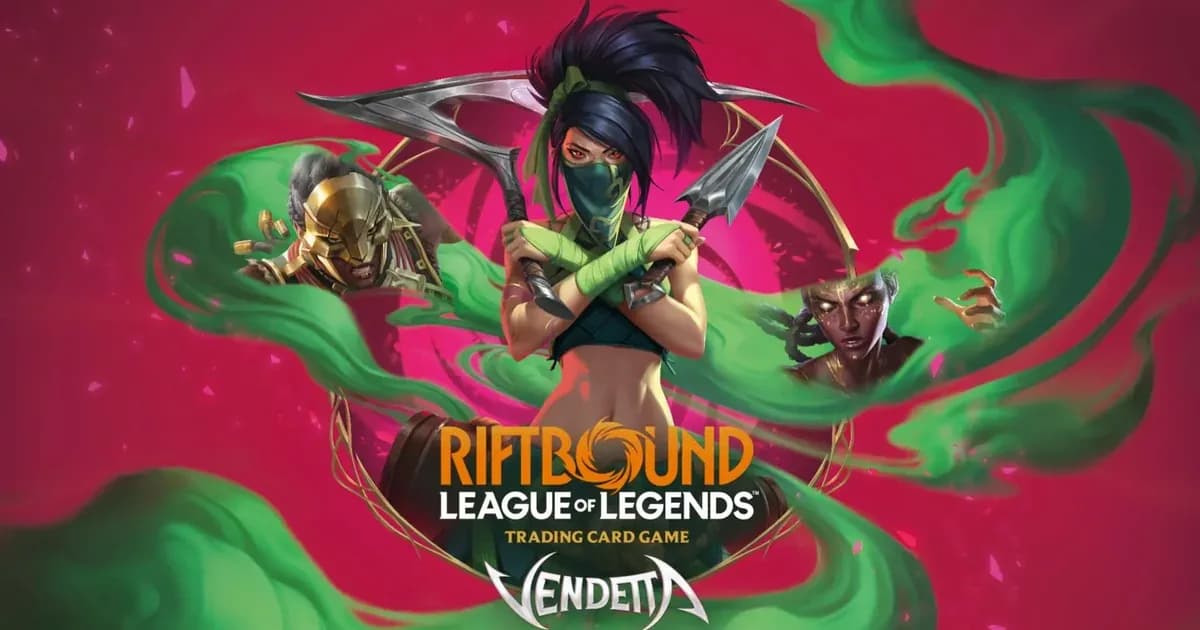
TL;DR: Riftbound is Riot Games' first physical TCG, set in the League of Legends universe and built around two-Domain Legend decks. You win by reaching 8 points, scored by conquering or holding Battlefields. A legal deck runs 1 Legend, 40 Main Deck cards, 12 Rune Deck cards, and 3 Battlefields (56 cards total). The current set is Vendetta (released July 31, 2026, the 4th main set). In the post-ban snapshot covering September 25 through October 1, riftbound.gg labels Irelia and Master Yi Tier 1, while Riot's Los Angeles recap records a Rengar win. Set 5, Radiance, ships October 23, 2026.
Updated October 5, 2026: The current meta section now uses riftbound.gg's October 3 post-ban report and Riot's September 30 Los Angeles recap. The older Barcelona and pre-ban aggregate numbers remain only as dated historical context. Radiance details are limited to Riot's published overview, with no strength predictions for unreleased cards.
What is Riftbound?
Riftbound comes from Riot Games, the studio behind League of Legends, and it's the company's first attempt at a physical, tournament-supported trading card game. The game released in 2025 and pulls its cast, its factions, and its visual identity straight from the League of Legends universe. Champions like Kennen, Master Yi, and Ornn appear as playable Legends, each locked to two of the game's six Domains.
Two players (the game also supports 3 and 4-player modes, with extra Battlefields added to the board) each build a 56-card deck around a single Legend and race to outscore each other across a shared board of Battlefields, rather than attacking a life total directly. That structural choice, contesting territory instead of draining health, is the single biggest thing that separates Riftbound from most of the card games covered on this site.
Riftbound isn't an anime property, and it doesn't try to be. It sits in our coverage alongside games like the best anime TCGs worth playing in 2026 because the overlap in players is real even when the source material isn't. Same collectors chasing rare pulls. Same local game stores running weekly events. A lot of the deckbuilding instincts carry over too, if you already play a two-color, two-resource card game, most of what follows will feel familiar fast.
Note: Riftbound is not licensed anime content. It's a Riot Games property built on League of Legends. We cover it here because it shares an audience and a competitive infrastructure with the anime TCGs on this site, not because it fits the anime label itself.
How to Play Riftbound
The core loop is short enough to learn in one game, even if the depth takes longer to master.
The win condition. First to 8 points wins. You score by conquering a Battlefield (winning a fight there) or by holding a Battlefield you already control at the start of your turn, worth 1 point each and capped at 1 point per Battlefield per turn. There's a wrinkle worth knowing before your first match: you generally can't score your eighth and final point from a conquer unless you also scored from every other Battlefield that same turn. In practice, the last point almost always comes from holding a Battlefield you already own, not from one dramatic final conquest.
Deck construction. A legal deck needs exactly 1 Legend (your commander, sitting in the Legend Zone all game), 40 Main Deck cards (up to 3 copies of any card by name, including at least 1 Champion Unit matching your Legend), 12 Rune Deck cards that match your Legend's two Domains, and 3 Battlefield cards. Add it up and a full deck is 56 cards. Signature Cards, tied to a specific Legend, are capped at 3 total per deck no matter how many different Signatures you'd like to run.
Turn structure. Every turn follows the same four-letter shorthand players use: ABCD. Here's the sequence: 1) Awaken, untap and ready everything you control; 2) Beginning, score a point for every Battlefield you're currently holding, channel 2 Runes from your Rune Deck into play (3 if you're going second on turn 1, to offset the draw disadvantage), then draw 1 card; 3) the Action Phase, where you actually play cards, move units, and start fights. This is where games are actually won or lost, and there's no formal fourth phase in practice, the turn just ends once you pass.
Most cards have an Energy cost, paid by exhausting (tapping) that many ready Runes, and some also carry a Power cost underneath, paid by Recycling, putting Runes of the matching Domain type on the bottom of your Rune Deck instead of simply tapping them. A single Rune can pay both costs at once if its Domain matches. Units are measured by one Might stat that does double duty as attack and health, and every unit enters play Exhausted, so it can't act the turn it's played.
Moving a unit into a Battlefield your opponent already occupies starts a Showdown. Both players get a chance to respond with Action Spells, then combat resolves in order: the attacker's total Might deals damage to a defending unit of the attacker's choice, with overflow carrying to the next unit in line; surviving defenders deal their Might back; and if only the attacker has units left standing, they conquer the Battlefield and score. Reactions add a layer most new players don't expect. A Reaction card resolves before whatever it's responding to, not after, so a well-timed Reaction can undo a buff spell before it ever lands on the board. Riftbound's own beginner materials use exactly that scenario, a movement or disruption effect fired in response to a buff spell, to teach the timing.
Gear enters play ready, no Exhausted turn-in penalty, and usually sits at your Base providing an ongoing effect. A Gear subtype called a Seal can pay a Power cost for free once it's in play, by exhausting the Seal itself instead of Recycling a Rune. Some Legends also carry an Exhaust-cost ability usable during your own Action Phase, though notably not during an active Showdown. To start the game, you draw 4 cards, and you may set aside up to 2 of them and redraw once before play begins.
Domains Explained
Every card in Riftbound belongs to one of six Domains, and your Legend locks you into exactly two of them for the whole match. That two-Domain restriction is Riftbound's version of the two-color deckbuilding constraint you'll recognize from other card games, close in spirit to how Disney Lorcana restricts a deck to two of its six inks, just reskinned around League of Legends' own color language.
| Domain | Color | Identity |
|---|---|---|
| Fury | Red | The most aggressive Domain in the game, built around fast damage and pressure |
| Calm | Green | Movement and Showdown dominance, out-positioning opponents instead of out-punching them |
| Mind | Blue | Deep spellcasting options, the natural home for combo-oriented decks |
| Body | Orange | Large units in limited numbers, with a strong Rune-recycling subtheme |
| Chaos | Purple | Spells, mobility, and disruption mixed together |
| Order | Yellow | Board control and defensive staying power |
Fury and Calm sit opposite each other on the Domain wheel, as do Mind and Body, and Chaos and Order, but a Legend's two Domains don't have to come from opposite ends of it. Kennen, Heart of the Tempest, pairs Order and Chaos. Master Yi, Wuju Bladesman, runs Calm and Body. Rengar, Pridestalker, runs Fury and Body. Riot's Los Angeles recap says Irelia became the most-played Legend after the bans, while Kennen still had a strong Day 2 conversion. Three very different Legends, three very different Domain pairings. That's the point: which two Domains a Legend carries tells you most of what you need to know about how it wants to play before you've read a single card in the deck.
- Riftbound Domains Explained: All Six Colors and Deck Roles: a standalone breakdown of each Domain's strengths, tradeoffs, and common pairings.
Deck Building Basics
The legal-deck math is short: 1 Legend, 40 Main Deck cards (up to 3 copies of any card by name, including at least 1 Champion Unit matching your Legend), 12 Rune Deck cards matching your Legend's two Domains, and 3 Battlefield cards. Beyond legality, the actual craft is in two ratios.
First, your Rune split. A common starting point is 6 Runes for each of your two Domains, then adjusted once you know your list. If one Domain carries most of your expensive Power-cost cards and the other is mostly free, skew the split toward the heavier Domain, something like 8 and 4, instead of running an even split that starves your real curve.
Second, your Champion count and Signature count. You need at least 1 Champion Unit matching your Legend in the Main Deck, and most competitive lists run more than the bare minimum since Champion Units tend to be a deck's strongest bodies. Signature Cards are capped at 3 total, so pick which Signature effects actually matter for your gameplan rather than spreading copies thin across several.
If you've already built a two-resource deck in another card game, the instincts carry over more than you'd expect. Runes fill a role close to One Piece TCG's DON!! and color system: a hard color restriction paired with a separate resource you spend to actually cast things, rather than one number doing both jobs at once.
- Riftbound LeBlanc Deck Guide: Mind-Order Meta Build: Mind-Order Reflection copies and Deathknell timing for the current post-ban field.
- Riftbound Rek'Sai Deck Guide: Fury Order Tunnels 2026: the Tier 2 Fury and Order shell, early conquer plan, Void Burrower sequencing, and current matchup notes.
- Riftbound Jayce Deck Guide: Aurora Mind-Body Build: Dazzling Aurora ramp, Elder Dragon, and Gutter Palace lines for Jayce lists.
- Riftbound Irelia Deck Guide: Calm-Chaos Blade Dancer Build: movement, ready effects, and Astral Heron timing for the Wuhan-winning shell.
- Riftbound Akali Deck Guide: Fury-Calm Rogue Assassin Build: aggressive pressure, Empower timing, and protection for the current Vendetta field.
Vendetta Set Guide
Vendetta is Riftbound's current set (Set 4), and it's the card pool every tournament result in this guide is drawn from. It released to a single unified worldwide date, July 31, 2026, with 166 total cards including more than 50 Showcase alternate-art and Overnumbered variants. Vendetta also trimmed the roster of playable Legends down to 9, fewer than the 12 Legends each of the prior two sets (Origins and Spiritforged) had introduced, and brought new champions including Ambessa, Mel, and Akali into the game for the first time.
Riot has already confirmed what comes after Vendetta, and it's not a quiet follow-up. Set 5, Radiance, ships worldwide on October 23, 2026 (Pre-Rift events run October 16 to 22), sized at 180 cards including 66 Showcase cards, and adds new Legends including Seraphine, Ziggs, Jarvan IV, Ekko, and Evelynn. Beyond that, Set 6, Legacy, is confirmed for January 29, 2027 as the largest Riftbound set to date at 346 cards, and Set 7, The Reckoning, follows on April 30, 2027 with 9 more playable Legends including Aurelion Sol, Cho'Gath, Shyvana, Vayne, and Zilean.
That's three fully-dated sets already locked in past the current one. It's a longer public roadmap than most trading card games commit to this early, and it's worth knowing if you've heard the (inaccurate) idea that a Riot-published TCG might be a short-lived side project.
A full Vendetta set guide covering every new Legend, the complete Showcase list, and current singles pricing is coming soon on the site.
- Riftbound Pre-Rift Guide: Radiance Kit, Rules and Dates: Radiance Pre-Rift kit contents, the Limited deck rules, and PlayRiftbound registration.
- Riftbound Radiance Legends: Full List, Domains and Text: all nine Radiance Legends with their Domains, ability text and Signature cards.
Best Cards and the Current Meta
Riftbound's competitive scene tracks results through community sites that aggregate tournament top cuts and wins, while Riot's event recaps supply the official event context. The current numbers below come from riftbound.gg's October 3 post-ban report, covering September 25 through October 1, plus Riot's September 30 Los Angeles recap. Treat this as a dated snapshot rather than a permanent ranking, and check the current Riftbound banlist before copying any list.
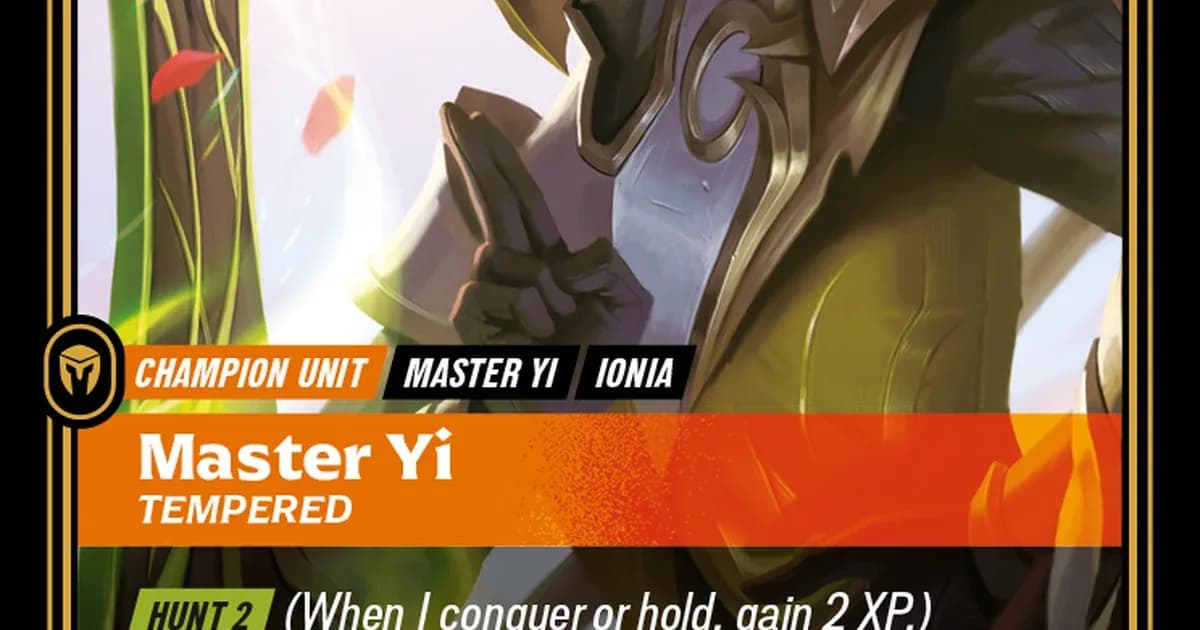
- Irelia and Master Yi, Wuju Bladesman are the report's Tier 1 Legends. Irelia has 4 wins and 11 top cuts in the tracked window and finished runner-up in Los Angeles. Master Yi has 2 wins and 15 top cuts and reached the Los Angeles Top 8.
- Rengar, Pridestalker is Tier 2 in the same report with 1 win and 7 top cuts. Riot's official recap records Rengar as the Los Angeles winner.
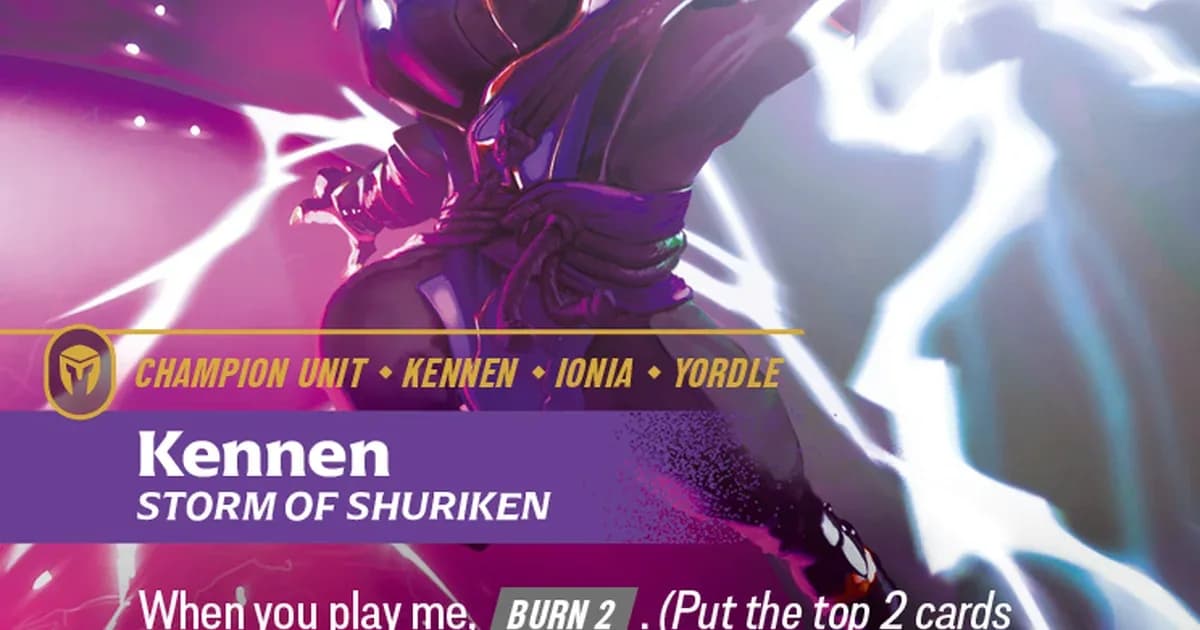
- Kennen, Heart of the Tempest is also Tier 2 in that report with 10 top cuts and a Los Angeles Top 16. Riot's recap says Irelia became the most-played Legend after the bans, while Kennen put the most players into Day 2.
- Azir, LeBlanc, and Akali are also Tier 2 in the October 3 report, so the post-ban field is broader than the older Kennen-led snapshot.
The older Barcelona Regional Qualifier result remains useful historical context, but it is not the current post-ban ranking. Ornn, Fire Below the Mountain, went 6-0 against Kennen at Barcelona before the September 18 ban update. The later Los Angeles recap records a different winner, Rengar, and a Top 8 made up of two Irelia, two Azir, Master Yi, Akali, Ornn, and Rengar.
That is a better way to read the field than calling one Legend permanently best. The post-ban report labels Irelia and Master Yi Tier 1, but the official Los Angeles Top 8 included several different shells. If you're building your first competitive list, choose a current archetype for its dated results and its matchups, then recheck legality and tournament data before registering it.
A full Riftbound meta tier list with matchup breakdowns, plus a dedicated Kennen, Heart of the Tempest deck guide, are both coming soon on the site.
All Riftbound Guides
This page is the hub for the site's Riftbound coverage, and it's just getting started.
- How to Play Riftbound: Full Beginner Rules Guide 2026: A complete beginner walkthrough covering the ABCD turn structure, deck construction, and a full worked first Showdown.
- Riftbound Meta Tier List: Current Vendetta Results: The current Vendetta tier breakdown, sourced from the post-ban tournament snapshot and official Los Angeles recap.
- Riftbound Kennen Deck Guide: A deep dive on Kennen's combo game plan and the proactive builds that have challenged it.
- Riftbound Master Yi Deck Guide: Tier 1 Midrange: How the format's fundamentals-focused Legend performed in the post-ban snapshot, and what it costs to build.
- Riftbound Rengar Deck Guide: Post-Ban Winner: The proactive, early-pressure shell that won Los Angeles, and why its own card predates Vendetta.
- Riftbound Ornn Deck Guide: Fire Below the Mountain: The Barcelona-winning Gear shell, Calm and Mind rune plan, and Pit Crew sequencing.
- Riftbound Azir Deck Guide: Emperor of the Sands Build: The Calm and Order token plan, Equipment turns, and Sand Soldier movement lines.
- Riftbound Fiora Deck Guide: Grand Duelist Build 2026: The Body and Order Mighty-combat shell, ready attacks, and current matchup plans.
- Riftbound Vex Deck Guide: Gloomist Control Build 2026: The Calm and Chaos hold shell, Gloomist card draw, Hidden units, and current matchup plans.
- Riftbound Vendetta Set Guide: Legends, Mechanics, Release: The full breakdown of the current set: new mechanics, the rivalry theme, and the confirmed roadmap beyond it.
- Riftbound Card Values: Chase Promos to Playable Prints: Real TCGPlayer prices across every tier, from playable base prints to ultra-premium Metal promos.
- Riftbound Radiance Release Date: Set 5 Ships October 23: What's confirmed about the next set, and why it matters for the current Vendetta metagame.
- Riftbound vs One Piece TCG vs Lorcana: Full 2026 Comparison: How Riftbound's Domain and Rune systems actually compare to the site's other two major TCGs.
Frequently Asked Questions
What is Riftbound? Riftbound is Riot Games' first physical trading card game, built on the League of Legends universe. Players build a 56-card deck around a single Legend and score points by conquering and holding Battlefields. It released in 2025, and its current set, Vendetta, launched July 31, 2026.
How do you win a game of Riftbound? You win by reaching 8 points first. You score by conquering a Battlefield you don't control or by holding one you already own at the start of your turn, worth 1 point each. Your final point usually has to come from holding, not conquering, due to a scoring rule on the eighth point.
How many Domains are there in Riftbound? Six: Fury (Red), Calm (Green), Mind (Blue), Body (Orange), Chaos (Purple), and Order (Yellow). Every Legend is locked into exactly two of these Domains, and every card in your deck must match one of your Legend's two Domains. That pairing defines your deck's entire strategy.
How many cards are in a Riftbound deck? A legal deck is 56 cards total: 1 Legend, 40 Main Deck cards (up to 3 copies of any card by name), 12 Rune Deck cards matching your Legend's Domains, and 3 Battlefield cards. Signature Cards are capped at 3 total regardless of how many different ones you run.
What is the current Riftbound set? Vendetta, the 4th main set, released worldwide on July 31, 2026, with 166 cards and 9 playable Legends. It's the set every current tournament result is drawn from. Set 5, Radiance, is already confirmed for October 23, 2026.
Is Riftbound an anime card game? No. Riftbound is built on Riot Games' League of Legends universe, not an anime property. This site covers it alongside anime TCGs like One Piece TCG and Disney Lorcana because it shares the same competitive infrastructure, collector base, and local game store scene as those games.
Who is the best Legend in the current Riftbound meta? There is no single source-supported best Legend in the current post-ban snapshot. riftbound.gg labels Irelia and Master Yi Tier 1 for September 25 through October 1, with Irelia at 4 wins and 11 top cuts and Master Yi at 2 wins and 15 top cuts. Riot's Los Angeles recap records Rengar as the winner, so the dated event and tier results are more useful than the older Kennen aggregate.
References
- Riftbound official site (Riot Games)
- Riftbound beginner's guide: basic rules and how to play (riftbound.gg)
- Riftbound meta tier list, Post Barcelona RQ update (riftbound.gg)
- Riftbound Meta Tier List: Best Decks for Vendetta, Post-Ban Metagame Week 3 (riftbound.gg): October 3, 2026 post-ban snapshot for current tiers and tournament totals
- Los Angeles Top Decks (official Riftbound): September 30, 2026 recap for the official Top 8, winner, and Day 1/Day 2 field
- September Ban List Updates (official Riftbound): official effective date and post-ban context
- Riftbound: Vendetta set guide (riftbound.gg)
- Riftbound: Radiance, Set 5 information (riftbound.gg)
- Domain, Riftbound League of Legends Wiki
About the author
Deck guides and meta
Pen name for the Shonen TCG desk's One Piece TCG deck guides, tier lists and meta reports.
- Lists averaged from public tournament results, sample size stated
- Card text quoted from Bandai's official card list
- Opinions marked as ours, with the reason
Keep reading
How to Play Riftbound: Full Beginner Rules Guide 2026
Guides · 13 min
Riftbound Meta Tier List: Irelia, Master Yi Lead Post-Ban
Guides · 15 min
Riftbound Kennen Deck Guide: Tier 2 After Stacked Deck Ban
Guides · 15 min
Riftbound vs One Piece TCG vs Lorcana: Full 2026 Comparison
Guides · 14 min

Riftbound Radiance Release Date: Set 5 Ships October 23
News · 5 min
Riftbound Card Values: Chase Promos to Playable Prints
Guides · 13 min
Riftbound Vendetta Set Guide: Legends, Mechanics, Release
Guides · 11 min

Riftbound Rengar Deck Guide: Won Los Angeles, Now Tier 2
Guides · 15 min
Disclaimer
This article is published for informational and entertainment purposes. It does not constitute professional financial, legal, or technical advice. Game performance, online services, patch schedules, and store listings change. Verify critical details (pricing, system requirements, regional availability) with publishers and storefronts before you buy. Affiliate links, where present, help support our editorial work and are labelled in our affiliate disclosure.