

Shonen TCG · Guides
Riftbound Irelia Deck Guide: Blade Dancer Vendetta Plan
The Riftbound Irelia deck is a Calm and Chaos Blade Dancer list that wins through movement, ready effects, and small advantages that become hard to answer after the first good turn. The current public tracker puts Irelia in Tier 1, and a Wuhan Regional Open list gives the archetype a concrete post-Vendetta shell to study.

TL;DR: The current Irelia shell uses five Calm and seven Chaos runes in the Wuhan winning sample.
SFD-195
SFD-195Shop on TCGplayer Irelia Blade Dancer readies units and herself,
SFD-057
SFD-057Shop on TCGplayer Irelia Fervent turns those choices into Might, and
SFD-048
SFD-048Shop on TCGplayer Stellacorn Herder draws when it moves.
VEN-044
VEN-044Shop on TCGplayer Astral Heron is the seven-cost anchor that lets the deck keep holding a battlefield after the early movement turns.
Is the Riftbound Irelia deck good after the post-ban reset? (Quick Answer)
Yes. Irelia is a current Tier 1 Legend on Riftbound.gg's September 24 tracker, and the live post-ban report still lists her among the format's top contenders. The results have a regional split: the Blade Dancer won Wuhan, reached the top 16 in Barcelona, and reached the top 32 in Singapore. That makes the deck a serious choice for a player who enjoys precise movement, while its performance also warns you that the list does not get free wins in every field.
The Riftbound meta tier list is the right place to compare Irelia with Akali, LeBlanc, Jayce, and the other current Legends. This guide narrows the question to the deck's decisions: which cards make the movement engine work, what to keep in the opening hand, and how to turn a ready effect into a location win.
Key Takeaways for the Riftbound Irelia deck
- Calm and Chaos give Blade Dancer access to movement, draw, combat tricks, and flexible answers.
- The public Wuhan winner used five Calm runes and seven Chaos runes. Treat that as a verified starting shell, not a rule that every local list must follow.
- Irelia's Legend ability can ready a friendly unit after you choose it, then ready herself after a conquer for one Energy.
- Irelia Fervent is a five-cost, four-Might Champion with Deflect. Choosing or readying her gives +1 Might for the turn.
- Stellacorn Herder draws a card when it moves, so the deck wants movement effects to create value as well as score pressure.
- Astral Heron gives the late game a real anchor. Its first-card discount can make the second card of the turn much cheaper while Heron sits at a battlefield.
- Older lists need a legality check before you copy them. The post-ban format changed which Gear and spells are legal.
Riftbound Irelia deck core: movement, draw, and the late game
The list has three connected jobs. It needs a unit at a battlefield, a way to choose or move that unit, and a payoff for taking the extra action. Irelia herself supplies the ready effects. Irelia Fervent makes those choices increase pressure, while Stellacorn Herder turns a move into a card. The result feels like a tempo deck, but the best turns are built one small resource at a time.
SFD-195SFD-195Shop on TCGplayer Irelia Blade Dancer is the Legend that makes the whole sequence possible. When you choose a friendly unit, you may exhaust Irelia and pay a Rainbow rune to ready that unit. When you conquer, you may pay one Energy to ready Irelia. The two clauses work together. A unit that was chosen for a combat trick can act again, and a successful conquer can give Irelia another action before the turn ends.
SFD-057SFD-057Shop on TCGplayer Irelia Fervent is the cleanest Champion payoff in the public shell. Deflect forces an opponent to spend a Rainbow rune before choosing her with a spell or ability. Her second line gives +1 Might whenever you choose or ready her. Irelia does not need to attack immediately after every ready. Sometimes the threat of a larger body at the next location is more valuable than spending the unit into a bad showdown.
SFD-048SFD-048Shop on TCGplayer Stellacorn Herder is where the deck's movement stops feeling like a cost. The four-cost Calm unit has three Might and draws one when it moves. That means a movement card can improve the board and replace itself. Herder is a good early keep when the rest of the hand can put it at a battlefield, but it is a poor first play if there is no realistic way to move it or protect the location.
The late game uses VEN-044VEN-044Shop on TCGplayer Astral Heron as a large Calm unit rather than a flashy finisher. It has seven Energy and seven Might. Once it is at a battlefield, the first card you play each turn makes your next card cost two Energy and two Rainbow runes less. That discount matters because the deck can spend one card on movement, then use the cheaper second card to protect a hold or create another attacker. Heron also gives Irelia a way to win a long game after the early units have traded away.
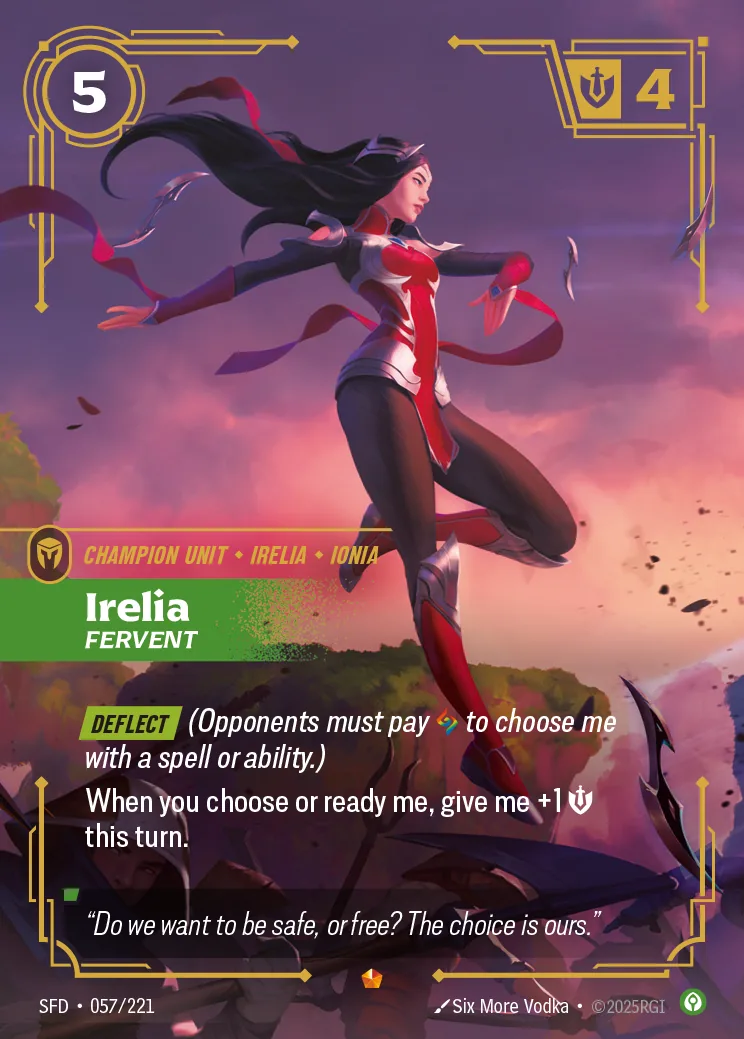 Irelia Fervent is the protected Champion body in the Wuhan Blade Dancer sample.
The public Irelia list and its Calm Chaos rune split
Mobalytics lists the Wuhan Regional Open sample at overall placement #1, updated September 10, 2026. The list uses five Calm runes and seven Chaos runes, with three Battlefields that support movement and contested holds. Its main deck leans on the four core cards above, then fills the rest with cheap movement, draw, protection, and combat interaction.
That rune split tells you what the sample is trying to do. Calm gives the deck its defensive timing and movement support. Chaos supplies the pressure and interaction that let a small unit turn a contested location into a winning one. The list does not want to spend every early turn setting up a perfect hand. It wants to establish one useful unit, keep a way to choose or move it, and leave enough resources open for the opponent's response.
The exact list is useful as a map of roles. It includes a low-cost draw body, movement effects, a small number of larger units, and several responses that change Might totals. Copying every count without checking your own field is less useful. If your local games are full of wide boards, keep more interaction. If games are slower, the Heron package and extra movement become more attractive.
The post-ban detail matters here. Some early Irelia results were recorded before the current ban reset, so a list copied from an older article can contain a card that is no longer legal. Check the official Riftbound Rules Hub before an event, especially if a decklist page is not dated. The current public results are enough to confirm Irelia's competitive status, but they do not make every older 40-card list current.
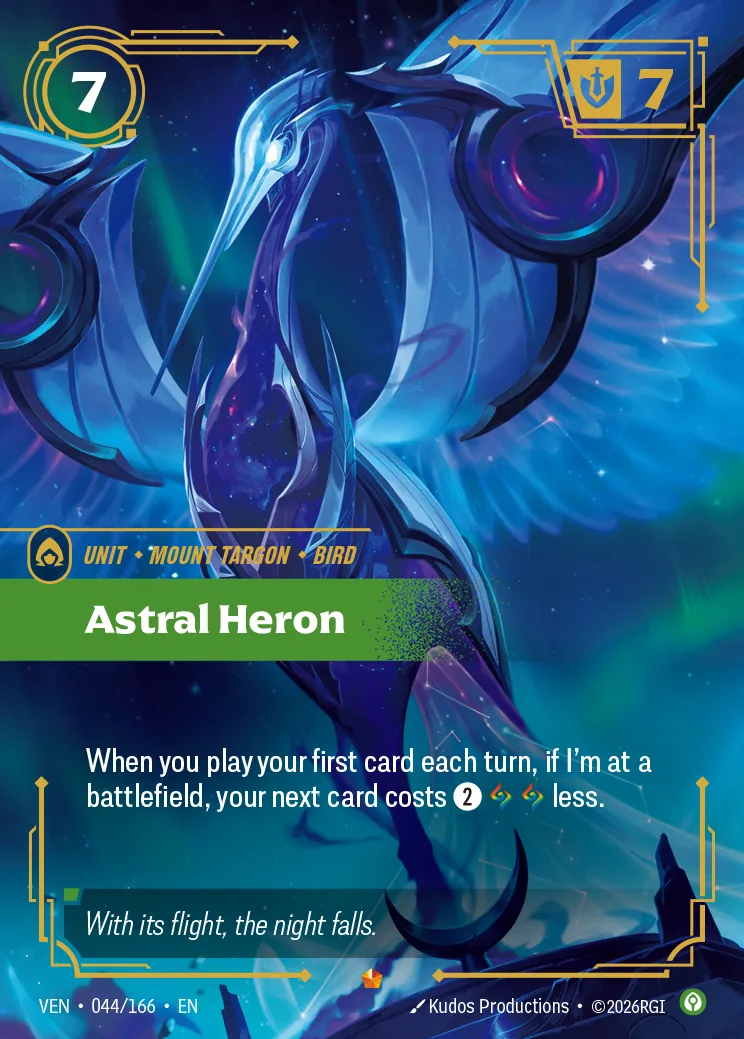 Astral Heron turns the first card of a turn into a discount for the second card while it holds a battlefield.
Step-by-Step: How to pilot the Riftbound Irelia deck
1. Mulligan for a playable first location. Keep a cheap unit, a way to access both domains, and one card that either moves a unit or improves the next draw. Return a hand made only of Astral Heron and expensive interaction. Irelia wins long games, but she still has to contest the first battlefield before the engine matters.
2. Put the first body where a move can create a second action. A unit at the safest location is not always the best opening. Look for a battlefield where a later move can turn on Herder, change a showdown, or force the opponent to split their board. Leave yourself a route to score even if the first attack fails.
3. Use Irelia's ready effect when it changes the board. The Legend ability costs a Rainbow rune and exhausts Irelia, so it should create a real action. Ready a unit that can conquer, trade up, or hold a location after the opponent's response. Using it on a body that cannot affect either battlefield simply leaves Irelia exhausted for the rest of the turn.
4. Treat movement as card advantage when Stellacorn Herder is in play. Herder draws when it moves, which lets you turn a positional effect into another resource. Move it before committing your last card to a combat trick when possible. The extra card often gives you the protection needed for the next location.
5. Save the conquer ready for the second problem. Paying one Energy to ready Irelia after a conquer is strongest when it lets her contest a second battlefield or threaten a follow-up move. If the first conquer already wins the turn, keep the Energy for a reaction and leave the Legend ready for the opponent's action.
6. Build toward Astral Heron instead of rushing it into an empty board. Heron is a seven-cost unit with a discount effect, so it becomes much better after you have a first card to play and a battlefield for it to occupy. The ideal turn uses the first card to make progress, then turns Heron's discount into a second meaningful play.
7. Finish on the location the opponent cannot retake. Irelia can make two locations matter at once, but she still loses if every unit is committed to one fight. Count the opponent's movement options before you spend the last ready effect. Leave one location stable, then use the Blade Dancer turn to force the decisive showdown elsewhere.
Tips for playing the Riftbound Irelia deck into common matchups
Against fast Fury decks, prioritize cheap bodies and an interaction card. You can keep a hand with Irelia Fervent, but you cannot keep a hand that needs three turns before a unit reaches a battlefield. Your first goal is to make the opponent spend a card to remove or dislodge a small unit. Every turn they spend answering that body is a turn in which Herder or Astral Heron gets closer to mattering.
Against value decks, protect Stellacorn Herder and take the first clean conquer you can find. The matchup gets worse when both players build a board and wait. Irelia is comfortable turning a small advantage into another card, while a passive opponent gives you time to plan a ready effect around the next battlefield. Keep one answer for the unit that would otherwise stabilize the board.
Against another movement deck, resist the urge to move first every time. Track which unit is carrying the opponent's draw engine and which battlefield actually determines the score. A movement effect that changes the wrong location can give the opponent the exact opening they need. Irelia's ready ability is at its best after the opponent has committed to a line and you can make the final action.
Your sideboard or flex slots should answer the field you expect. The Wuhan sample includes extra answers that can be exchanged after you know whether you need to fight large Body units, Gear decks, or wide aggressive boards. Keep the core movement and draw engine intact when tuning. Cutting too many ways to choose or move units turns Irelia into an ordinary midrange deck with a very demanding Legend.
Common mistakes with the Irelia deck
Spending the Rainbow rune on a ready effect that scores nothing. Irelia's ability is tempting because it is always available when the cost is paid. Ask what the readied unit does next. If it only moves back to a location the opponent already controls, save the rune.
Playing Astral Heron as a seven-cost stat line. Heron is powerful because the first card unlocks the discount on the second card. If you cannot play another relevant card after it lands, wait until the turn can use the discount or the seven Might actually protects a hold.
Keeping a beautiful late-game hand. Irelia does not need to mulligan every expensive card, but she needs a first unit and a way to reach a battlefield. Two large units and three combat tricks are not a plan if the opponent scores before they become playable.
Copying an undated pre-ban list. Deck sites keep old results visible, which is useful for history and dangerous for event preparation. Check the date, confirm legality, and compare the shell with the current tracker before buying missing pieces.
Treating movement as decoration. The deck's movement cards are how Irelia creates extra attacks, Herder draws, and Astral Heron holds. If you use them only to repair a bad position, the list will feel slower than the tournament sample that made it attractive.
Frequently Asked Questions
Is Irelia a good Riftbound deck in the current format?
Yes. Irelia is Tier 1 on the September 24 Riftbound.gg tracker and won the Wuhan Regional Open. Her Barcelona top 16 and Singapore top 32 show that she can compete across regions, while the results also suggest that faster western fields punish loose opening hands and delayed movement.
What should I keep in my opening hand?
Keep a cheap unit, access to the Calm and Chaos domains, and one movement or draw card. A hand with Irelia Fervent plus Astral Heron looks strong but can be too slow by itself. You need a body at a battlefield before the ready effects and discount turns have a target.
How many Calm and Chaos runes should I play?
The public Wuhan winner used five Calm runes and seven Chaos runes. That split is the clearest verified starting point for this guide, but it is still one tournament list. Adjust the flex slots after you identify whether your local games demand more protection, more movement, or more answers to large units.
What is Astral Heron's role?
Astral Heron is the late-game hold piece. It costs seven Energy and has seven Might, then reduces your next card by two Energy and two Rainbow runes after the first card of a turn while Heron is at a battlefield. That lets one turn develop the board and still leave resources for a second play.
Does Irelia use Chaos or Order?
The current Blade Dancer shell discussed here uses Calm and Chaos. Older deck pages can show other Legends or pre-ban experiments, so read the rune symbols on the dated list before assuming a pairing. This distinction matters because the interaction and movement lines change when the second domain changes.
Is the Wuhan list safe to copy card for card?
It is a strong public sample, not a permanent prescription. The list won the Wuhan Regional Open and gives you a verified five Calm, seven Chaos shell, but the format has a current ban context and local matchups vary. Use the list to identify roles, then confirm legality and adjust flex slots.
Related Reading
- Riftbound Riven deck guide: Another Calm and Chaos Radiance shell with three Astral Heron, built on units that enter ready, from Sithis's 9-0-1 Online Showdown 5 win.
- Riftbound Akali deck guide: Compare another current Vendetta Tier 1 Legend that uses Calm with a more aggressive Fury package.
- Riftbound Vex deck guide: Compare another Calm shell that wins by making one battlefield difficult to enter and hold.
- Riftbound Domains explained: Review what Calm and Chaos contribute before changing the rune split.
- Riftbound complete guide 2026: Keep the rules, set context, and cluster overview beside the deck guide.
- Riftbound beginner guide: Refresh locations, movement, and combat timing if the deck's sequencing is new to you.
References
- Riftbound.gg current tier list, updated September 24, 2026.
- Riftbound.gg post-ban Vendetta metagame report.
- Mobalytics Irelia Wuhan Regional Open list, updated September 10, 2026.
- Riftbound Irelia guide, updated September 8, 2026.
- Official Riftbound card gallery for SFD-195, SFD-057, SFD-048, VEN-044, and SFD-196.
Was this guide helpful?
Cards in this article
About the author
Deck guides and meta
Pen name for the Shonen TCG desk's One Piece TCG deck guides, tier lists and meta reports.
- Lists averaged from public tournament results, sample size stated
- Card text quoted from Bandai's official card list
- Opinions marked as ours, with the reason
Keep reading

Riftbound Akali Deck Guide: Rogue Assassin Vendetta Plan
Guides · 7 min

Riftbound Domains Explained: All Six Colors and Deck Roles
Guides · 9 min

Riftbound Ornn Deck Guide: Fire Below the Mountain
Guides · 13 min
Riftbound Azir Deck Guide: Emperor of the Sands Build
Guides · 13 min

Riftbound Jayce Deck Guide: Aurora Mind-Body Build
Guides · 7 min

Riftbound LeBlanc Deck Guide: Mind-Order Meta Build
Guides · 11 min

Riftbound Fiora Deck Guide: Grand Duelist Build 2026
Guides · 16 min

Riftbound Vex Deck Guide: Gloomist Control Build 2026
Guides · 16 min
Disclaimer
This article is published for informational and entertainment purposes. It does not constitute professional financial, legal, or technical advice. Game performance, online services, patch schedules, and store listings change. Verify critical details (pricing, system requirements, regional availability) with publishers and storefronts before you buy. Affiliate links, where present, help support our editorial work and are labelled in our affiliate disclosure.