

Shonen TCG · Guides
Riftbound Domains Explained: All Six Colors and Deck Roles
Riftbound Domains explained in one sentence: your Champion Legend gives the deck its Domain Identity, and that identity decides which cards and Runes you can use. Riot's official primer describes six philosophies, Fury, Calm, Mind, Body, Chaos, and Order. This guide turns that list into deckbuilding decisions and keeps current format rules separate from general strategy.
Domains are Riftbound's colors. If you came here looking for "Riftbound colors" or "color identity," Domain Identity is the same idea: Fury is red, Calm green, Mind blue, Body orange, Chaos purple and Order yellow (Core Rules 134.2, last updated October 9, 2026). A normal constructed Legend has two of them, and the Main Deck plus Rune Deck must follow that pair. Start with a 6 and 6 Rune split, then adjust toward the Domain that carries your expensive Power costs.
Riftbound Domains explained: the quick answer
The six Domains are color labels and play patterns. Each one points toward a different way to win Battlefields:
| Domain | Color | Core role | Common pressure point |
|---|---|---|---|
| Fury | Red | Fast pressure, damage, and conquering rewards | Direct card draw and removal outside combat |
| Calm | Green | Positioning, defense, and holding locations | Efficient aggression and non-unit interaction |
| Mind | Blue | Planning, card draw, shrinking, hidden cards, and Gear | Moving units and efficient bodies |
| Body | Orange | Resource growth, large units, and combat | Efficient draw and noncombat spells |
| Chaos | Purple | Tricks, mobility, trash access, and filtering | Permanent removal and lasting unit buffs |
| Order | Yellow | Wide boards, death payoffs, and direct removal | Small-unit interaction and movement |
These are tendencies, not deck restrictions inside the two colors. A Fury and Body deck can play a slower curve than another Fury deck. A Mind and Order list can use small units instead of Gear. Read the Legend, Chosen Champion, and card package together before deciding what a Domain pair means.
How Domain Identity works in Riftbound
The official Riot deckbuilding primer says the Champion Legend determines the Domains of a normal deck. Jinx, for example, is Fury and Chaos, so the list can use cards from those two Domains and not Calm cards. Your Legend's ability also pushes the strategy in a direction, which is why the same Domain can feel different under two Legends.
In constructed play, the identity controls both the Main Deck of at least 40 cards and the 12-card Rune Deck. A card with two Domains needs an identity containing both. If a card shows more than two Domains, a two-Domain Legend cannot normally include it simply because one of the symbols looks familiar. Check every symbol when confirming identity; a matching dominant color is insufficient.
The Domain rules by number
Riot's Core Rules (last updated October 9, 2026) spell the whole system out in a handful of lines. These are the ones worth knowing by number:
| Rule | What it says | Why it matters |
|---|---|---|
| 103.2.b.2 | Your Domain Identity comes from your Champion Legend's domains, shown as symbols in the Legend's upper-left corner | Read the Legend, not the cards you like |
| 103.2.b.3 | A single-Domain card fits the identity with that Domain | The normal case |
| 103.2.b.4 | A multi-Domain card fits only an identity containing every Domain on it | A Fury/Calm card is out of a Fury/Chaos deck |
| 103.2.b.5 | A card with no Domain fits any identity | Colorless cards go anywhere |
| 103.2.b.6 | Some effects let you add cards regardless of Domain; they count as part of your identity | A card-effect exception; game modes (103.1) and sealed/draft (below) are others |
| 103.4.a.1 | Rune Deck cards must match the Legend's identity | No splash Runes |
| 134.1, 134.2 | Six Domains, each with a color, a symbol in the card's lower-right corner, and a text shorthand | See the next table |
The shorthand is what you'll see in rules text and card databases, so it's worth matching to the symbol once:
| Domain | Color | Symbol (Core Rules wording) | Shorthand |
|---|---|---|---|
| Fury | Red | Circular symbol with three projecting points | [R] |
| Calm | Green | Resembles a leaf | [G] |
| Mind | Blue | Resembles a sun and moon | [B] |
| Body | Orange | Blocky diamond shape | [O] |
| Chaos | Purple | Hexagon with swirls coming from the center | [P] |
| Order | Yellow | Angular winged symbol | [Y] |
Rule 103.1 also leaves room for game modes to bend this. Its own example is a mode that adds a second Chosen Champion with a different Domain, and then the deck's identity includes that extra Domain. Limited play is the other exception: the Tournament Rules (October 9, 2026) let a sealed or draft deck use any three domains, or any one domain plus its Legend's domains (602.4.a.3 and 602.4.b.4). In Constructed, a Legend has two Domains and your identity is those two, unless a card effect or game mode adds more (103.2.b.6, 103.1).
The Chosen Champion is a separate decision inside that identity. Riot's primer recommends choosing the Champion version that matches how you want to use the Legend power. The card is part of the Main Deck, but the registered copy starts available as the Chosen Champion. That guaranteed access can change the correct curve for the rest of the list.
The current Rules Hub should override older guides when a legality or format question appears. Its Constructed legality section (last updated September 18, 2026) says all sets currently produced are legal in sanctioned Constructed events and publishes the current banned cards and Battlefields. Rules documents are the place to check before an event, especially when the question is about a format exception rather than a Domain philosophy. If you're heading to a sealed event, the Pre-Rift guide walks through building a three-domain deck from what you open.
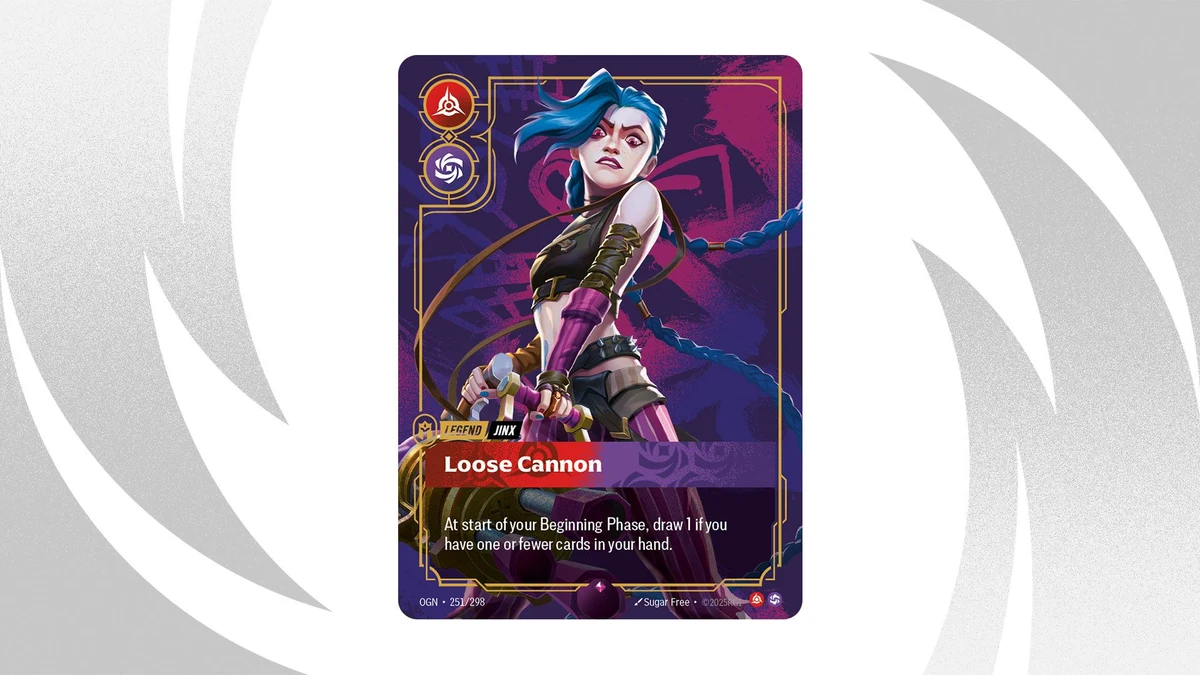 Jinx is the official primer's example of a Legend whose Fury and Chaos identity shapes the whole deck.
Fury and Calm: pressure versus position
Fury
Fury is the red Domain for players who want to make the opponent answer immediately. Riot describes it around aggression, passion, damage-based removal, Accelerate, and rewards for conquering. A Fury unit wants its Might to matter at a Battlefield now, not after several turns of setup.
The weakness is structural. Fury has a harder time drawing large numbers of cards or killing units that sit away from combat. That means a Fury deck needs to convert its first pressure turn into a lead instead of assuming every later board state favors it. If your list loses the first fight and has no way to rebuild, the Domain's speed becomes a liability.
Use Fury when you like counting the next conquer turn, forcing awkward blocks, and making the opponent spend a spell before they are ready. It pairs naturally with Body for efficient units or Chaos for mobility and tricks, but the Legend decides whether those pairings actually fit.
Calm
Calm is green and cares about balance, movement, defensive tricks, and holding. It can move enemies away from the Battlefield that matters, protect a position with counters or stuns, and win by making the opponent's attack arrive at the wrong place.
Calm is not simply a slow Domain. Its best turns use movement to create a favorable Showdown or make a second location impossible to contest. Its listed limitation is that it can struggle with raw aggression and interaction that does not use units. A Calm player should ask whether each defensive effect also improves the next score.
The site's Master Yi deck guide is a practical Calm and Body example. It uses Calm movement beside Body's larger units, so the Domain pair has a clear job for both early positioning and midgame combat.
Mind and Body: planning versus power
Mind
Mind is blue and rewards players who want more information before committing. Riot ties it to innovation, long-term planning, card draw, shrinking effects, hidden cards, and Gear synergy. Mind decks often look quiet for a turn, then convert a prepared hand or Gear board into a large location swing.
Its limit is the opposite of Fury's. Mind can have a harder time moving units or playing efficient bodies, so it needs a plan for the first Battlefield. A hand full of clever spells still loses if no unit arrives in time to contest a score.
Mind pairs well with Body when the list wants a large Gear or unit payoff after its setup turns. The new Jayce deck guide shows that approach through Mind and Body, Dazzling Aurora, and Elder Dragon. That is one example, not a rule that every Mind deck should copy.
Body
Body is orange and asks whether your units can win a fight on raw board power. Riot describes it around resource growth, efficient high-impact units, and combat dominance. It is the Domain to choose when you enjoy a clear curve and want a large unit to turn a contested Battlefield into a favorable Showdown.
Body's cost is flexibility. The official primer notes that it has a harder time finding efficient draw or noncombat spells. A Body list should therefore decide early which units are the real core and which expensive cards are only attractive in theory. Too many large bodies create a hand that cannot contest the first location.
Chaos and Order: tricks versus board control
Chaos
Chaos is purple and plays around uncertainty. It manipulates position and the trash, uses hidden tricks, and filters toward the right card. A Chaos deck often wins by making the opponent commit first, then using a Reaction or mobility effect to make that commitment awkward.
The limitation is that Chaos can struggle to permanently remove a threat or grant lasting advantages to its own units. Its answer may be temporary, delayed, or dependent on a specific board position. Plan the turn after the trick so the opponent does not simply rebuild in a better place.
The site's LeBlanc deck guide is a current Mind and Order example rather than a Chaos list, but its Reflection timing illustrates the kind of sequencing question that matters in a trick-heavy Domain. For an actual Chaos pairing, check the Legend's ability and signature cards before importing a shell from another pair.
Order
Order is yellow and builds value from unity and sacrifice. It makes many small units, gains effects when units die, and can kill opposing units directly. This gives Order a strong way to turn a crowded board into removal and pressure, especially when a Legend rewards a wide formation.
Order can have trouble with small units and movement. A list that produces bodies without deciding where they need to stand can spread its own power too thin. The right Order turn usually has a location in mind before the first token enters play.
Kennen's Chaos and Order pairing is the clearest established example on this site. The Kennen deck guide explains why the pair creates a removal-heavy combo shape, while the Riftbound meta tier list tracks its results separately from the Domain philosophy.
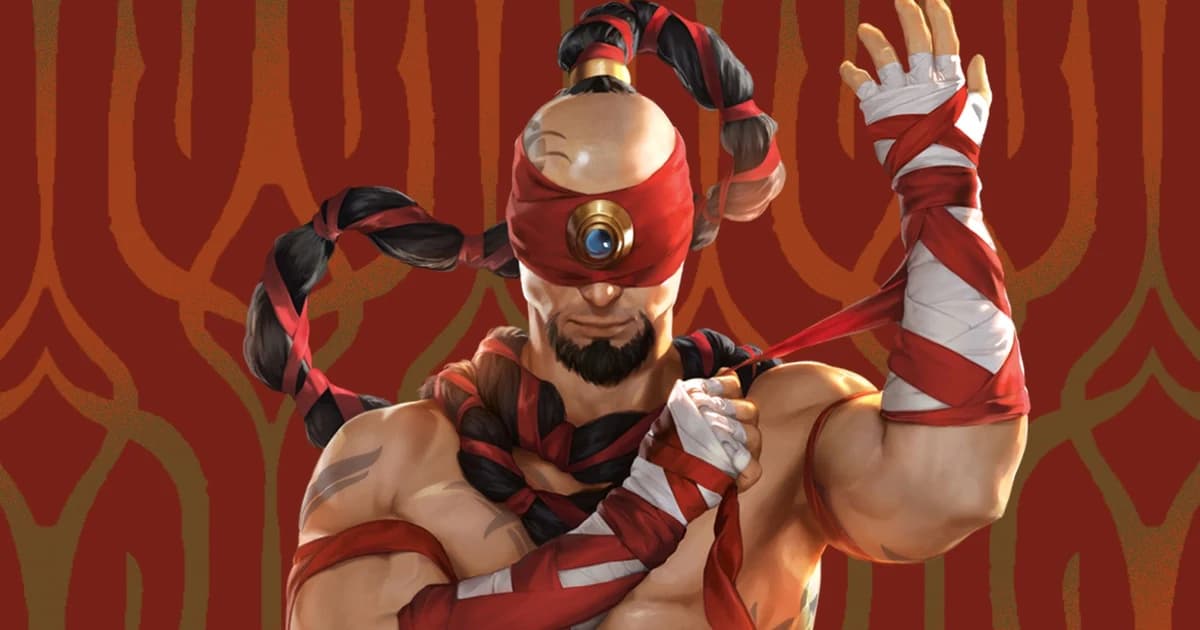
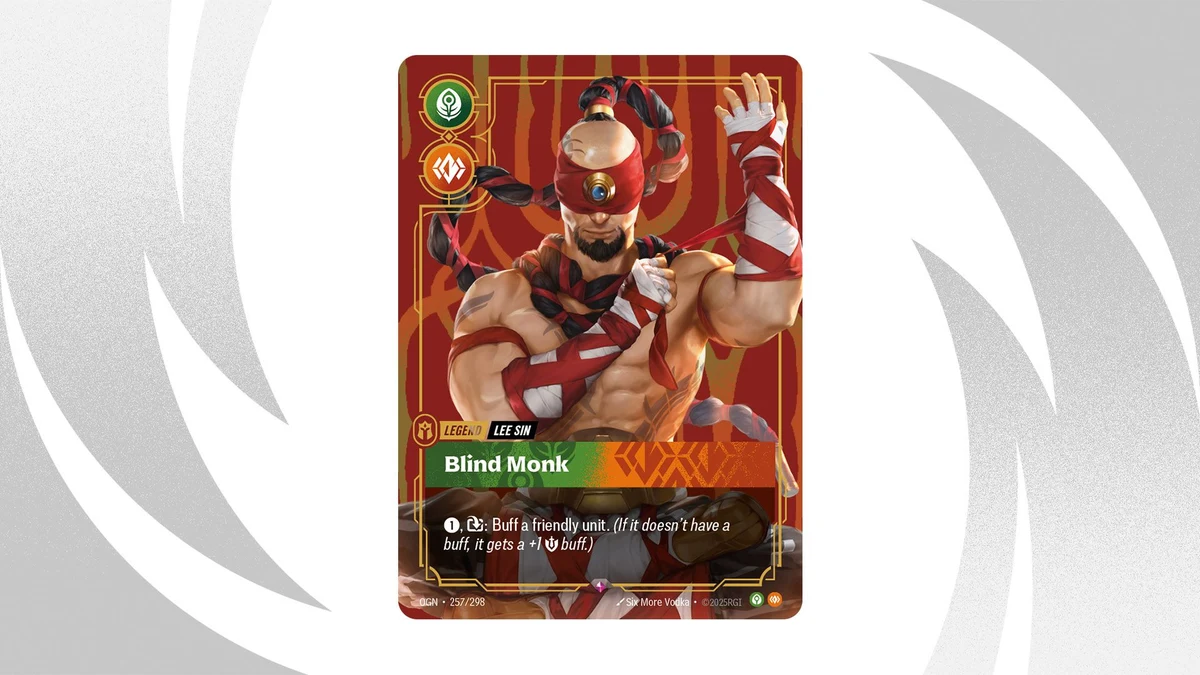 The primer uses Lee Sin to show how two different Chosen Champion options can change the same Legend's game plan.
Every Legend by domain pair
Six Domains make 15 possible pairs, and Riot has now printed a Legend for every one of them. We pulled every Legend from Riot's card gallery on November 3, 2026: 58 different Legends across Origins (OGN), Proving Grounds (OGS), Spiritforged (SFD), Unleashed (UNL), Vendetta (VEN) and Radiance (RAD), counting each Legend once and leaving out showcase reprints. The names are the Legend titles printed on the cards.
| Domain pair | Legends | Legend titles (set) |
|---|---|---|
| Fury / Calm | 1 | Rogue Assassin (VEN) |
| Fury / Mind | 4 | Daughter of the Void (OGN), Mechanized Menace (SFD), Virtuoso (UNL), Boy Who Shattered Time (RAD) |
| Fury / Body | 4 | Relentless Storm (OGN), Purifier (SFD), Pridestalker (UNL), Butcher of the Sands (VEN) |
| Fury / Chaos | 6 | Loose Cannon (OGN), Dark Child (OGS), Glorious Executioner (SFD), Bloodharbor Ripper (UNL), Master of Shadows (VEN), Hexplosives Expert (RAD) |
| Fury / Order | 4 | Hand of Noxus (OGN), Void Burrower (SFD), Piltover Enforcer (UNL), Iron Revenant (RAD) |
| Calm / Mind | 5 | Nine-Tailed Fox (OGN), Fire Below the Mountain (SFD), Bashful Bloom (UNL), Curator of the Sands (VEN), Lady of Clockwork (RAD) |
| Calm / Body | 5 | Blind Monk (OGN), Wuju Bladesman (OGS), Grandmaster at Arms (SFD), Wuju Master (UNL), Pride of Nazumah (RAD) |
| Calm / Chaos | 4 | Unforgiven (OGN), Blade Dancer (SFD), Gloomist (UNL), The Exile (RAD) |
| Calm / Order | 4 | Radiant Dawn (OGN), Emperor of the Sands (SFD), Green Father (UNL), Eye of Twilight (VEN) |
| Mind / Body | 1 | Defender of Tomorrow (VEN) |
| Mind / Chaos | 4 | Swift Scout (OGN), Prodigal Explorer (SFD), Scorn of the Moon (UNL), Soul's Reflection (VEN) |
| Mind / Order | 5 | Herald of the Arcane (OGN), Lady of Luminosity (OGS), Chem-Baroness (SFD), Deceiver (UNL), Starry-Eyed Songstress (RAD) |
| Body / Chaos | 4 | Bounty Hunter (OGN), Battle Mistress (SFD), Voidreaver (UNL), Agony's Embrace (RAD) |
| Body / Order | 6 | The Boss (OGN), Might of Demacia (OGS), Grand Duelist (SFD), Keeper of the Hammer (UNL), Matriarch of War (VEN), Exemplar of Demacia (RAD) |
| Chaos / Order | 1 | Heart of the Tempest (VEN) |
Three things stand out. The Domains themselves are balanced: Body and Order each sit on 20 Legends, the other four on 19. The pairs are not. Fury/Chaos and Body/Order have six Legends each, while Fury/Calm, Mind/Body and Chaos/Order got their only Legend in Vendetta. If you like one of those three pairs, your Legend choice is made for you, and so is most of your deck's direction. And Radiance's nine Legends all landed on pairs that already had one; the champions behind them are in our Radiance Legends list.
Step-by-Step: choose Domains and build the deck
1. Pick the play pattern before the color names. Decide whether you want early pressure, holding, long-term planning, large units, tricks, or a wide board. The Domain that matches your decisions is more useful than a color you like in isolation.
2. Choose a Legend with two Domains that support that pattern. Read the Legend ability, Chosen Champion options, and Signature Cards together. The pair should give you a way to contest the first Battlefield and a way to close the game later.
3. Check every Main Deck card against both Domains. A multi-Domain card needs all of its symbols inside your identity. Do not rely on a deck builder's color filter without opening the card and checking the printed Domains.
4. Start with a 6 and 6 Rune split. This is a practical first draft for two equal Domains. If one side carries most of the Power costs, move toward 8 and 4 so the deck can recycle the Runes it needs.
5. Add enough early units to fight for a location. Riot's primer recommends at least nine small units as a general rule and six or more interactive spells. Treat those as starting numbers, then adjust to the Legend and format.
6. Pick three Battlefields that reward the actual plan. Ask which locations help your deck score, which one is dangerous if the opponent controls it, and which one your Domain pair can contest without spending every card.
7. Test the first five turns before tuning the top end. Record whether you had a unit, a usable Rune split, and an interaction card by the middle of the game. A Domain pair is not working if its exciting late cards never get a stable board.
Common Domain-building mistakes
Choosing colors before choosing a Legend. The Legend supplies the identity and the strategy. Starting from a pile of favorite cards often leaves no coherent Rune Deck.
Using a 6 and 6 split forever. Equal Runes are a good first draft, not a rule. A Power-heavy Domain may need more than half the Rune Deck.
Forgetting the Rune Deck restriction. The Main Deck and Rune Deck share the same Domain Identity in normal constructed play. A legal unit does not make an off-identity Rune legal.
Packing too many spells and Gear. Battlefields are won by units. Support cards matter, but a hand without a body cannot contest a location no matter how clever the spells are.
Treating Domain descriptions as hard archetypes. Fury can play a longer game, Mind can play units, and Order can use a small package. Use the official identities as a starting map, then follow the Legend and actual card text.
Related Reading
- Riftbound Complete Guide 2026: the full turn loop, deck math, Battlefields, and a compressed six-Domain overview.
- Riftbound How to Play Beginner Guide: the ABCD turn structure, Runes, Showdowns, and first-game decisions.
- Riftbound Rengar Deck Guide: a current Fury and Body example built around proactive combat pressure.
Frequently Asked Questions
How many Domains are in Riftbound?
There are six: Fury, Calm, Mind, Body, Chaos, and Order. Each has a color and symbol, and normal constructed Legends use two of them.
What is Domain Identity?
Domain Identity is the set of Domains allowed by your Champion Legend. In normal constructed play, the Main Deck and Rune Deck must use cards that fit that identity. A multi-Domain card requires every shown Domain to be included.
Which Domain should a new player choose?
Choose the play pattern you enjoy. Fury teaches pressure, Calm teaches positioning, Mind teaches planning, Body teaches combat, Chaos teaches sequencing, and Order teaches board width and sacrifice.
How many Runes should each Domain get?
Start with six of each Domain for a two-Domain Legend. Shift toward eight and four when one side has most of the Power costs, then test the change across actual games.
Can I use a card from a third Domain?
Not in normal constructed play if that Domain is outside the Legend's identity. Read the current Rules Hub for sealed and team-format exceptions because those formats can use different construction rules.
Do Domains determine every deck decision?
No. The Legend ability, Chosen Champion, Signature Cards, Rune split, Battlefield choices, and actual card curve all matter. Domains narrow the card pool, but they do not choose the final list for you.
References
- Riftbound official Deckbuilding Primer: six Domain identities, Legend and Chosen Champion choices, Rune splits, and deckbuilding guidance.
- Riftbound official Rules Hub: current Constructed legality, bans, and rules documents checked September 25, 2026.
- Riftbound official How to Play page: current beginner rules and deck overview.
- Riftbound Core Rules reference: Domain Identity and Rune Deck rules cross-checked against the official hub.
Was this guide helpful?
About the author
Beginner guides and anime crossover
Pen name for the Shonen TCG desk's beginner guides, starter decks and anime-to-card-game explainers.
- Rules checked against the official rulebook and card text
- Every claim traced to a cited source
- Opinions marked as ours, with the reason
Keep reading
Riftbound Akali Deck Guide: Rogue Assassin Vendetta Plan
Guides · 7 min
Riftbound Irelia Deck Guide: Blade Dancer Vendetta Plan
Guides · 14 min
Riftbound Ornn Deck Guide: Fire Below the Mountain
Guides · 13 min
Riftbound Azir Deck Guide: Emperor of the Sands Build
Guides · 13 min

Riftbound Jayce Deck Guide: Aurora Mind-Body Build
Guides · 7 min
Riftbound LeBlanc Deck Guide: Mind-Order Meta Build
Guides · 11 min
Riftbound Fiora Deck Guide: Grand Duelist Build 2026
Guides · 16 min
Riftbound Vex Deck Guide: Gloomist Control Build 2026
Guides · 16 min
Disclaimer
This article is published for informational and entertainment purposes. It does not constitute professional financial, legal, or technical advice. Game performance, online services, patch schedules, and store listings change. Verify critical details (pricing, system requirements, regional availability) with publishers and storefronts before you buy. Affiliate links, where present, help support our editorial work and are labelled in our affiliate disclosure.