

Shonen TCG · Guides
Riftbound Rek'Sai Deck Guide: Fury Order Tunnels 2026
The Riftbound Rek'Sai deck is a Fury and Order pressure list that wants to score before the opponent has time to build a stable hold. The Riftbound complete guide covers the broader rules and card flow, while public deck coverage calls this plan a tunnel strategy. The important detail is what happens after the first score: Void Burrower turns a conquer into a look at the top two cards, while Order cards make the opponent pay for trying to block the next one.
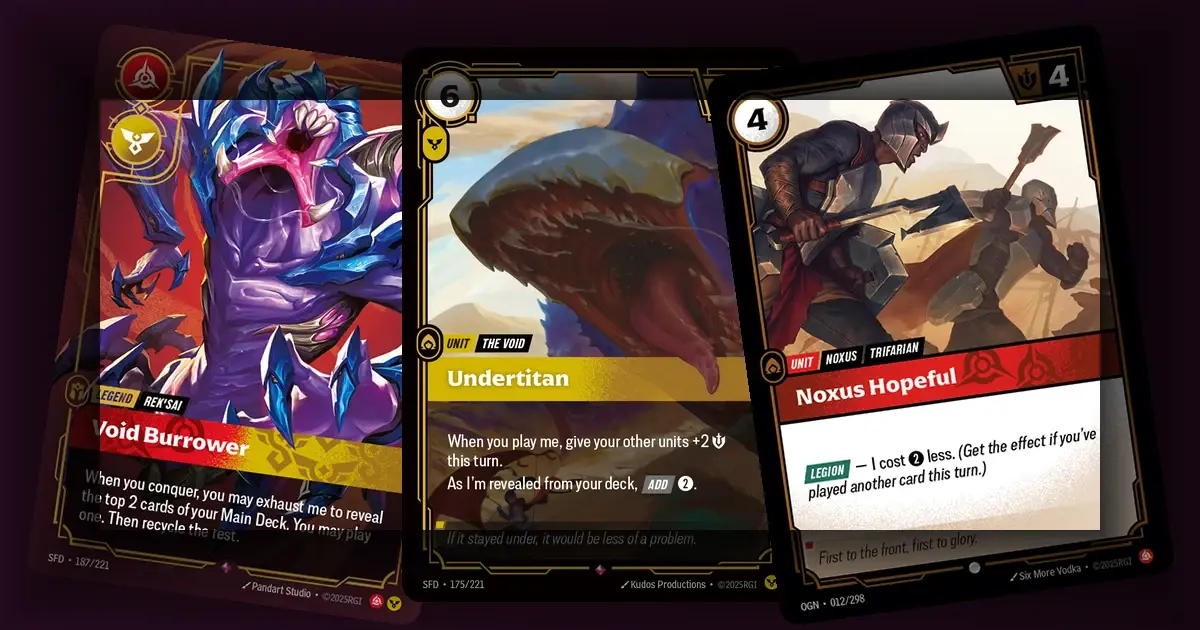
TL;DR: Riftbound.gg's October 9 tier list ranks Rek'Sai in Tier 3, down from Tier 2 on October 1. The deck uses cheap Fury units, Order removal, and a conquer-first curve.
SFD-187
SFD-187 Void Burrower rewards a successful conquer with a top-two reveal,
SFD-175
SFD-175Shop on TCGplayer Undertitan turns a wide board into a sudden Might check, and the list is strongest when it starts ahead.
Updated October 12, 2026: Every fact re-checked. Rek'Sai moved from Tier 2 to Tier 3 in Riftbound.gg's October 9 update. Ride the Wind and Flash were removed because both are Chaos cards and illegal under a Fury and Order Legend; Falling Star, Vi, and Kai'Sa from Riftbound.gg's guide replace them. The mulligan advice now follows Riftbound's set-aside-two rule.
Riftbound Rek'Sai deck? (quick answer)
Yes, this is a real current archetype, but it is an aggressive change-up rather than the safest tournament registration. Riftbound.gg's tier list, updated October 9, 2026 for the post-ban metagame, places Rek'Sai in Tier 3 after its October 1 report had it in Tier 2. The October 9 report credits Rek'Sai with 5 top cuts since the bans: Top 64 at the Los Angeles RQ, Top 16 at Showdown Series Murcia, Top 32 at Malmö, and Top 4 at Showdown Series Bristol. Riftbound.gg's dedicated guide, updated September 14, lists earlier finishes of Top 64 at the Barcelona RQ, Top 128 in Wuhan, and Top 16 in Singapore and Shenyang. RiftboundDecklists' strategy page links 14 public Rek'Sai lists and advises taking the deck "as an aggressive change-up, not as your Regional Qualifier lock."
The deck's identity is Fury pressure plus Order disruption. It does not play like a pure rush deck that empties its hand and hopes the opponent cannot interact. The first turns create a board, the first conquer creates a lead, and the following turns use removal or movement to protect that lead. That distinction is why the list can beat slower decks while still struggling when an opponent gets the first meaningful score.
If you are coming from a game with a leader card, Riftbound's equivalent is the Champion Legend. Void Burrower starts in the Legend Zone, outside the Main Deck, and its two Domain icons, Fury and Order, set the deck's Domain Identity: every card in the list must be Fury, Order, or both. That rule matters when you copy ideas from other decks, because strong Chaos or Body cards are not legal here.
Key takeaways for the Riftbound Rek'Sai deck
- Start with cheap units. The list wants several bodies at two Energy or less so its first Battlefield contest does not cost the whole hand.
- Score early whenever the exchange is favorable. Void Burrower is better after a conquer than it is sitting safely at base.
- Fury provides the board pressure; Order supplies the answers that stop one blocker from turning off the entire plan.
- Undertitan is a midgame swing card. It is strongest after two or three units are already in play, not as a lonely six-Energy play.
- Noxus Hopeful gets its reduced cost after another card has been played, so sequence a cheap card before the Legion unit.
- Hidden Blade, Cull the Weak, and Falling Star are better after the opponent has committed bodies than when they are used as automatic removal.
- Void Rush is a bridge between pressure and reach. It can turn a favorable top two into another unit while drawing the card you did not play.
- Do not register the deck because one Top 16 result looks exciting. Register it when your expected field rewards an early conquer and cannot easily stabilize the first two Battlefields.
How the Rek'Sai core turns a lead into more cards
SFD-187SFD-187 Void Burrower is the reason the deck cares about conquering early. After you conquer, you may exhaust the Legend to reveal the top two cards of your Main Deck, play one of them, and recycle the rest. The ability does not promise a card advantage engine every turn. It asks you to create a board state where a top-two reveal is likely to produce a playable unit, removal spell, or resource swing.
That makes the first conquer a choice, not a reflex. If the reveal is safe but the location is worth very little, you may prefer to hold and protect a larger score next turn. If the opponent has only one blocker and the Battlefield is worth the point that puts you ahead, take the conquer even if the top two are ordinary. The Legend is strongest when it converts a normal score into a second action without forcing you to spend the whole hand.
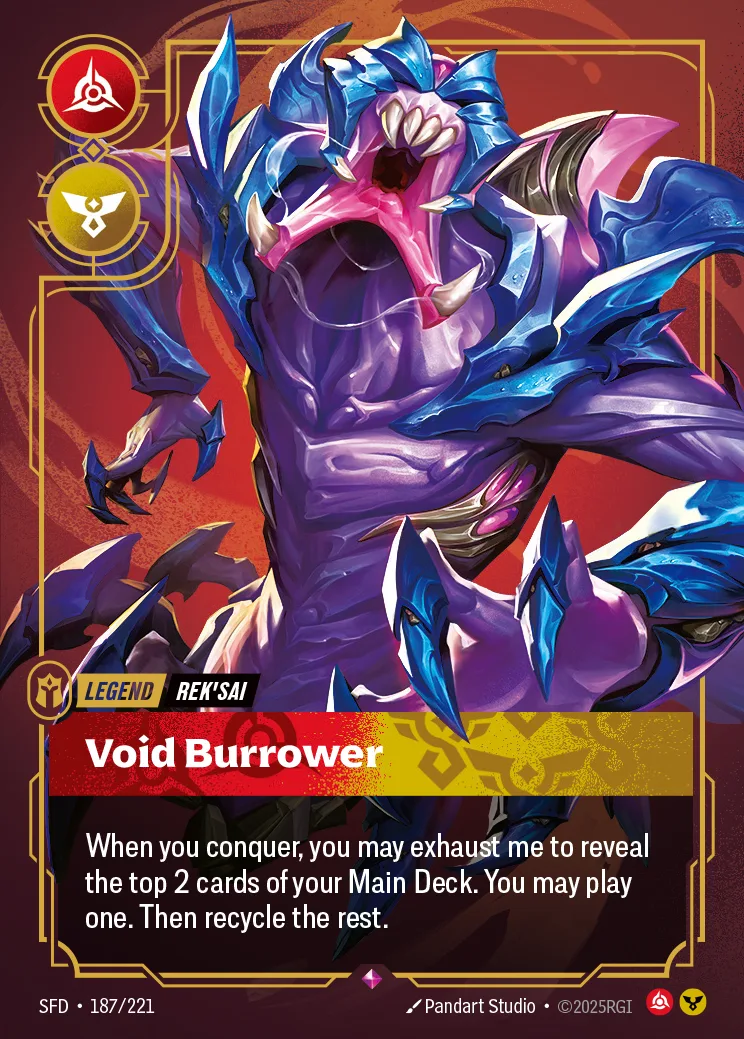 Image: Riot Games, Riftbound official card gallery (SFD-187, Void Burrower). The two Domain icons, Fury and Order, limit the deck to those Domains.
Undertitan is the most dramatic payoff in the core. It is an Order unit that costs six and has five Might. When you play it, your other units get +2 Might for the turn, and when it is revealed from your deck it adds 2 Energy, which can trigger off Void Burrower's or Void Rush's reveal. The play-from-hand effect is the important part in this shell: a board of small units suddenly becomes a credible conquer or defense instead of a collection of bodies waiting to be cleaned up.
Do not treat Undertitan as an opening-hand requirement. It is a keep only when the rest of the hand already has development and a route to six Energy. In most games, the correct Undertitan turn follows two cheap units and an opponent who has spent a removal card on the first threat. That sequence asks the opponent to answer a wide board, not one oversized unit.
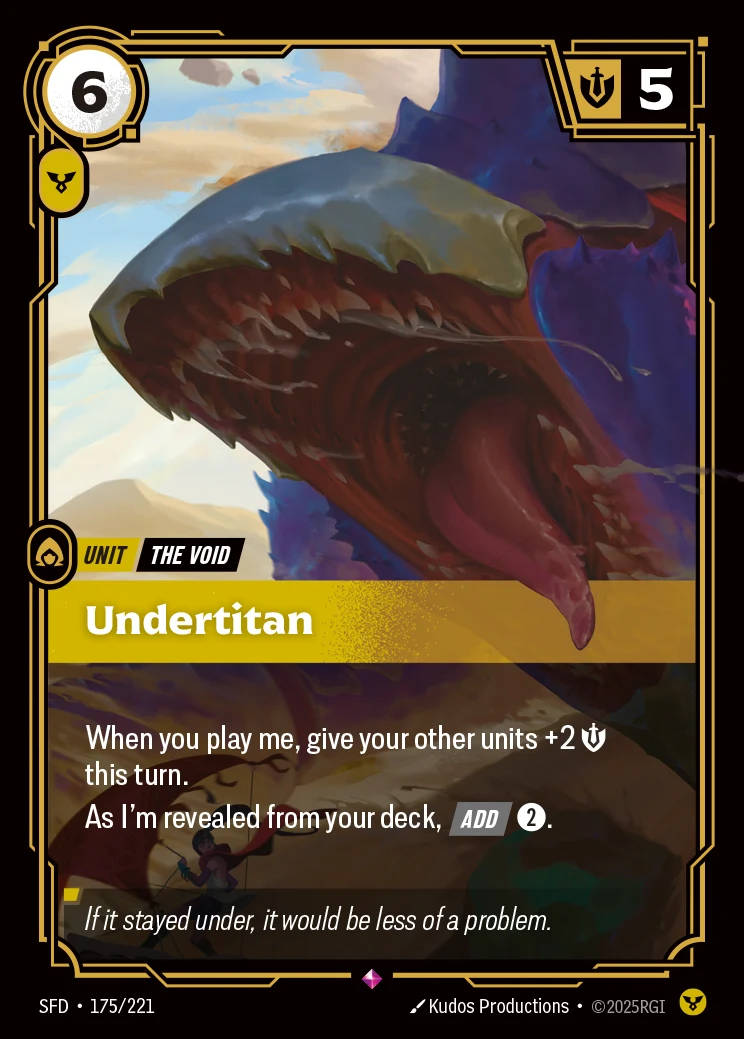 Image: Riot Games, Riftbound official card gallery (SFD-175, Undertitan). It rewards a board that already has several cheap units.
 OGN-012
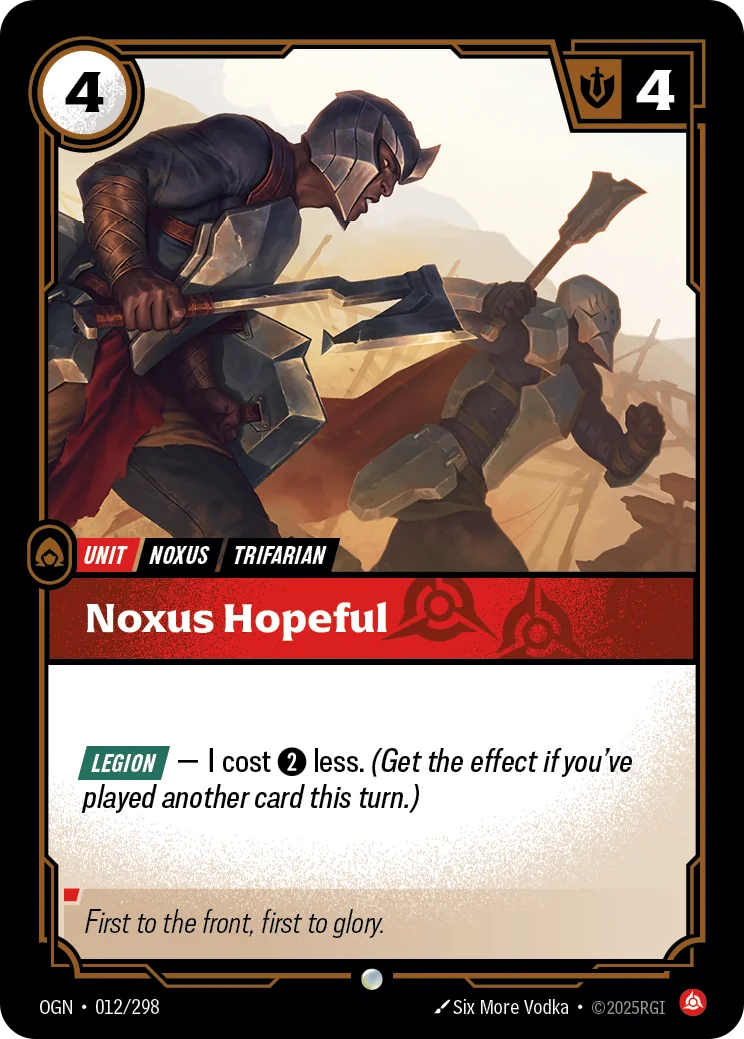 OGN-012Shop on TCGplayer Noxus Hopeful is a Fury unit that costs four before its Legion reduction. After you play another card in the turn, it costs two less. That means the card belongs in a sequence, not at the front of one. Play a cheap unit, a low-cost spell, or another card that advances the board, then use Noxus Hopeful to add four Might without paying its printed cost.
The discount also changes mulligan math. A hand with Noxus Hopeful plus a cheap play is workable. A hand with Noxus Hopeful and only five- and six-Energy cards is not. The unit is a curve card when the hand has a first step, and it is a stranded four-cost body when the hand does not.
Riftbound.gg's Rek'Sai guide notes that "In most top performing decks for the legend, at least nine 2-cost units were included," plus Noxus Hopeful at its discounted cost. That number explains the feel of the deck better than any single headline card. Cheap units make the first Battlefield contest possible, turn on Noxus Hopeful, give Undertitan more bodies to empower, and make a Void Burrower reveal less likely to whiff. A list that cuts too many of them for clever late cards stops being a Rek'Sai list in practice.
Order answers and the Fury pressure curve
Order cards are not a second deck hidden inside the list. They are the part that makes the Fury board matter after the opponent has found a blocker.  OGN-213
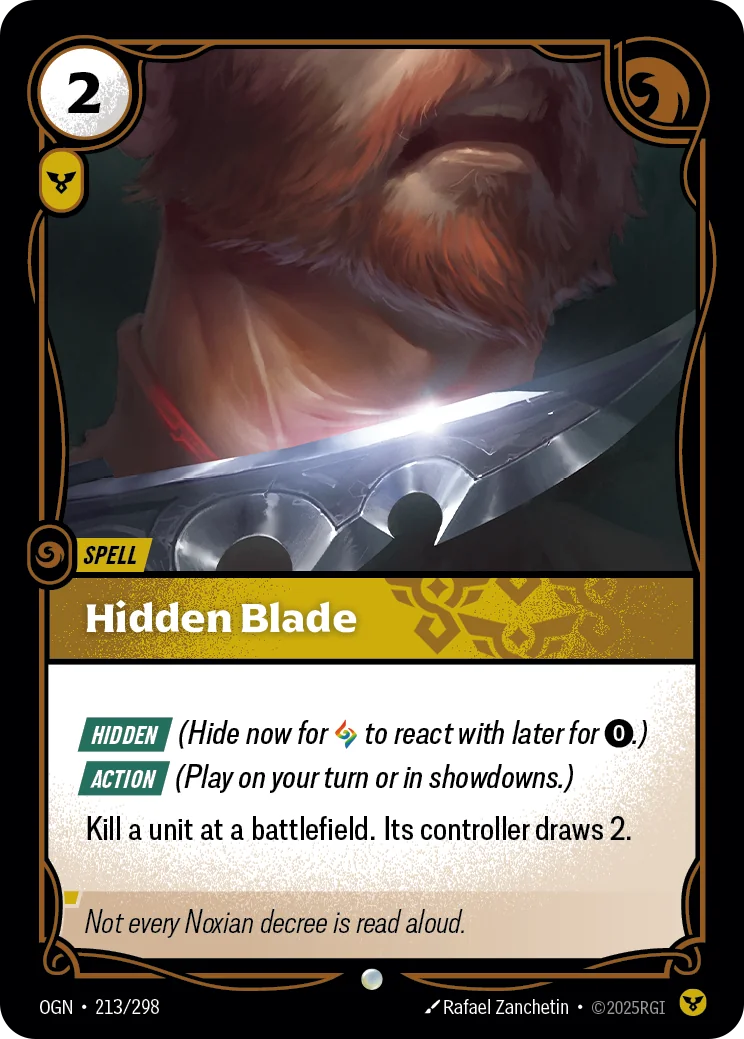 OGN-213Shop on TCGplayer Hidden Blade is a two-Energy Hidden Action that kills a unit at a Battlefield, but its controller draws two. Use it when the removal changes the score or removes the only blocker that can stop a conquer. Killing a small unit just to make the opponent draw is often a poor exchange.
 OGN-209
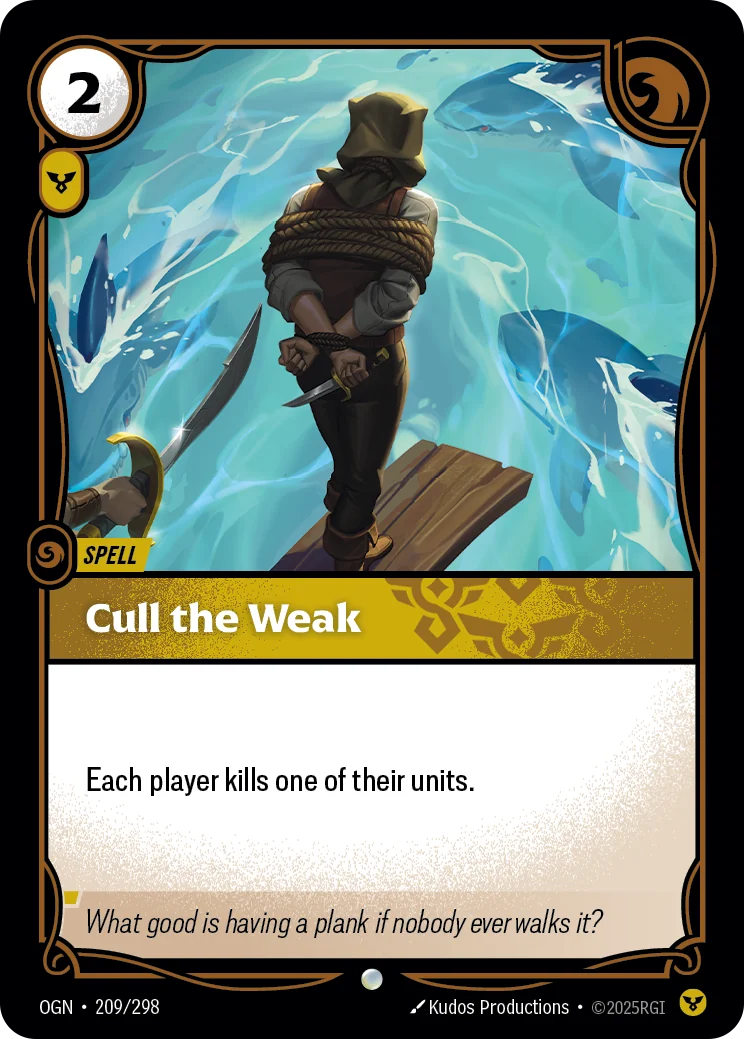 OGN-209Shop on TCGplayer Cull the Weak costs two and asks each player to kill one of their units. It is strongest when your board is wider or when one of your cheap bodies has already done its job. It is much worse when both players have one important unit and you are the player trying to protect a lead. Count the likely sacrifices before putting the spell in the opening plan.
 SFD-188
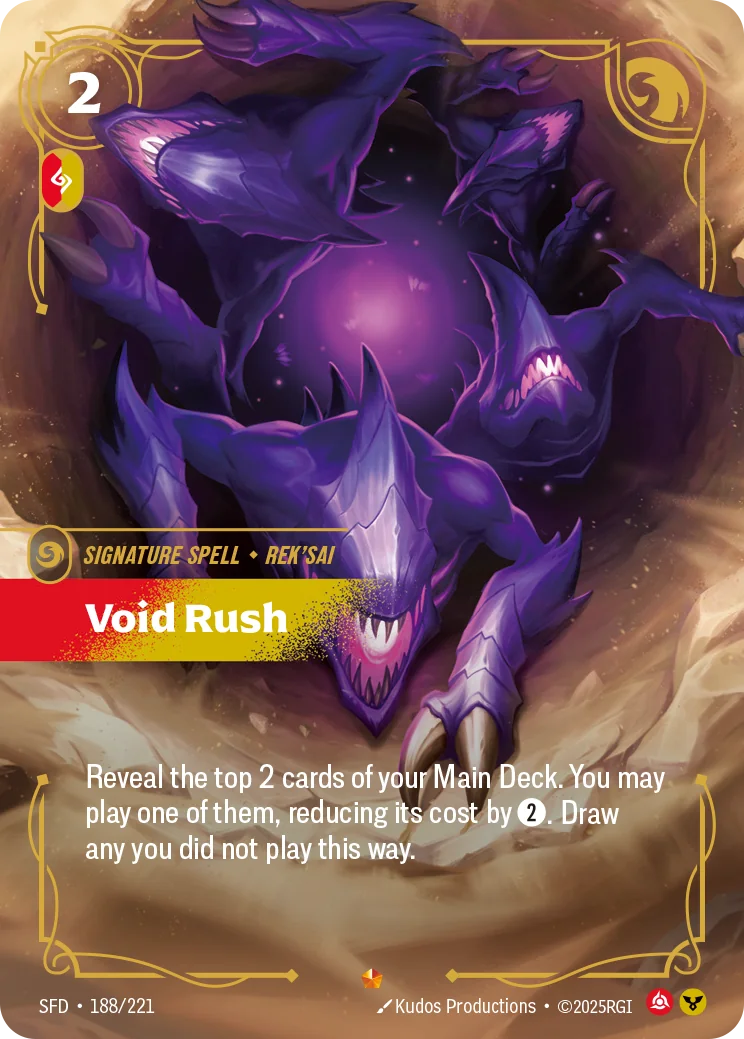 SFD-188Shop on TCGplayer Void Rush provides a different kind of reach. It reveals the top two cards, lets you play one with its cost reduced by two, and draws any card you did not play. The reduction is useful for a unit that is almost within range, but do not force the play merely because it is available. Drawing the unplayed card can be better when the opponent has stabilized and your next turn needs a specific answer.
Fury adds direct damage and Order adds surprise bodies. Riftbound.gg's guide names Falling Star, a two-Energy Fury spell that deals 3 to a unit and then deals 3 to a unit again, and Vi, a five-Energy Order unit with Ambush that Stuns an enemy unit when she attacks, among the cards that improve once the opponent is on the back foot.  OGN-039
 OGN-039Shop on TCGplayer Kai'Sa, a Fury unit that draws a card when she conquers, rewards the same early lead.
The split between Fury and Order should serve the opening curve. Fury cards make the first question. Order cards punish the answer. If you draw only the second half, the deck looks slow. If you draw only the first half, a single blocker can buy the opponent the turn they need. The best hands have one early body, one follow-up, and one card that can change a combat or remove a blocker.
GODEEPER: Learn how Fury and Order resources shape the first two turns before tuning the tunnel curve in Riftbound Domains Explained →
Sample role map for a Rek'Sai deck list
This is a role map rather than a claim that one exact 40-card list is mandatory. Public lists differ in their cheap-unit names and the number of reactive cards, but the jobs stay stable.
| Slot group | What the cards must do | What to protect |
|---|---|---|
| Cheap Fury units | Contest a Battlefield early and make the first conquer plausible | Enough bodies to enable a wide Undertitan turn |
| Noxus Hopeful package | Convert a prior card play into a discounted four-Might unit | The cheap play that turns on Legion |
| Order removal | Remove or trade with the blocker that stops a score | Timing, because early removal can leave the hand empty |
| Damage and Ambush | Clear a blocker with Falling Star or arrive with Vi's Ambush | At least one surprise line for the final Battlefield |
| Void Burrower payoffs | Turn a conquer into another action or card | The lead that makes the top-two reveal useful |
The deck does not need every hand to contain all five groups. It needs the groups to arrive in the right order. Mulligan for the first two, use the third to preserve the lead, and keep the fourth for the turn where the opponent believes the board is solved.
Step-by-Step: How to pilot the Riftbound Rek'Sai deck
1. Mulligan for a first Battlefield play. Riftbound's mulligan lets you set aside up to two of your four opening cards and draw that many. Keep a cheap Fury unit, two early bodies, or a cheap body plus an Order card that protects the first score, and set aside cards that cost four or more when the hand has no early unit.
2. Pick the first location by score and access. A Battlefield is not good merely because it is open. Ask how many moves the opponent has, how much it scores, and whether your first unit can hold it for a full turn. Rek'Sai wants the location that makes the opponent spend a real card to answer it.
3. Sequence the discount before Noxus Hopeful. Play another card first, then use the Legion unit at its reduced cost. If the discounted play would leave the board unable to contest the next location, keep Noxus Hopeful for the following turn instead.
4. Take the first conquer when it creates a lead. Void Burrower is not a reason to attack into a losing combat. It is a reward for a conquer that was already good enough. If the score puts you ahead and the opponent must answer two locations, take it and consider the top-two reveal.
5. Use the top two for tempo, not greed. A free or reduced unit is usually the best reveal when it adds Might immediately. If neither card changes the board, take the draw from the unplayed card and keep your hand for the opponent's response.
6. Make Undertitan a board card. Wait until its temporary +2 Might affects at least two other units or changes a decisive showdown. Playing it onto an empty board gives the opponent one obvious target and wastes the part of the card that makes the deck wide.
7. Hold Order removal until the blocker matters. Hidden Blade and Cull the Weak can both be dead if cast before the opponent commits. Let the opponent show which unit is carrying the defense, then remove the piece that changes the score rather than the piece that merely looks annoying.
8. Save the surprise for a score. Vi's Ambush and Falling Star should either win a conquer, save a unit from a bad fight, or deny the opponent's counter-score. If neither changes the next score, hold them for the turn that does.
9. Count the final turn from the opponent's resources. Before attacking, count available moves, ready units, and likely Reactions. Rek'Sai closes games by making the opponent answer two problems at once. Do not spend the final Ambush or damage spell before you know which Battlefield must be won.
Matchups for the Rek'Sai deck
Against Ornn, race the first Gear investment; RiftboundDecklists' matchup note is that Rek'Sai "Races Ornn." Ornn is at its best after a small unit has turned into a durable long-term resource, so make that setup compete with an early score. Avoid spending Cull the Weak while the opponent has only one expendable body and you have one valuable Fury unit. The Riftbound Ornn deck guide shows why the matchup gets harder once the Gear engine is online.
Against Master Yi, a Tier 1 Legend on October 9, expect a hard game: RiftboundDecklists says the deck "Loses to well-built Yi." Both Yi Legends are Calm and Body, and Wuju Bladesman gives a unit that defends alone +2 Might, which makes your first removal card less valuable than your first extra body. Put pressure on the location where Yi needs to establish a hold, then use Void Burrower only after the conquer is likely to stick. The Master Yi deck guide is a useful reference for the slower Calm and Body curve.
Against Kennen, also Tier 1 and another listed loss for Rek'Sai, do not let the game become a sequence of small trades where your Legend never scores. Kennen's Legend empowers when its controller plays a card from anywhere other than hand and can give a unit Assault 2. Force the opponent to answer a wide board, then use the Order half to remove the one unit that lets the opponent turn defense into a counter-score. Kennen can punish a slow hand, so a flashy six-Energy keep is especially dangerous here.
Against Rengar, protect the unit that makes the first conquer possible. Rengar's Legend gives a unit +1 Might each time its controller plays a unit, so it is comfortable turning a small opening into a fast Battlefield fight, so do not send your only cheap body into an exchange that leaves the second location empty. The Rengar deck guide explains the proactive pressure you need to respect.
Against Azir, whose Legend makes 2-Might Sand Soldier tokens on turns it has played an Equipment, make the token board answer your score instead of allowing it to widen for free. Save Vi or Falling Star for the turn when two locations become live, and use Cull the Weak only when your own expendable unit leaves you with the better board. Compare the Azir deck guide when you need to identify which token turn deserves the removal card.
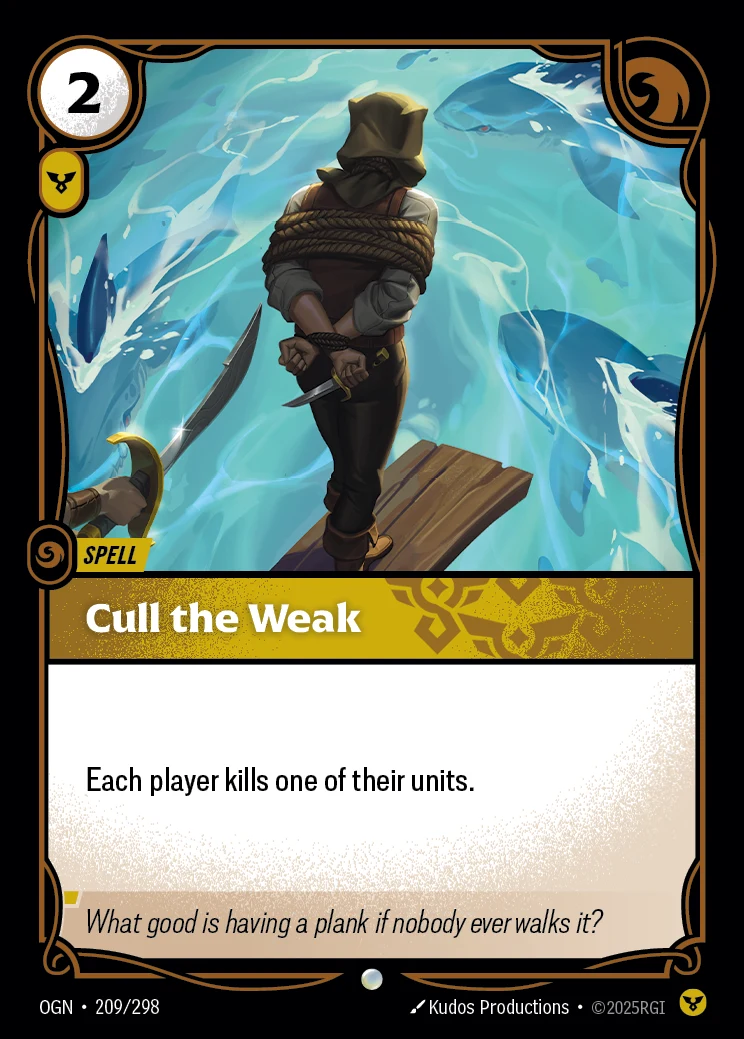 Image: Riot Games, Riftbound official card gallery (OGN-209, Cull the Weak). Strongest when your board can sacrifice a lower-value unit.
GODEEPER: See how the current field separates aggregate tier strength from tournament counter-picks in the Riftbound Meta Tier List →
Tips for the Riftbound Rek'Sai deck
The first practical rule is to count bodies, not just cards. A hand with four cards can be stronger than a hand with six if the four cards create two Battlefields and one answer. Void Burrower rewards a board that already functions, so raw hand size is not the only measure of safety.
The second rule is to keep the lead narrow enough to defend. Rek'Sai does not need to occupy every location at once. A single safe conquer plus a second location that the opponent must respect is often better than spreading three weak units across the whole board. Wide boards are for Undertitan turns, not for every opening turn.
The third rule is to identify the opponent's first real blocker. Do not spend removal on the first unit that enters unless it is also the unit that controls the score. The right target is the body that forces you to lose a conquer, enables a counter-score, or protects a more important threat.
The fourth rule is to use Void Rush as a stabilizer when the first plan stalls. The spell is not only a high-roll card. Its draw clause means a failed top-two play can still turn into the next answer. Keep enough Energy to cast it without abandoning the Battlefield that made the spell attractive in the first place.
Finally, test the list against the field you actually expect. Rek'Sai's Tier 3 placement and public results prove that the archetype is viable. They do not say that it is the best blind pick for every event. Bring it when you expect slower decks, predictable blockers, or opponents who will spend their first turns preparing instead of scoring.
What players are saying about the Rek'Sai deck
TamCardwell's September 22 Vendetta gameplay video shows Void Burrower against Jayce, one of the Legends Rek'Sai shares Tier 3 with. On r/Riftbound, a newer player asking whether to start with Rek'Sai or Azir got this answer: "Rek'sai is a good, simpler, pure aggro playstyle." In a later thread titled "Giving up on Reksai," the original poster summed up the weakness that Riftbound.gg also describes: "I don’t feel you get to shutdown others as reksai as hard though."
Our take
Based on the tier data, card text, and public results cited above, Rek'Sai is a good deck to learn Riftbound's tempo game with and a risky one to register for a Regional Qualifier. It wins when it conquers first, but the two Legends that RiftboundDecklists lists as bad matchups, Master Yi and Kennen, are both Tier 1 in the October 9 list, and the deck dropped a tier in eight days. We would bring it to a smaller event or a field you expect to be slow, keep at least nine two-cost units as Riftbound.gg recommends, and stop trying to fix its late game with cards outside Fury and Order.
How we checked this: 30 facts checked on October 12, 2026 against Riftbound.gg, RiftboundDecklists, Riot's card gallery and Core Rules, and riftbound.org card pages; the full source table is kept with our editorial notes. Last reviewed: October 12, 2026.
Frequently Asked Questions
Is Rek'Sai competitive in the current Riftbound format? Yes, as a Tier 3 deck. Riftbound.gg's October 9, 2026 tier list moved Rek'Sai from Tier 2 to Tier 3, crediting it with 5 top cuts since the bans, including Top 64 at the Los Angeles RQ and Top 4 at Showdown Series Bristol. That is a real competitive shell, not a safe Regional Qualifier default.
What domains does the Rek'Sai deck use? The deck uses Fury and Order. Fury supplies cheap units and proactive pressure, while Order adds removal and control over the opponent's board. Together they support a conquer-first plan that wants an early lead, then turns that lead into stronger Void Burrower activations and cleaner trades.
What is the Rek'Sai deck trying to do? The plan is to establish cheap units, score a Battlefield early, and keep the opponent reacting. Void Burrower rewards a successful conquer by looking at the top two cards, while Order removal clears a blocker after the deck is ahead. The shell is much less comfortable when forced to recover from behind.
What should I keep in my Rek'Sai opening hand? Keep cheap units and one Order answer. Riftbound's mulligan lets you set aside up to two of your four opening cards and draw replacements, so set aside Undertitan or other expensive cards first when the hand has no two-cost unit. The deck needs a board and an early score before Void Burrower's reveals become reliable.
Does Rek'Sai work like a leader card in Riftbound? Riftbound's equivalent is the Champion Legend. Void Burrower is the Rek'Sai Legend: it starts the game in the Legend Zone rather than the Main Deck, and its Fury and Order icons set the deck's Domain Identity, so every card in the deck must be Fury, Order, or both.
What is Rek'Sai's biggest weakness? Rek'Sai struggles to play from behind. Riftbound.gg's October 9 report notes that Rek'Sai "mostly plays during her turns, making her more predictable," unlike Rengar, which has Body reactions. If the opponent survives the first pressure wave and keeps removal for your key unit, the deck can run out of ways to reclaim a Battlefield.
Related Reading
- Riftbound Fiora Deck Guide: a Body and Order combat shell with a different approach to winning early showdowns.
- Riftbound Jayce Deck Guide: a slower Gear plan that shows how a Mind pairing changes the resource curve.
- Riftbound Vex Deck Guide: a Calm and Chaos hold strategy that trades Rek'Sai's early pressure for denial.
References
- Riftbound.gg tier list and October 9 meta report: Rek'Sai in Tier 3, top cuts since the bans, checked October 12, 2026.
- Riftbound.gg October 1 meta report: Rek'Sai in Tier 2 before the October 9 update.
- Rek'Sai, Void Burrower Guide, updated September 14, 2026: key cards, two-cost unit count, earlier results.
- Rek'Sai strategy and public lists: Fury/Order tunnel plan, matchup notes, and public-list count.
- Official Riftbound card gallery: card names, Domains, text, and images, cross-checked on riftbound.org card pages.
- Riftbound Core Rules: Legend Zone, Domain Identity, opening hand, and mulligan.
Was this guide helpful?
Cards in this article
About the author
Beginner guides and anime crossover
Pen name for the Shonen TCG desk's beginner guides, starter decks and anime-to-card-game explainers.
- Rules checked against the official rulebook and card text
- Every claim traced to a cited source
- Opinions marked as ours, with the reason
Keep reading
Riftbound Banned Cards: Current Banlist Explained 2026
Guides · 14 min

Riftbound Vex Deck Guide: Gloomist Control Build 2026
Guides · 16 min

Riftbound Fiora Deck Guide: Grand Duelist Build 2026
Guides · 16 min

Riftbound Pre-Rift Guide: Radiance Kit, Rules and Dates
Guides · 14 min
Riftbound Azir Deck Guide: Emperor of the Sands Build
Guides · 13 min
Riftbound Ornn Deck Guide: Fire Below the Mountain
Guides · 13 min
Riftbound Domains Explained: All Six Colors and Deck Roles
Guides · 9 min

Riftbound Akali Deck Guide: Rogue Assassin Vendetta Plan
Guides · 7 min
Disclaimer
This article is published for informational and entertainment purposes. It does not constitute professional financial, legal, or technical advice. Game performance, online services, patch schedules, and store listings change. Verify critical details (pricing, system requirements, regional availability) with publishers and storefronts before you buy. Affiliate links, where present, help support our editorial work and are labelled in our affiliate disclosure.