Loading…
Loading…
Shonen TCG · Guides
Reviewing
Dragon Ball Super Card Game Fusion World
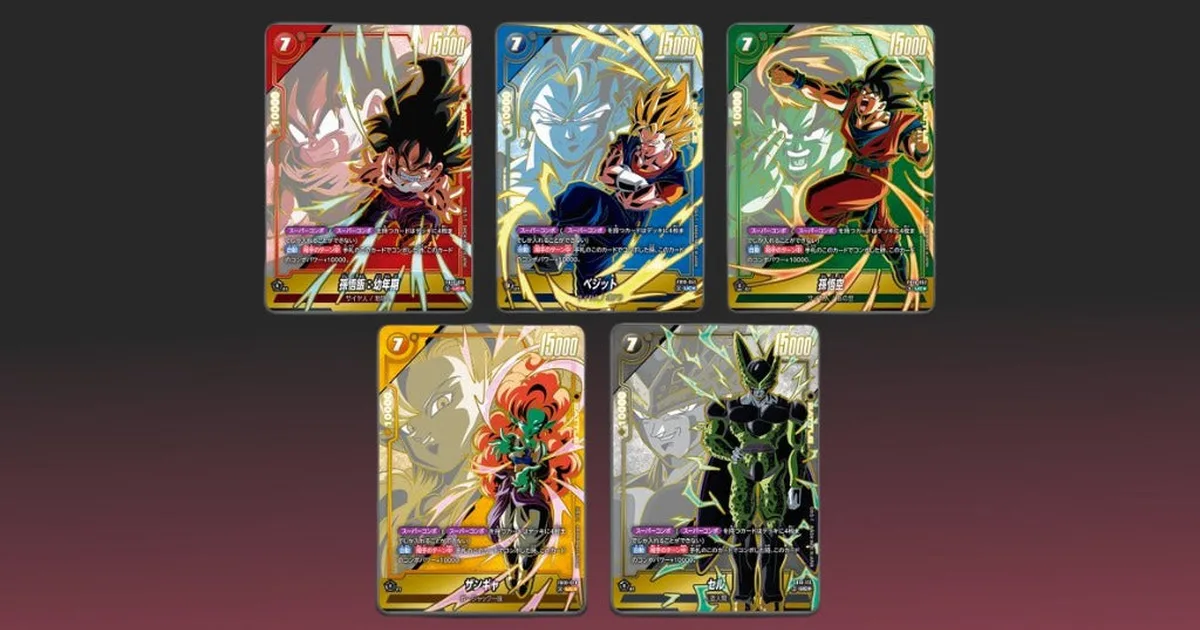
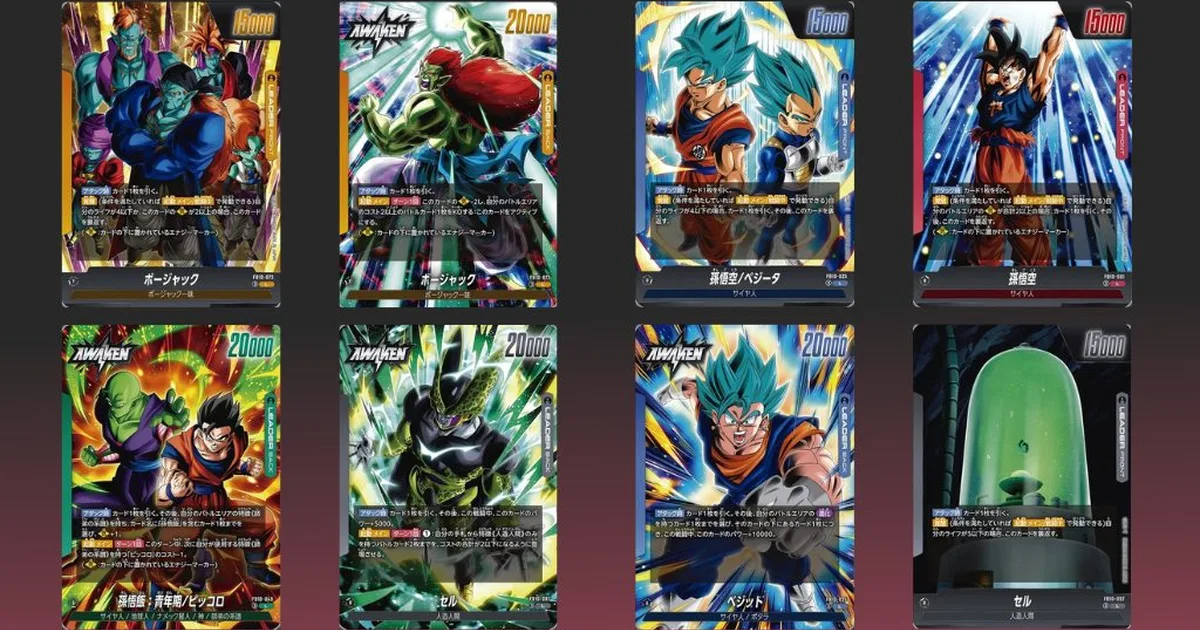
Dragon Ball Fusion World FB10 leaders total five in Cross Force, which launched June 12, 2026 across 123 cards. All five are confirmed by official name on Bandai's product page: Son Goku, Vegito, Son Gohan: Childhood, Boujack, and Cell. Each brings a distinct mechanic angle, and knowing what each leader does before you buy packs or build a deck will save you time and money. The FB10 set guide covers the full 123-card breakdown if you want to see the card pool alongside these leader profiles.
TL;DR: FB10 has 5 leaders. Vegito (Blue Evolve) is the set's headliner and the strongest day-1 pick. Son Gohan: Childhood uses Ki accumulation with a dual Awaken trigger that fires faster than standard leaders. Cell opens villain Evolve as a new archetype. Son Goku (Red, Ki) is the straightforward beginner pick, and Boujack (Yellow, aggro) rounds out the five with a cheap-plays-plus-protection plan. Vegito is easiest to build competitively, Cell is hardest, Gohan sits in the middle.
Five leaders are in FB10 Cross Force, all named in official materials: Son Goku (Red, Ki-based), Vegito (Blue, Evolve-focused), Son Gohan: Childhood (Green, Ki mechanic, dual Awaken condition), Boujack (Yellow, cheap plays plus a Ki-based protection skill), and Cell (Black, villain Evolve). Vegito is the flagship and appeared in day-1 deck lists at launch.
 FB10 introduces three leaders: Vegito (Evolve/Potara fusion), Gohan (Master's Teachings/Piccolo synergy), Cell (BIO archetype).
Vegito is the Potara fusion of Goku and Vegeta, and Bandai isn't subtle about who the star of FB10 is. He's the set's headliner, the Blue color flagship, and the Evolve archetype's showcase piece.
His Awaken condition fires at 4 Life or fewer. Most leaders Awaken at half their starting Life, which tends to land at 3 Life. Vegito's trigger is one step earlier, giving him a faster Awakened-form window. That matters because the Awakened side of a leader card usually carries stronger abilities, and going Awakened earlier against aggressive decks can be the difference between stabilizing and losing.
The Evolve mechanic that Vegito is built around works like this: instead of playing a new Battle card from scratch, you Evolve an existing one into a stronger form. The energy you already invested carries forward. You're not resetting to zero; you're building on the card already in play. For a Blue deck that wants to control the pace of the game, this is a good fit.
Day-1 deck lists confirm what the card text implied: Blue Vegito is the deck to beat coming out of launch. If you're walking into your first FB10 tournament or league night, you'll see this leader across the table.
Was this guide helpful?
About the author
Competitive TCG Analyst
Competitive One Piece TCG player and deck builder with 3 years of tournament experience. Covers meta analysis, tier lists, and leader builds.
Disclaimer
This article is published for informational and entertainment purposes. It does not constitute professional financial, legal, or technical advice. Game performance, online services, patch schedules, and store listings change. Verify critical details (pricing, system requirements, regional availability) with publishers and storefronts before you buy. Affiliate links, where present, help support our editorial work and are labelled in our affiliate disclosure.
Son Gohan: Childhood is the mechanically interesting pick. He's an SCR leader card, which signals Bandai treats him as a chase-level product, and his kit backs that up.
His trait is Master's Teachings, which reduces the cost of Piccolo cards after he Awakens. This pushes you toward a Gohan/Piccolo synergy build, which is thematically appropriate and mechanically coherent.
What makes him genuinely different is the dual Awaken condition. Standard Fusion World leaders Awaken when their Life drops to half the starting amount. Gohan Awakens when his Life drops to 3 OR when 3 Ki markers accumulate in the Battle Area, whichever comes first.
The Ki path is the interesting one. Ki markers accumulate on your cards over the course of a game. The Activate Main ability lets you move all Ki in the Battle Area onto a single card, concentrating the investment. When your Battle Area's total Ki hits 3, Gohan Awakens regardless of your Life total.
This means Gohan can Awaken before he takes the hits a standard leader would need to take. Against aggressive decks, that's an option to dodge their damage plan. Against control, it's a path to your stronger Awakened form without needing to survive their pressure. The Ki condition gives Gohan more agency over when he flips than any other leader in the set.
He's not a beginner pick. Understanding when to chase the Ki path versus accepting the Life path requires reading board states. But he's not the hardest to pilot either. If you already understand Fusion World's turn structure, Gohan is a reasonable second choice after Vegito.
Cell is historically significant in Fusion World terms. He's the first major Dragon Ball villain built around Evolve as a game plan. Before FB10, Evolve was a mechanic associated with hero-side archetypes. Cell opens the villain side.
His leader card is also an SCR, matching Gohan's treatment. The Evolve mechanic works the same for Cell as it does for Vegito in principle: Battle cards transform into stronger forms, energy carries forward. The difference is context. Cell operates on the villain side, which means his supporting card pool draws from villain-tagged characters, and the infrastructure for villain Evolve is newer.
This is the core tension with Cell at launch. He's clearly designed to enable something, and what he enables is genuinely new. Villain Evolve is not a solved archetype. There are no tested deck lists with weeks of tournament data behind them. You're building something during the first weeks of the format.
For competitive players who enjoy solving a new problem, Cell is compelling. For players who want to show up to a league night with a working deck, he's not the choice right now. Give the community time to work out the supporting cards, and check the FB10 meta tier list as results come in before investing in a Cell build. The Cell FB10 deck guide covers the Android trait engine, the cost-1 Cell trick, and the full 50-card list once the archetype settles.
 Each FB10 leader enables a distinct archetype, with Vegito's Evolve combo being the most skill-intensive.
Son Goku is the Red leader (FB10-001), and he's the most linear of the five. He Awakens once his Battle Area holds 2 or more Ki. After Awakening, his Activate Main skill clears all Ki from the Battle Area and stacks it onto himself for roughly +10,000 power on the turn it happens, on top of a draw effect on attack. There's no combo sequencing to learn: build Ki, Awaken, keep swinging with a growing power total. That simplicity is exactly why he's the best entry point for new players, and also why experienced opponents can see his plan coming from turn one. The full Son Goku Ki deck guide covers the Super Genki-Dama payoff and a recent Regional result worth knowing about.
Boujack is the Yellow leader (FB10-073). His On Play and When Attacking skill lets him drop a Battle Card costing 2 or less straight from hand, which keeps pressure on the board every turn without spending extra resources. His other skill is defensive rather than offensive: a Permanent skill that lets him spend 1 of his own Ki to KO a Battle Card in his own Battle Area instead of losing that card to the opponent's removal. It's a one-for-one trade that turns a would-be blowout into an even exchange, but the Ki cost competes with everything else a Yellow aggro deck wants to spend Ki on that turn. The full Boujack deck guide covers why his week-one hype cooled and where he still wins games today.
GODEEPER: If you're figuring out which specific cards inside these leader decks are worth pulling, the FB10 chase card breakdown is the companion piece to this guide. Dragon Ball Fusion World FB10 Best Cards to Pull ->
This is the practical question. Here's the direct answer:
Start with Vegito if you're new to FB10 or building your first competitive deck. Blue Evolve has the most day-1 support, the clearest game plan, and the most available deck lists to reference. He's the strongest leader in the set based on launch-day competitive presence, and he's the easiest to build around.
Pick Gohan if you want mechanical depth without the chaos of an unsolved archetype. His dual Awaken condition adds a layer of decision-making that rewards good play, and the Piccolo synergy gives his deck a coherent direction. He's harder than Vegito but not experimental.
Pick Cell if you want to solve a new problem. Villain Evolve is uncharted territory in Fusion World. Cell's ceiling could be high once the archetype matures. But you'll be doing pioneer work, not following a roadmap.
For players coming in from the FS01-FS04 starter decks: those are still valid entry points into Fusion World. FB10 boosters build on top of them. If your starter deck is Blue or a color that aligns with Vegito's kit, that's a natural path into the FB10 format.
SHOP: Picked your FB10 leader? Check current Dragon Ball Super Card Game prices on TCGPlayer. Shop TCGplayer →
1. Decide how much day-1 support matters to you. If you want the most available deck lists and the clearest game plan to follow, that points to Vegito's Blue Evolve archetype over the newer, less-established options.
2. Check your existing starter deck color. If your FS01 through FS04 starter deck is Blue or otherwise aligns with Vegito's kit, that's a natural on-ramp into FB10 rather than starting from zero.
3. Weigh your appetite for mechanical complexity. Pick Gohan if you want a dual Awaken condition and Piccolo synergy that rewards good decision-making without the risk of an unsolved archetype. Pick Goku if you want the single most linear plan in the set: build Ki, Awaken, keep swinging.
4. Decide if you want to pioneer an archetype. Pick Cell only if you're willing to do the deck-building groundwork yourself, since villain Evolve has the least established support infrastructure of the five leaders at launch.
5. Confirm your pick against current results before buying singles. Check the FB10 meta tier list for how each leader is actually performing, since Cell's archetype and Boujack's line strength both depend on infrastructure that's still developing post-launch.
6. Read that leader's dedicated deck guide before building your 50-card list. Each leader has a full deck guide with the exact card chain, matchup notes, and budget alternatives so you're not guessing at the supporting cast.
Understand the Evolve loop before committing to it. Vegito and Cell both rely on Evolve, but it requires board presence to pay off. You need a Battle card already in play to Evolve into a stronger form. If your board gets cleared repeatedly, Evolve stalls. Play cards that protect your field long enough for Evolve to generate value.
For Gohan: know when to chase Ki. The dual Awaken condition is your edge, but chasing Ki markers blindly can delay your development. If your Life is already at 4 or fewer, the standard Awaken path is closer. If your Life is stable, start accumulating Ki and plan for the faster flip.
Track your Charge Phase investment. Each turn you charge a card facedown to generate energy. Evolve decks benefit from not wasting that investment, since Evolve carries energy forward. Don't charge cards you'll never Evolve unless you have no better option.
Don't build Cell before seeing more official card reveals. This isn't a knock on the leader; it's a timing issue. Villain Evolve infrastructure is limited at launch. Building a Cell deck in week one means speculating on cards that may not exist yet in sufficient quantity. Wait for more FB10 content to confirm before investing.
Use the starter decks as a floor, not a ceiling. The FS01-FS04 starter deck guide explains which starter maps most directly onto each FB10 leader before you upgrade. Once you identify your leader, find a current deck list and understand why each card is in it.
FB10 is also no longer the newest set on the horizon. FB11 Brightness of Hope is confirmed for October 16, 2026, with its first leader reveal already out. That does not change anything about how these five FB10 leaders play today, but it is worth knowing the format is not standing still. The FB11 preview covers what is confirmed so far.
Who are the leaders in Dragon Ball Fusion World FB10? FB10 Cross Force launched June 12, 2026 with 5 leaders in its 123-card set, all confirmed by name on Bandai's official product page: Son Goku (Red, Ki), Vegito (Blue, Evolve), Son Gohan: Childhood (Green, Ki/dual Awaken), Boujack (Yellow, aggro), and Cell (Black, villain Evolve).
What is Vegito's playstyle in FB10? Vegito is a Blue Evolve leader. He Awakens when his Life drops to 4 or fewer, which is earlier than most leaders. He's the flagship deck archetype for FB10 and appeared in day-1 competitive deck lists. His playstyle revolves around the Evolve mechanic: transforming Battle cards into stronger forms while carrying energy investment forward.
How does Son Gohan: Childhood Awaken in FB10? Son Gohan: Childhood has a dual Awaken condition, which is unique among leaders in Fusion World. He Awakens when his Life drops to 3 OR when 3 Ki markers accumulate in the Battle Area, whichever comes first. The Ki-based path gives him faster Awaken timing than most leaders, since you can engineer it without taking hits.
Is Cell a good leader in Dragon Ball Fusion World? Cell is the first major villain built around Evolve in Fusion World history. His ceiling is hard to assess with day-1 data since villain Evolve has less established infrastructure than Blue Evolve. He's a high-skill pick: rewarding for players who understand the Evolve loop, but not the easiest starting point at launch.
Which FB10 leader is best for beginners? Vegito is the safest pick for beginners coming into FB10. His Blue Evolve archetype has the most day-1 support and the most available deck lists. Son Gohan: Childhood requires understanding Ki accumulation and dual Awaken triggers, which adds complexity. Cell is the hardest to build around because villain Evolve infrastructure is still being established.
What is the Evolve mechanic in Dragon Ball Fusion World? Evolve lets a Battle card transform mid-game into a stronger form, carrying its energy investment forward rather than resetting it. You're building on what you've already played rather than starting over. Vegito and Cell are both Evolve leaders, though they serve different color identities and archetypes.
What is the Ki mechanic in Dragon Ball Fusion World? Ki markers accumulate on cards in the Battle Area. Activate Main abilities let you move all Ki from the Battle Area onto a single card, concentrating the investment. For Son Gohan: Childhood, when the total Ki in your Battle Area hits 3, he Awakens regardless of your current Life total.
Related
Union Arena Bleach Ichigo Deck Guide: Purple Build 2026
8 min read
Best Deck Boxes for TCG Storage in 2026: Full Buying Guide
13 min read

Best TCG Playmats 2026: Stitched Edge Buying Guide
10 min read

Best TCG Binders and Portfolios 2026: Side-Load Guide
11 min read

PSA vs BGS vs CGC: Who Really Owns Your Grading Slab (2026)
11 min read