Loading…
Loading…
Shonen TCG · Guides
Disney Lorcana guide for 2026 explains the rules, all six ink colors, deck building, the live Attack of the Vine set, and the current meta for new players.
Reviewing
Disney Lorcana
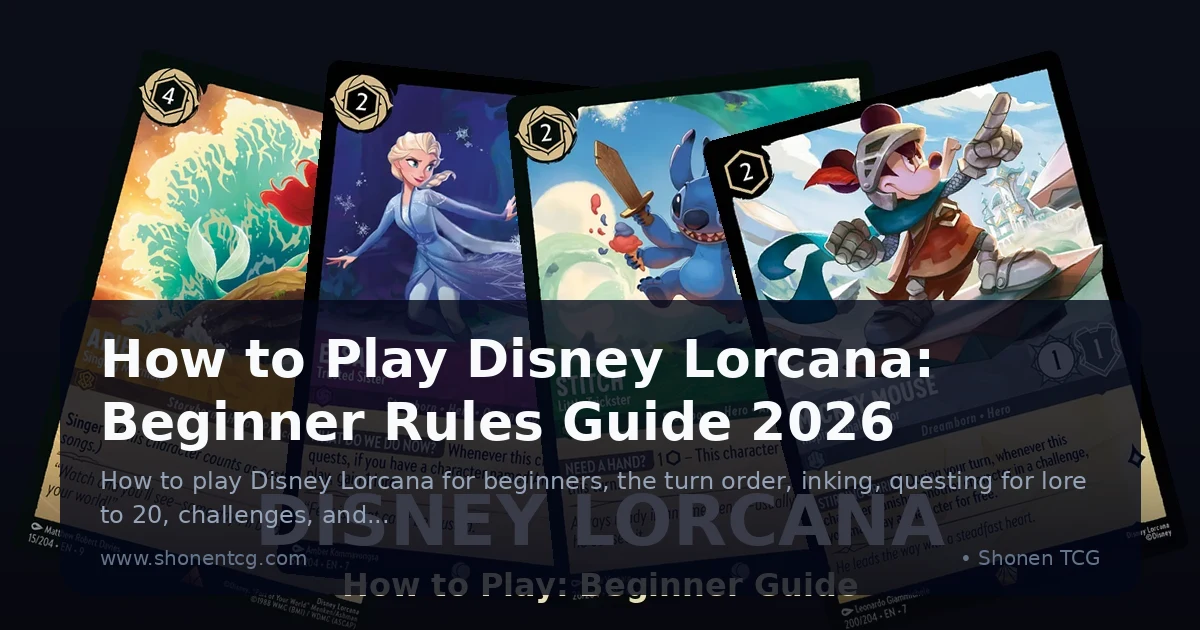
If you are new to the game or returning after a few sets, this Disney Lorcana guide gives you the full picture in one place: how a turn works, what the six ink colors do, how to build a legal 60-card deck, what the current Attack of the Vine set added, and which archetypes are winning now. Lorcana is a Disney and Pixar trading card game from Ravensburger where you play as an Illumineer summoning "glimmers" of famous characters, and the first player to gather 20 lore wins.
TL;DR: Disney Lorcana is a two-player card game where you ink one card per turn for resources, play Characters, Items, Songs, Actions, and Locations, and race to 20 lore. Decks are 60+ cards, up to 2 of 6 ink colors, max 4 copies each. The current set is Attack of the Vine (July 24, 2026, the 13th set, with Monsters Inc, Up, and Turning Red glimmers), and the post-rotation Core Constructed meta is led by Amber-paired decks: Amber/Emerald Elinor and Amber/Ruby Boost. This Disney Lorcana guide covers rules, ink, deck building, the live set, and the meta.
Disney Lorcana is a collectible card game published by Ravensburger, first released in September 2023. You play an Illumineer, a magic user who pulls "glimmers" (reimagined versions of Disney and Pixar characters) into the world to collect lore for the Great Illuminary. Two players each bring a deck, take turns, and the first to reach 20 lore wins, a running total most players end up tracking with a physical counter rather than doing the math in their head every turn.
What makes Lorcana approachable is that the resource system and the win condition are the same currency of attention. You are not counting damage to a life total. You are racing a counter to 20 while trying to slow your opponent down. That single idea keeps games fast and readable, which is why the game found a large beginner audience quickly. If you are weighing it against other anime and pop-culture card games, our roundup of the best anime TCG to play in 2026 puts Lorcana next to One Piece, Union Arena, and others.
Lorcana is also one of the more collectible games on the market because of its art. Every card uses original Disney and Pixar illustration, and the rarest "enchanted" versions feature full-art borderless treatments that drive the secondary market. We will cover where that value sits later in this Disney Lorcana guide.
A game of Lorcana is built from a few repeating steps, and the Disney Lorcana rules are short enough that once you have played a handful of turns, the loop becomes second nature.
The objective. Be the first to 20 lore. You gain lore primarily by questing: tapping (called "exerting") a character that has a lore value so it gathers that many lore for you. Some Items, Locations, and abilities grant lore too, but questing is the engine.
Your turn, step by step.
Inkwell and resources. Inking is the heart of the economy. Every card you ink is a card you cannot play, so deck building is a constant trade between cards you want to ink and cards you want to keep. A common rule of thumb is to run at least 45 inkable cards out of 60 so you are not stuck unable to ramp.
Challenging. Characters can challenge (attack) opposing characters that are exerted. Both characters deal their Strength to each other as damage, and a character is banished when damage meets or exceeds its Willpower. You generally cannot challenge a character that is still ready, which protects fresh plays and rewards good sequencing.
Keywords you will see constantly. Rush lets a character challenge the turn it is played. Evasive means only characters with Evasive can challenge it, which is why "Evasive" decks are strong. Ward stops opponents from choosing the card with actions or abilities. Bodyguard forces opponents to deal with that character first. You will also meet Singer, Shift, Support, Challenger, Reckless, and Resist as you read more cards.
A worked first three turns. On turn one you usually ink a card and play a one-cost character, then pass. On turn two you ink again, play a two-cost character, and if your turn-one character survived and is still ready, you quest with it for its lore. By turn three you have three ink, which is the first real decision point: do you develop a bigger threat, quest with everything for tempo, or hold up a removal Action for the opponent's best play? New players almost always quest too greedily here and lose their board to a single challenge. The stronger habit is to quest with evasive or protected characters and keep your fragile ones back until they are safe. Learning that one rhythm, quest when safe and develop when not, is most of what separates a new Illumineer from a confident one.
About the author
Multi-TCG analyst covering the competitive trading card game scene. Tournament coverage, format analysis, and cross-game comparison content.
Disclaimer
This article is published for informational and entertainment purposes. It does not constitute professional financial, legal, or technical advice. Game performance, online services, patch schedules, and store listings change. Verify critical details (pricing, system requirements, regional availability) with publishers and storefronts before you buy. Affiliate links, where present, help support our editorial work and are labelled in our affiliate disclosure.
Your deck uses up to two of the six inks, and that pairing is the single biggest decision you make. Each ink has a personality, and the best decks pick two that cover each other's weaknesses.
| Ink | Identity | What it does best |
|---|---|---|
| Amber | Healing and protection | Aggressive go-wide boards, healing, song support |
| Amethyst | Magic and card flow | Card draw, bounce, flexible answers |
| Emerald | Disruption and tempo | Hand attack, evasive threats, sneaky lore |
| Ruby | Aggression and power | High Strength bodies, fast challenges |
| Sapphire | Ramp and value | Extra ink, Items, expensive payoffs |
| Steel | Removal and big threats | Damage-based removal, durable characters |
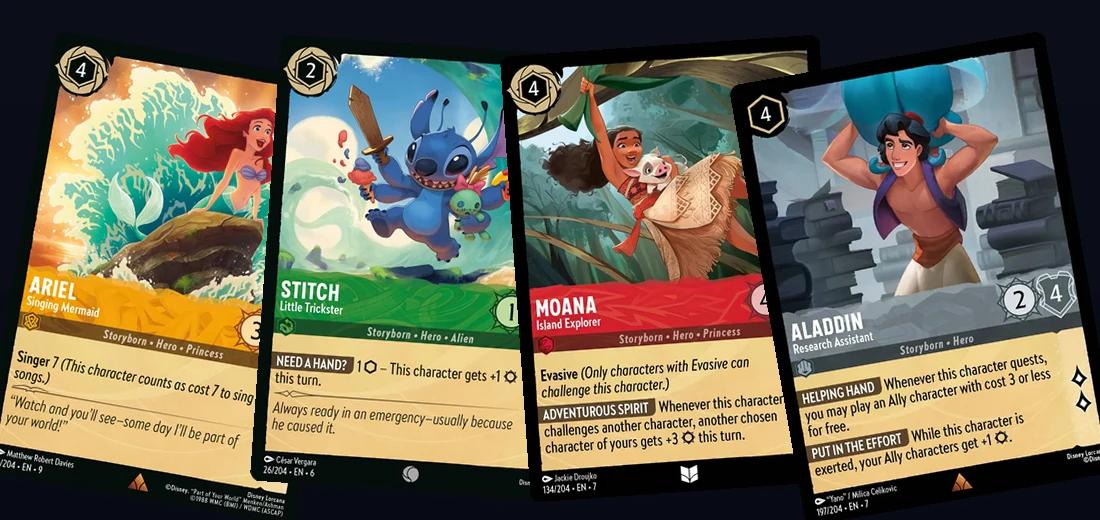 Caption: A card's ink (the gem in the top-left of the cost) decides which deck it can go in. These four show Amber, Emerald, Ruby, and Steel.
A few classic pairings explain why these matter. Amber Amethyst leans on cheap evasive characters and protection to quest unblocked. Ruby Sapphire ramps into oversized threats and Items. Emerald Steel mixes disruption with removal to grind the opponent out. Amethyst Ruby is the current #1 Bounce archetype; the Lorcana Amethyst Ruby deck guide covers the full 60-card build. There's no single best ink, only the best pairing for the plan you want to run. When you are ready to build, the deck building section below shows how to turn an ink pairing into 60 cards.
Lorcana deck building rules are short, which is part of the appeal:
Beyond the legal rules, the craft is in three numbers. First, your inkable count: aim for around 45 or more inkable cards so your early turns aren't stranded. Second, your curve: have enough cheap plays (1 to 3 cost) to act on turns one through three, then a few expensive payoffs. Third, your lore output: count how much lore your board can generate per turn, because 20 lore arrives faster than new players expect.
A simple first build is a two-ink aggressive deck: lots of small evasive characters, a couple of songs for tempo, and a light removal package. It teaches the core loop of inking, questing, and protecting your board. From there you can move toward control or ramp once you understand how the meta punishes a slow start. If you have played other two-resource card games, the deckbuilding instincts transfer well; our One Piece TCG beginner guide and Union Arena beginner guide cover similar fundamentals from a different angle.
Attack of the Vine is the current set. It released to wide retail on July 24, 2026 (prereleases ran the week of July 17, the same day Core Constructed rotation took effect) and it's the 13th main set in the game. It brings three new IPs into Lorcana for the first time: Monsters Inc, Up, and Turning Red glimmers join the roster alongside the usual mix of Disney and Pixar classics.
If you're buying in, the main products are:
For collectors, Iconic rarity sits above Enchanted as the set's top chase tier. For players, singles in your chosen ink pairing bought during release week is the most efficient path into the competitive format; the Attack of the Vine best cards to pull guide (linked in the full guide list below) covers which Iconics and Enchanted are actually worth chasing versus which are display-only.
GODEEPER: Curious how Lorcana's collectible value compares to other card games before you open packs? See how the One Piece market handles chase cards in our most expensive One Piece TCG cards breakdown. Most Expensive One Piece TCG Cards →
Ravensburger has confirmed Set 14, Hyperia City, for an October 23, 2026 release (prerelease October 16). It brings Coco into Lorcana for the first time. See the Hyperia City preview for every confirmed card and product detail so far.
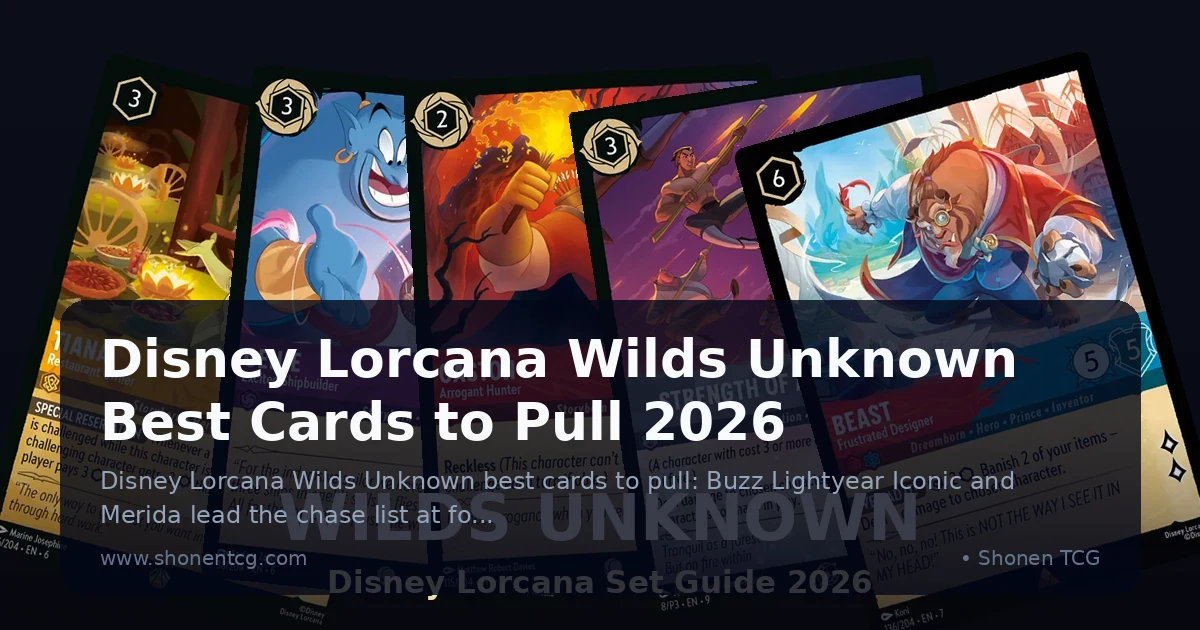
Wilds Unknown was the 12th main set, released May 15, 2026, and it holds one historical distinction: it was the first set to include Pixar glimmers, with Toy Story, Brave, and The Incredibles characters (Woody, Buzz Lightyear, Jessie, Merida, and the Parr family) joining the game for the first time. It's no longer the current set, but its cards remain legal in Core Constructed (Sets 9-13) and its Pixar debuts still see competitive and collector demand.
The best Disney Lorcana decks are tracked closely by community sites, and the Core Constructed format, post-Set-13-rotation, has a new top tier. The pre-rotation leaders (Amethyst Sapphire Evasive, Amber Emerald Aggro) did not hold a standalone top-tier slot after Sets 5-8 left the format; Amber paired with nearly every other ink turned out to be the story instead. Metashare shifts week to week, so treat these as a snapshot rather than fixed law:
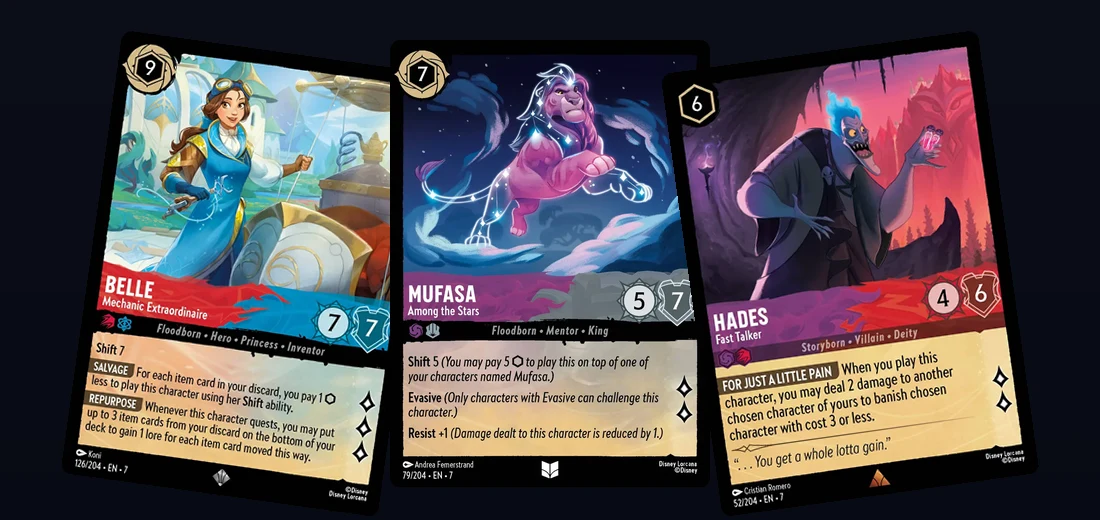 Caption: Dual-ink cards like Belle, Mufasa, and Hades anchor the two-color archetypes that lead the current meta.
The clear theme post-rotation is that Amber is the format's defining ink, appearing in nearly every top-five deck paired with something different: Emerald for tempo, Ruby for aggression, Amethyst for card flow, Steel for removal. If you are building your first competitive deck, an Amber-based shell gives you the widest range of proven pairings to pick from. The Infinity Constructed format (which allows older cards) still runs on the pre-rotation pool, led by Amber Steel Steelsong, so always check which format your local event uses.
A practical buying tip: since the meta rewards Amber's flexibility, cards that protect your board or push through the last few points of lore are premium regardless of which second ink you pair it with. Prioritize those when you spend on singles.
This Disney Lorcana guide is the hub for our Lorcana coverage. Start with these and work from beginner to competitive in order:
What is the goal of Disney Lorcana? You win by being the first player to collect 20 lore. You gain lore mainly by questing with characters that have a lore value (the diamond icon). Most games end somewhere between turn 6 and turn 10 once a player can quest freely.
How many cards are in a Disney Lorcana deck? A constructed deck needs at least 60 cards with no upper limit, can use up to two of the six ink colors, and can run a maximum of 4 copies of any one card by full name. Most competitive lists run exactly 60 to keep their draws consistent.
What are the six ink colors in Disney Lorcana? Amber (healing and protection), Amethyst (magic and card draw), Emerald (disruption and tempo), Ruby (aggression and high power), Sapphire (ramp and value), and Steel (removal and big bodies). A deck mixes two of these, which defines its game plan.
What is the newest Disney Lorcana set in 2026? Attack of the Vine, the 13th main set, released to wide retail on July 24, 2026, following its July 17 prerelease, the same day Core Constructed rotation took effect. It's the first set with Monsters Inc, Up, and Turning Red glimmers. Wilds Unknown (May 15, 2026), the 12th set and first Pixar set, is now the previous release.
Is Disney Lorcana good for beginners? Yes. The core loop of inking a card, playing characters, and questing for lore is simple to learn, and starter products like the Illumineer's Trove and two-player starters teach the game with fixed decks. The depth comes from ink pairings and timing your challenges.
Do I have to buy single cards to be competitive? Eventually yes, but you can start with a starter deck and upgrade slowly. Singles let you build a focused two-ink archetype, which is how the top meta decks are built. Sealed products are better for collectors and casual play than for chasing a specific competitive list.
Related
Union Arena Fullmetal Alchemist Deck Guide: Blue 2026
8 min read
Union Arena Attack on Titan Vol.2: New Yellow Color
8 min read
OP-17 Mihawk Deck Guide: Green Dracule Mihawk 2026
13 min read
Dragon Ball Fusion World FB11 Leaders: All 5 Revealed
8 min read
OP-17 Mihawk Matchup Guide: All 6 Leaders Explained
14 min read