Loading…

Shonen TCG · Guides
Lorcana Attack of the Vine Mechanics: Shift, Hunny, Dual Ink
Lorcana Attack of the Vine mechanics are easier to understand after the full set release than they were during preview season. Set 13 adds four named Shift variants, a deck-construction exception for Hunny characters, and more Dual Ink cards. The official release notes also add important edge cases that the early three-mechanic summary missed.
TL;DR: Attack of the Vine introduces Duo Shift, Combo Shift, Temporary Shift, and Potato Shift. Team is a new classification for many dual-named characters. Christopher Robin lets an Amethyst/Sapphire deck include other Hunny characters regardless of their ink type, while Dual Ink still requires both listed inks in your deck.
Lorcana Attack of the Vine mechanics? (quick answer)
The short version is that Shift now has more ways to build a stack. Team characters can match either name, Duo Shift needs two named characters, Combo Shift can use one or two bases, Temporary Shift returns its top card to hand, and Potato Shift can use an item as its base. Hunny changes deck construction for other Hunny characters, while Dual Ink remains a two-ink requirement rather than a permission to use either color alone.
Lorcana Attack of the Vine Shift variants
The official set release notes separate the new Shift rules from the normal Shift ability. Keeping those distinctions straight prevents most deckbuilding mistakes.
Team characters and dual names
Attack of the Vine adds a large group of dual-named characters with the Team classification. A card named Sulley & Boo counts as Sulley, Boo, and Sulley & Boo for name checks, while still being one character. Team cards can generally use a normal Shift ability on either matching name, which gives them more possible bases than a single-name character.
Duo Shift
Duo Shift requires two separate characters, one matching each name on the card. Mickey Mouse & Minnie Mouse - Adventuring Duo is the official example: you need both a Mickey Mouse and a Minnie Mouse in play, then place the Duo Shift card on top of both. Its cost is 0 ink, but the two-card setup is the real restriction.
When a Duo Shift stack uses bases with different ready or drying states, the top character inherits the more restrictive state. A ready card and an exerted card produce an exerted top character. A dry card and a drying card produce a drying top character.
Combo Shift
Combo Shift is the flexible middle ground. Dash Parr & Violet Parr - Super Siblings can shift onto a Dash Parr, a Violet Parr, or one of each. Sulley & Boo - Scare Buddies is another official example. If you use two bases, the same ready, exerted, dry, and drying state rules apply.
Temporary Shift
Temporary Shift is the Turning Red variant. Meilin Lee - Popular Red Panda costs 6 ink normally and has Temporary Shift 3, so you can pay 3 ink to place it on a character named Meilin Lee. At the end of the turn, the card text removes all damage from the character and returns only the Temporary Shift card to your hand. Its Karaoke Queen ability gains 3 lore once during your turn when she sings a song.
Ming Lee - Giant Red Panda uses the same keyword with a different scale. She costs 9 ink, has 10 Strength and 10 Willpower, and can pay 7 ink to shift onto a character named Ming Lee. Her Path of Destruction ability readies her after she challenges another character, but she cannot quest again for the rest of that turn.
The return is conditional. If the Temporary Shift card is banished before the end of the turn, it stays in the discard pile. If it is in a stack that is still in play, it returns even if another card has been shifted on top of it. The official notes also clarify that the damage removal applies to the character at the top of the stack, so a player should track the stack rather than treating the effect as simple immunity.
Potato Shift
Potato Shift changes the type of legal base. Posey - Vampire Potato can pay 5 ink to shift onto an item named Potato. If that Potato was in play at the start of your turn, Posey can quest, challenge, sing, and take normal character actions. If you play the Potato and then shift Posey onto it during the same turn, Posey is drying and cannot take those actions yet.
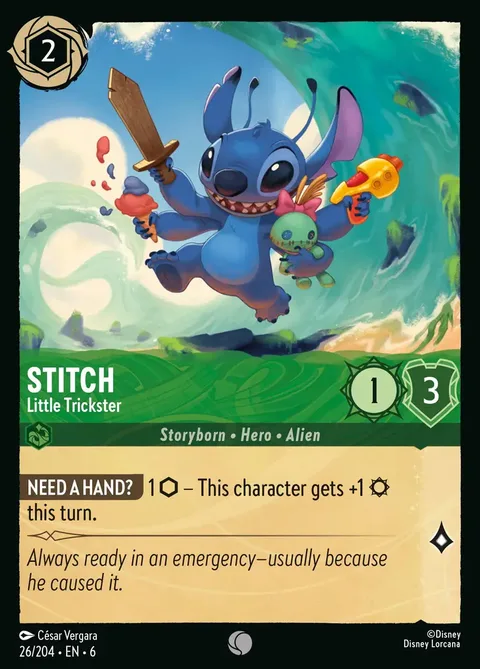 This older Lorcana card shows where cost, ink, and ability text appear; use the official Set 13 release notes for current Shift wording.
Step-by-Step: resolve a Temporary Shift turn
1. Check the base requirement. Confirm the card's exact Shift text. Meilin Lee and Ming Lee require a character with the matching name, while other Set 13 variants can use a classification or an item.
2. Pay the printed Shift cost. Temporary Shift uses the reduced cost shown on the card, but it still needs a legal base and the normal play conditions for a character.
3. Take actions within the turn's restrictions. Ming Lee can challenge and then ready from Path of Destruction, but that ability also prevents her from questing for the rest of that turn. Do not assume a ready effect erases every restriction.
4. Resolve the end-of-turn return. If the stack is still in play, remove damage from the character and return only the Temporary Shift card to your hand. The card underneath remains in the stack.
5. Check the zone before planning the next use. A banished Temporary Shift card stays in the discard pile, so the repeat loop only exists when the card survives in a stack in play and you have another legal base and enough ink.
Hunny: a narrow deck-construction exception
Christopher Robin - Hunny Sage is the card that makes the Hunny rule unusual. His Gather the Party ability says you can have other Hunny characters in your deck regardless of ink type. That is narrower than saying every Hunny card becomes neutral, and it does not change the ink requirement for Christopher Robin himself.
Christopher Robin is an Amethyst and Sapphire character that costs 6 ink, has 4 Strength, 4 Willpower, and 2 lore. He can therefore only be included in an Amethyst/Sapphire deck. Once he is a legal inclusion, other Hunny characters can join that deck even when their printed ink type is different. His Magical Summons ability can also search the deck for a Hunny card when he is played.
In practical deckbuilding, the sequence is:
- Start with an Amethyst/Sapphire shell so Christopher Robin is legal.
- Add Christopher Robin only if a six-ink character fits the plan.
- Choose Hunny characters for their actual effects, not just because they bypass an ink restriction.
- Do not extend the exception to non-character Hunny cards unless a card specifically grants that permission.
The official release notes call out the restriction directly. Christopher Robin cannot use his own ability to enter a deck with different inks because the ability does not apply until he is already in the deck.
Dual Ink and the returning two-color rule
Dual Ink cards belong to two ink types. To include one, your deck must match both. A Ruby/Sapphire card can be used in a Ruby/Sapphire deck, but not in a Ruby-only or Sapphire-only deck. The fact that you can pay its cost with one of its listed inks does not remove the deck-construction requirement.
Dual Ink first appeared in Archazia's Island and returned in later sets. Attack of the Vine continues the mechanic through Team characters that combine two ink identities. Belle & Beast - Certain as the Sun is Ruby/Sapphire, while Lilo & Stitch - Fun-Loving Friends is Amber/Steel. The official card gallery lists their standard versions and separate Iconic printings, so Set 13 should not be described as lacking an Enchanted tier.
The most useful deckbuilding test is simple: if your deck does not already play both listed inks, the Dual Ink card is not legal for that list. If it does play both, the card may offer a flexible role, but its cost, Shift base, and abilities still need to justify the slot.
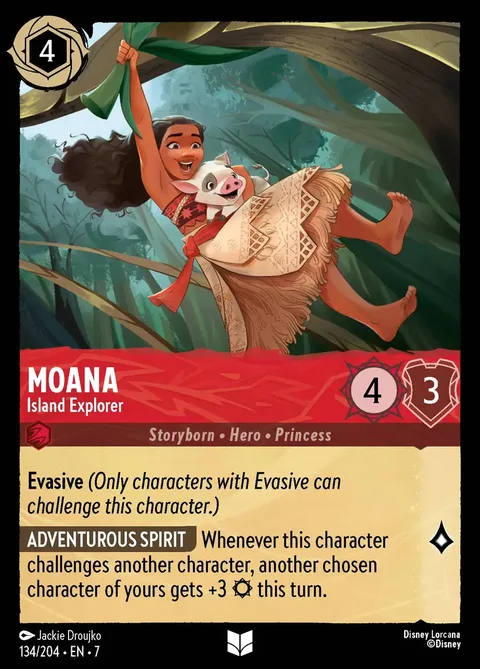 This older single-ink card shows the ink symbol location; Set 13 Dual Ink cards display two symbols in that area.
How the mechanics affect deckbuilding
Temporary Shift rewards a deck that can provide the correct base and pay the reduced cost repeatedly. It is not automatic protection: a card that is banished before the end-of-turn trigger stays in the discard pile, and you still need a legal base for the next turn.
Team, Duo, and Combo Shift reward careful board state tracking. Duo Shift spends two characters for one top card, while Combo Shift lets you choose between one matching base and two matching bases. That flexibility can matter more than the printed Shift discount, but it also creates more ways to misread whether a card is ready or drying.
Hunny is strongest when Christopher Robin is a reasonable Amethyst/Sapphire card before the splash package is considered. Dual Ink is the opposite kind of restriction: it expands effects across a two-color shell, but it does not let a mono-ink deck use the card.
The official card gallery is the right place to confirm the exact text, rarity, legal formats, and collector number of a named Set 13 card. Those fields can differ between a normal printing and a premium treatment, and they matter more than preview-era shorthand when you are building a current list.
Frequently Asked Questions
What new mechanics are in Attack of the Vine? The official release notes introduce Duo Shift, Combo Shift, Temporary Shift, and Potato Shift. The set also adds many dual-named Team characters, the Hunny deck-construction rule, and more Dual Ink cards.
What is Temporary Shift in Lorcana? It lets you play a character on a matching base for a reduced cost. If the stack is still in play at the end of your turn, remove damage from the character and return only the Temporary Shift card to your hand.
Does Temporary Shift return if the character is banished? No. A Temporary Shift card that is banished before the end of the turn stays in your discard pile. If it remains in a stack in play, it returns even if another card is on top of it.
What is the Hunny mechanic? Christopher Robin - Hunny Sage lets you include other Hunny characters regardless of ink type. Christopher Robin himself still requires an Amethyst/Sapphire deck.
How does Dual Ink work? Your deck must match both ink types printed on a Dual Ink card. A Ruby/Sapphire card cannot be included in a Ruby-only deck.
What is Potato Shift? It lets Posey - Vampire Potato shift onto an item named Potato. A Potato already in play at the start of your turn lets Posey act normally, while a Potato played that turn leaves her drying.
What are Meilin Lee - Popular Red Panda's stats? She is a Ruby Legendary character with a 6-ink cost, 4 Strength, 5 Willpower, 3 lore, Temporary Shift 3, and Karaoke Queen.
Related Reading
- Disney Lorcana How to Play: Beginner Guide: Core turn and deck rules behind Shift, ink, and character actions.
- Disney Lorcana Core vs Infinity Format Guide for 2026: Format legality and rotation context for Set 13 cards.
- Disney Lorcana Attack of the Vine Complete Set 13 Guide: A wider card-pool overview for the set's characters and themes.
- Disney Lorcana Attack of the Vine Best Decks: Current deck context after the set's release.
- Disney Lorcana Rotation 2026 Guide: Which older sets remain legal in Core and which move to Infinity.
References
- Attack of the Vine official set release notes: Shift variants, Hunny deck construction, and rules clarifications
- An Ever-Shifting Game: Official designer overview of Team, Duo, Combo, and Temporary Shift
- Ming Lee - Giant Red Panda card gallery: Official card text, stats, rarity, and formats
- Meilin Lee - Popular Red Panda card gallery: Official card text, stats, rarity, and formats
- Christopher Robin - Hunny Sage card gallery: Official Hunny rule, stats, rarity, and formats
- Belle & Beast - Certain as the Sun card gallery: Official Ruby/Sapphire card text and standard printing details
- Lilo & Stitch - Fun-Loving Friends card gallery: Official Amber/Steel card text and Iconic printing details
- Introducing Dual-Ink Cards: Official deck-construction rule for Dual Ink cards
Was this guide helpful?
About the author
AC
Multi-TCG analyst covering the competitive trading card game scene. Tournament coverage, format analysis, and cross-game comparison content.
- Covers multiple TCG formats
- Tournament reporter and analyst
- Cross-game format comparison specialist
- Active in OPTCG, Union Arena, and Lorcana communities
Disclaimer
This article is published for informational and entertainment purposes. It does not constitute professional financial, legal, or technical advice. Game performance, online services, patch schedules, and store listings change. Verify critical details (pricing, system requirements, regional availability) with publishers and storefronts before you buy. Affiliate links, where present, help support our editorial work and are labelled in our affiliate disclosure.