Loading…
Loading…
Shonen TCG · Guides
Reviewing
Disney Lorcana
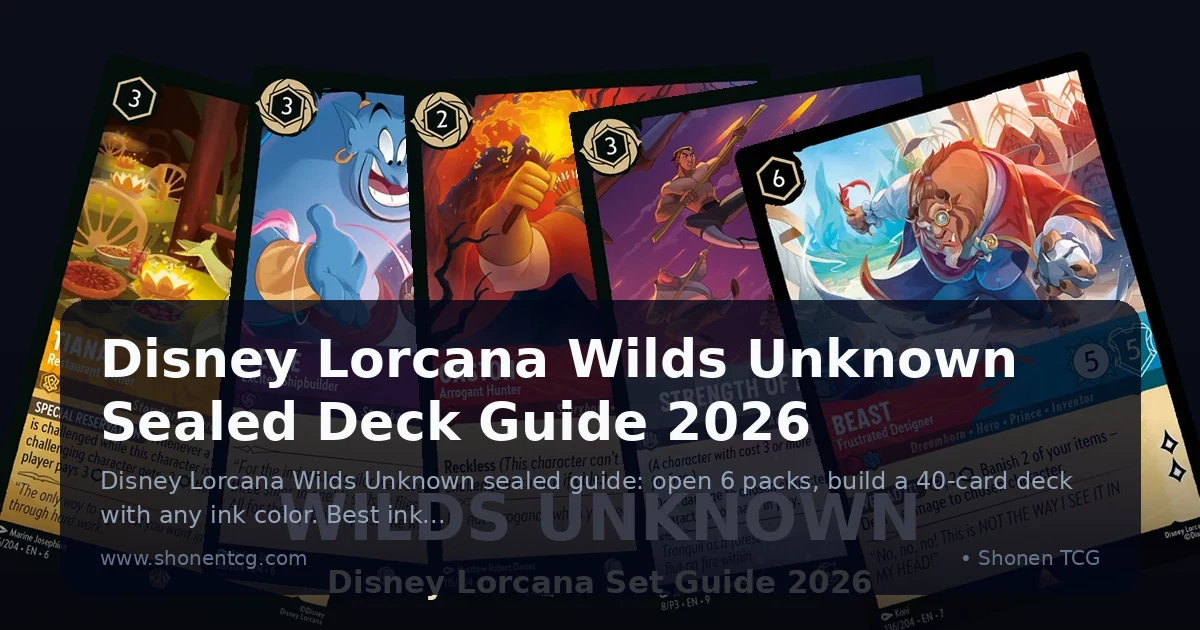
Disney Lorcana Wilds Unknown sealed format is what you play at prerelease events for Set 12. Open 6 packs, build a 40-card deck in 20 minutes, then play against other people who built from the same pool. No collection required. No two-color restriction. No deck from home. Wilds Unknown also introduces Monster and Toy card type classifications that debut in this set, and they shift how you evaluate your pool.
TL;DR: Open 6 packs (72 cards), build a minimum 40-card deck. Any ink color combination is legal. Prioritize standalone power over synergy, anchor your curve around 2-4 cost characters, keep your inkable count at 24+ cards, and pick the two colors with the most playable cards even if they're not your usual favorites. Wilds Unknown Monster and Toy cards add new sealed-specific decision points around triggered abilities.
Sealed is a limited format where your deck comes entirely from cards you open that day. At a Wilds Unknown prerelease, you get 6 booster packs and 20 minutes to sort, register, and build a playable deck of at least 40 cards. It's the format that strips away collection advantages: whoever opens better cards that day has the edge, not whoever spent more on the secondary market.
When you sit down at a Wilds Unknown sealed event, you open 6 sealed booster packs simultaneously. Each pack contains cards across the six ink colors, so your pool spreads across Amber, Amethyst, Emerald, Ruby, Sapphire, and Steel in roughly even distribution.
The math: 6 packs times 12 cards per pack equals 72 cards total. Your deck must include at least 40 of them. Most players build to exactly 40 because a smaller deck means drawing your best cards more often.
Three rules shift from Constructed:
No ink color restriction. In standard Lorcana you must declare two colors and stick to them. In sealed, you can use any combination. This sounds good but creates a trap: spreading across four or five colors dilutes your Inkwell options and makes your early turns awkward. Two focused colors almost always beats a rainbow build.
No copy limits. If you open three copies of the same character, you can run all three. In a 72-card pool this rarely matters for most cards, but it changes how you evaluate duplicates. A second copy of a strong 3-cost character is never dead weight.
20-minute build window. The clock is real. Experienced players spend the first 8 minutes sorting by ink color, the next 6 evaluating their two or three best color combinations, and the last 6 physically building and checking the list. Practicing this at home before your first prerelease helps more than studying any tier list.
You can learn the core rules at the Disney Lorcana how-to-play beginner guide if sealed is your first exposure to the game.
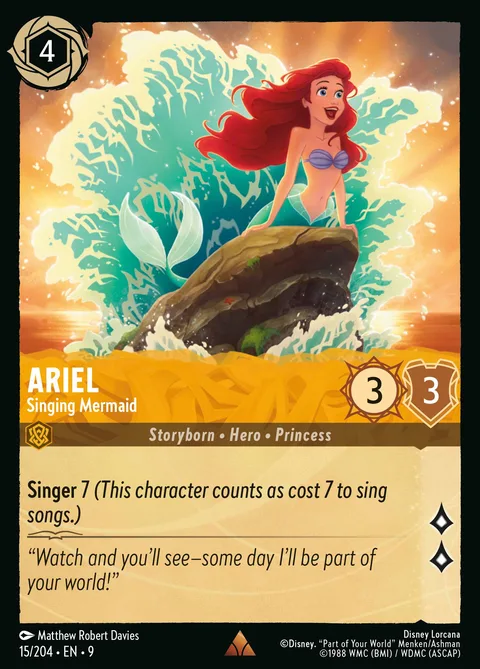 Ariel - Singing Mermaid is one of the key characters in this Lorcana format.
Don't evaluate cards one at a time when you open your packs. That burns your time budget. Sort by ink color into six piles first, then count each pile.
A pile with 15 or more cards is a strong color for your build. A pile with 8 or fewer cards is almost certainly unplayable as a main color.
After sorting, run a quick count for each color:
Pick your top two colors based on that scan, not based on which color has the single most exciting rare. A 7-drop legendary in a thin color that has no 2-drops is unplayable.
GODEEPER: Understanding ink color identities helps you evaluate your sealed pool faster. Disney Lorcana Ink Colors Explained: All 6 Inks Compared →
Was this guide helpful?
About the author
Multi-TCG analyst covering the competitive trading card game scene. Tournament coverage, format analysis, and cross-game comparison content.
Disclaimer
This article is published for informational and entertainment purposes. It does not constitute professional financial, legal, or technical advice. Game performance, online services, patch schedules, and store listings change. Verify critical details (pricing, system requirements, regional availability) with publishers and storefronts before you buy. Affiliate links, where present, help support our editorial work and are labelled in our affiliate disclosure.
Each ink color plays differently in Wilds Unknown sealed. Here's how they tend to shake out in limited:
Amber brings efficient mid-cost characters with reasonable Strength and Willpower. Amber characters quest reliably because many have Evasive or conditional resistance. Good Amber opens let you establish a questing board early and defend it.
Amethyst leans toward bounce and control. Return-to-hand effects are strong in sealed because opponents often can't rebuild quickly when they lose a character. A single bounce can swing a stalled game.
Emerald is utility and flexibility. Many Emerald cards have conditional text that gets useful when you understand your pool's specific threats. Emerald pairs well with anything because its support cards rarely need a specific partner.
Ruby is the aggressive option. Strong early characters with high Strength force opponents to trade or fall behind on lore. Ruby sealed pools with a solid 2-3 cost curve can end games before the late game matters.
Sapphire gives card draw and Inkwell acceleration. In sealed, drawing more cards matters because your card quality is inconsistent by definition. Sapphire draw effects smooth out bad opening hands.
Steel has high-cost payoffs and durable characters. It's slower and rewards pools with enough early game from the second color. Strong Steel backed by Amber or Ruby early game is a reliable sealed archetype.
The best two-color sealed combinations from Wilds Unknown are Ruby-Amber for aggressive builds, Sapphire-Amethyst for control, and Emerald-Steel for midrange. Those are starting points, not rules. Your pool's actual contents override theory every time.
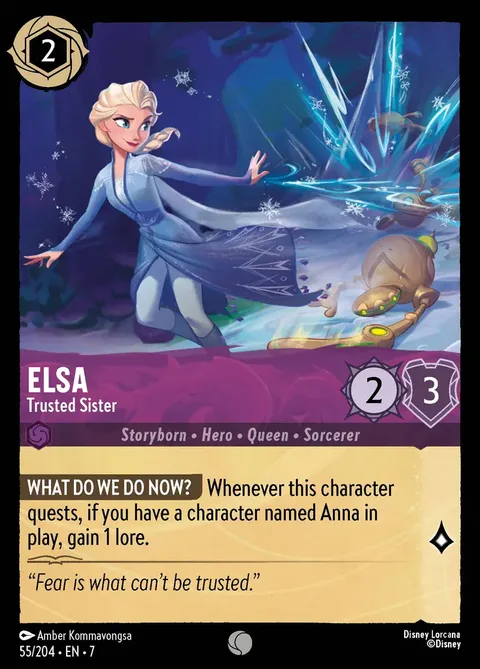 Elsa - Trusted Sister brings unique abilities to the Lorcana card pool.
Sealed card evaluation differs from Constructed. The Constructed question is "does this card fit my deck's plan?" The sealed question is simpler: "does this card do something useful without needing a specific partner?"
Cards that pass: characters that can quest without dying to the most common Strength values you'll face, removal or bounce that works on any target, card draw that doesn't require a board state to trigger, cheap inkable cards that give Inkwell flexibility in early turns.
Cards that fail: characters with triggered abilities that require another specific named card, high-cost characters with no built-in protection in a color with no cheap support, items or actions that enhance characters you might not have.
Wilds Unknown adds Monster and Toy type classifications to the Lorcana card pool. Monster characters in sealed tend to have high raw stats for their cost but fewer passive keyword abilities. In sealed, raw Strength is more reliable than triggered text, so Monster cards tend to over-perform their Constructed evaluations. A 5-Strength character for 4 cost is consistently playable even if the trigger never fires.
Toy characters have abilities that scale with other Toy cards in play. The best Toy cards in sealed work individually first. If a Toy character needs 3 other Toys on the board to do something meaningful, it's a sideboard card in limited. If it does something useful alone and gets better with Toy partners, it's a reasonable include.
GODEEPER: See which Wilds Unknown cards are commanding the highest secondary market prices and why. Disney Lorcana Wilds Unknown Most Valuable Cards →
Once you've chosen your two main colors, the build follows a clear priority order.
1. Count your curve first. Count how many 2-cost, 3-cost, and 4-cost characters you have in your two colors. Aim for 8-12 total characters in that range; below 8 and you'll stall on early turns regularly, above 12 and you can trim to keep your average cost down.
2. Hit your inkable count. Target at least 24-26 inkable cards in a 40-card deck. Low inkable counts cause games where you can't Ink for multiple turns, and sealed punishes tempo losses hard.
3. Cap your top end at 5+ cost. Include 3-5 high-cost characters maximum. Sealed games sometimes go long, but flooding on expensive cards makes early turns painful, so pick your best 2-3 top-end cards and leave the rest in your sideboard.
4. Add every removal, bounce, and draw effect you have. Include every removal or bounce effect in your chosen colors, up to about 6, plus all of your card draw. These effects are more powerful in sealed than any other format because both players are working with inconsistent pools.
5. Check your lore generation. Check how much lore per turn your deck can produce by turn 5. If you can't realistically reach 18 lore in a normal game through your characters' Quest values, adjust your top-end choices.
6. Count your final deck and trim to 40. If you're over 45 cards, trim the weakest 2-cost characters or the most situational Actions first. Don't cut inkable cards below your 24-card target.
Set 12 introduces Monster and Toy as new card types, and they need separate evaluation in limited.
Monster cards are high-Strength characters with conditional triggered abilities. Raw Strength is more reliable in sealed than in Constructed, so Monster cards tend to over-perform. A 5-Strength character for 4 cost is consistently playable in limited even if the trigger never fires.
Toy characters have abilities that scale with other Toy cards in play. The key question: does this card do anything useful by itself? If a Toy character needs 3 other Toys on board to do something meaningful, it's a sideboard card in limited. If it does something useful alone and gets better with Toy partners, it plays as a solid include.
Check the Disney Lorcana Wilds Unknown set guide for a full breakdown of which Wilds Unknown cards have the strongest standalone power.
Players coming from Constructed need to adjust their instincts for sealed.
In Constructed, you build with full card selection: 60 cards, exactly two ink colors, whatever copies you need. Strategy comes from executing a specific plan consistently. Synergy and combo chains are viable because you can guarantee specific card combinations.
In sealed, consistency is gone by design. You have 72 random cards and must find a playable 40 from them. The game becomes about card advantage, curve, and tempo rather than specific interactions.
The two biggest adjustment points:
Inking decisions matter more. In Constructed, you often know exactly which cards to Ink. In sealed, your Inkwell choices are more situational because your hand quality varies more. Inkable cards you'd never play in Constructed become important sealed includes purely for Inkwell flexibility.
Tempo swings are wider. Sealed games punish falling behind more than Constructed does. A 2-card loss from one removal effect in Constructed usually recovers within a few turns because your deck is built to recover. In sealed, losing two characters in a turn can end the game because you might not draw the right answers.
The Disney Lorcana Core vs Infinity format guide covers how Constructed format differences affect card legality, which is useful if you're coming from a specific Constructed format.
Build tight, not greedy. The best sealed players consistently build 40 cards. Resisting the urge to include a powerful 6-drop that your curve can't support is a real skill.
Register everything. Before you start cutting, write down every card in your pool. Prerelease events sometimes allow sideboard adjustments between rounds, and knowing your full 72 cards helps.
Prioritize your mainboard first. Spending time agonizing over sideboard options during the build window costs you mainboard accuracy. Build your 40, then note 3-5 obvious sideboard cards for game 2.
Mulligans matter. Sealed opening hands with no 2-3 cost characters are worth throwing back. A one-card mulligan looking for an inkable 2-drop is almost always correct.
Track your opponent's ink colors. After game 1, you know which two colors they're running. Sideboard toward answers for their specific threats.
Forcing three colors. You open 12 cards per pack and six colors exist. Math says you'll get two or three cards in each color per pack on average. Spreading across three colors for a powerful rare usually means your curve breaks on turns 2 and 3.
Keeping too many expensive cards. A sealed deck with eight 5+ cost cards is too slow. The player who lands a 3-cost character by turn 2 has a real advantage against the player who can't play until turn 4.
Undervaluing inkable commons. A plain 2-cost character with no keywords but inkable status contributes more to your 40-card deck than a non-inkable card with marginal text. Inkwell flexibility matters all game long.
Ignoring Willpower thresholds. In sealed, common Strength values tend to cluster around 2-3. Characters with 4+ Willpower survive those attacks and stay on board to quest multiple turns. When evaluating two similar cards, favor the one with higher Willpower.
Splashing too many off-color cards. Including 2-3 cards from a third color for a specific effect can work if your pool supports it. Including 6-8 from a third color almost never does.
What is sealed format in Disney Lorcana? Sealed format is a limited play style where every player opens a fixed number of booster packs, then builds a deck using only the cards they pulled. You have 20 minutes to register your pool and build your deck. It's the format used at Lorcana prerelease events.
How many packs do you open in Lorcana sealed? You open 6 booster packs in standard Lorcana sealed, giving you a pool of 72 cards to work with. Your deck must be at least 40 cards. Most experienced players build closer to 40 exactly to improve consistency.
Can you use any ink color in Lorcana sealed? Yes. Sealed removes the standard two-ink-color restriction. You can build with any combination of the six ink colors, but playing more than two or three colors stretches your curve and makes early inkable cards harder to find. Most competitive sealed builds still stick to two colors.
How is sealed different from standard Lorcana? In standard Constructed, you build from your full collection with a 60-card deck using exactly two ink colors. Sealed uses only the 72 cards you open that day, your deck is 40 cards minimum, and ink color restrictions don't apply. Card synergy matters less than raw card quality.
What cards are best in Lorcana sealed format? Cards that win games on their own without setup tend to perform best in sealed. High-Strength characters that can quest safely, removal effects, card draw, and cheap inkable cards to build your Inkwell faster all outperform combo-reliant pieces that need specific partners.
Is Lorcana sealed good for beginners? Sealed is one of the best formats for newer players. Everyone starts with the same number of packs, so collection size doesn't matter. You learn to evaluate individual card power without needing to know the full meta, and prerelease events are generally low-pressure community gatherings.
Related
Union Arena Re:ZERO Emilia Deck Guide: Purple Build 2026
13 min read
Union Arena Attack on Titan Vol.2 Buying Guide: What to Buy
14 min read
Sabo deck guide: OP17 Red/Black Elbaph Build Plan 2026
12 min read
Union Arena Re:ZERO Buying Guide: Box, Deck, or Singles
17 min read
Union Arena Attack on Titan Armin Deck Guide: Red Vol.2
21 min read