Loading…


Shonen TCG · Guides
Union Arena Worth Collecting in 2026? A Real Price Check
Union Arena worth collecting? A September 2026 TCGplayer snapshot separates chase-card variants across Bleach, Solo Leveling, Kagurabachi, and Chainsaw Man.

Reviewing
Union Arena TCG
Union Arena worth collecting is the question every new pull of a high-rarity Chihiro Rokuhira or Sung Jinwoo forces you to ask, and the honest answer is more complicated than either the hype threads or the doom threads want it to be. A four-figure listing may be a regional promo or an SR*** parallel, not the ordinary SR with the same character name.
I track Union Arena prices across TCGplayer and the aggregator sites the way I track One Piece TCG. The difference is how young this market still is. Bandai says the English version launched in October 2024. That is not enough time to know whether today's four-figure chase cards are a floor or a peak.
What follows is a dated September 2026 price check: which exact card variants still command serious money, which older figures no longer hold up, and the volatility pattern that makes Union Arena a different collecting bet from a more established card game.
TL;DR: Four-figure Union Arena prices still exist, but the card number and rarity suffix do the real work. TCGplayer snapshots show a Chihiro Regionals promo at $2,250, Reze SR*** at $2,233.33, Sung Jinwoo SR*** at $2,037.80, and much lower prices for the ordinary versions. I am not carrying forward the old aggregate index percentages because they were early-August observations, not a stable September quote. Buy for the anime first and treat appreciation as a bonus.
Is Union Arena worth collecting? (quick answer)
As a hobby built around anime you already love, yes. The chase cards are well designed and the pull excitement is real. As a reliable investment vehicle, no, not yet. The English market is still under two years old, the product calendar is crowded, and parallel and promo variants make price history uneven. No Union Arena card has a long enough track record to call it a safe store of value.
Key Takeaways
- Four-figure prices are variant-specific: a Chihiro Regionals promo, Reze SR***, Sung Jinwoo SR***, and Tanjiro SR*** all appeared at that level in dated TCGplayer snapshots.
- Ordinary versions of the same character can be dramatically cheaper, so the card number and rarity suffix matter more than the character name.
- Value concentrates in tournament promos, scarce parallels, and cards tied to highly visible anime releases rather than evenly across the catalog.
- Bandai's English product calendar has added many single-IP releases since October 2024, rotating collector attention quickly.
- A thin listing count can make a market-price figure look precise when it is really an observation from a small number of sales.
- Buy for the anime, gameplay, or artwork first. The available price history is too short to promise appreciation.
Union Arena Worth Collecting Overview: How Card Values Actually Move
Union Arena doesn't work like most TCGs where a handful of core sets anchor the format for years. Bandai splits the entire card pool across single-IP boosters, one anime franchise per set, released in a steady sequence since the English line launched in October 2024. The official product calendar now contains a large catalog of separate English titles.
That structure changes how value behaves. A card's price tracks how hot its anime is right now, but supply, rarity, variant, and play demand still matter. The official product calendar shows a steady stream of single-IP releases, so collector attention has more places to move than it did at the English launch. That makes a price spike worth documenting, not automatically worth projecting forward.
The practical result: chasing whatever set is hottest this month is a much riskier collecting strategy in Union Arena than in a game with a slower release schedule. You're not betting on a card holding value over years so much as betting on an anime staying culturally relevant for the next few months while the set is fresh.
Price Analysis: What the Current Chase Cards Actually Cost
The following are TCGplayer price-guide and marketplace snapshots checked during this update. They are not appraisals, and some rows have very few listings or no current inventory. Always compare the exact card number, print, rarity suffix, condition, and language before buying.
Chihiro Rokuhira, Regionals 26-27 promo, UEPR/KGR-1-015: the Union Arena promotion-card price guide showed $2,250 for a lightly played copy. That is a useful observation for a tournament promo, not a guaranteed sale price or a floor.
Reze, UE22BT/CSM-1-031: the same character and number split sharply by finish. The ordinary SR row showed $6.97, the SR* row $58.43, and the SR*** row $2,233.33 in the Chainsaw Man price guide. The old article collapsed those three versions into one “Reze” price, which made the comparison misleading.
Sung Jinwoo, UE17BT/SLG-1-022: TCGplayer showed roughly $22.48 for the regular version, $931.73 for SR**, and $2,037.80 for SR***. Another Sung Jinwoo card, 021, showed $671.14 for SR**. Again, the character name alone is not a price identity.
Tanjiro Kamado, UE05BT/KMY-1-008: the ordinary SR** snapshot was $332.22, while the SR*** row showed $2,350 and was out of stock. That is a better explanation for a four-figure Tanjiro headline than the old claim that two generic Tanjiro prints sat around $1,875 and $1,420.
Chihiro Rokuhira, UE16BT/KGR-1-060 SR:** a direct TCGplayer product page showed a $897.50 market price with no current listings and only four sales in its displayed three-month snapshot. Thin liquidity makes this a poor candidate for a precise “fair value” claim.
Ichigo Kurosaki, Regionals 25-26 promo, UEPR/BLC-1-041: the Union Arena promotion-card guide showed $1,500. Like the Chihiro promo, it is a tournament-linked version and should not be compared with an ordinary booster SR.
The pattern is the point. A high number can describe a scarce promo, an SR*** parallel, or a thin market with one recent sale. It cannot automatically describe every version of that character or prove that the card will appreciate.
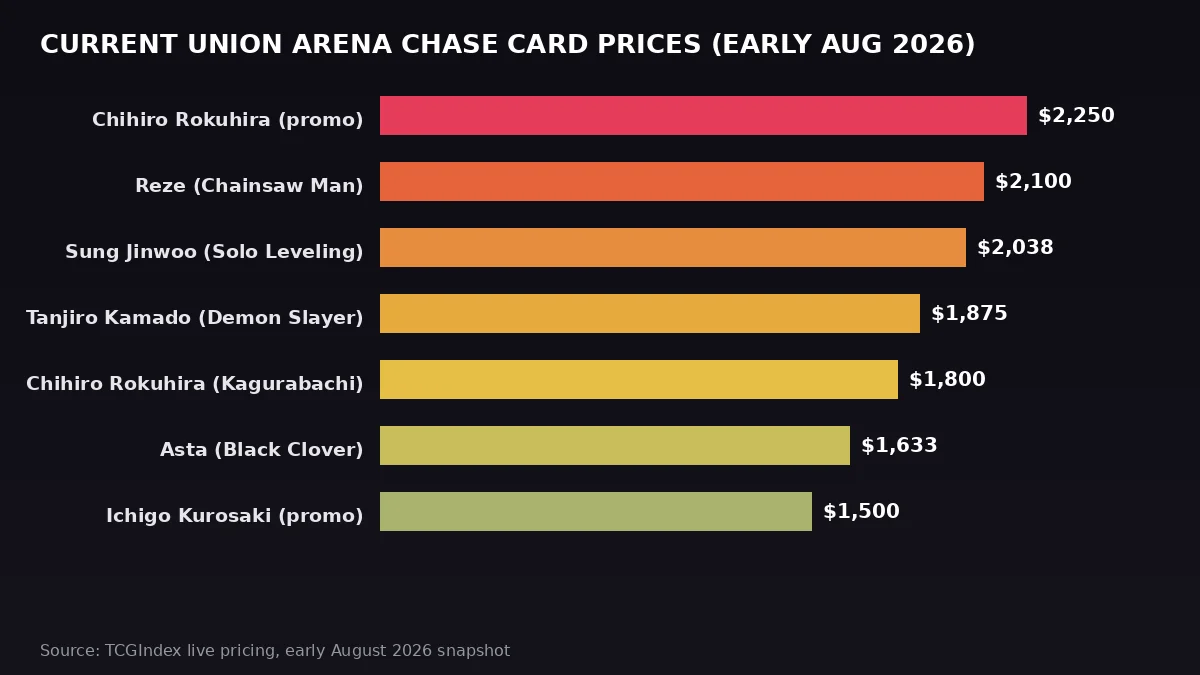 This chart is a historical early-August snapshot, not a live September price feed. Its labels should be read with the variant-specific price checks above.
GODEEPER: Brand new to Union Arena and not sure where to start before you spend real money on singles? Union Arena TCG Beginner Guide →
Has Union Arena Crashed Before? The Honest Volatility Record
The old version of this article quoted aggregate 30-day and 90-day market moves from an early-August snapshot. That data is not a stable September source, so I am removing the percentages rather than presenting them as current market facts. The card-level evidence above is easier to audit because every figure names a product, number, and rarity.
Even a positive price window on a young game would not be a proven track record. The dated examples show concentration in tournament promos, scarce parallel finishes, and high-visibility anime releases. That is useful for understanding risk, but it is not enough to rank every set or claim that the whole market is rising.
Three structural factors keep this market more volatile than most collectors are used to:
Release pace. The official English product calendar has added many single-IP sets since October 2024. Collector money and attention have more recent releases to choose from, which can pull demand away from older sets faster than in a game with a slower schedule.
Variant structure. Normal, parallel, alternate-art, and promotion versions can share a character name while having completely different supply and prices. The Reze and Sung Jinwoo examples show why a collector must identify the exact finish before deciding whether a card is scarce.
Anime-driven demand. A card's price can track its anime's current popularity as much as anything happening in the actual game. When a show trends, its Union Arena set can spike. When attention moves to the next title, a previous chase card can cool off fast. That is a reasonable risk model, not a promise about any specific set.
None of this means Union Arena is a bad game to collect. It means the honest answer to "does it appreciate" is: sometimes, unevenly, and not for long enough yet to trust as a rule.
SHOP: Collecting Union Arena across multiple IPs? Compare current Union Arena listings for the chase cards you actually want. Shop TCGplayer →
GODEEPER: Curious which decks are actually winning right now instead of just which cards cost the most? Union Arena Current Meta: Which Deck Is Strongest Right Now →
Should You Buy Union Arena Cards as an Investment?
My honest answer, after tracking this market for a year: buy Union Arena cards because you love the anime or want to compete, not primarily to flip them later.
If you already collect for love of the IP, the price data shows that the hobby has real high-end cards, but it also shows how uneven that value is. Bleach, Chainsaw Man, Solo Leveling, and Kagurabachi all have high-value variants in the snapshots above, while ordinary versions of the same characters can be inexpensive. That is a good reason to collect selectively, not a guarantee of appreciation.
If you're buying purely to resell later, weigh three things before spending real money on a single chase card. First, how new is the set? Fresher sets carry more launch-hype risk that can unwind. Second, is the card's value tied to a tournament promo with thin event-linked supply or a booster pull with more supply uncertainty? Third, does the source anime have staying power, or is it riding a single season or movie's momentum? One Piece TCG's most expensive cards show a similar pattern in a more established game: cards tied to permanently beloved characters hold value far better than cards tied to a single hot moment.
Grade the card on those three questions before paying a premium. None of them guarantee anything, but they separate a considered purchase from pure hype-chasing. That's the honest shape of the "is Union Arena worth collecting" question: yes for the hobby, not yet as a reliable investment.
Related Reading
- Union Arena Beginner Deck Tier List: Which starter decks give new players the best value for their money.
- Union Arena JJK: Jujutsu Kaisen Guide: A closer look at the set whose launch-era chase cards never reclaimed their hype-era prices.
- Union Arena InuYasha Confirmed Card List: The post-launch roster and card numbers for the English UE23BT set.
Frequently Asked Questions
Is Union Arena TCG worth collecting in 2026? Depends on your goal. For the love of the anime, yes, the current snapshots show well-made chase cards and real collector demand. As a pure investment, no, the track record is too short and the release calendar too active to call it dependable.
What is the most expensive Union Arena card right now? Among the dated TCGplayer snapshots checked for this update, Chihiro Rokuhira's Regionals 26-27 promo showed $2,250. Reze SR*** showed $2,233.33, Sung Jinwoo SR*** $2,037.80, and Tanjiro Kamado SR*** $2,350. These are variant-specific observations, not a guaranteed global ranking.
Do Union Arena card prices ever crash? Individual chase cards can drop hard once launch hype fades or a stronger IP releases the following month. There isn't yet a long enough track record to call any specific pattern permanent, but the risk is structurally real given the release pace.
Why is Union Arena more volatile than other TCGs? Its English card pool is split across many single-IP releases that began in October 2024. Prices reflect anime attention, set supply, variant, and playable demand, so value can rotate between sets quickly. Thin listings also make a quoted market price less dependable than it looks.
Should beginners buy Union Arena cards to invest, or just to play? Buy to play first. A starter product or a small group of targeted singles gives you a lower-risk entry than chasing a high-rarity card at a hype price. Treat resale value as a bonus, not a plan, especially while the English market is still under two years old.
References
- TCGplayer Union Arena Promotion Cards price guide: Chihiro and Ichigo regional-promo snapshots
- TCGplayer UE22BT Chainsaw Man price guide: Reze normal, SR*, and SR*** rows
- TCGplayer UE17BT Solo Leveling price guide: Sung Jinwoo variant rows
- TCGplayer UE05BT Demon Slayer marketplace snapshot: Tanjiro SR** and SR*** rows
- TCGplayer Chihiro Rokuhira SR** product page: UE16BT/KGR-1-060 market snapshot and sales history
- TCGplayer Union Arena marketplace: general listings and product checks
- Union Arena official English launch message: English version launch timing and regional version context
- Union Arena official English product calendar: release cadence and product list
About the author
MS
TCG Collector & Value Analyst
TCG collector and value analyst covering anime card games since 2021. Specializes in pull rates, card values, and market trends across One Piece TCG and Union Arena.
- TCG collector since 2021
- Tracks card values across TCGPlayer and CardMarket
- Pull rate analysis across 100+ boxes opened
- Covers One Piece TCG and Union Arena collector market
Disclaimer
This article is published for informational and entertainment purposes. It does not constitute professional financial, legal, or technical advice. Game performance, online services, patch schedules, and store listings change. Verify critical details (pricing, system requirements, regional availability) with publishers and storefronts before you buy. Affiliate links, where present, help support our editorial work and are labelled in our affiliate disclosure.