Loading…
Loading…
Shonen TCG · Guides
Reviewing
Disney Lorcana
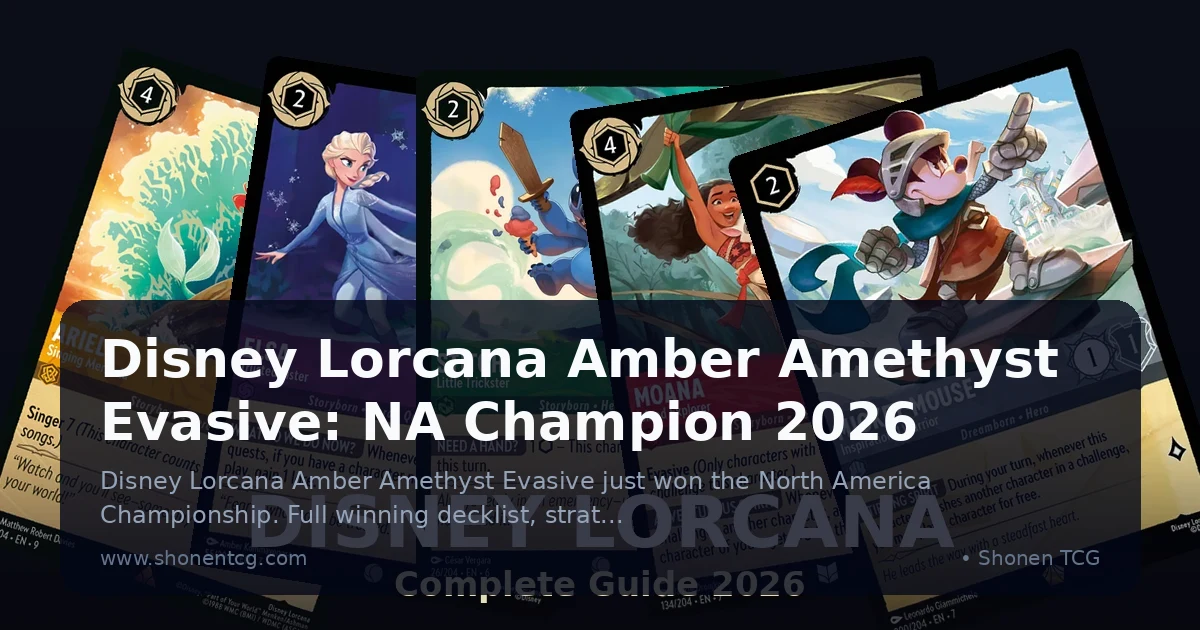
Disney Lorcana Amber Amethyst Evasive (tracked as Amber Amethyst Midrange) just won the biggest possible stage: Dillon LeDuc piloted the archetype to the title at the Disney Lorcana North America Championship, beating an Emerald/Steel finalist 3-1 in Anaheim. That's a real, verified tournament win against 136 of the format's best players, not a meta-share estimate. New to the game? See the Disney Lorcana how to play guide before tackling Evasive deck strategy. The deck's core identity hasn't changed since Wilds Unknown (Set 12): it's good into aggro, and that identity is exactly what let it prey on a field that skewed heavily toward Emerald/Steel.
This Disney Lorcana Amber Amethyst Evasive guide covers what the deck does, how it wins, the actual championship-winning decklist, and how it handles the current Core matchup spread.
Update, September 14, 2026: Amber Amethyst won the Disney Lorcana North America Championship (Anaheim, concluded Sep 3, 2026), with Dillon LeDuc defeating Sky Duntz's Emerald/Steel deck 3-1 in the finals. Emerald/Steel was the most-represented deck in the 136-player field at 24.4%, and took 11 of the Top 16 slots, but Amber/Amethyst (only 3 of Top 16) had the better matchup profile and claimed the title. The full winning decklist and key new cards, including Gaston, Superior Archer, are covered below. This is separate, event-specific data from the ongoing inkdecks.com Core meta-share tracker cited elsewhere in this guide; treat the two as different lenses on the same format, not conflicting numbers.
TL;DR: Amber Amethyst Evasive uses protected Evasive characters to quest for lore while Amethyst bounce and Amber Shift create sustained card advantage. It just won the Disney Lorcana North America Championship in Anaheim (Dillon LeDuc, 3-1 over Emerald/Steel), beating a field where Emerald/Steel was the most popular deck at 24.4%. Separately, ongoing Core-wide tracking (Aug 7, inkdecks.com) has it co-leading meta share at 14% alongside Amber Emerald Elinor. It wins by racing lore in a way most aggressive decks can't interrupt without dedicated Evasive challengers.
The deck wins by getting Evasive characters into play, questing them safely every turn, and bouncing or Shifting past whatever your opponent plays to stop you. Amethyst handles the draw and bounce package. Amber handles early curves and Support synergies that let your Evasive characters quest for more lore than their base value suggests.
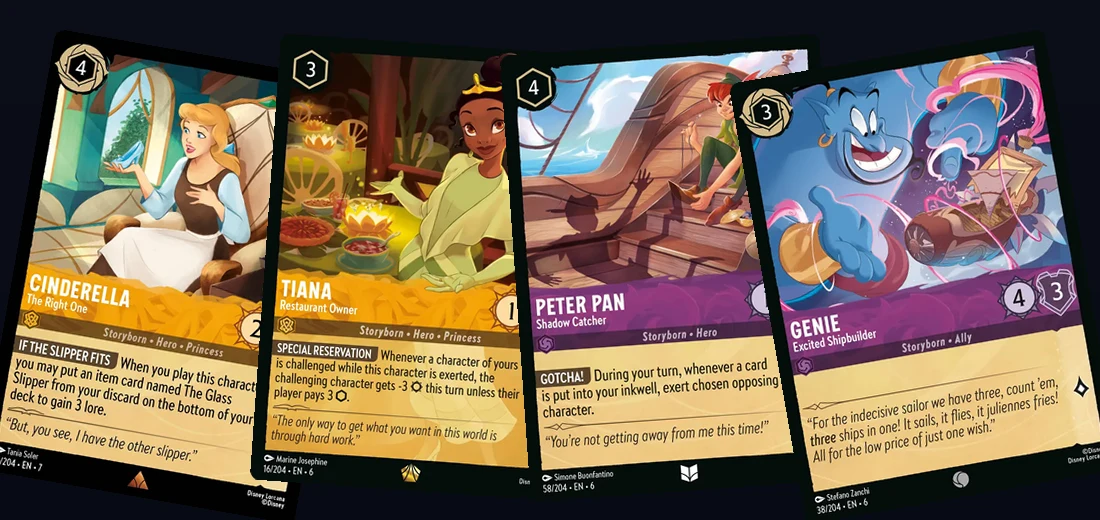 The Amber/Amethyst Evasive build generates lore through unblockable characters while the Amethyst engine refills the hand.
The game plan is intentionally boring to play against. You establish Evasive characters in the first few turns, those characters quest each turn while remaining challengeable only by other Evasive characters, and the lore accumulates until you win. Opponents without Evasive characters in their deck have to use bounce effects, songs, or other board interaction to remove your questers. That's a limited answer pool.
Amethyst gives you bounce: events that return characters to their owner's hand, which either removes an opposing threat or protects your own characters from targeted removal. Amber gives you Shift: cards that play over an existing character at a reduced ink cost, letting you upgrade a cheap early Evasive character into a more expensive one without paying full price. Together those two mechanics mean you're spending ink efficiently while maintaining a board the opponent can't profitably challenge.
The deck doesn't typically race to lore quickly. It builds a position where every turn you're questing for 4-8 lore from multiple Evasive characters while the opponent scrambles for answers. Amethyst Sapphire tends to go faster. Amber Amethyst tends to go more safely.
Was this guide helpful?
About the author
Multi-TCG analyst covering the competitive trading card game scene. Tournament coverage, format analysis, and cross-game comparison content.
Disclaimer
This article is published for informational and entertainment purposes. It does not constitute professional financial, legal, or technical advice. Game performance, online services, patch schedules, and store listings change. Verify critical details (pricing, system requirements, regional availability) with publishers and storefronts before you buy. Affiliate links, where present, help support our editorial work and are labelled in our affiliate disclosure.
Dillon LeDuc's Championship-winning 60-card list, per Ravensburger's official recap, is the closest thing this archetype has to a verified, battle-tested reference build right now:
4 Besties, Assemble!
4 Cheshire Cat, Inexplicable
4 Demona, Scourge of the Wyvern Clan
3 Dumbo, The Flying Elephant
4 Gaston, Superior Archer
4 Grandmother Willow, Ancient Advisor
4 Hamm, Piggy Bank
4 Isis Vanderchill, Ice Queen of St. Canard
3 Luisa Madrigal, Confident Climber
4 Luisa Madrigal, Pushing Through
3 Nakoma, Waiting Out the Storm
1 Ohana Means Family
4 Rafiki, Mystical Fighter
4 Stitch, Carefree Surfer
2 Sven, Leaping Reindeer
4 The Horseman Strikes!
4 Tigger, Bouncing All the Way
A few pieces stand out. Gaston, Superior Archer is a new addition that wasn't in earlier reads of this archetype: he can banish a character with 5 Strength or more, giving the deck a real, hard-removal answer it didn't previously have on paper. Hamm, Piggy Bank reduces character cost, functioning as this list's version of the Shift-adjacent ramp discussed below. Grandmother Willow, Ancient Advisor gives the deck what Ravensburger's own recap called "pseudo ramp," accelerating access to its strongest characters. The Horseman Strikes! is the removal package's other half, run at a full 4 copies. Notably, this Championship list runs zero dedicated bounce events by name, a contrast with the Amethyst-bounce framing later in this guide; treat the general Amethyst package below as the archetype's broader toolkit, and this exact list as one specific, proven configuration of it.
The backbone of any Evasive deck is the characters themselves. In Core Constructed (Sets 9-13 as of late July 2026, after Set 13 rotated Sets 5-8 out), both Amber and Amethyst have accessible Evasive characters across the 2-5 ink cost range.
What to look for when building:
Low-cost Evasive characters (2-3 ink): These establish your early board before the opponent's removal comes online. You want Evasive characters that either quest on their own or trigger an effect when played.
Mid-cost Evasive characters (4-5 ink): These are the main questers. Characters with Evasive and a lore value of 2+ make up the bulk of lore generation. Some also carry Support or Singer, which means they contribute to the card draw or song package while questing.
Support characters: Amber characters with Support add their strength value to an adjacent questing character's lore count. This means a Support character next to a 2-lore Evasive quester can effectively make that character quest for 3 or more lore per turn.
Singer characters: Amethyst has Singer characters who can use their cost to play songs for free. This turns expensive bounce events into effectively free plays when you have the right Singer in play.
Build at 60 cards with 20 Amber, 20 Amethyst, and ideally 3-4 copies of each key piece. The more you can hit your Evasive curve in the first 5 turns, the more consistently the deck plays.
GODEEPER: How the Core Constructed format works, what rotated out with Set 13, and which sets are legal right now. Disney Lorcana Core vs Infinity Format Guide 2026 →
Amethyst's contribution has two parts: card draw and bounce.
Card draw: Draw effects in Amethyst tend to be attached to characters or triggered by song plays. When you're questing and using ink efficiently, drawing additional cards keeps you ahead on resources against decks that draw a single card per turn naturally.
Bounce events: Bounce in Lorcana returns a character to its owner's hand. Against you, this means your Evasive characters can be saved from banish or relocated for Shift. Against opponents, this clears threats without challenges, which is relevant when facing characters that generate effects when they leave play.
The song package is where Amber and Amethyst intersect most cleanly. Amber characters with high ink costs often qualify as Singers, and Amethyst songs give those Singers something to play. If you're choosing between Amber Amethyst and the alternatives, the Disney Lorcana starter decks guide covers which ink pairings make the best starting points. Getting a song off for free through a Singer character is one of the more efficient turns in the format.
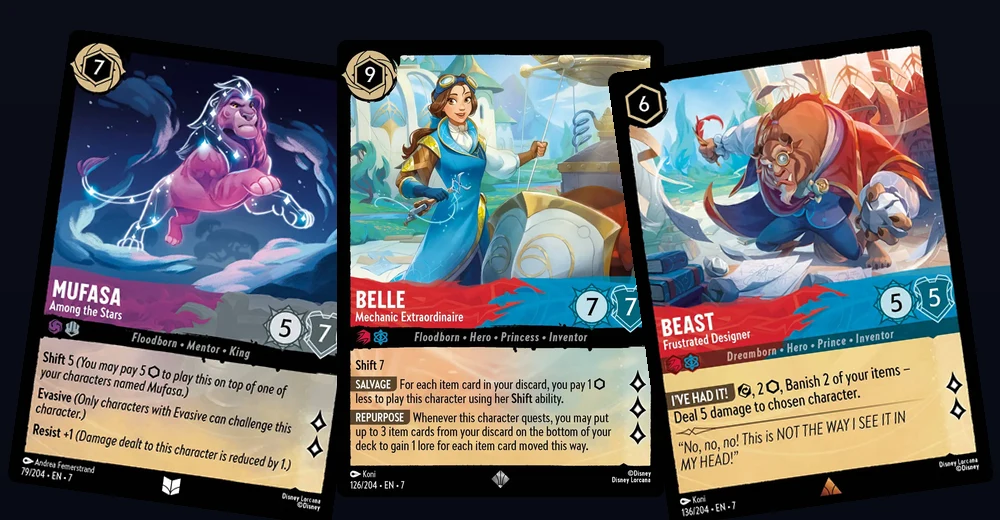 Evasive synergies from Wilds Unknown built this archetype's identity; it now co-leads Core Constructed metashare alongside Amber Emerald Elinor.
Amber's role is establishing curves and amplifying questing.
Shift characters: Amber has strong Shift chains, where a cheap early character becomes the platform for a more expensive character at reduced cost. A 2-ink character on turn 2 becomes the target for a 5-ink character Shifted in for 3 on turn 5. That's 2 turns of board presence for 5 total ink instead of 7.
Support: When an Amber character with Support quests alongside another character, it adds its strength to that character's lore count for the turn. Place a Support character next to your Evasive quester and that Evasive character queries for more than its card says. The effect doesn't scale infinitely, but 1-2 extra lore per turn compresses your wins significantly.
Amber's role in the bounce interaction: When Amethyst bounces your own Evasive character, Amber's Shift pool lets you replay that character cheaply. You're not losing resources when you pull your own character back; you're setting up a Shift.
SHOP: Building this Amber Amethyst Evasive list? Check current Disney Lorcana singles prices for the Shift package. Shop TCGplayer →
Versus Amber Emerald Aggro: Amber Amethyst tends to win this matchup when it establishes Evasive by turn 3. Aggro decks challenge actively, and your Evasive characters can't be reached. The Amber durability cards help absorb the early pressure while Evasive characters build lore. Don't race on challenges; let Evasive do the work.
Versus Amethyst Sapphire Evasive: This is a mirror on the Evasive strategy but Sapphire runs faster. The matchup usually comes down to whoever establishes Evasive advantage earlier. Your Amber cards give you access to Shift into larger Evasive characters than the pure Amethyst Sapphire list typically runs. In long games, Amber Amethyst tends to have better late-game resources.
Versus Amber Steel Steelsong (Infinity): Steelsong is primarily an Infinity format concern, but if you're facing it in a mixed event, the Amethyst bounce package is useful here. Bouncing a Steelsong character before it quests is one of the cleaner answers available without challenging into it.
Versus control decks: These are harder matchups. Control decks running heavy bounce or banish can answer Evasive repeatedly. The Disney Lorcana Ruby Sapphire Items deck guide shows exactly what a control-leaning shell looks like and why the Amethyst bounce package matters against it. The Amethyst draw package keeps your hand stocked for these games, and the Shift chain means bounced characters cost less to replay. But a control deck with consistent removal will slow your lore clock.
GODEEPER: Current Core meta breakdown across all top decks, with tier placement and matchup data. Disney Lorcana Wilds Unknown Best Decks and Meta 2026 →
1. Find a current list. Check inkdecks.com filtered to Core, Amber, and Amethyst, sorted by performance. Lorcana meta lists shift after each major event; the most recent strong finish tells you what configuration is working now.
2. Identify your card costs. Separate the 60 cards into Amber and Amethyst columns, then sort by ink cost. The curve should peak at 3-4 ink with presence at 2 and 5. Anything at 6+ should have a specific payoff that justifies the late timing.
3. Check Set legality. Core as of late July 2026 runs Sets 9-13. Sets 5-8 already rotated out when Set 13 (Attack of the Vine) released. Build with Sets 9-13 cards only.
4. Buy non-Enchanted, non-Iconic versions. Enchanted and Iconic rarity versions of cards play identically to standard versions but cost significantly more. For a functional competitive deck, standard copies work fine. Wilds Unknown's Enchanted and Iconic cards are for collectors and players who want the premium experience, not required for competitive play.
5. Test 10 games before making changes. Evasive decks have a learning curve around timing your quests and choosing when to use bounce. The deck can feel slow in the first few games before the bounce-Shift flow becomes intuitive.
Quest with Evasive characters every turn they're available unless there's a specific reason not to. The lore builds slowly enough that missing quest turns costs games.
Use bounce to protect your own characters as often as you use it to disrupt opponents. Pulling an Evasive character before it's challenged, then replaying it for Shift cost, is often better than using bounce as a removal tool.
Manage your Amethyst draw carefully. Draw effects tempt you to use them early, but saving a draw event for a turn when you need to refuel after using your entire hand is often more valuable.
Against mirrors (any Evasive opponent), establishing the larger Evasive character first matters more than raw lore pace. A 3-lore Evasive quester beats a 2-lore Evasive quester in a race, and Amber's Shift chains let you access higher-value Evasive cards earlier than the opponent might expect.
What is the Amber Amethyst Evasive deck? A Core Constructed deck using Evasive characters from Amber and Amethyst ink pools to generate lore safely, with Amethyst bounce and Amber Shift providing card efficiency.
Did Amber Amethyst Evasive win a real tournament? Yes, the biggest one available. Dillon LeDuc piloted Amber/Amethyst to the title at the Disney Lorcana North America Championship in Anaheim, beating an Emerald/Steel finalist 3-1, in a 136-player field where Emerald/Steel was itself the most popular deck at 24.4%.
What Core meta share does Amber Amethyst hold? Separately from the Championship win, ongoing Core-wide tracking (Aug 7 tournament data) has it at 14%, co-leading the format alongside Amber Emerald Elinor (15%) and ahead of Amber Ruby Boost (12%).
Is it better than Amethyst Sapphire Evasive? Different. Amethyst Sapphire tends to be faster. Amber Amethyst is better into aggressive strategies due to Amber's board durability. Both remain solid Core options, though the post-Set-13 meta leaders (Amber Emerald Elinor, Amber Ruby Boost) currently outpace both.
Is Amber Amethyst good for beginners? Workable but not the easiest starting point. Amber Emerald Aggro is simpler to learn first.
Should I buy Enchanted copies of key cards? Only if you want them for collection purposes. Standard copies play identically.
Where do I find a current deck list? inkdecks.com filtered to Core, Amber, Amethyst, sorted by recent top finishes.
Do Sets 5-8 cards rotate before I finish building? They already have. Sets 5-8 rotated out of Core Constructed when Set 13 (Attack of the Vine) released in late July 2026. Build with Sets 9-13 cards only.
Related
Union Arena Fullmetal Alchemist Deck Guide: Blue 2026
8 min read
Union Arena Attack on Titan Vol.2: New Yellow Color
8 min read
OP-17 Mihawk Deck Guide: Green Dracule Mihawk 2026
13 min read

Dragon Ball Fusion World FB11 Leaders: All 5 Revealed
8 min read
OP-17 Mihawk Matchup Guide: All 6 Leaders Explained
14 min read