Loading…


Shonen TCG · Guides
Disney Lorcana Ink Colors Explained: All 6 Inks (2026)
Reviewing
Disney Lorcana
If you are choosing what to build, this is the Disney Lorcana ink colors guide you want: what all six inks actually do, the example characters that show each one's style, and the two-color pairings that make the strongest decks. Every Lorcana deck uses up to two of the six inks, so understanding color identity is the first real deckbuilding skill.
TL;DR: Disney Lorcana has six ink colors: Amber (healing/protection), Amethyst (magic/draw), Emerald (disruption/tempo), Ruby (aggression/power), Sapphire (ramp/value), and Steel (removal/big bodies). A deck uses up to two inks, and the pairing defines your plan. There is no single best ink, only the best pairing for the strategy you want.
Key Takeaways
- There are six ink colors, and a deck uses up to two.
- Each ink has a clear identity that most of its cards follow.
- Amber/Emerald leads Core Constructed metashare as of late July 2026, with Amethyst/Sapphire close behind, but no ink is strictly best.
- Your inkwell pays for any color once cards are inked. Color only limits what you can play, not how ink pays.
- Pick a pairing with a clear game plan before you buy singles.
What Disney Lorcana Ink Colors Are (Overview)
Disney Lorcana ink colors are the game's six factions, shown by the gem behind a card's cost. They work like color identity in other card games: each ink leans toward a style, and building a deck means choosing two inks whose strengths combine into a coherent plan. You are not locked into rigid roles, since most inks can do a bit of everything, but the center of gravity is real. Aggro decks reach for Ruby and Amber, value decks reach for Sapphire and Emerald, and control decks lean on Steel and Amethyst. If you are brand new, read our how to play Disney Lorcana guide first, then come back here to choose colors.
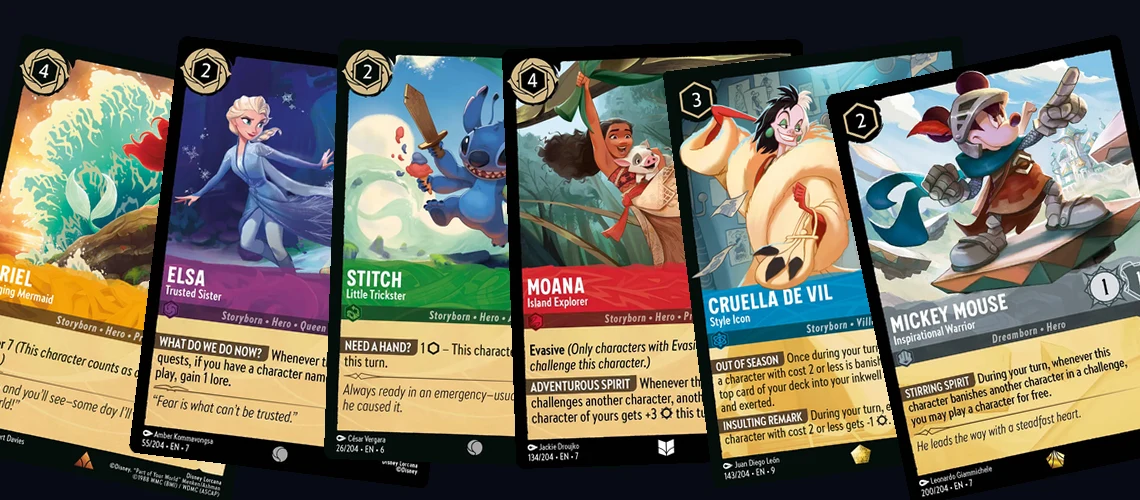 Caption: One card per ink. The gem behind the cost in the top-left tells you the color.
All 6 Disney Lorcana Ink Colors
Amber, healing and protection. Amber wants a wide board of cheap characters it can keep alive. It has the best healing, strong song support, and effects that protect your questers. Amber decks tend to flood the board and grind out lore. Ariel and Cinderella are classic Amber faces.
Amethyst, magic and card flow. Amethyst is the toolbox color. It draws cards, bounces characters back to hand, and bends the rules with flexible answers. If you like reacting to what the opponent does, Amethyst gives you the most options. Elsa and Genie sit here.
Emerald, disruption and tempo. Emerald plays dirty in the best way: hand attack, sneaky evasive threats, and effects that set the opponent back a beat. It rewards players who like to disrupt a plan rather than race it head-on.
Ruby, aggression and power. Ruby is the beatdown color, full of high-Strength characters that challenge well and end games fast. If you want to apply pressure from turn two, Ruby is your engine. Moana and Gaston are aggressive Ruby staples.
Sapphire, ramp and value. Sapphire makes extra ink, leans on Items, and pays it off with expensive characters other inks cannot reach on curve. It is the patient color, and it pairs beautifully with anything that needs time. Cruella is a Sapphire favorite.
Steel, removal and big threats. Steel is the damage-and-removal color, with effects that banish or weaken enemy characters and durable bodies that trade up. When you want to control the board and then close with something large, Steel delivers. Mickey Mouse and Aladdin show its range.
A note on reading color in practice: the gem behind a card's cost is the fastest tell, but the card's text matters more than its color label. Two Amethyst cards can play completely differently, one drawing cards and one bouncing threats, so treat the color identities above as a starting bias rather than a rule. As you collect, you will notice that the strongest cards often bend their color slightly, an aggressive Sapphire body or a removal-heavy Amber card, and those flexible cards are exactly the ones that make a pairing click.
Color also shapes the current format. As of late July 2026 (post-Set 13, Attack of the Vine), Amber/Emerald leads Core Constructed metashare at roughly 19%, with Amethyst/Sapphire close behind, largely because Amethyst's card flow and Sapphire's ramp support evasive-lore plans while Amber/Emerald punishes them with a faster board-flood plan. That does not make the other four inks weak; Ruby and Amber power the fastest aggro decks, Steel and Emerald anchor the best control shells, and a well-built off-meta pairing still wins events. The lesson is that ink representation tracks the strategies that are strong right now, and strategies rotate every set, so do not read a popularity chart as a permanent power ranking. The Wilds Unknown best decks guide tracks which pairings are winning in the current format.
Best Ink Color Pairings
The reason two-ink decks dominate is that a good pairing covers a weakness:
- Amber Amethyst: cheap evasive characters plus protection and draw. Forgiving and fast. See the full deck guide at our Amber Amethyst evasive deck guide.
- Ruby Sapphire: Ruby pressure backed by Sapphire ramp into oversized payoffs. Covered in detail in our Ruby Sapphire items deck guide.
- Emerald Steel: disruption plus removal, the classic grind-you-out control shell.
- Amber Steel: go-wide aggression with removal to clear blockers, a long-standing strong pair.
- Amethyst Sapphire: the value engine, card flow plus ramp into evasive payoffs, and one of the most-played shells in mid-2026.
The pattern to notice is that every strong pairing answers one question: how does the second ink fix what the first one cannot do alone? Ruby hits hard but runs out of gas, so Sapphire feeds it. Steel removes threats but can stall, so Amber floods the board to keep pressure on. When you evaluate a new pairing, do not just add two colors you like; ask what specific weakness the second ink is patching. If you cannot answer that, the pairing is probably worse than a focused single-plan deck.
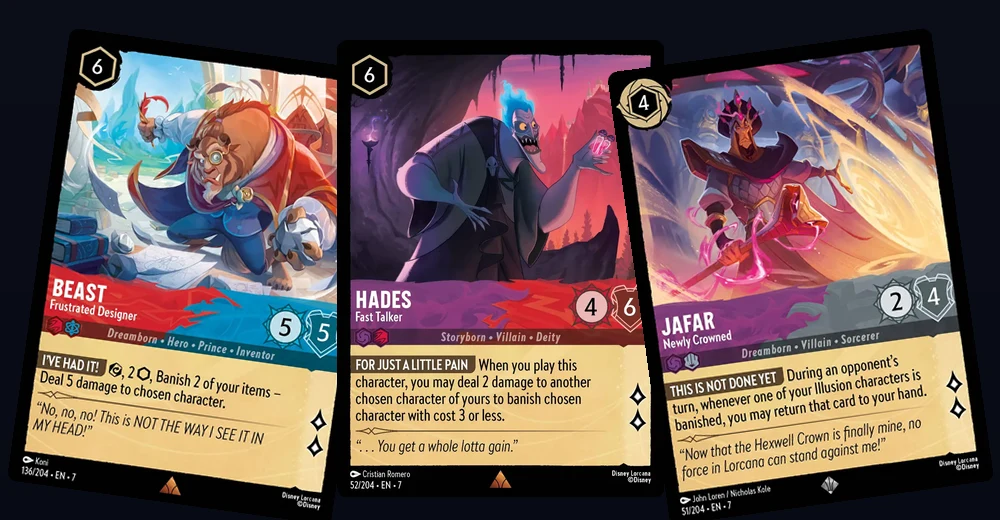 Caption: Dual-ink cards like Beast, Hades, and Jafar can only go in decks running both their colors, so they reward committing to a pairing.
GODEEPER: Once you have a pairing in mind, the hub guide covers deck building rules and what is winning in the current meta. Disney Lorcana Complete Guide →
Step-by-Step: How to Choose Your Inks
1. Pick a game plan. Do you want to race (aggro), grind (control), or build up and overpower (ramp)?
2. Choose a primary ink that matches your plan. Ruby or Amber for aggro, Steel or Emerald for control, Sapphire for ramp.
3. Add a second ink that patches the weakness. Aggro wants reach or protection, control wants card flow, ramp wants payoffs.
4. Check your curve and inkable count. Aim for around 45 inkable cards and enough cheap plays for turns one through three.
5. Test and adjust. Swap the cards that underperform, not the whole plan.
Tips for Picking Colors
- Do not chase the meta blindly. Play the pairing whose decisions you enjoy, since you will pilot it better.
- Single-ink is a trap for most. A second color almost always adds removal or reach you will miss.
- Match removal to the field. In an evasive-heavy meta, value Wards and ways to hit evasive characters.
- Borrow from comparisons. If you came from another TCG, the color-identity idea maps cleanly onto the One Piece TCG colors explained framework.
- Understand formats before buying. The Core vs Infinity format guide explains which sets are currently legal in each format, which affects which color cards are available to you.
- Start with a starter deck. The Disney Lorcana starter decks guide ranks all current options by ink color and playstyle, so you can lock in a direction before spending on singles.
Related Reading
- Disney Lorcana Wilds Unknown Set Guide: what the newest set added to each ink's card pool.
- Disney Lorcana Rotation 2026 Guide: which sets are currently legal, since that affects which color cards you can access.
- Best Anime TCG to Play in 2026: how Lorcana's color system compares to other games.
- Disney Lorcana Hyperia City: Set 14 Preview: which inks show up in the first cards confirmed for the next set.
Frequently Asked Questions
How many ink colors are in Disney Lorcana? There are six ink colors: Amber, Amethyst, Emerald, Ruby, Sapphire, and Steel. A constructed deck can use up to two of them, and that pairing defines the deck's strategy.
What is the best ink color in Disney Lorcana? There is no single best ink. Each has a role, and strength comes from pairing two that cover each other's weaknesses. As of late July 2026, Amber/Emerald leads Core Constructed metashare, with Amethyst/Sapphire close behind, but the format shifts each set.
Can you play three ink colors in Lorcana? No. A legal constructed deck can use at most two ink colors. Single-ink decks are allowed but rare, since a second ink almost always adds useful tools. The two-ink limit is the core constraint of deck building.
What do the Lorcana ink colors mean? Each ink has an identity: Amber is healing and protection, Amethyst is magic and card flow, Emerald is disruption and tempo, Ruby is aggression and power, Sapphire is ramp and value, and Steel is removal and big bodies. Cards mostly follow their color's theme.
What are good ink pairings for beginners? Amber Amethyst (evasive aggression with protection) and Ruby Sapphire (ramp into big threats) are forgiving and effective starting points. Both teach a clear game plan, which makes your in-game decisions easier while you learn.
Do ink colors affect which cards I can ink for resources? No. Any inkable card from either of your two colors can go into your inkwell, and once there it pays for cards of any color. Ink color affects which cards you can play, not how the inkwell pays for them.
References
Was this guide helpful?
About the author
AC
Multi-TCG analyst covering the competitive trading card game scene. Tournament coverage, format analysis, and cross-game comparison content.
- Covers multiple TCG formats
- Tournament reporter and analyst
- Cross-game format comparison specialist
- Active in OPTCG, Union Arena, and Lorcana communities
Disclaimer
This article is published for informational and entertainment purposes. It does not constitute professional financial, legal, or technical advice. Game performance, online services, patch schedules, and store listings change. Verify critical details (pricing, system requirements, regional availability) with publishers and storefronts before you buy. Affiliate links, where present, help support our editorial work and are labelled in our affiliate disclosure.