Loading…
Loading…
Shonen TCG · Guides
Reviewing
Disney Lorcana
Disney Lorcana Core vs Infinity format is the first decision to make before buying cards or copying a deck list. Core uses the current rotation pool, while Infinity keeps every released set available. The difference affects legality, deck construction, event choice, and how you interpret older tournament results.
TL;DR: Core Constructed uses the post-July 17, 2026 rotation pool: Fabled, Whispers in the Well, Winterspell, Wilds Unknown, and Attack of the Vine. Infinity Constructed allows cards from every released set, with its own ban list. A matching legal reprint can make an older printing usable in Core, so checking only the set number is not enough.
Core is the rotating competitive format. After the Attack of the Vine prerelease, its listed card pool is Fabled, Whispers in the Well, Winterspell, Wilds Unknown, and Attack of the Vine. Infinity is the unrestricted-by-rotation format, so a deck can combine cards from any released set, subject to the format's own banned-card rules.
There is no universal rule that every organized event uses Core. Ravensburger's current Challenge information lists Core Constructed for the main championship path and also includes an Infinity Constructed Challenge. Store events can choose either format, so read the event listing before treating a deck as legal.
The first Core rotation happened when Fabled released in September 2025. The First Chapter, Rise of the Floodborn, Into the Inklands, and Ursula's Return left the Core pool. Ravensburger introduced Infinity Constructed at the same time so those cards would remain usable in a full-card-pool format.
The next annual rotation took effect with the Attack of the Vine prerelease on July 17, 2026. Ravensburger's official announcement lists these five sets as legal in Core:
| Set | Core status after the July 2026 rotation |
|---|---|
| Fabled | Legal |
| Whispers in the Well | Legal |
| Winterspell | Legal |
| Wilds Unknown | Legal |
| Attack of the Vine | Legal |
| Reign of Jafar and earlier rotated sets | Not legal by set alone |
The product page lists July 24 as Attack of the Vine's everywhere release date. That date is not the same as the prerelease date that introduced the new Core pool for official prerelease play. When a source says “July rotation,” check whether it means the July 17 prerelease or the July 24 mass release.
Core rotation is annual, not an automatic event every time a new product becomes available. Ravensburger's original rotation explanation said future rotations would happen once a year and generally leave between five and eight sets in Core. Check the latest announcement when the next rotation approaches rather than assuming that every new set removes the oldest set immediately.
Set rotation is not a simple rule that makes every older card unusable. Ravensburger's Fabled announcements explain that a card with the same name and version as a legal reprint can be used in Core even if the copy in your hand came from an older set.
The example given by Ravensburger is Stitch - Rock Star. If the Fabled version is legal, an older matching Stitch - Rock Star printing can be used as a copy of that legal card. The copies still share one card identity for the four-copy deck limit. This is a card-specific reprint rule, not a blanket return of all Set 1 through Set 4 cards.
Use this check when a deck list contains an older card:
The official card database or the Disney Lorcana Companion App is safer than judging legality from the art, character, or collector number alone. A card that looks similar to a legal reprint may still have a different version or effect.
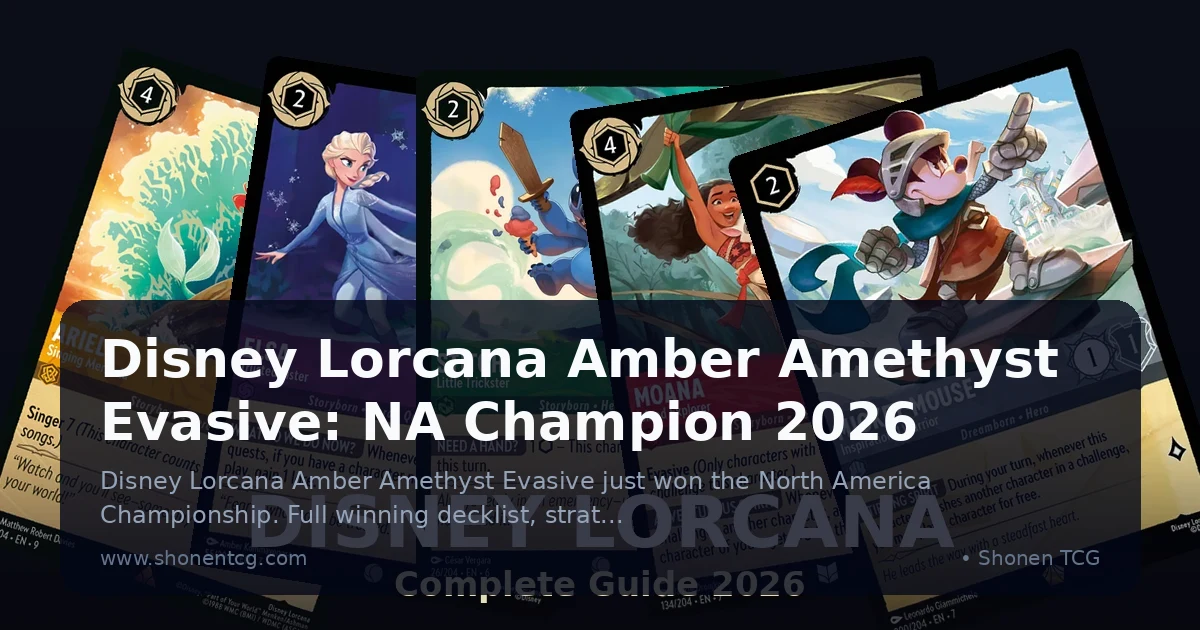
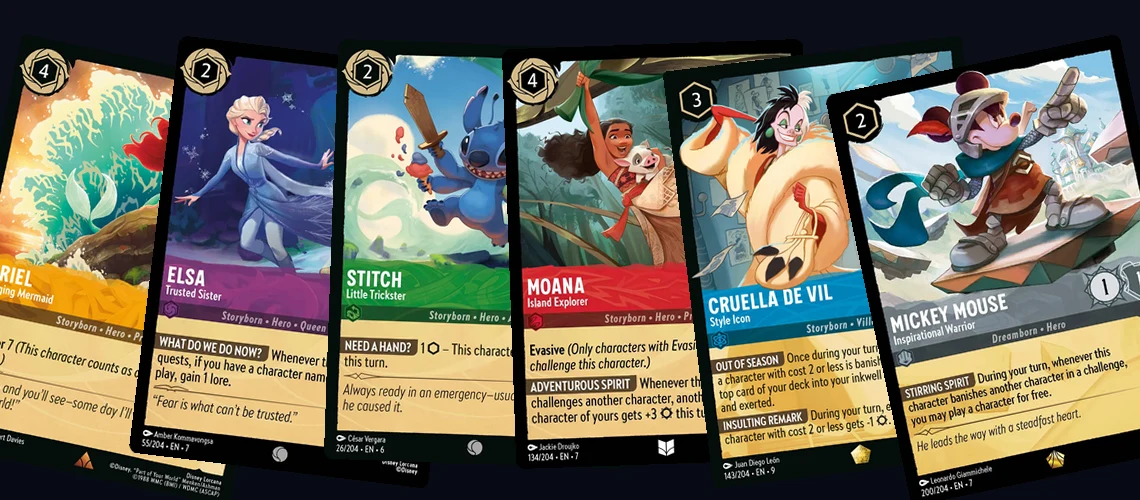 This real collage shows cards from different Lorcana sets, including visible earlier-set cards. It illustrates the card pool, not a complete legality list.
Was this guide helpful?
About the author
Multi-TCG analyst covering the competitive trading card game scene. Tournament coverage, format analysis, and cross-game comparison content.
Disclaimer
This article is published for informational and entertainment purposes. It does not constitute professional financial, legal, or technical advice. Game performance, online services, patch schedules, and store listings change. Verify critical details (pricing, system requirements, regional availability) with publishers and storefronts before you buy. Affiliate links, where present, help support our editorial work and are labelled in our affiliate disclosure.
Infinity Constructed ignores rotation. Ravensburger describes it as a format where players can use any cards they want, regardless of rotation. That makes it the format for older collections, long-running deck ideas, and groups that want the full history of the game in one card pool.
Infinity is not simply Core with extra cards added. A larger pool creates interactions that never exist in the five-set Core environment, and Ravensburger says Infinity has its own banned-card list. A deck may be legal in Infinity but irrelevant to a Core event because its key cards are rotated. The reverse can also happen when an event has a Core-specific restriction.
The difference is easiest to see in the set table:
| Set group | Core Constructed | Infinity Constructed |
|---|---|---|
| The First Chapter through Ursula's Return | No by set alone, except matching legal reprints | Yes |
| Shimmering Skies through Reign of Jafar | No by set alone after the July 2026 rotation | Yes |
| Fabled through Attack of the Vine | Yes | Yes |
| A matching older printing of a legal reprint | Often yes under the reprint rule | Yes |
“Yes” in the Infinity column means the set is available by rotation. It does not remove the need to check the current Infinity ban list or a specific event's deck-construction rules.
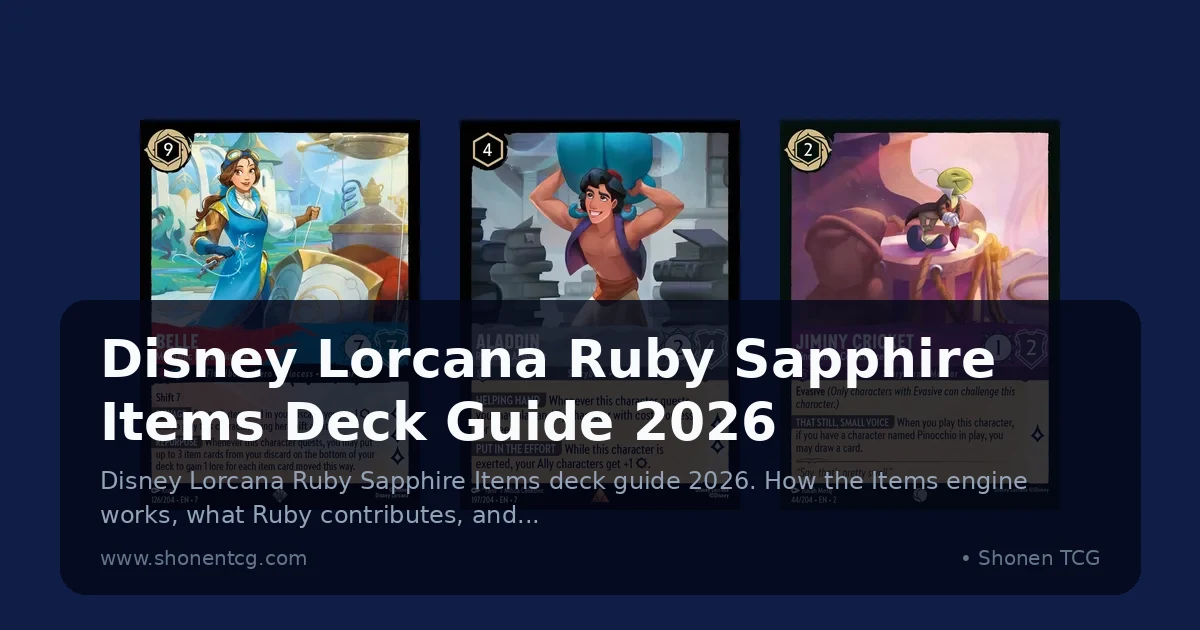
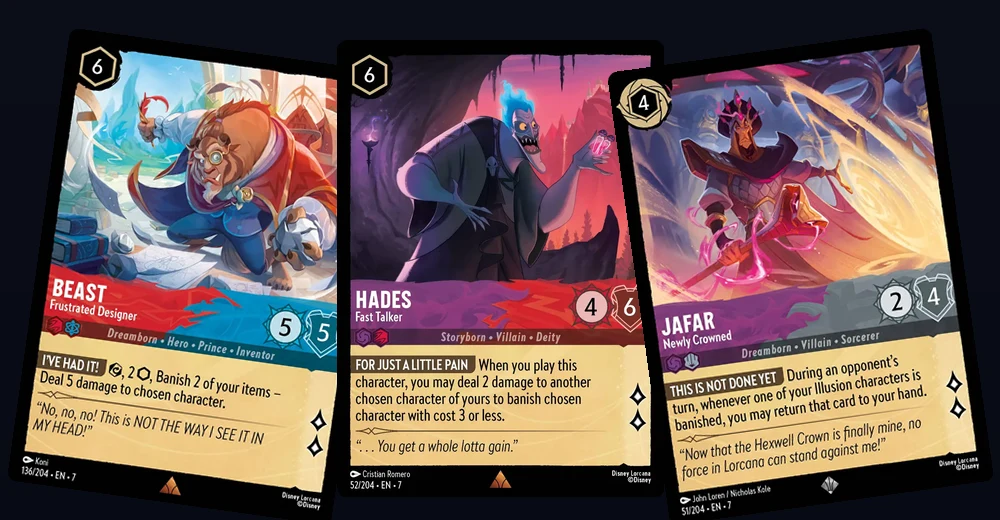 These real cards use an earlier-set numbering pattern. Use the current set list and the reprint rule to decide Core legality, rather than treating the image as a legal deck list.
Format choice should come before reading a tier list. A Core result from the current five-set pool cannot be compared directly with an Infinity result that includes early staples. The same archetype name can also mean a different list after rotation.
As a dated September 16, 2026 reference, Inkdecks' Core page lists Amber Amethyst Midrange at 19% share, Amber Emerald Elinor at 14%, Amber Emerald Songs at 7%, and Detectives at 6% among the top entries. Its Infinity page is much smaller, listing Amber Steel Steelsong, Ruby Sapphire Shark, and Amber Emerald Elinor in the displayed snapshot. The two tables use different pools and should not be combined.
TCG Contender's September Core view also places Amber Amethyst and Amber Emerald among its leading entries, while using its own composite scoring method. That is useful as a cross-check, not proof of one permanent ranking. Meta shares move as new Set Championship lists are added.
The practical rule is simple: use Core data for a Core event and Infinity data for an Infinity event. If a deck guide does not name the format and date, treat its placement as incomplete information.
There is no reliable universal price split between the two formats. Core decks can still contain expensive recent cards, and Infinity decks can use affordable older cards if a strategy does not need scarce staples. Reprints can also lower the cost of a card while preserving its legality.
For a new player, Core usually reduces the amount of history you need to learn before entering a current event. For a long-time collector, Infinity may get more value from cards already in the collection. Neither choice guarantees a cheaper deck, because exact lists, condition, language, local supply, and current demand matter.
Before buying, write down:
This prevents a common purchase mistake: buying an expensive card for an Infinity list when the intended tournament is Core, or selling a rotated card that still has a home in Infinity.
Choose Core when:
Choose Infinity when:
Many players can enjoy both, but keep separate deck lists and testing notes. A Core list is not automatically an Infinity list, and an Infinity result should not be used to predict a Core matchup without rebuilding the comparison.
1. Identify the event format. Read the store, Challenge, or tournament page. Do not infer Core from the fact that the event is competitive.
2. List every card's name and version. Record the set number as a clue, but do not use it as the only test.
3. Compare the card to the current Core pool. The current listed sets are Fabled, Whispers in the Well, Winterspell, Wilds Unknown, and Attack of the Vine.
4. Check reprints. If a card is from a rotated set, confirm whether the exact name and version has a legal reprint. Count old and new copies together.
5. Check bans and event-specific rules. Core and Infinity do not share every legality decision. Confirm the current ban list and any deck registration instructions before the event.
6. Recheck after an official rotation notice. Ravensburger describes rotation as an annual process, but the exact date and legal set list come from the newest official announcement.
What is the difference between Core and Infinity in Disney Lorcana?
Core Constructed follows the current rotation and, after the July 17, 2026 prerelease, uses Fabled, Whispers in the Well, Winterspell, Wilds Unknown, and Attack of the Vine. Infinity Constructed allows cards from every released set, subject to its own rules and ban list. Reprints can make an older printing legal.
What sets are legal in Core right now?
Ravensburger's current rotation announcement lists Fabled, Whispers in the Well, Winterspell, Wilds Unknown, and Attack of the Vine for Core Constructed. The new pool took effect with the July 17 prerelease, while Attack of the Vine became available everywhere on July 24. Always check the event announcement.
Can an older printing be used after its set rotates?
Yes, when the same card name and version has a legal reprint. Ravensburger says an older printing can be used if the matching current version is legal, and all copies still count toward the same four-copy limit. This exception does not make every rotated card legal.
Does Infinity have a separate ban list?
Yes. Ravensburger's Fabled release notes say Infinity Constructed has its own banned card list because the full card pool creates different balance questions. Do not assume a Core legality decision applies to Infinity, or that an Infinity deck is legal for a Core event without checking the event rules.
Which Lorcana format is better for a new player?
Core is usually the clearer starting point because its card pool is defined by rotation and current event announcements. Infinity can be a good choice if your group owns older collections or specifically schedules Infinity play. Ask the store which format it runs before buying cards for a tournament.
Can I use Set 1 through Set 8 cards anywhere?
They can be used in Infinity Constructed, and rotated cards can still be played casually. They are not automatically Core legal, although a rotated printing may become usable when the same name and version receives a legal reprint. Check the exact card, not only the set number.
Which format do major Lorcana events use?
Major events can specify either format. Ravensburger's current Challenge page lists Core Constructed for the main championship path and also schedules an Infinity Constructed Challenge, so Core is not a universal default. Read the event page for the format, legal card pool, and any current bans.
Related
Union Arena Fullmetal Alchemist Deck Guide: Blue 2026
8 min read
Union Arena Attack on Titan Vol.2: New Yellow Color
8 min read
OP-17 Mihawk Deck Guide: Green Dracule Mihawk 2026
13 min read
Dragon Ball Fusion World FB11 Leaders: All 5 Revealed
8 min read
OP-17 Mihawk Matchup Guide: All 6 Leaders Explained
14 min read