Loading…
Loading…
Shonen TCG · Guides
Reviewing
Disney Lorcana
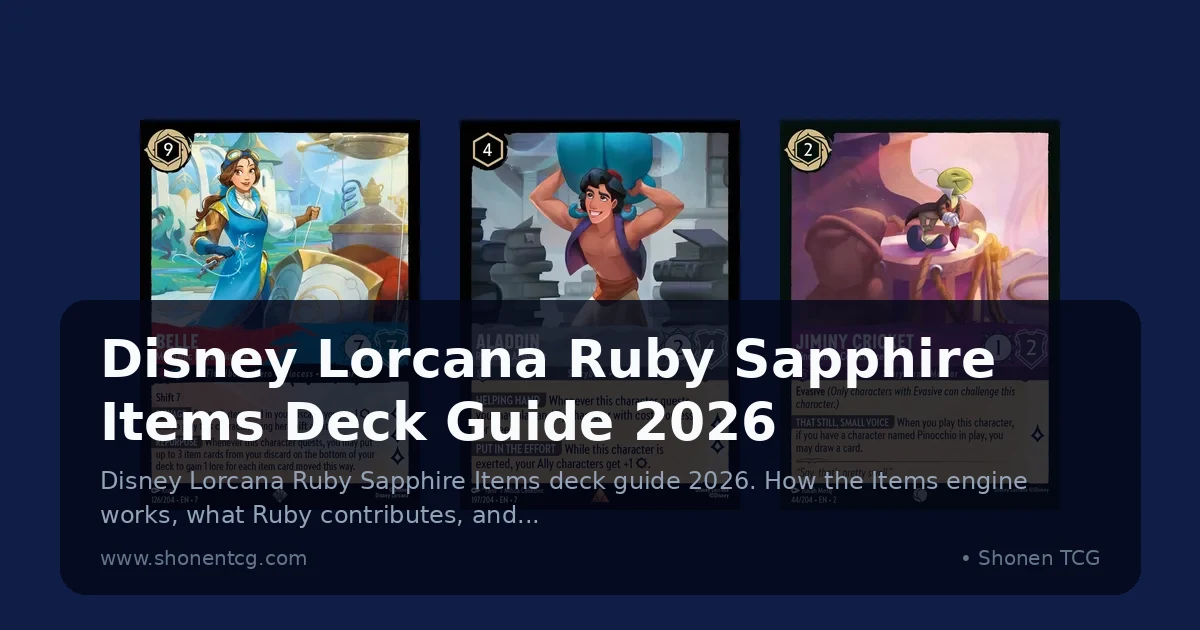
Disney Lorcana Ruby Sapphire Items is a Core Constructed deck that does something most Lorcana decks don't: it uses Items as a sustained engine rather than a one-time value play. Ruby clears non-Evasive threats and applies lore pressure; Sapphire maintains hand size and powers up the board through Items. Against opponents relying on unprotected board presence, the combination is punishing.
This guide covers how the deck works, what card types to build around, and how it handles the current Core meta. If you're new to Lorcana, read the how to play Disney Lorcana guide first to understand inking and questing before building into a specific archetype.
TL;DR: Ruby Sapphire Items uses Ruby's challenge-focused attackers to pressure reachable characters, while Sapphire Items provide value across multiple turns. The shell punishes boards without Evasive protection, but current September 2026 data does not establish it as a top-tier Core deck, so verify recent Set 13 lists before buying in.
The deck is built around two ideas: Ruby characters that make favorable challenges, and Sapphire Items that generate value while those challenges happen. Against decks without Evasive protection, you can contest the board more directly. Against Evasive decks, the plan shifts toward lore and resource efficiency rather than guaranteed removal.
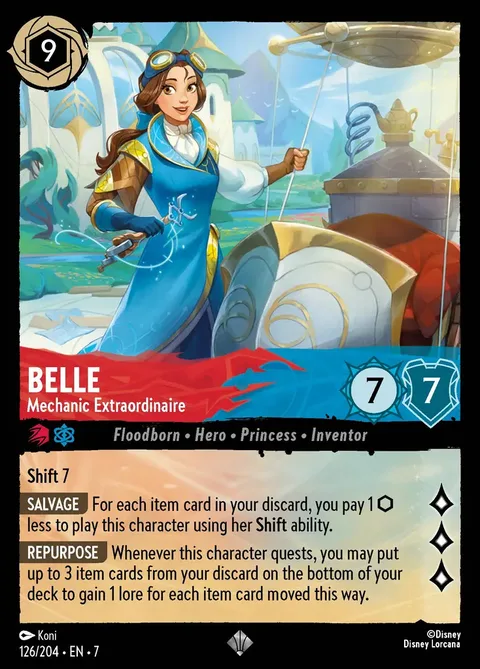 Belle's printed text shows the kind of Item interaction that makes Sapphire the engine half of this shell.
Items in Lorcana stay on the board after you play them. They're not discarded like Event cards. That persistence is what makes them a resource engine rather than a one-time tool.
In the Ruby Sapphire context, Items serve two functions. Some provide ongoing stat bonuses or ability modifiers to specific characters you control. Others provide activated abilities you can trigger on your turn, which can generate card draw, ink generation, or disruption effects over multiple turns.
The critical difference from a standard deck structure is persistence. A deck without Items relies more heavily on character effects and normal draw, while an Items list can leave value on the board after the initial play. Opponents may need a dedicated answer or a way to race that value, depending on the matchup.
Sapphire is a natural starting point for an Items shell because its characters and card pool include effects that reward or reference Items. The exact package still needs to be checked against the current Sets 9-13 pool. For a breakdown of all six Lorcana inks and their roles, our Disney Lorcana ink colors guide explains each one.
Was this guide helpful?
About the author

TCG Reviews & Guides Editor
TCG reviews and guides editor specialising in set reviews, deck builds, and beginner content across One Piece TCG, Union Arena, Disney Lorcana, and Dragon Ball Fusion World. Known for step-by-step guides that actually work at the local game store level.
Disclaimer
This article is published for informational and entertainment purposes. It does not constitute professional financial, legal, or technical advice. Game performance, online services, patch schedules, and store listings change. Verify critical details (pricing, system requirements, regional availability) with publishers and storefronts before you buy. Affiliate links, where present, help support our editorial work and are labelled in our affiliate disclosure.
Ruby is the aggression half of the pairing. Ruby characters in Lorcana tend toward Challenge-focused effects: characters that gain power bonuses when challenging, that banish themselves and opposing characters, or that go to your hand after a successful challenge for immediate replay.
Against non-Evasive boards, these characters can be efficient removers. A Ruby challenger that trades with an opposing character and returns to hand may remove a threat while preserving a replayable card. That kind of resource efficiency can create turns where you challenge, replay, and still quest with a Sapphire Items character.
Ruby also gives the shell a way to apply combat pressure against opponents who commit reachable characters to the board. Rush characters can create immediate tempo, while the Items package supports the turns after that pressure.
The limitation is rules-based: Ruby characters without Evasive cannot challenge Evasive characters. As of September 17, 2026, the Inkdecks Core report identifies Amber Amethyst Midrange as the leading archetype at 19%, followed by Amber Emerald Elinor and Amber Emerald Songs. It does not establish Ruby Sapphire Items as a current top-tier deck, so use recent results and the Evasive mechanic itself when preparing matchups.
GODEEPER: How the Evasive keyword works and why it defines so much of the Core meta. Disney Lorcana Wilds Unknown Best Decks and Meta 2026 →
Items selection (Sapphire package): Start with Items that provide value immediately or repeatable value on later turns. One-time Items can still be correct when the effect is strong. Test roughly 8-12 Items in a 60-card list, then tune the count around the actual cards and the matchups you expect.
Ruby character selection: Prioritize characters with built-in challenge incentives over pure aggressive stat blocks. A 5-ink Ruby character that returns to hand after a challenge provides more total value than a 5-ink Ruby character that simply has high power. Rush characters (which can challenge on the turn they're played) are valuable for applying immediate pressure.
Sapphire characters: Look for characters that trigger when you play Items or gain bonuses from the Items you control. These are what turn the package from a resource tool into an engine. The exact breakpoints depend on the cards in your list, so check their printed text rather than assuming every Sapphire character rewards the same count.
Curve considerations: A reasonable test curve puts a low-cost Item in play early, a Ruby challenger online in the middle turns, and a Sapphire Items payoff soon after. Later turns are where the engine can pay off. If your curve stalls, early Items may still give you a way to refuel while you recover.
60-card split: Do not treat a fixed Ruby/Sapphire ratio as a rule. Start from a recent legal list, count how many Ruby cards create pressure and how many Sapphire cards support the Items engine, then tune those numbers for your local meta. More Evasive opponents may reward a resource-heavy build; reachable midrange boards may reward more Ruby pressure.
SHOP: Building this Ruby Sapphire Items list? Check current Disney Lorcana singles prices for the Items package. Shop TCGplayer →
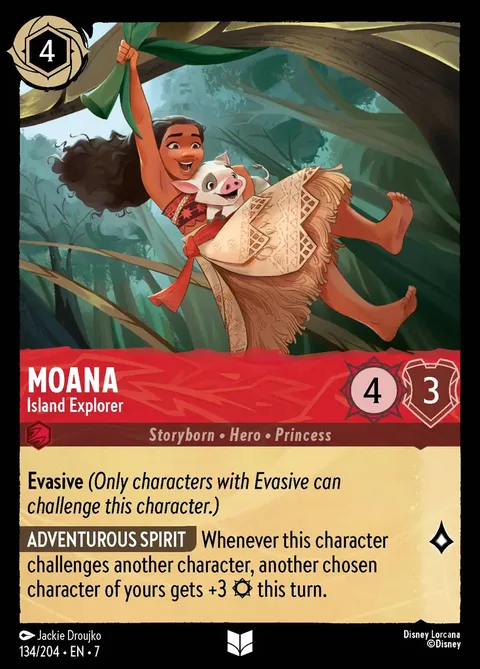 Ruby's challenge pressure is the combat half of the shell; Sapphire Items provide the longer resource plan.
Matchups should be framed by mechanics rather than by a frozen top-five list. The current Core pool is Sets 9-13, and the September Inkdecks report lists different leaders than the July snapshot this article previously used. Prepare for Evasive and non-Evasive boards first, then check recent Set 13 lists for the names you are likely to face.
Versus Evasive-built opponents (any color pair): This is the structural matchup to test most carefully. Your non-Evasive Ruby challengers cannot reach Evasive questers, so you need lore and resource efficiency rather than relying on challenge removal. Prioritize repeatable Item value where possible and check current Set 13 lists to see which named decks are actually using Evasive.
Versus non-Evasive midrange or aggro opponents: This is often the more comfortable matchup profile. Characters your Ruby challengers can reach give you targets while Sapphire Items sustain your resource base through the early pressure. Still check the current list, because the exact threats and removal lines change with the set.
Versus other Items or control decks: These matchups are often won by the player whose Items provide stronger activations rather than by raw character advantage. If you're interested in other non-Evasive midrange approaches in Core, the Disney Lorcana Seven Dwarfs Snow White deck guide covers a character-synergy alternative that has different matchup profiles from Ruby Sapphire Items. Know what each opponent's Items do and plan your challenge turns around denying them the resources to generate that value.
GODEEPER: The full format picture including how July 2026 rotation changes Core and what sets remain legal. Disney Lorcana Core vs Infinity Format Guide for 2026 →
1. Find a base list. Check inkdecks.com for recent Ruby Sapphire Items results in Core. Filter by the last 2-4 weeks. Ruby Sapphire Items lists vary more between pilots than Evasive decks do, so look for patterns across 3-4 lists rather than copying one exactly.
2. Identify your Items package. Count which Items appear in all or most of the lists you found. Those are the core pieces. Items appearing in one list but not others are tech choices that depend on what that pilot expected to face.
3. Check rotation status. Official Core information lists Sets 9-13 as legal after the July 17 rotation, with Attack of the Vine widely released on July 24, 2026. If any key Item or Ruby character is from Sets 5-8, replace it with a legal Sets 9-13 alternative before testing the list.
4. Acquire non-Enchanted copies. Enchanted rarity versions of Items and Ruby characters play identically to standard copies. Skip the premium version unless you specifically want it for collection reasons.
5. Test the matchup you struggle most against. Evasive matchups are the hardest for this deck. If you're new and still choosing between builds, the Disney Lorcana starter decks guide covers starter options that can bridge into Ruby Sapphire Items with minimal additional investment. Practice them specifically before competitive events so you know your lines when Ruby's challenge package has nothing to reach.
Don't play all your Items on the first two turns just because you can. One Item in play is a resource; three Items in play in turns 1-3 means your curve is over-committed early and you're not threatening with Ruby challengers yet.
Challenge when it's favorable, not just when it's possible. Ruby gives you the tools to challenge efficiently, but forcing challenges into unfavorable matchups wastes the character when a quest would generate more value.
The turn where you play an Item and trigger a Sapphire character's Items effect while questing with another character is the deck's best turn. Set that turn up rather than playing for speed alone.
When facing Evasive decks, resist the temptation to challenge the Evasive characters with non-Evasive Ruby cards. You can't reach them. Spend those turns playing more Items and questers. The Items value advantage has to be your win condition in those matchups, not combat.
What is the Ruby Sapphire Items deck? A Core deck combining Ruby's challenge-focused attackers with Sapphire Items for persistent resource advantage.
What are Items in Disney Lorcana? Permanent card type that stays in play and provides ongoing effects. Different from Events, which are discarded after use.
Is Ruby Sapphire Items competitive in Core 2026? It has recorded Core results and a dedicated Inkdecks archetype page, but current September data does not place it among the leading top-tier decks. Treat it as a metagame-dependent or local choice, not a guaranteed competitive tier call.
What sets provide the Items package? Build from Sets 9-13: Fabled, Whispers in the Well, Winterspell, Wilds Unknown, and Attack of the Vine. The official July 2026 announcement says Sets 5-8 rotated out and Set 13 became widely available on July 24.
What is the hardest matchup? Evasive-heavy decks are the structural matchup to test first because non-Evasive Ruby characters cannot challenge them. The exact named deck changes, so use recent Set 13 lists and plan to win through lore and resource efficiency.
Where do I find a current deck list? inkdecks.com filtered to Core, Ruby, Sapphire, sorted by recent performance.
Should I build this before the rotation? The relevant rotation already happened. Build within Sets 9-13; official Core event information confirms that Sets 5-8 are outside the current Core pool.
Related
Union Arena Fullmetal Alchemist Deck Guide: Blue 2026
8 min read
Union Arena Attack on Titan Vol.2: New Yellow Color
8 min read
OP-17 Mihawk Deck Guide: Green Dracule Mihawk 2026
13 min read
Dragon Ball Fusion World FB11 Leaders: All 5 Revealed
8 min read
OP-17 Mihawk Matchup Guide: All 6 Leaders Explained
14 min read