

Shonen TCG · Guides
Union Arena Card Rarities Explained: C, U, R, SR, Parallels
The letter says where a card sits in the set. The stars say what a collector pays. We priced every rarity across 31 English sets.
Our callStars set the price, not letters: the median regular Super Rare sells for $1.71 on TCGplayer, the median SR three-star parallel for $1,094.97, and both play exactly the same.
Union Arena card rarities explained in one line: the letter (C, U, R, SR) tells you where a card sits in the base set, and the stars after it tell you what a collector will pay. A parallel keeps the card number and the text of the regular card, so it plays exactly the same.
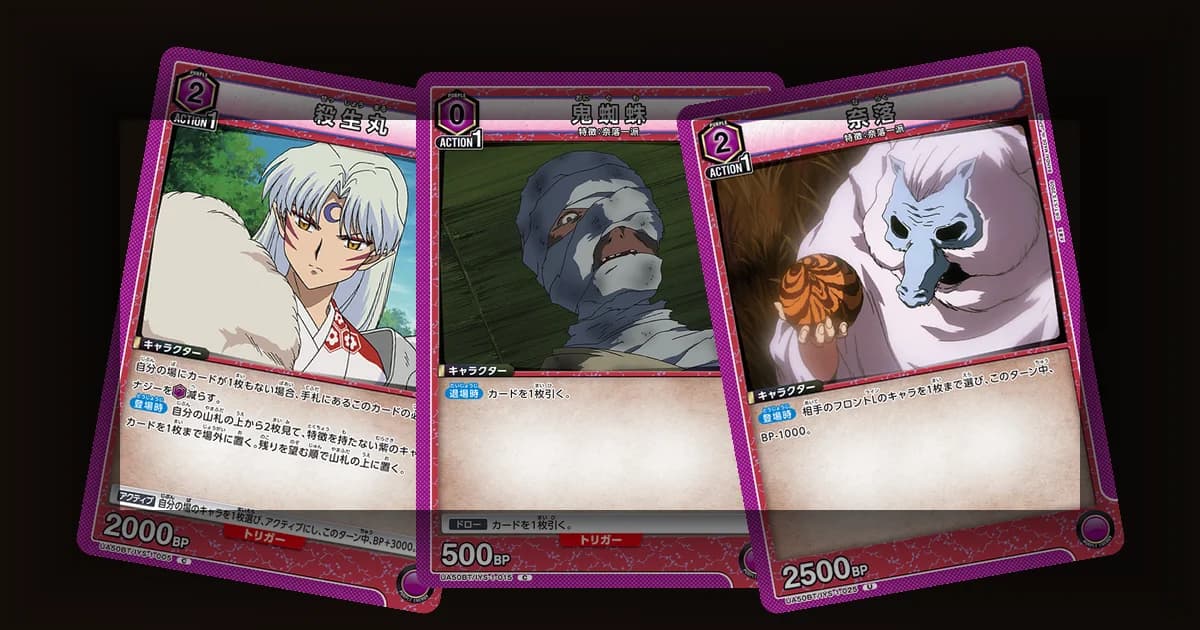
We read Bandai's English product pages for what each set contains, and pulled TCGplayer's market price for every priced card in the 31 English booster sets out so far.
The four base rarities
Bandai's English booster pages list four base rarities plus Action Point cards, with a type count for each. Solo Leveling has 30 Common, 27 Uncommon, 12 Rare and 11 Super Rare types, plus 12 AP types. A pack holds 12 cards and a display box holds 16 packs.
| Label | Name | What it is |
|---|---|---|
| C | Common | The bulk of the set |
| U | Uncommon | The second-largest group |
| R | Rare | About a dozen types per set |
| SR | Super Rare | The set's headline characters |
| AP | Action Point | Not part of your deck: you play with 3 AP cards beside a 50-card deck |
The letter isn't a power ranking, and a regular Super Rare usually isn't expensive either. The median regular SR on TCGplayer sells for under two dollars. The priciest one we found, the regular Sung Jinwoo from Solo Leveling, is $28.15.
Stars mark the parallels
A parallel is the same card with new art or a different finish, and it's marked with stars after the rarity: SR★, SR★★, SR★★★. Bandai's pages only say that alt-art cards are included in the product. TCGplayer lists them as 1-Star, 2-Star and 3-Star versions.
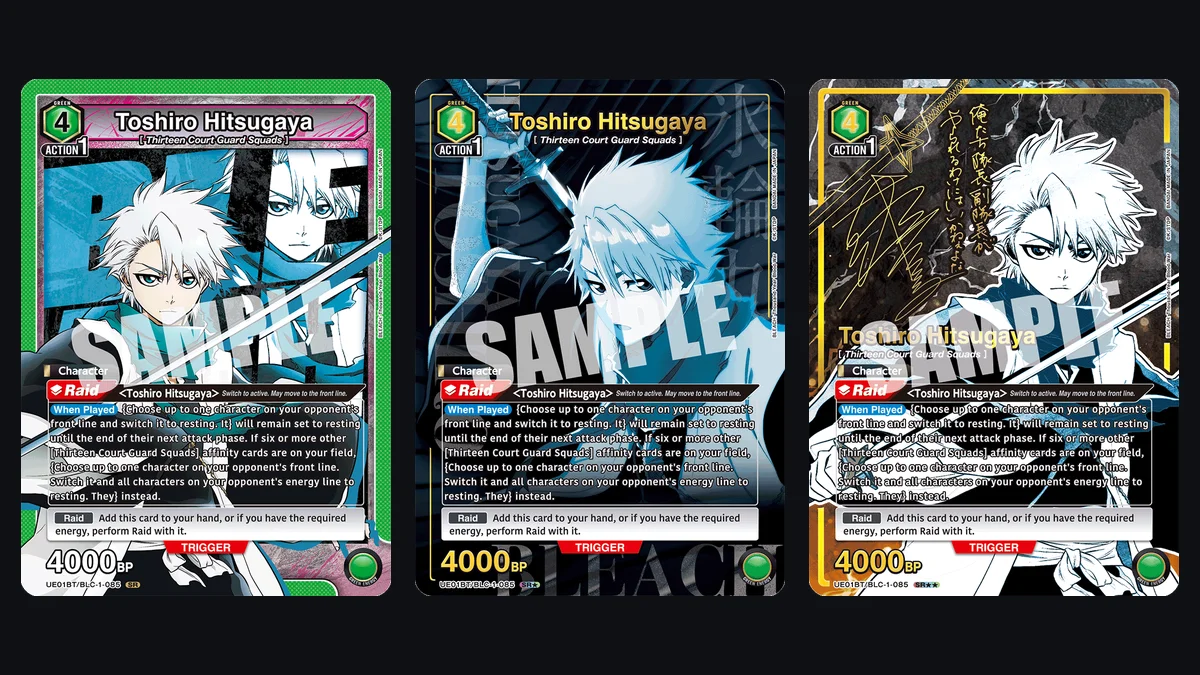 Image: Bandai, official UNION ARENA card images via Bandai TCG+ (UE01BT/BLC-1-085 SR, SR★ and SR★★)
That's one card, Toshiro Hitsugaya BLC-1-085, three times. Cost, BP and text match, so any of them does the same job in a deck. Only the art and the rarity mark next to the card number change. On TCGplayer the regular one sells for $4.42, the one-star for $32.40 and the two-star for $250.68.
Stars aren't only for Super Rares. TCGplayer lists one-star Commons, Uncommons and Rares, plus a handful of two-star and three-star versions of lower rarities.
What each rarity sells for
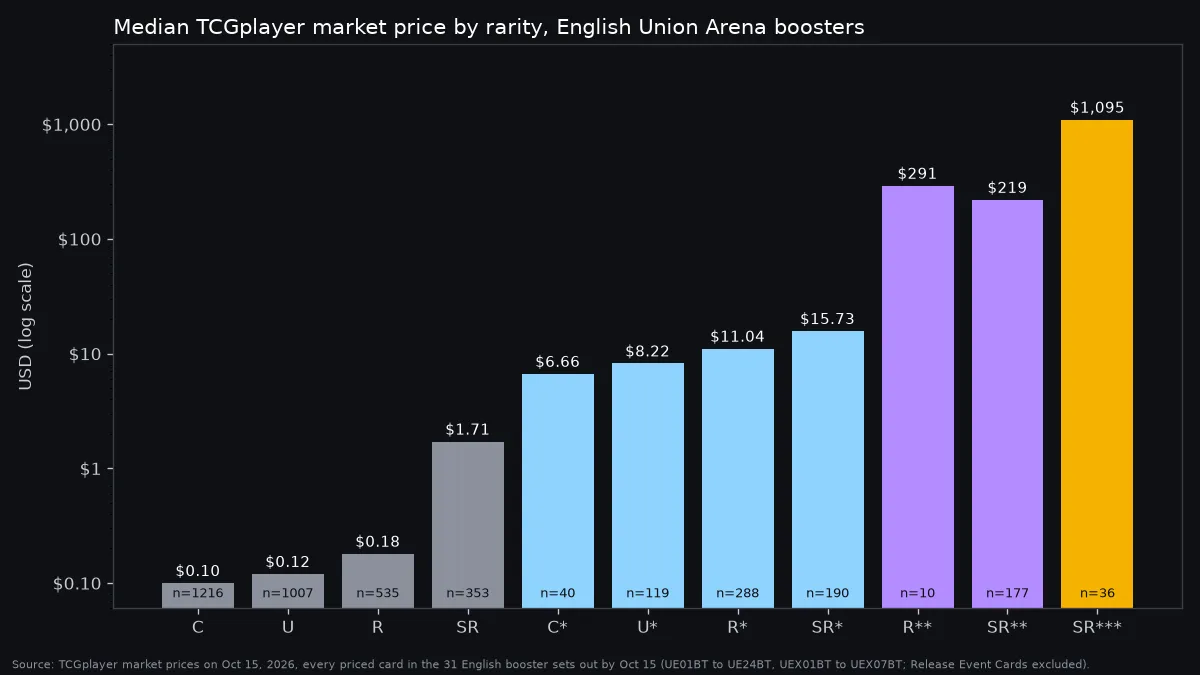 Chart: ShonenTCG. Source: TCGplayer market prices on October 15, 2026, every priced card in the English booster sets released by then, Release Event Cards excluded
The jumps are what matter. A regular Common, Uncommon or Rare is pocket change: $0.10, $0.12 and $0.18 at the median. One star moves a card into the $6.66 to $15.73 range. Two stars is where it turns into real money: $219.25 for the median SR★★, and $290.99 for the rare R★★.
SR★★★ is the chase, and its median is past a thousand dollars. TCGplayer has 48 SR★★★ listings across every English booster so far, serial-numbered versions included. Some of those prices rest on very few sales, which our Union Arena price check looks at card by card.
The other things in a box
Action Point cards. Every set has its own AP cards, and some products add special ones. Bandai's Chainsaw Man page says "serial-numbered, hand-signed Action Point cards are included in booster packs at an extremely low pull rate".
Box toppers. Many boxes come with a box topper. Solo Leveling's page says its "Box topper includes 1 of 5 types of foil design cards."
Serial numbers. Some SR★★★ cards also come serial-numbered, and TCGplayer lists those as separate products.
Cards outside the boosters. Bandai also sells small premium sets. BLEACH New Card Selection is 12 cards for $25, and the top Green Bleach list plays sixteen of them. Our Bleach guide has that list.
What Bandai doesn't publish: pull rates
The product pages say "Which of the cards are included is random." That's the whole official statement. There's no published rate for SRs, stars or special AP cards.
Openers fill the gap with their own counts. Union Arena Guides' pull-rate video walks through what a Jujutsu Kaisen Vol.2 box and case gave them.
In the comments, the channel added that it's "been confirmed (by me) that 3*** STARS are IN ADDITION to anything you get in the case." That's one opener's count, not a Bandai figure. A viewer who'd opened 8 booster boxes from their local store said they "only got SR's and some but no fancy parallel" before their first case.
Telling versions apart is tricky even for regulars. Asked about Bleach AP cards on r/union_arena, one collector explained that "The only ones that have a star at the bottom left will be the numbered/serial APs." Check the mark next to the card number before you buy or sell.
Our take
If you play, ignore the stars. Buy the regular version of every card your list needs and you'll have the same deck as the person holding the SR★★★.
If you collect, the stars are the whole game. Read the exact mark and number on any listing, because a one-star and a two-star of the same card can be hundreds of dollars apart. New to the game? Start with the Union Arena beginner guide before you open anything.
How we checked this: rarity counts, box sizes and product notes come from Bandai's English UNION ARENA product pages and beginner guide; card images from Bandai TCG+; rarity labels and market prices from TCGplayer on October 15, 2026, covering every priced card in the English booster sets UE01BT to UE24BT and UEX01BT to UEX07BT (Release Event Cards excluded). Where TCGplayer's daily price file had no market price for an SR★★★, we used that product's own price page. Medians use each product's market price.
Frequently Asked Questions
What are the Union Arena rarities? Common (C), Uncommon (U), Rare (R) and Super Rare (SR), plus Action Point cards. Parallels add stars: SR★, SR★★ and SR★★★, and some lower rarities get one or two stars too.
What is the rarest Union Arena card? SR★★★ parallels. Every English booster set but one has one or two, and some come serial-numbered.
Do parallels play differently? No. A parallel has the same card number and text as the regular card. Only the art, finish and rarity mark change.
Does Bandai publish Union Arena pull rates? No. The product pages only say which cards you get is random. Pull-rate numbers online come from people counting their own openings.
Is a Common ever valuable? The regular version almost never is. A Common with a star is a different product and usually sells for a few dollars or more.
Related Reading
- Union Arena Card Grading Guide: when grading a parallel is worth it.
- All Union Arena Sets: English Release Schedule: every set and its release date.
References
Was this guide helpful?
About the author
Beginner guides and anime crossover
Pen name for the Shonen TCG desk's beginner guides, starter decks and anime-to-card-game explainers.
- Rules checked against the official rulebook and card text
- Every claim traced to a cited source
- Opinions marked as ours, with the reason
Keep reading
Union Arena Tournament Guide 2026: Rules and Formats
Guides · 12 min
Union Arena Beginner Deck Tier List: Four EN Picks 2026
Guides · 11 min
Union Arena vs Dragon Ball Super Card Game: 2026 Guide
Guides · 11 min
Union Arena vs One Piece TCG: Which Anime TCG to Play
Guides · 10 min

Union Arena JJK Guide: Jujutsu Kaisen Best Decks (2026)
Guides · 14 min

Union Arena Bleach Guide: Best Decks & Cards (2026)
Guides · 7 min
Union Arena Deck Building Guide: Build a 50-Card Deck
Guides · 11 min
Union Arena How to Play: Win by Taking 7 Life Cards
Guides · 12 min
Disclaimer
This article is published for informational and entertainment purposes. It does not constitute professional financial, legal, or technical advice. Game performance, online services, patch schedules, and store listings change. Verify critical details (pricing, system requirements, regional availability) with publishers and storefronts before you buy. Affiliate links, where present, help support our editorial work and are labelled in our affiliate disclosure.