

Shonen TCG · Guides
Union Arena Solo Leveling Guide: Cards and Builds (2026)
This Union Arena Solo Leveling guide is a current, source-checked starting point for UE17BT. Bandai's official product page confirms the English set released on March 20, 2026, with 12 cards per pack, 16 packs per display, and a $4.99 MSRP per pack. The release event ended March 26, so the useful question now is how to read the card pool and choose a build.
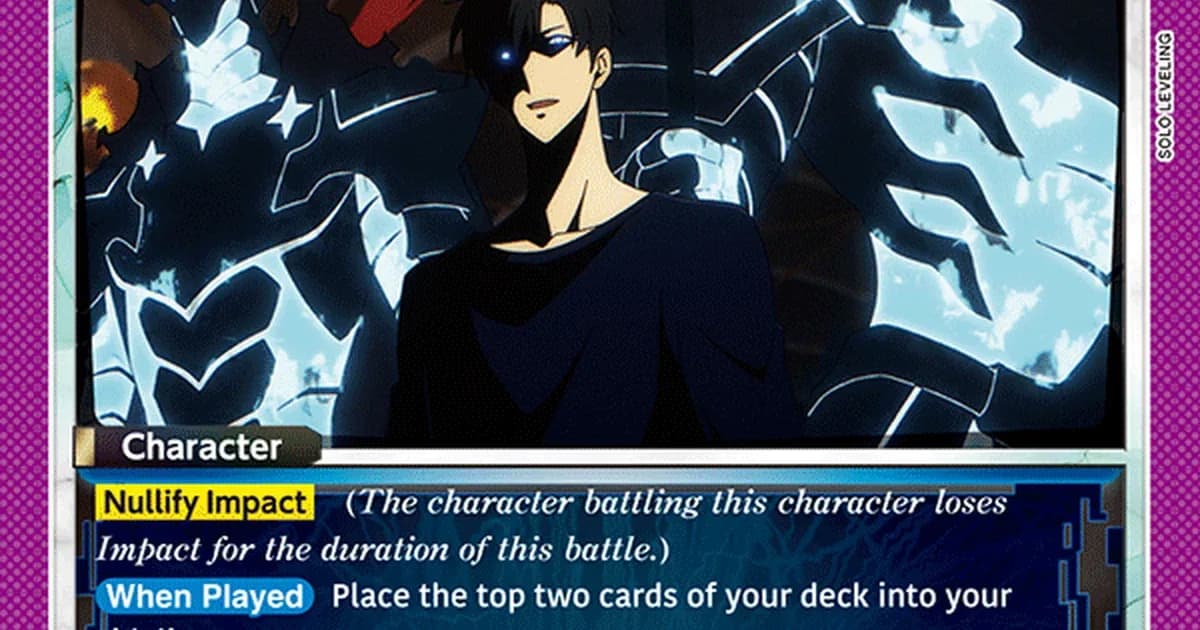
TL;DR: UE17BT has 80 regular card types and 12 Action Point card types, plus alt-art cards and a five-design box topper. The official card list supports several different plans, including Purple Shadow Army cards and Green or Purple Sung Jinwoo Raid lines. Start with card text and a real deck shell, not stale singles prices or an invented “Shadow Storage” engine.
Union Arena Solo Leveling guide: quick answer
Treat the set as a card pool with several routes rather than one automatic best deck. Purple Shadow Army is the clearest competitive starting point because the official results page records two regional wins and a September community tier list places Shadow Army in S tier. Green and Purple Sung Jinwoo cards point toward different Raid and sideline decisions, so the right first purchase depends on the list you actually want to test.
Key Takeaways
- The English UE17BT booster released on March 20, 2026.
- Each pack has 12 cards, each display has 16 packs, and the listed MSRP is $4.99 per pack.
- Bandai lists 80 regular card types and 12 Action Point card types, with random contents and alt-art cards.
- Purple Solo Leveling won the May 8 Wave 1 regional and the August 21 Wave 2 Gen Con regional on Bandai's published results page.
- The official English text uses the game's normal field, energy line, sideline, and removal terminology. The cards checked here do not establish the old Shadow Storage loop.
- Arise is an AP-readying Event. It is not a card that sends an opposing character to your Shadow Storage.
- There is no current reason to use an old $70 to $80 Igris price, pull-rate estimate, or box EV claim as a fixed fact.
Official product facts
Bandai's SOLO LEVELING UE17BT product page is the source of truth for the sealed product:
| Product fact | Official information |
|---|---|
| English set | SOLO LEVELING [UE17BT] |
| Release date | March 20, 2026 |
| Release event | March 20 through March 26, 2026 |
| Pack MSRP | $4.99 |
| Cards per pack | 12 |
| Packs per display | 16 |
| Regular card types | 80 |
| Action Point types | 12 |
| Additional treatments | Alt-art cards and a five-design foil box topper |
The display configuration is 192 cards before duplicates, not a guaranteed playset. Bandai also lists five foil-stamped autograph card subjects from the English dub cast and 17 brand-new illustrations. Those details matter to collectors, but they do not tell you which cards a competitive deck needs.
The North American products page does not list a dedicated Solo Leveling starter deck. It does list the booster and a separate Playmat and Action Point Cards Set. That makes singles, trades, and local testing more practical starting points for a player who wants a playable list instead of a sealed opening experience.
What the official card text actually supports
An earlier version of this article described a Shadow Storage zone where defeated Shadows could be replayed for free. The official UE17BT entries checked for this update use the sideline for the relevant effects. Do not build around a general Shadow Storage loop unless a future card or official ruling explicitly establishes one. Bandai's UE17BT card list should control over an old article, a translated Japanese list, or a marketplace description.
The correction also matters for Arise. Arise, UE17BT/SLG-1-038, is a purple Event with required energy 3 and AP cost 1. Its main effect chooses up to two of your AP cards and switches them to active. Its Final trigger puts the top card of your deck into your life area if you have 0 life. It does not convert an opposing character into a reusable Shadow.
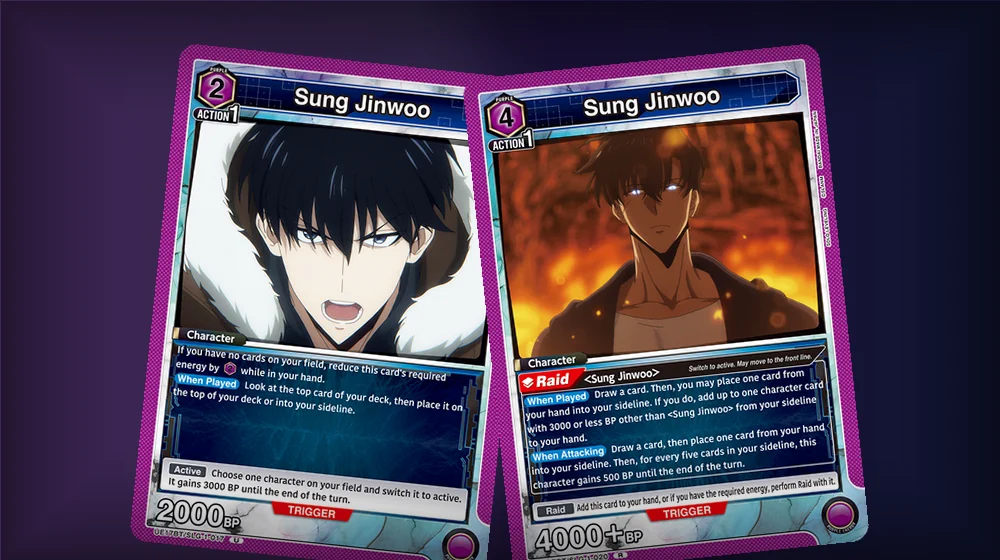 English Sung Jinwoo cards illustrate the set's separate Raid lines and different build requirements.
Core card roles
The card pool is easier to evaluate when each card is assigned a job instead of a market price.
Sung Jinwoo, UE17BT/SLG-1-049. The official 049 card entry is a green 6-energy, 1-AP character with 4000+ BP. It has Raid for another Sung Jinwoo, Impact 1, gains 500 BP, can sideline an opposing front-line character when played with one of your abilities, and draws a card when attacking before placing a card from hand face down under itself. That is a Raid and hand-management line, not proof that every Solo Leveling list should be green.
Sung Jinwoo, UE17BT/SLG-1-022. The 022 card entry is a purple 12-energy, 1-AP character with 5000 BP. Its required energy is reduced by one purple for each Shadow Army card on your field while it is outside the field or sideline. It also has Raid, Impact 1, and an effect that can switch a Shadow Army card on the front line and one on the energy line to active while giving it Snipe for the turn. This is a different commitment from the green 049 line.
Igris, UE17BT/SLG-1-028. The official Igris entry lists a purple 4-energy, 2-AP Rare with 4000 BP and Shadow Army affinity. When played, it can play up to one Shadow Soldiers card from hand or sideline to your field in resting position. That makes Igris a board-development card. It does not need an unverified secondary-market price attached to it to be useful in a deck discussion.
Beru, UE17BT/SLG-1-033. The Beru entry lists a purple 5-energy, 1-AP Rare with 4000 BP and Shadow Army affinity. When attacking, if you have at least four resting Shadow Army cards with 3000 or less base BP, you may place one card from hand into your sideline to switch Beru to active. That is a board-state requirement and a hand-to-sideline cost, not a generic recursion trigger.
Sites and events. Monarch's Domain is a purple Shadow Army Site that can give your Shadow Army cards 500 BP, or 1000 BP if you have five or more of them. Demon's Castle places the top card of your deck into your sideline once per turn and has a later sideline threshold for using Elixir of Life. Shadow Monarch plays one Shadow Army card from the sideline active, or up to two qualifying cards resting. These cards support a sideline plan, but their exact costs and thresholds still matter in a real list.
Step-by-Step: Build a first list
1. Pick the play pattern before buying cards. Decide whether you want a Purple Shadow Army board, a Green Raid Jinwoo shell, or a sideline-focused experiment. “Solo Leveling” is the title, not a single deck list.
2. Start from an evidence-based shell. Bandai's Top-Placing Decks page records Purple Solo Leveling lists in multiple 2026 Championship events. Use a published event list or a local player's tested list as the starting point. Do not fill 50 slots with guessed card names.
3. Verify every card number. Check the official card list for the exact title, color, required energy, AP cost, affinity, BP, and text. This catches common errors such as treating Arise as removal or assuming that every Jinwoo has the same Raid line.
4. Separate the resource plan. If the list uses the sideline, track which effects put cards there, which effects retrieve or play them, and what costs each action consumes. If the list uses Raid, track the base character, required energy, and AP timing. Do not call a card advantage loop “free” when it still needs an AP or an ability condition.
5. Test opening hands and turns three through six. Keep notes on whether you can establish an early field, meet your energy curve, and use a Site without losing tempo. Then test against the current decks at your local store. A plausible card sequence is not the same thing as a verified matchup percentage.
6. Buy the missing pieces after testing. Once the list has survived several games, buy the cards that are actually repeated in the tested version. Sealed product is fine for collecting and opening, but random packs are a poor substitute for a known list.
Union Arena Solo Leveling guide: build priorities
Use these priorities when comparing a Purple Shadow Army list with a Jinwoo or sideline variant:
- Purple Shadow Army: Begin with the cards whose official affinity and effects explicitly reference Shadow Army, including Igris, Beru, Monarch's Domain, and Shadow Monarch. Count how many of your effects require a wide board or resting cards before assuming the list is aggressive.
- Green Raid Jinwoo: The 049 line rewards a different sequence involving a Sung Jinwoo base, an ability-based play, hand management, and attack timing. Treat it as its own shell rather than adding one green card to a purple list without checking the energy base.
- Purple Raid Jinwoo: The 022 line asks you to establish Shadow Army cards because its energy reduction and activation effects refer to that affinity. Its 12 printed required energy is a deck-building constraint even when the reduction is online.
- Sideline engines: Demon's Castle, Shadow Monarch, and cards that interact with the sideline can produce a longer setup plan. Count the cards that must be placed there and the AP required to use them. If the setup takes too long, the deck may need more early characters.
- Mill labels: A community deck label such as “Cha/Jinwoo Mill” should not be treated as the default Solo Leveling plan. It is a separate archetype label that needs its own list and test results.
Current tournament and tier context
Bandai's official results page currently shows Purple Solo Leveling in several recent 2026 events. It records 1st place at the Wave 1 The Booster Box regional revealed May 8 and 1st place at Wave 2 Gen Con revealed August 21. It also shows Purple Solo Leveling entries in the June 12 Top Cut and June 26 Versus Games results. The page does not publish a complete win-rate table for the title.
For a broader community snapshot, Joseph Writer Anderson's September 14 English tier list places Shadow Army in S tier and Cha/Jinwoo Mill in A tier. That is useful context for choosing what to test, but it is a community ranking, not an official Bandai classification. Results can shift as more titles and lists enter the 2026-27 season.
Buying guidance after release
Use the official $4.99 pack MSRP as a product reference, not as a promise about current store or secondary-market pricing. Current listings can differ because of availability, reprints, shipping, condition, and the treatment of alt-art or signed Action Point cards. This update intentionally does not repeat the old Igris, Jinwoo, or Beru price ranges because a dated number is not a current price source.
Choose a display if you want to open the set, collect its illustrations, trade locally, or see what kind of cards your group plays. Choose singles if you have a tested list and need repeated copies of specific cards. If you are undecided, buy enough to learn the game locally before committing to a full playset.
SHOP: Building a Solo Leveling Union Arena list? Compare current Solo Leveling listings for the cards and upgrades this guide covers. Shop TCGplayer →
What changed from the old guide
The old copy mixed genuine card names with unsupported effect text, called Arise a removal spell, used an unverified Shadow Storage loop, and repeated old price and pull-rate claims. Those details have been removed or corrected against Bandai's official product and card pages. The current guide also separates official Championship results from a community tier list.
That distinction is important for future updates. A new result can change the competitive section. A new ruling can change a card interaction. A marketplace price can change every day. Update each claim from its relevant source instead of carrying one stale number through the whole article.
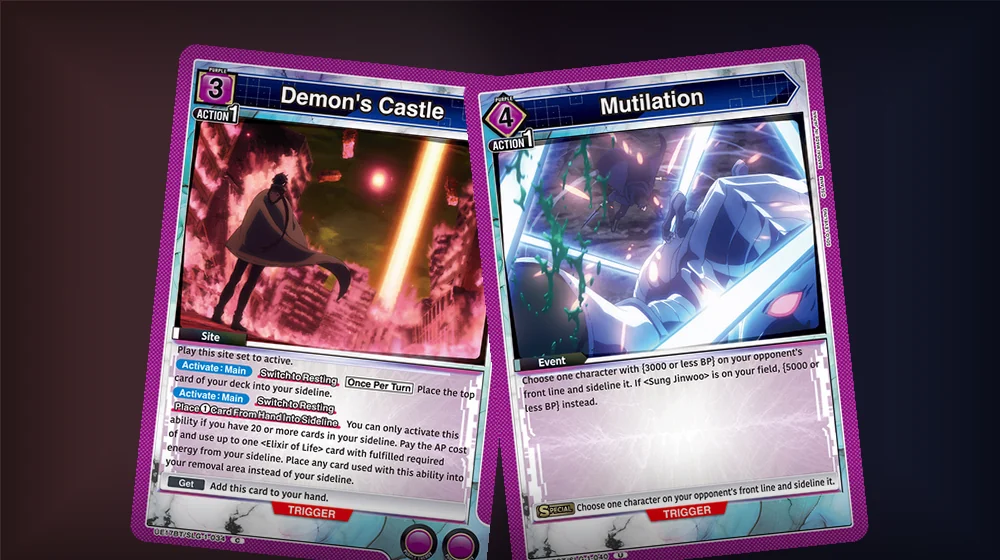 Demon's Castle and Mutilation show the set's sideline and removal vocabulary in English card text.
Related Reading
- Union Arena Solo Leveling Mill Deck Guide: a separate archetype guide for the Cha and Jinwoo mill shell.
- Union Arena Solo Leveling vs JJK: Which Deck to Play: a dated comparison of the two IPs' play patterns, products, and official regional results.
- Union Arena Deck-Building Guide: energy, AP, title codes, and list construction.
- Union Arena Tournament Guide 2026: how to prepare for organized play and read event results.
- Union Arena Trigger System Explained: how trigger effects resolve during games.
- Union Arena TCG Beginner Guide 2026: the core rules before choosing an IP.
Frequently Asked Questions
When did the English booster release?
Bandai lists March 20, 2026 for UE17BT. The release event ran March 20 through March 26. The official product page lists 12 cards per pack, 16 packs per display, and a $4.99 MSRP per pack.
How many cards are in a display?
The listed configuration is 12 cards per pack and 16 packs per display, or 192 cards before duplicates. The set has 80 regular card types and 12 Action Point types. Random contents and alt-art treatments mean a display is not a guaranteed playset.
Is there a dedicated starter deck?
The North American products listing checked for this update does not show a Solo Leveling starter deck. It shows the booster and a separate Playmat and Action Point Cards Set. Plan around singles, sealed packs, trades, or a tested local shell.
Which Jinwoo should I start with?
Compare the official 049 green Raid entry and 022 purple Raid entry against the rest of your list. They have different colors, energy requirements, and supporting effects. The better starting card depends on the deck's energy base and whether the list is built around Shadow Army affinity.
Is Shadow Army a top deck?
Bandai's page records two Purple Solo Leveling regional wins and additional Purple entries in 2026 events. A September 14 community tier list places Shadow Army in S tier. That is strong evidence for testing, but it is not a guarantee for every list or player.
Does Arise remove an opposing character?
No. The official Arise entry says to choose up to two of your AP cards and switch them to active. Its Final trigger adds the top card of your deck to your life area when you have 0 life. The old opposing-character description was incorrect and has been removed.
Where should I verify card effects?
Use Bandai's UE17BT card list and the direct card pages linked in this guide. Check the exact card number, color, required energy, AP cost, affinity, BP, and printed effect before buying or copying a list from a community post.
References
- SOLO LEVELING [UE17BT] official product page: release date, MSRP, pack configuration, card-type counts, and product features
- SOLO LEVELING [UE17BT] official card list: English card pool and search results
- Sung Jinwoo UE17BT/SLG-1-049: official card text
- UNION ARENA Top-Placing Decks: official Championship results
- UNION ARENA English Tier List: September 14 community tier snapshot
Was this guide helpful?
About the author
Card values and pull rates
Pen name for the Shonen TCG desk's card value, pull rate and collector market coverage.
- Prices read from TCGplayer and Cardmarket listings, dated
- Pull rates tied to a stated sample
- Opinions marked as ours, with the reason
Keep reading

All Union Arena Sets: Complete EN Release Schedule (2026)
Guides · 12 min

Union Arena TCG Beginner Guide: How to Start (2026)
Guides · 11 min

Union Arena Bleach Guide: Best Decks & Cards (2026)
Guides · 13 min

Union Arena JJK Guide: Jujutsu Kaisen Best Decks (2026)
Guides · 14 min
Union Arena vs One Piece TCG: Which Anime TCG to Play
Guides · 10 min
Union Arena vs Dragon Ball Super Card Game: 2026 Guide
Guides · 11 min
Union Arena Beginner Deck Tier List: Four EN Picks 2026
Guides · 11 min
Union Arena Card Rarities Explained: C, U, R, SR, Parallels
Guides · 12 min
Disclaimer
This article is published for informational and entertainment purposes. It does not constitute professional financial, legal, or technical advice. Game performance, online services, patch schedules, and store listings change. Verify critical details (pricing, system requirements, regional availability) with publishers and storefronts before you buy. Affiliate links, where present, help support our editorial work and are labelled in our affiliate disclosure.