Loading…
Shonen TCG · General
Union Arena InuYasha Naraku: Villain Deck Guide 2026
9 min readBy Michael Riley
Reviewing
Union Arena
Union Arena InuYasha Naraku villain cards have proven their value across six weeks of JP community play with UA50BT, and the tier lists haven't fully caught up: the villain package isn't just flavor. Naraku, Kagura, and Kanna cards serve real disruptive functions in a set where the dominant mechanic (Jewel Shard counters) depends on specific activation windows. Block those windows, and the hero decks stop working.
This guide covers how Union Arena InuYasha Naraku villain cards function, when disruption is worth building around, and how to put the package together before UE23BT drops on August 14, 2026.
Quick note upfront: specific card effect text here comes from JP community descriptions and translated summaries. The EN card database isn't live yet. For verbatim effect text, check the official Bandai EN product page after launch.
TL;DR: Naraku (UA50BT-025, SR) negates all Jewel Shard counter effects for one turn. He's a 1-copy tech piece in most builds and a 2-copy mirror-match weapon in InuYasha-heavy metas. Kagura and Kanna round out the villain package with wind and mirror-based disruption effects. Full villain builds are viable but need the Kagome draw engine to stay consistent. EN launches August 14, 2026.
Union Arena InuYasha Naraku villain cards: quick answer
Naraku is the disruptor. In a set built around Jewel Shard counter management, his ability to blank the whole counter system for one turn is a precision tool against the most popular archetypes. The villain-forward approach doesn't race to win the way Counter Rush does. It controls the pace and cuts the opponent's combo window.
Kagura and Kanna extend the package beyond Naraku. From JP community descriptions since the UA50BT May 29 launch, Kagura provides control effects tied to her wind and death dancer role, while Kanna handles hand or board manipulation through her mirror's reflection ability. Once those windows close on the hero side, the attrition game tilts fast.
A caveat worth repeating: everything here is built from JP community summaries and translated card data, not the EN card database. Where specific numbers are uncertain, this guide says so.
Key takeaways
- Naraku (UA50BT-025) is a counter-negation Special Rare, devastating in InuYasha mirrors and situationally useful elsewhere
- Kagura and Kanna carry disruption effects that support a slow, attrition-based game plan
- Kikyo provides a third Purification axis with defensive application, bridging villain and hero builds
- The villain package requires the Kagome draw engine to stay consistent, meaning pure villain builds still run hero staples
- Naraku trades at $15-22 JP, making him the most affordable Special Rare with genuine competitive upside
- EN releases August 14, 2026 as UE23BT; JP data from UA50BT has been forming since May 29
Naraku in Union Arena: how the counter negation works
The Jewel Shard counter system is what makes InuYasha decks tick. Miroku stacks counters on your characters. Kagome spends them through Purification for draw and power boosts. Full Demon InuYasha's game-ending sequence activates when a character reaches maximum counter count (4). Every piece in the deck is built around accumulating and spending counters at the right moment.
Naraku's ability cuts all of that off.
When his effect resolves, all Jewel Shard counter abilities on the field are negated for that turn. Characters with counters still have the physical tokens, but the effects those counters enable don't trigger. Full Demon InuYasha at counter maximum can't activate. Kagome can't fire Purification. The Tessaiga event card's counter interaction goes blank.
In the InuYasha mirror, landing Naraku on the turn your opponent is about to close with Full Demon InuYasha means their entire combo turn doesn't happen. They wasted their counter accumulation. You advance your board while they reset.
Timing is everything with him. Naraku is most effective played reactively, in response to a confirmed counter threshold rather than speculatively. Play him too early and the opponent just rebuilds. Play him on the exact turn their combo is assembled, and you've bought yourself two or three turns to close.
That's not a subtle edge. That's a game.
GODEEPER: Want to understand exactly how the Jewel Shard counter system works before building around disrupting it? The complete set guide covers the mechanic in depth. Union Arena InuYasha: Complete Set Guide (EN 2026) →
The villain supporting cast: Kagura and Kanna
Naraku alone isn't a deck. He's a finisher on a disruption strategy that Kagura and Kanna actually build.
Kagura is Naraku's first incarnation in the anime: a wind dancer who controls the dead and cuts against both Naraku and InuYasha at different story points. JP community descriptions from UA50BT play put her cards in a wind-element control role, board presence removal or power reduction applied at range. That fits how she works in the anime. She slots into the villain build as the mid-game controller, holding the field until Naraku can fire.
Kanna is Naraku's second incarnation: a silent girl with a mirror that reflects attacks and drains souls. In other Union Arena IP sets, mirror-based characters tend to show up as hand disruption or effect copy pieces. Community summaries from UA50BT suggest Kanna runs similarly, either as hand interaction or counter-drain, pulling resources away from the opponent before Naraku closes.
Kagura handles the board. Kanna cuts resources. Naraku lands when the combo is assembled. That's a genuine three-piece disruption sequence, not three separate cards that happen to share a faction.
Both Kagura and Kanna's exact rarities are from community breakdowns rather than the official EN card database. Their presence in the UA50BT pool is confirmed on the Bandai product page. Exact costs and effect text will be verifiable after August 14.
Kikyo's role in villain-adjacent builds
Kikyo isn't a villain in any clean sense. She's InuYasha's original love, resurrected as a clay construct, and her story involves a genuinely complicated relationship with both InuYasha and Naraku. Union Arena uses that ambiguity in how her card works.
Kikyo (UA50BT-048, SR, $25-35 JP) applies Purification through an opponent-targeting effect, not the forward-tempo version Kagome provides. Kagome's Purification draws cards and pushes your own board state. Kikyo's spends Jewel Shard counters to debuff opposing character power. She's defensive Purification.
Sesshomaru Control already runs this combination at 4x Kagome and 2x Kikyo. Villain builds can do the same thing and add the Naraku disruption layer on top. Kikyo doesn't compete with Naraku for deck slots. She extends what he does by contesting opposing power levels while he handles counter negation.
Her lore ambiguity is the mechanical advantage here. She works in both villain-forward and hero builds, which means she's never a dead card regardless of which direction your local meta pulls.
GODEEPER: Full breakdown of Kikyo's value as both a competitive piece and a collector card, with JP pricing and EN expectations. Union Arena InuYasha Best Cards to Pull →
Building the villain-forward deck
Naraku Disruption builds off the same base as Sesshomaru Control, swapping the Sesshomaru-heavy finisher line for Naraku as the disruptive centerpiece. The game plan isn't to close fast. It's to deny the opponent their win condition long enough to establish a board they can't answer.
Core engine (same across all InuYasha archetypes):
Kagome Higurashi (Rare) at 4 copies. She's the draw engine and Purification activation that keeps your hand stocked through a slow game. No InuYasha build cuts her.
Miroku (Uncommon) at 4 copies. Counter accelerator. Even when you're disrupting your opponent's counters, you need to accumulate your own for the Kagome engine to run.
Sango (Uncommon) at 3-4 copies. Blocker piece. She holds the early board while the disruption package assembles.
Villain disruption package:
Naraku (UA50BT-025, SR) at 1-2 copies. One copy is the baseline in any mixed meta. Two copies is for InuYasha-mirror focused preparation.
Kagura at 2-3 copies. Mid-game board controller, fills the gap before Naraku can fire.
Kanna at 1-2 copies. Hand or counter manipulation applied as a resource denial tool.
Kikyo (UA50BT-048, SR) at 2 copies. Defensive Purification that contests opposing character power.
Finisher:
Skip Full Demon InuYasha here. You're not racing to counter maximum; you're grinding. The finisher slot runs Sesshomaru SR (UA50BT-006) at 2 copies because his flat 7000 power doesn't depend on the counter system you're disrupting. When Naraku blanks the opponent's counters, your own finisher stays active. That asymmetry is the whole point.
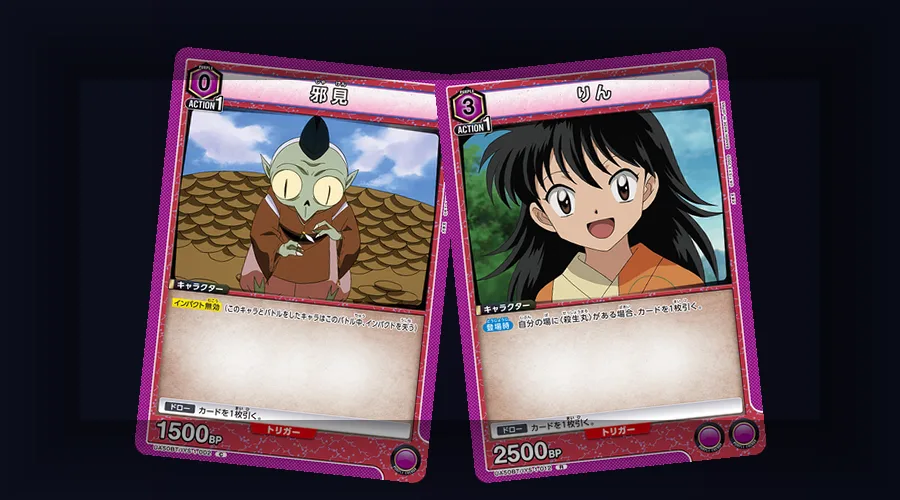 The villain package: Naraku as counter-negation, Kagura for board control, Kanna for resource disruption. Sesshomaru SR closes as the counter-independent finisher.
When to play the villain build
The villain build has a specific meta context where it's worth playing:
InuYasha-heavy metas. When multiple players at your local or regional are on Counter Rush or Sesshomaru Control, Naraku is the best tech piece available. He shuts down InuYasha mirrors more completely than any other card in the set.
Metas with combo-dependent decks. Naraku's counter negation generalizes beyond the InuYasha mirror if other Union Arena IPs in your meta rely on specific activation windows. Check what's popular locally before deciding on a second copy.
Where it struggles: pure aggro. Against decks that don't rely on counter accumulation, Naraku's a dead card on certain turns. Aggro applies pressure before disruption can get set up, and the villain build takes more turns to close than Counter Rush. You need Sango and Kikyo holding the early board or you don't survive long enough for the disruption to matter.
For EN players entering the August 14 launch: Counter Rush has the most JP data and the clearest learning path. The villain build is better suited to someone who's already played Counter Rush or Sesshomaru Control and wants to approach the meta from a different angle. Learning it first means learning the counter system and how to break it simultaneously, which is harder than it sounds.
Competitive viability
JP community data from six weeks of UA50BT puts InuYasha builds broadly at 52-55% in community tournaments: mid-tier, viable but not dominant. Most of that data is Counter Rush and Sesshomaru Control, which have the most documented decklists.
Naraku Disruption is the less-documented variant. Based on available JP discussion, it sits in a similar range to Sesshomaru Control: functional at local and community level, needing strong meta-reading to hold up at higher tables. The variance is higher than Counter Rush because the disruption package is conditional. On the wrong matchup, Naraku does less.
The edge is specific: villain builds perform better in longer formats and invitational structures where InuYasha mirrors are more likely. At open locals facing diverse IPs, Counter Rush is the safer choice. At InuYasha-focused events or set-specific tournaments, the Naraku package earns its slot against the most popular builds in the room.
EN results after August 14 will form their own picture. The JP data is directional. EN print volume, player demographics, and card availability will all shift the competitive landscape from what UA50BT established in Japan.
For the full breakdown of where each InuYasha archetype sits in the competitive hierarchy, including matchup spreads and counter-archetype considerations, the Union Arena InuYasha deck archetypes guide covers the competitive picture across all three main builds. The Union Arena InuYasha competitive tier list ranks all four archetypes from S to B based on six weeks of JP community data.
Step-by-Step: building your villain deck
-
Start with the starter deck ($17 MSRP). Gets you 4x Miroku and the core InuYasha pieces that run in every archetype.
-
Add 4x Kagome Higurashi (Rare, $6-10 JP each). She's the draw engine the attrition game runs on. Non-negotiable.
-
Pick up Naraku SR (UA50BT-025, $15-22 JP, 1-2 copies). The centerpiece. He's more affordable than Sesshomaru SR or Full Demon InuYasha, which makes this build one of the cheaper paths to an SR-level archetype.
-
Add Sesshomaru SR (UA50BT-006, $20-30 JP, 2 copies). Counter-independent finisher. His flat 7000 power doesn't care about the counter system you're disrupting with Naraku.
-
Add Kikyo SR (UA50BT-048, $25-35 JP, 2 copies) if the budget allows. Defensive Purification that completes the villain-adjacent engine. If you're budget-constrained, swap her slot for a second Naraku copy: more disruption-heavy, cheaper to build.
-
Wait on Kagura and Kanna until EN singles prices settle (2-3 weeks post-August 14). Community descriptions put them at Uncommon or Rare tier, meaning they'll be affordable once the launch premium drops.
-
Fill the remaining slots with Sango (blocker, 3-4 copies) and Shikon Jewel Shard event cards.
Total singles cost for a competitive villain build: roughly $80-130. A full Hybrid build runs $160-200+. For players who want something off the main archetypes without paying top dollar, this is the most accessible path.
Tips for playing the villain archetype
Hold Naraku. Burning him speculatively on turn 4 when the opponent has 2 counters wastes the card entirely. Wait until their combo pieces are assembled and the Full Demon InuYasha play is obvious. That's the turn he shuts down their entire win condition.
Keep Kagome draws prioritized even when you want to develop your villain pieces. Running dry in hand is worse than losing a turn of board development in an attrition game.
Don't spend Kikyo's Purification reactively. She generates the most value when the opponent's characters are already at threatening power levels and you need to contest the board. Holding costs almost nothing; early spending wastes the effect.
For EN retailer options and singles-buy timing around the August 14 launch, the Union Arena InuYasha pre-order guide covers where to buy and when prices typically settle. For villain builds, singles after week 2 or 3 of EN release will almost always be cheaper than launch-week prices.
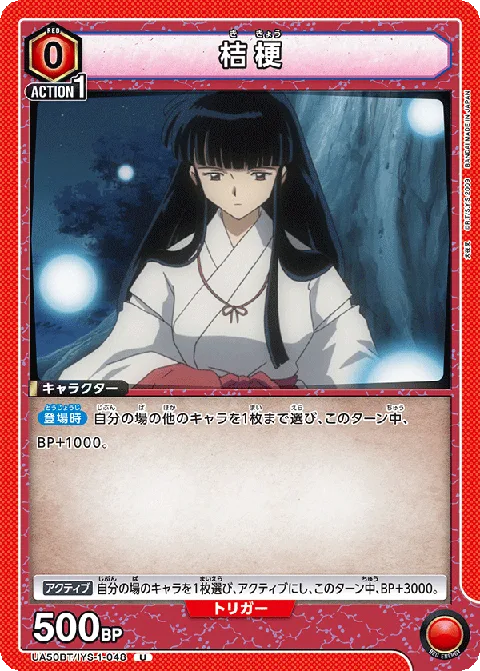 Kikyo (UA50BT-048) provides early board defense in villain builds while Naraku disrupts the opponent's counter engine.
Related Reading
- Union Arena InuYasha Complete Guide Hub: Every InuYasha guide in one place, plus the full set overview and EN release details.
- Union Arena InuYasha Deck Archetypes: Counter Rush, Sesshomaru Control, and Hybrid builds compared with JP community data.
- Union Arena InuYasha Best Cards to Pull: All 6 Special Rares ranked by competitive value and collector appeal, including Naraku SR pricing.
- Union Arena InuYasha Sesshomaru and Kagome Guide: Deep look at the two most prominent supporting characters and their card roles.
- Union Arena InuYasha Pre-Order Guide: EN retailers, JP import options, and singles-buy timing for the August 14 launch.
Frequently Asked Questions
What does Naraku do in Union Arena InuYasha? Naraku (UA50BT-025) negates all Jewel Shard counter effects on the field for one turn. This shuts down Full Demon InuYasha's activation, Kagome's Purification trigger, and any other counter-dependent effect in the InuYasha set. In the mirror match, landing Naraku on the opponent's combo turn means their entire game plan collapses for that turn.
Is Naraku good for competitive play in Union Arena? He is a meta-call card. In InuYasha-heavy metas, run 2 copies. In mixed metas with diverse IPs, run 1 copy as a flex piece. He is not a 4-of staple because his disruption value is conditional on the opponent running counter-based effects.
What is the villain archetype in Union Arena InuYasha? The Naraku Disruption archetype uses Naraku, Kagura, and Kanna as a disruption core alongside the standard Kagome engine. It plays slower than Counter Rush, targeting the opponent's combo windows rather than racing to its own win condition. Sesshomaru SR closes as a counter-independent finisher.
How much does the Naraku Special Rare cost? $15-22 JP market. EN pricing typically lands 10-20% below JP street price after the first few weeks of release. He is the 4th-highest value Special Rare in the set and one of the more accessible SRs with genuine competitive upside.
Can you build a full villain deck in Union Arena InuYasha? Yes, but villain-forward builds still need the Kagome draw engine to stay consistent. Pure villain without Kagome and Miroku struggles with hand size in a long attrition game. The villain package is the disruption core; the hero staples provide the engine that keeps it running.
Who are the villain characters in the Union Arena InuYasha set? Confirmed: Naraku (main antagonist, UA50BT-025 SR), Kagura (wind incarnation), and Kanna (mirror incarnation). Kikyo occupies a villain-adjacent role with her defensive Purification effect fitting both hero and villain builds.
When does Union Arena InuYasha release in English? August 14, 2026 as UE23BT. The Japanese version (UA50BT) launched May 29, 2026. Card functions are identical between JP and EN versions.
References
- Union Arena UA50BT Official Product Page, Bandai: Set contents, character list, and confirmed villain character inclusions
- Union Arena English Card Database, ExBurst.dev: EN card list tracker and decklists; Naraku UA50BT-025 confirmed entry
- Union Arena InuYasha UE23BT Pre-Order, 88 Cardhouse: EN retailer listing and launch date confirmation
- r/UnionArena: JP community discussion, UA50BT play reports, and Naraku Disruption build discussions since May 29 launch
Was this guide helpful?
About the author

TCG Deck Analyst
Former card game tournament organiser turned analyst. Covers One Piece TCG meta, deck efficiency, and card valuation. Builds spreadsheets for decks most people just play.
- Regional TCG tournament organiser
- One Piece TCG meta specialist
- Competitive deck analysis
Disclaimer
This article is published for informational and entertainment purposes. It does not constitute professional financial, legal, or technical advice. Game performance, online services, patch schedules, and store listings change. Verify critical details (pricing, system requirements, regional availability) with publishers and storefronts before you buy. Affiliate links, where present, help support our editorial work and are labelled in our affiliate disclosure.