

Shonen TCG · Guides
Union Arena Tournament Guide 2026: Rules and Formats
This Union Arena tournament guide uses the official rules, tournament manual, restrictions page, and event pages checked on September 17, 2026. Local and championship regulations can differ, so use this as a preparation framework and confirm the page for your specific event.
TL;DR: A tournament-legal Union Arena deck has a 50-card main deck plus 3 Action Point cards, uses one source material code, and allows no more than 4 cards with the same card number. Official organized play supports constructed and sealed formats. The current tournament manual uses best-of-one qualifying rounds and best-of-three top cut for professional-level events, but your event page controls the exact format, time, decklist, and registration requirements.
Union Arena tournament guide: quick answer
Start with these verified rules before you buy cards or register:
Deck rules:
- 50-card main deck plus 3 Action Point cards
- One source material code in the main deck
- No more than 4 cards with the same card number
- Special, Color, and Final triggers are each limited to 4 cards in the official tournament manual
Event structure:
- Organizers may use single elimination, Swiss, or Swiss with a single-elimination top cut
- The standard professional structure is best-of-one qualifying, then best-of-three top cut
- Championship and local event pages may add their own time, decklist, and registration rules
GODEEPER: New to Union Arena? The beginner guide explains the core rules and turn flow before you compete. Union Arena TCG Beginner Guide 2026
Deck Construction in Detail
The official tournament manual is more precise than the old shorthand “50 cards, max 4 per name.”
The main deck. Bring exactly 50 cards made from Character, Event, and Site cards, plus 3 Action Point cards. No side deck is permitted in the cited organized-play manual.
The copy limit. The limit is tied to the card number, not only the printed name. Cards with the same card number but different illustrations count as the same card for restrictions. Build and check your list using the collector number shown on the card.
The source material code. A constructed deck may contain only cards with one source material code. That is the formal version of the game's single-title construction rule. Do not combine cards from unrelated anime titles unless the event's specific rules create a different deckbuilding environment.
Trigger limits. The tournament manual also limits cards with Special, Color, and Final triggers to no more than 4 cards for each trigger type. This is separate from the four-copy card-number limit, so check both when reviewing a list.
The energy line. Union Arena uses an Energy Line as part of its game system. You do not add a separate land or DON!! resource deck to the tournament list, but you still need to understand the Energy Line and the exact effects in your build.
How Matches and Tournament Structure Work
There is no single BO3 rule for every Union Arena event. The official manual separates tournament structure from match structure.
Approved structures. Organizers may run single elimination, Swiss, or Swiss followed by a single-elimination top cut. Swiss pairs players by record and does not eliminate a player after one loss. A top cut creates a separate elimination stage after the announced qualifying rounds.
Standard match structure. The manual lists best-of-one qualifying matches at 30 minutes plus 5 minutes of extra time. Top cut finals use best-of-three at 50 minutes plus 10 minutes of extra time. The Championship Top 2 match is best-of-three with no time limit in that manual.
Going first. Players use a random method to determine the first player in a normal game. In a best-of-three match, the player who lost the previous game chooses whether to go first in the next game. Event regulations can take precedence, so read them before round one.
Swiss points and rounds. The manual awards 3 points for a win, 1 for a draw, and 0 for a loss. Expected Swiss rounds and top cut size depend on attendance, and organizers must announce the structure before the event starts.
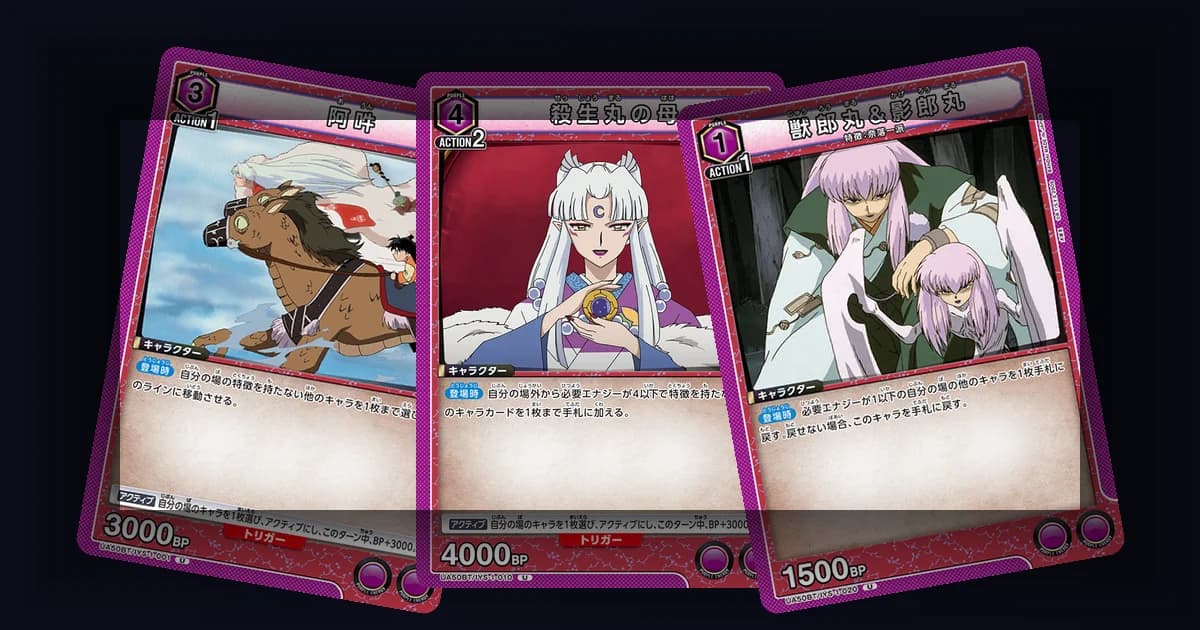
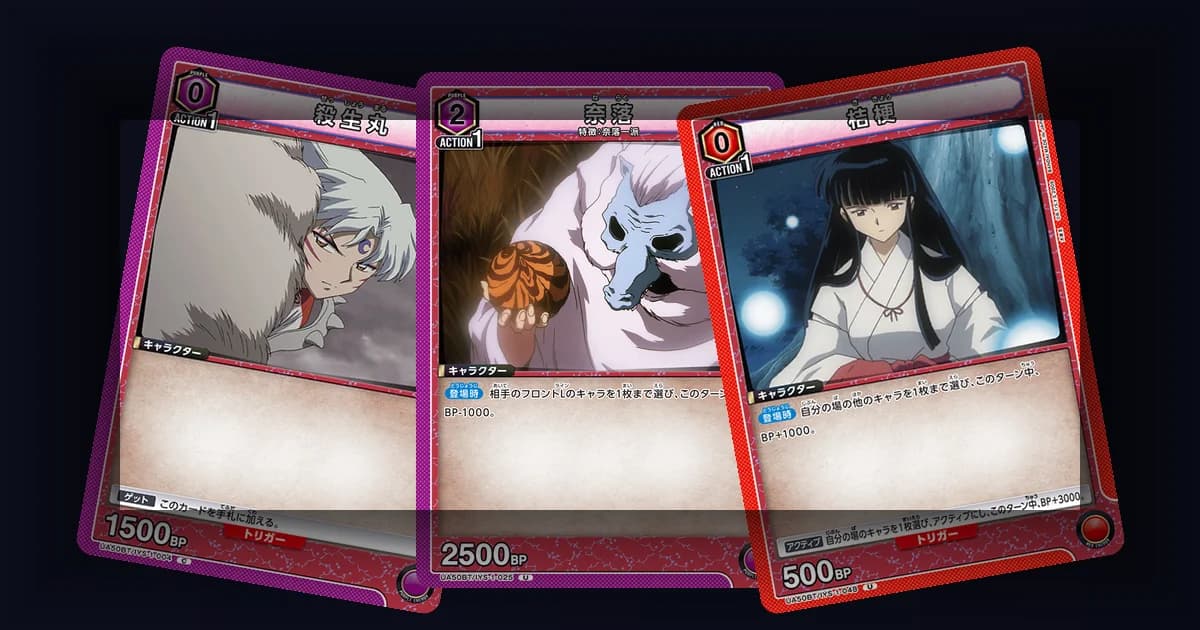
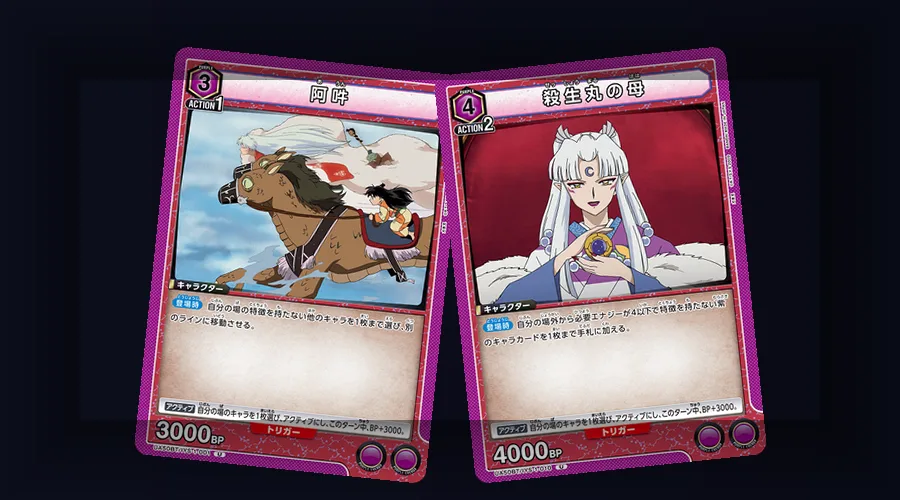 These real Japanese Union Arena Inuyasha cards show A-Un and Sesshomaru's mother. They are representative cards, not a tournament table or an English event product image.
Registration and What to Bring
Registration rules depend on event level and organizer, so do not assume a local walk-in policy.
Registration:
- Create or use the required Bandai TCG+ account for official Bandai events
- Check the individual event page for application dates, fees, venue rules, and identification requirements
- Championship-level events require a complete decklist; local organizers may require one if advertised before the event
- Submit the full card names and collector numbers when a decklist is required
- Confirm the announced start time and registration cutoff instead of using a generic arrival estimate
Tournament materials:
- Your 50-card main deck and 3 Action Point cards
- Identical opaque sleeves for the main deck, with extra sleeves for replacements
- A pen for match result slips when the event uses them
- Legal dice, counters, or tokens your deck needs
- Proof of registration or entry fee, your Bandai TCG+ account, and identification when required
- A playmat only if you want one; the official manual says playmats are optional
The manual says players cannot take notes during official matches. Keep a phone for event information outside play, but follow the organizer's device policy once the match begins.
The Restriction List and Format Rules
Union Arena uses an official restrictions page to manage cards in authorized and official tournaments. The page distinguishes cards restricted to one copy or two copies and notes that different illustrations with the same card number count as the same card.
As of this update, the English restriction page lists current restrictions for Code Geass: Lelouch of the Rebellion Nunnally Lamperouge and Code Geass Rozé of the Recapture Foul Bout, along with Evangelion: New Theatrical Edition restrictions. That list is a snapshot, not a permanent deckbuilding rule. Check it again when you register and immediately before the event.
The official tournament manual recognizes constructed and sealed formats. Constructed means you bring a legal deck. Sealed means the organizer provides event product and you build only from that product. Do not assume that a list legal for constructed is legal for sealed, or that a side event uses the same match structure as the main championship.
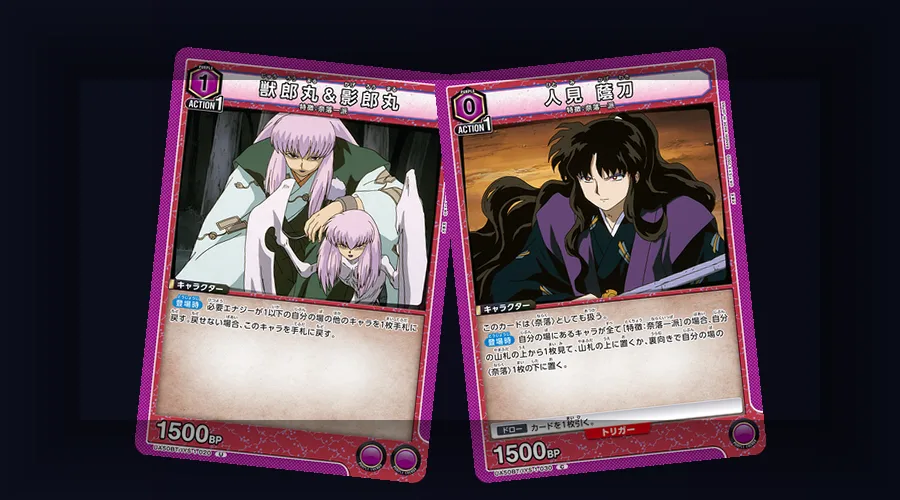 These real Japanese Union Arena Inuyasha cards show JuroMaru and KageroMaru plus a dark-haired character. They are representative cards, not proof of a single-IP tournament setup.
Step-by-Step: Preparing for Your First Tournament
1. Read the event page and current restrictions. Confirm the event level, format, time limits, registration cutoff, decklist requirement, language rules, and current restricted cards.
2. Count your deck twice. Verify the main deck has exactly 50 cards, the AP area has 3 Action Point cards, the source material code is consistent, and no card number exceeds 4 copies.
3. Check trigger limits. Count Special, Color, and Final trigger cards separately because the tournament manual limits each trigger type to 4 cards.
4. Write the decklist accurately. Use the full card name and collector number when a list is required. Compare the submitted list against the actual sleeved deck before you leave.
5. Pack the legal tournament kit. Use identical opaque main-deck sleeves, bring spare sleeves, a pen, and only legal dice, counters, or tokens. Add a playmat if you prefer one.
6. Register and report on time. Complete the organizer's application steps, keep proof of registration, and find your seat before the announced round begins.
Preparing for Your First Event
A few habits make the current rules easier to apply in a live event.
Practice one legal list. Learn the exact cards you registered and test the list against the decks you are likely to meet locally. The official Top-Placing Decks page is a better current reference than an undated social post, and our Union Arena current meta breakdown adds site context.
Know the time limit. Qualifying and top-cut clocks can differ. Practice making clear decisions without slow play, and ask a judge about time procedures before the match starts.
Know when to call a judge. Ask for a ruling when a card interaction or policy is unclear. Do not try to settle a disagreement by searching your phone during the game if the event prohibits devices.
Restore the registered deck between games. In a best-of-three match, make sure cards are back in the correct areas and the deck still matches the submitted list before the next game.
Common Tournament Mistakes to Avoid
Incorrect deck count. The tournament manual treats an incorrect number of cards in the deck or decklist as a game-loss infraction. Count the main deck and AP cards separately before submitting.
Decklist mismatch. A physical deck that differs from the submitted list can receive a penalty and must be corrected. Use collector numbers and full names so a judge can check the list quickly.
Marked sleeves. Scuffed, bent, or distinguishable sleeves can be ruled marked. Use identical opaque sleeves and carry replacements.
Unapproved notes or accessories. Official matches prohibit player note-taking, and supplementary objects must not obscure cards or confuse game elements. Ask the organizer what is permitted if you use a custom counter or token.
Assuming a past list is still legal. Restrictions, event formats, and regional language rules can change. Recheck the official pages instead of copying an old decklist without review.
Key Takeaways
- A tournament-legal deck has a 50-card main deck plus 3 Action Point cards
- Use one source material code and no more than 4 cards with the same card number
- Special, Color, and Final trigger limits also matter
- Tournament organizers may use single elimination, Swiss, or Swiss with a top cut
- The official manual uses BO1 qualifying and BO3 top cut for professional-level events, not universal BO3
- Check the current event page, restrictions, decklist, sleeve, and language requirements before attending
GODEEPER: Choosing a first title? The beginner deck article is an editorial four-title comparison, not a live meta ranking. Union Arena Beginner Deck Tier List
Related Reading
- Union Arena Card Rarities Explained: Rarity and deck-cost context.
- All Union Arena Sets EN Release Schedule: Product and release context.
- Union Arena InuYasha English Release Guide: A breakdown of the August 2026 release.
Frequently Asked Questions
Q: What are the deck construction rules? A: Use a 50-card main deck plus 3 Action Point cards, one source material code, and no more than 4 cards with the same card number. The tournament manual also limits Special, Color, and Final triggers to 4 cards each.
Q: What is the match format? A: It depends on the event. The official manual allows single elimination, Swiss, and Swiss with a top cut. Its standard professional structure is BO1 qualifying and BO3 top cut, with published time limits.
Q: How do I register? A: Use Bandai TCG+ for official Bandai events and follow the event organizer's application window. Local decklist requirements and walk-in policies must be advertised by that organizer.
Q: Can I mix IP sets? A: Standard constructed decks use one source material code. Team or sealed events can have different rules, so read the specific event regulation before combining or selecting cards.
Q: What should I bring? A: Bring the 50-card main deck, 3 AP cards, identical opaque sleeves, spare sleeves, a pen, legal counters or dice, registration proof, and identification when required. A playmat is optional.
Q: Does Union Arena have a ban list? A: It has an official restrictions page with one-copy and two-copy limits for specific cards, and the list can change. Check the current regional page before a sanctioned event.
Q: How do Swiss rounds work? A: Players with similar records are paired, and a loss does not automatically eliminate you. The manual awards 3 points for a win, 1 for a draw, and 0 for a loss. Round count and top cut depend on the announced event structure.
References
- Union Arena official North American rules: Current rules hub and restriction links
- Union Arena official restrictions page: Current restricted-card entries and copy limits
- Bandai Organized Play Tournament Rules Manual: Deck materials, registration, formats, match times, and penalties
- Union Arena Sanctioned Tournament Floor Rules: Sanctioned-event policy and event progression
- Union Arena Championship 26-27 Wave 2: Current regional schedule and organizer registration notes
- Bandai TCG+: Official event registration and event search system
- Union Arena official Top-Placing Decks: Current competitive deck-list reference
Was this guide helpful?
About the author
Pen name for the Shonen TCG desk's tournament coverage, format analysis and cross-game comparisons.
- Results taken from event pages and standings
- Other games checked against their own official rules
- Opinions marked as ours, with the reason
Keep reading
Union Arena Card Rarities Explained: C, U, R, SR, Parallels
Guides · 5 min
Union Arena Beginner Deck Tier List: Four EN Picks 2026
Guides · 11 min
Union Arena vs Dragon Ball Super Card Game: 2026 Guide
Guides · 11 min
Union Arena vs One Piece TCG: Which Anime TCG to Play
Guides · 10 min

Union Arena JJK Guide: Jujutsu Kaisen Best Decks (2026)
Guides · 14 min

Union Arena Bleach Guide: Best Decks & Cards (2026)
Guides · 7 min
Union Arena Deck Building Guide: Build a 50-Card Deck
Guides · 11 min
Union Arena How to Play: Win by Taking 7 Life Cards
Guides · 12 min
Disclaimer
This article is published for informational and entertainment purposes. It does not constitute professional financial, legal, or technical advice. Game performance, online services, patch schedules, and store listings change. Verify critical details (pricing, system requirements, regional availability) with publishers and storefronts before you buy. Affiliate links, where present, help support our editorial work and are labelled in our affiliate disclosure.