Loading…
Shonen TCG · Guides
Union Arena EN Meta Tier List 2026: September Rankings
Union Arena EN meta tier list for September 2026: current community tiers, official Regional results, and the decks still waiting for tournament data.
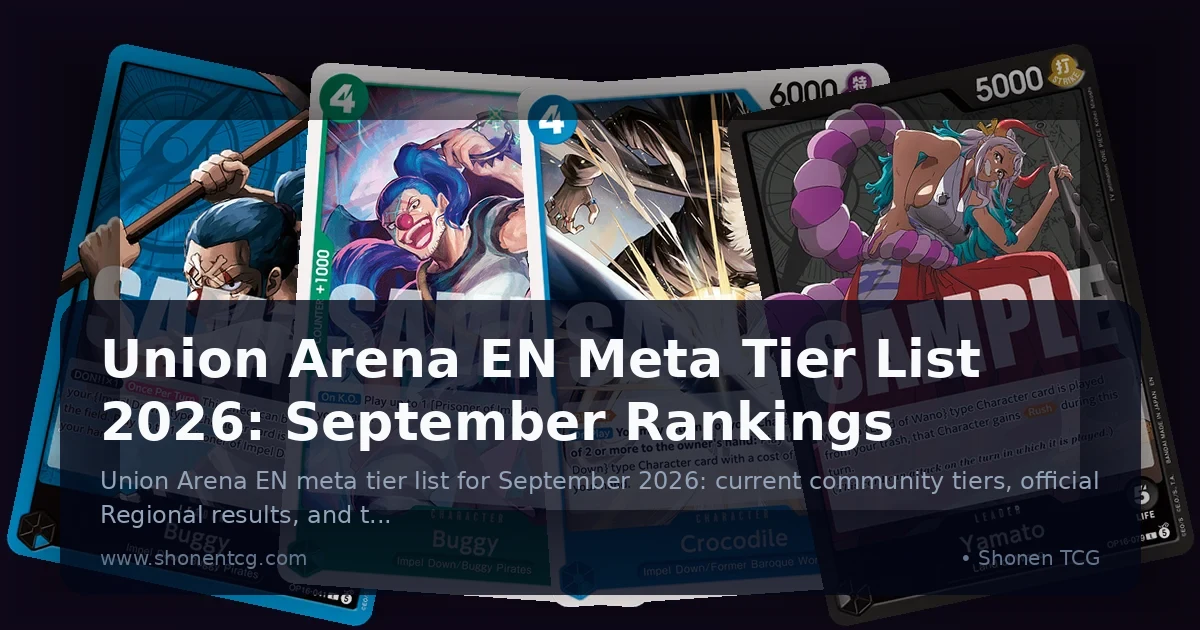
Union Arena EN meta tier list rankings need a date attached to them. For this September 16 update, Joseph Writer Anderson's September 14 community list puts six deck families in S tier, while Bandai's official top-placing page adds a newer result: Purple Solo Leveling is listed first in the latest Gen Con Wave 2 regional block. Those are different kinds of evidence, so this article keeps community tiers and tournament finishes separate.
TL;DR: The current community S tier is Yellow Sakamoto Hybrid, Shadow Army, Chainsaw Man/Power, Red Kenshin, Shinji/Rei, and Yellow Evangelion. A+ includes Red Kagurabachi, Gaius, Reze, Red InuYasha, Green Bleach, and other competitive decks. Official results tell a more mixed story: Purple Solo Leveling leads the latest listed Gen Con Wave 2 block, while the Core Wave 1 top four includes Jujutsu Kaisen, Kenshin, Bleach, and Sakamoto Days.
Union Arena EN meta tier list? (quick answer)
The short answer is that the current community S tier has six entries, while the official results page has a different leader for the latest listed regional block. Use the tier list to choose what to test and the official results to check which decks have actually placed.
The newest community reference checked here is Joseph Writer Anderson's September 14 English tier list. It puts these decks in S tier:
- Yellow Sakamoto Hybrid
- Shadow Army
- Chainsaw Man/Power
- Red Kenshin
- Shinji/Rei
- Yellow Evangelion
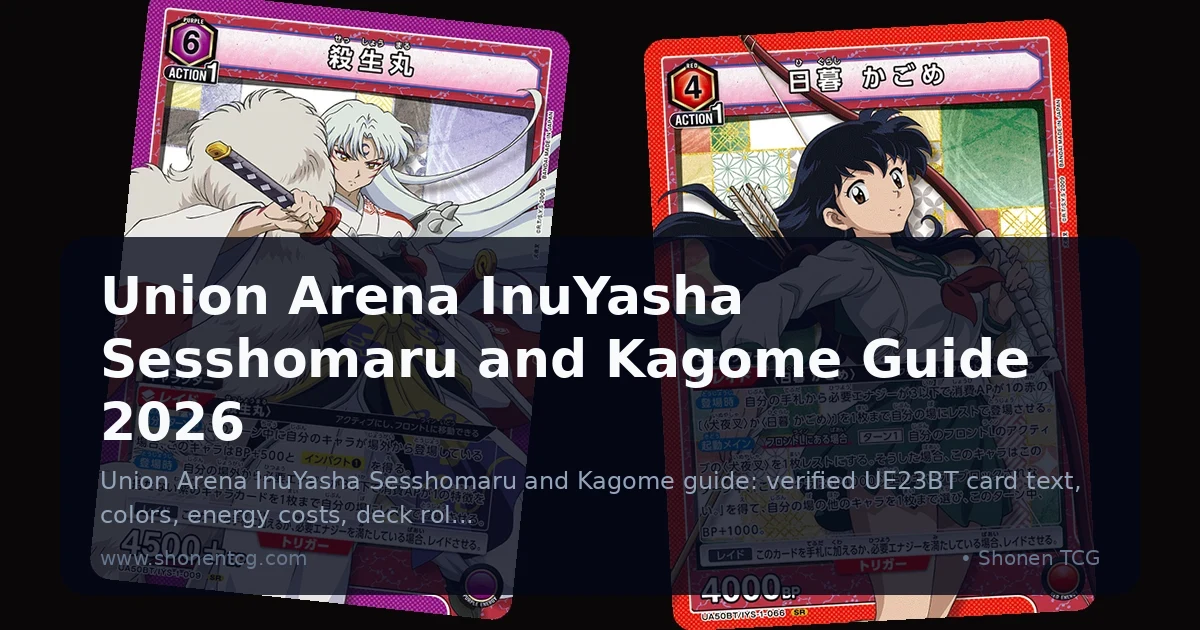
Its A+ group includes Red Kagurabachi, Gaius, Sakamoto Store, Saito, Reze, Red InuYasha, Green Bleach, Song, Rem/Ram, Rem/Subaru, Nano and Shizuka, and Attack Titan. The same list puts Cha/Jinwoo Mill in A tier, alongside decks such as Todo, Blue Slime, WILLE, Progressive, GGO, Purple Chihiro, Purple Sakamoto, Makima, Purple Sesshomaru, Purple Kaneki, and Arima.
These labels are a community assessment, not an official Bandai ranking. They are useful for deciding what to test because they compress a large field into practical groups, but the list itself says it is not a one-stop answer for the single best deck. New sets and regional results can move a deck before a formal update.
The most important correction from the older version of this article is the Chainsaw Man distinction. The current list places Chainsaw Man/Power in S tier but places Reze in A+. That is not a contradiction once the deck labels are kept separate. It also means the older claim that Purple Reze alone sat in S tier should not remain.
Key Takeaways
- The September 14 community list has six S-tier entries, including Yellow Sakamoto Hybrid, Shadow Army, Red Kenshin, and Yellow Evangelion.
- Red Kagurabachi, Reze, Red InuYasha, and Green Bleach are in the current A+ group.
- Bandai's official page lists Purple Solo Leveling first in the latest visible Gen Con Wave 2 block, followed by Yellow Sakamoto Days, Yellow Evangelion, and another Yellow Sakamoto Days entry.
- The latest visible Core Wave 1 block lists Purple Jujutsu Kaisen first, Red Kenshin second, Green Bleach third, and Yellow Sakamoto Days fourth.
- Cha/Jinwoo Mill and Shadow Army are separate community labels. The mill build is A tier, while Shadow Army is S tier.
- InuYasha is now old enough to have a community placement, but the official top-placing page checked here does not yet show an InuYasha regional entry.
What the official results actually show
Bandai's official Top-Placing Decks page lists the latest visible Championship 26-27 Offline Regionals Wave 2 block as follows:
| Listed finish | Deck |
|---|---|
| 1st | Purple Solo Leveling |
| 2nd | Yellow Sakamoto Days |
| 3rd | Yellow Evangelion |
| 4th | Yellow Sakamoto Days |
The same page lists the preceding Core TCG Wave 1 block with Purple Jujutsu Kaisen in first, Red Rurouni Kenshin in second, Green BLEACH: Thousand-Year Blood War in third, and Yellow SAKAMOTO DAYS in fourth.
Earlier visible blocks reinforce the same point. Solo Leveling appears in first at The Booster Box Wave 1, while Purple Rurouni Kenshin, Yellow Evangelion, Yellow Sakamoto Days, Kagurabachi, and Tokyo Ghoul also appear in regional top four or top-cut entries across the page. Those placements establish that several archetypes can convert at organized events. They do not produce a universal win-rate table for every deck in the community tier list.
The official Championship 26-27 event page says Wave 1 runs from April through July 2026 and Wave 2 from August through December 2026. That matters when comparing the July Core result with the newer Wave 2 listing. The competitive season is still moving, so a September snapshot should not be presented as a final 2026 verdict.
Union Arena EN meta tier list: how to read the tiers
A tier label answers a narrower question than “what wins every tournament?” It usually combines observed results, expected matchups, card access, and the judgment of the person maintaining the list. Joseph Writer Anderson's September list explicitly presents S as the strongest current group, A+ as the competitive core just below it, and A as a strong backbone that can still top events.
That framework explains why Purple Solo Leveling can lead a recent official regional block while Cha/Jinwoo Mill remains A tier on the community list. Solo Leveling is an IP family with multiple builds, and a result for one build does not automatically transfer to every version. The same caution applies to Chainsaw Man/Power and Reze, or to Shinji/Rei and other Evangelion builds.
Use the groups as a testing map:
- S tier: Start here if your priority is the current community consensus on high-level strength. Test Yellow Sakamoto Hybrid, Shadow Army, Chainsaw Man/Power, Red Kenshin, Shinji/Rei, and Yellow Evangelion against one another.
- A+ tier: Choose this group if you want a competitive deck with a different matchup profile or better local card access. Red Kagurabachi, Reze, Red InuYasha, Green Bleach, and Saito have a current community case.
- A tier: Treat this as the competitive backbone rather than a discard pile. Cha/Jinwoo Mill, Todo, Purple Chihiro, and the other A-tier entries can be reasonable regional choices when practiced and metagamed.
- Below A: A lower community tier is not a ban on playing the deck. It is a warning that the deck may need a stronger pilot, a favorable field, or a more specific plan to convert consistently.
The official results page should then be used as the reality check. If a deck has a strong community label but no listed result, call that a projection. If it has a result but a lower community label, call out the disagreement instead of silently changing the ranking.
Where the major decks stand
Yellow Sakamoto Hybrid: This remains one of the clearest community leaders. It sits in S tier on the September list, and Yellow Sakamoto Days appears repeatedly in the official top-placing blocks, including second and fourth in the latest visible Wave 2 block and fourth in the Core Wave 1 block. The result record supports the deck's relevance, while the community label explains why it remains a default testing target.
Shadow Army: Shadow Army is separately listed in S tier. This is the Solo Leveling summon-oriented label, not a synonym for every purple Solo Leveling list. The official page also records Solo Leveling at the top of multiple regional blocks, giving the archetype strong result support even though the official page does not name the community deck label in the same way.
Red Kenshin: Red Kenshin remains in S tier and has a strong official history. It won the 2025-26 North America Finals, appears second in the Core Wave 1 block, and appears in earlier Wave 1 results. The latest community label is therefore supported by both historical results and a recent top-four finish, though that does not make every matchup favorable.
Yellow Evangelion and Shinji/Rei: The latest community list keeps Yellow Evangelion and Shinji/Rei in S tier. The official page lists Yellow Evangelion third in the latest visible Wave 2 block and records additional early-season top finishes. Keep the deck label in mind when comparing older Yellow Evangelion results with newer Shinji/Rei lists.
Chainsaw Man/Power and Reze: The community list puts Chainsaw Man/Power in S tier and Reze in A+. Do not collapse those labels into one claim. The current official top-placing page checked for this update does not display a regional top-four entry for either label, so their placement here is a community projection rather than an official result claim.
Red Kagurabachi and Green Bleach: Both are in the current A+ group. Green Bleach also appears third in the Core Wave 1 official block, making it a useful example of a deck whose result record supports its current placement. Kagurabachi appears in earlier Wave 1 top-cut and top-four entries, but its current S or A+ boundary remains a community judgment.
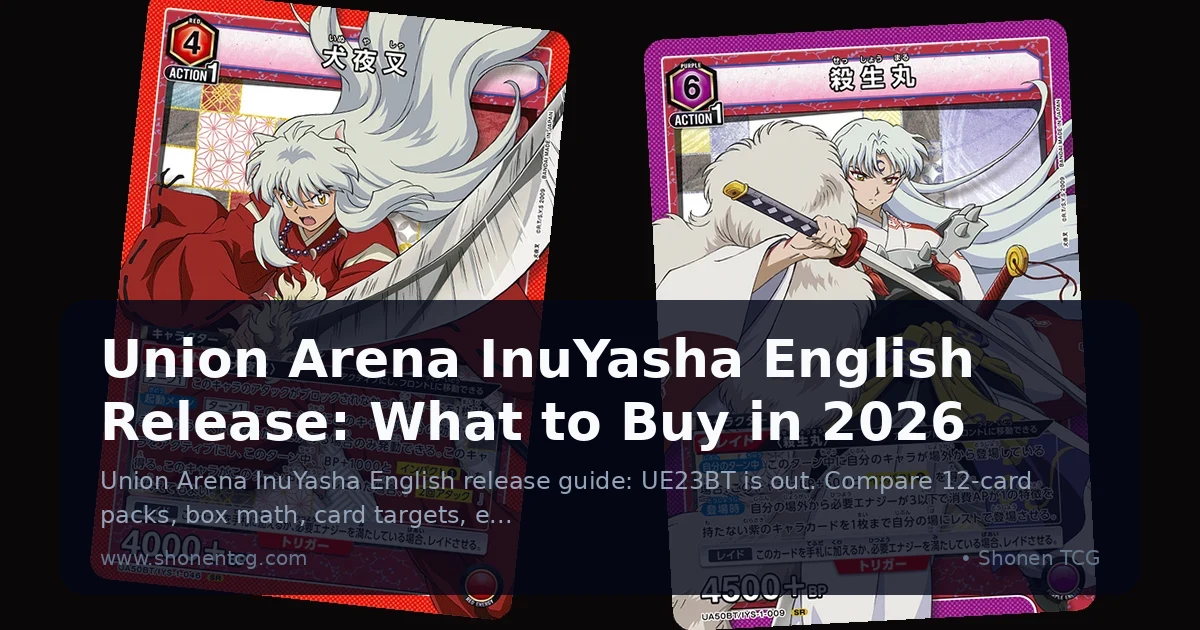
InuYasha: Bandai's official InuYasha product page lists the English release date as August 14, 2026. The release event ran August 14 through August 20. Joseph Writer Anderson's current list places Red InuYasha in A+, while the official top-placing page checked here has no InuYasha entry. It is no longer accurate to call the set too new to have any community evaluation, but it is still fair to say its official regional record is not established on that page.
Cha/Jinwoo Mill: The September 14 community list places this mill label in A tier, separate from S-tier Shadow Army. That is consistent with the fact that the official results page records Solo Leveling results but does not tell us that every Solo Leveling build performs equally. Players considering the mill plan should compare the exact list and local field rather than borrowing Shadow Army's placement.
Choosing a deck for September testing
Start with the latest official results if you want evidence that a deck has already converted at a listed regional. Purple Solo Leveling, Yellow Sakamoto Days, Yellow Evangelion, Purple Jujutsu Kaisen, Red Kenshin, and Green Bleach all have recent visible entries on the official page.
Then use the community tier list to identify what the results page cannot tell you: which deck families are considered strongest right now, which newer builds have high expectations but limited result data, and which labels describe distinct builds inside one IP. That is why Chainsaw Man/Power and Reze should stay separate, as should Shadow Army and Cha/Jinwoo Mill.
For beginners, Red Kenshin and Yellow Sakamoto Hybrid are reasonable starting points because they are in the current S tier and have substantial discussion and result history. A player who prefers newer sets can test Red InuYasha or Reze, but should treat A+ as a competitive invitation to test, not a promise of easy wins. Budget and card availability can matter as much as a one-step tier difference.
The Union Arena deck-building guide is the better starting point for energy, AP, and title-code fundamentals. For the Solo Leveling branch specifically, compare the Solo Leveling guide with the Solo Leveling mill guide before assuming that one result applies to every purple list.
Related Reading
- Union Arena InuYasha EN Tier List: A set-specific look at InuYasha lists and the evidence behind them.
- Union Arena Re:ZERO EN Tier List: 7-Leader Snapshot: A provisional new-set snapshot that separates public list volume from tournament results.
- Union Arena Tournament Guide 2026: Event structure and preparation for organized play.
- Union Arena Impact Keyword Explained: Rules context for one of the keywords discussed in current deck evaluations.
- Union Arena Beginner Deck Tier List: Learnability context for players choosing a first list.
- Union Arena 100 Girlfriends EN Launch Guide: A separate set guide for the expanding English card pool.
Frequently Asked Questions
What is the best deck right now?
There is no official single best-deck ranking. Joseph Writer Anderson's September 14 list puts Yellow Sakamoto Hybrid, Shadow Army, Chainsaw Man/Power, Red Kenshin, Shinji/Rei, and Yellow Evangelion in S tier. Bandai's official results separately show Purple Solo Leveling leading the latest listed Gen Con Wave 2 block.
Which decks are S tier?
The current community S group is Yellow Sakamoto Hybrid, Shadow Army, Chainsaw Man/Power, Red Kenshin, Shinji/Rei, and Yellow Evangelion. Red Kagurabachi, Reze, Red InuYasha, and Green Bleach are in A+, while Cha/Jinwoo Mill is listed in A tier.
What did the latest official results show?
Bandai's page lists Purple Solo Leveling first, Yellow Sakamoto Days second and fourth, and Yellow Evangelion third in the latest visible Gen Con Wave 2 block. The latest Core block lists Purple Jujutsu Kaisen first, Red Kenshin second, Green Bleach third, and Yellow Sakamoto Days fourth.
Is Purple Reze still S tier?
Not on the latest list checked for this update. Chainsaw Man/Power is in S tier, while Reze appears in A+. Those labels describe different community deck groupings, so a Reze list should not automatically inherit the placement of every Chainsaw Man build.
Where does Solo Leveling mill rank?
Cha/Jinwoo Mill is listed in A tier. Shadow Army is a separate S-tier label. Official Solo Leveling results show the IP can convert at regionals, but they do not prove that every build inside the IP deserves the same community placement.
Is InuYasha too new to evaluate?
No longer completely. The English product released August 14, 2026, and the current community list places Red InuYasha in A+. Bandai's top-placing page checked here does not yet show an InuYasha regional entry, so the community tier remains ahead of its official result record.
How should beginners use the rankings?
Use S and A+ to choose what to test, then pick a deck whose cards and play pattern you can practice. Compare community tiers with Bandai's listed finishes, check the event format, and avoid treating a label as a win-rate guarantee or a substitute for testing.
References
- UNION ARENA English Tier List: Joseph Writer Anderson's September 14, 2026 community tier list
- UNION ARENA Top-Placing Decks: Bandai's official listed regional finishes
- UNION ARENA Championship 26-27: official Wave 1 and Wave 2 season structure
- UNION ARENA InuYasha product page: English release date and product facts
- The Best UNION ARENA TCG Decks Right Now: community deck ranking and context from August 5
About the author
MS
TCG Collector & Value Analyst
TCG collector and value analyst covering anime card games since 2021. Specializes in pull rates, card values, and market trends across One Piece TCG and Union Arena.
- TCG collector since 2021
- Tracks card values across TCGPlayer and CardMarket
- Pull rate analysis across 100+ boxes opened
- Covers One Piece TCG and Union Arena collector market
Disclaimer
This article is published for informational and entertainment purposes. It does not constitute professional financial, legal, or technical advice. Game performance, online services, patch schedules, and store listings change. Verify critical details (pricing, system requirements, regional availability) with publishers and storefronts before you buy. Affiliate links, where present, help support our editorial work and are labelled in our affiliate disclosure.