Loading…
Shonen TCG · General
Union Arena InuYasha Collector Guide: SR Rarity and Value
9 min readBy Michael Riley
Reviewing
Union Arena
Union Arena InuYasha collector guide: if you want to know which cards are worth hunting, what the rarity symbols actually mean, and how to spend your money wisely at EN launch in August 2026, this is the breakdown you need. The set launched in Japan as UA50BT on May 29, 2026 and arrives in English on August 14 as UE23BT, giving us real JP market data to work from rather than speculation.
TL;DR: The InuYasha Union Arena set has five rarity tiers, with SR three-star signed cards (roughly 1 per 12-16 boxes) as the collector crown jewel. Signed SR★★★ cards were trading in the $80-200 range on JP secondary markets as of research; EN launch pricing should be confirmed once the set actually releases in August. SR two-star parallel foils sit around $15-40 each on JP data and are the best middle-ground collector buy. Standard SR cards are easier to get but have limited upside beyond gameplay value.
Union Arena InuYasha collector guide: quick answer
SR three-star cards are the top collector target in this set. They carry foil-stamped voice actor signatures, pull at about 1 per 12-16 boxes, and Sesshomaru's signed card was trading in the $120-180 range on the JP secondary market as of research. If budget is the constraint, SR two-star parallel foils offer better art than standard SR at a much lower premium. Standard SR is worth picking up for play but doesn't hold collector value the way starred variants do.
Key Takeaways
- The InuYasha set (UE23BT) has 160 cards across five rarity tiers: C, UC, R, SR, SR★★, SR★★★, and Key Card
- SR two-star alternate art cards pull roughly 1 per 3-4 packs; SR three-star signed cards pull roughly 1 per 12-16 boxes
- JP market data shows SR★★★ signed cards trading in the $80-200 range depending on character as of research; EN launch prices should be confirmed at release, though they typically track close to these JP figures initially
- Singles buying is more efficient than box buying unless the pack-opening experience matters to you
- The Key Card (KS) is the highest-power single card per set and often commands collector interest alongside three-stars
Understanding Union Arena Rarity Tiers
Union Arena uses a tiered rarity system that goes deeper than most TCGs. Knowing what each tier means before you spend money is the difference between getting what you want and being surprised at the pull table.
Common (C) and Uncommon (UC) fill out the set's supporting cast. Character cards at these rarities appear frequently, usually one or more per pack. Bulk value is near zero, but a few UC cards with strong keyword abilities (Impact, Trigger) see competitive play at 4 copies.
Rare (R) is where competitive play lives. Many of the strongest engine pieces in Union Arena decks are Rare, not SR. Kagome Higurashi's Purification engine, for example, runs as a 4-of in InuYasha builds and prices around $6-10 on the JP market. Collectors often overlook R cards, but budget players and competitive builders should not.
Super Rare (SR) is the first foil tier. Standard SR cards feature full-art foil treatment, higher power stats, and often carry abilities that aren't available at lower rarities. Pull rate is roughly one SR per pack in a standard booster display. The InuYasha set has multiple SR cards covering the main cast.
SR Two-Star (SR★★) is the first collector tier. These are alternate-art parallel foils, meaning the art differs from the standard SR version of the same card. The foil treatment is more intense, and the artwork typically shows the character in a different pose or scene. Pull rate is approximately 1 per 3-4 packs. JP market prices range from $15-40 depending on the character and demand.
SR Three-Star (SR★★★) is the collector crown jewel. These cards carry everything the two-star has, plus a foil-stamped signature from the character's original Japanese voice actor. Pull rate is roughly 1 per 12-16 booster boxes, making them genuinely rare. Not every character in a set gets a three-star, which concentrates demand further.
Key Card (KS) is the most powerful single card in the set. Each Union Arena set includes exactly one Key Card, representing a mechanically unique effect not achievable by other cards. The Key Card often carries a parallel foil or signed variant, stacking collector and competitive interest into one slot.
GODEEPER: The full breakdown of how every Union Arena rarity compares and what each symbol on the card means is in the Union Arena Card Rarities Explained →
InuYasha Set: SR and Chase Cards
The InuYasha set (UA50BT/UE23BT) covers characters from both the original InuYasha series and The Final Act. The main character roster includes InuYasha in full demon form, Kagome Higurashi, Sesshomaru, Naraku, Miroku, and Sango.
Each of the primary characters appears at multiple rarity tiers. InuYasha himself appears as a standard SR, an SR two-star parallel foil, and an SR three-star signed version. The signed version features InuYasha's Japanese voice actor, and it's the version pulling $100-150 on the JP secondary market right now.
Sesshomaru's SR three-star has been the set's highest-demand signed card since JP launch. The character's dedicated fanbase and the quality of the artwork have kept his three-star trading in the $120-180 range on JP secondary markets, with no significant drop as of the June 2026 data. At EN launch in August, expect similar or slightly lower pricing, but this is a projection, not a confirmed EN price, until the EN collector community actually engages with the set.
The Key Card in the InuYasha set carries extra weight both as a gameplay piece and a collector target. Based on the JP release, the Key Card has both standard and parallel foil variants, with the parallel pulling at the Key Card slot's reduced rate.
Pull Rates and Box EV
Understanding the math here saves money. A standard Union Arena booster box is 16 packs with 8 cards each, totaling 128 cards per box.
Per-pack expected pulls:
- 1 SR (standard) per pack = 16 SR per box
- 1 SR★★ per 3-4 packs = roughly 4-5 SR two-stars per box
- 1 SR★★★ per 12-16 boxes = you statistically need 12-16 boxes to expect one signed card
If you're buying a single box at $79.84 MSRP, your expected SR three-star count is somewhere between 0.06 and 0.08 (approximately 1/13 of a card). That means the average buyer opening one box walks away with zero signed cards.
The box EV math, using JP market data as a proxy for EN pricing, works out roughly like this: 16 standard SR at an average $4-8 each = $64-128, plus 4-5 SR★★ at $15-25 each = $60-125, plus a fractional expected value for the SR★★★ (say 1/13 of $120 = ~$9). Total expected box value: $133-262 at the optimistic end, $73-120 at the conservative end.
At MSRP, box EV is slightly positive to roughly break-even at average card prices. At street price (boxes typically hitting $90-110 after launch), EV skews negative unless you hit an SR★★★.
The collector math is different. If your goal is one specific SR★★★, buying that single card as it currently appears on JP secondary markets costs an estimated $80-200; treat this as a projection until EN street prices are confirmed at launch. Opening boxes to chase it costs a multiple of that in expected box purchases.
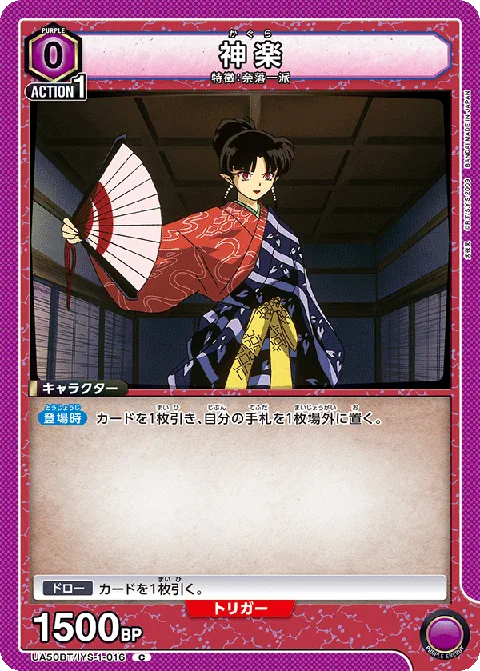 Kagura (UA50BT-016) features some of UA50BT's most striking villain-faction art , her signed SR variant is a mid-tier collector target at EN launch pricing.
GODEEPER: For which specific cards carry the strongest play value at EN launch, see the Union Arena InuYasha Best Cards to Pull →
What to Collect vs Skip
This is the practical guide for someone with a real budget.
Collect: SR three-star signed cards if you have the budget and the character matters to you. These are the long-term value holders in Union Arena. The signed mechanic is a physical artifact that can't be reprinted in the same form, and voice actor signatures carry cultural significance in the anime TCG collector space. Budget $100-200 per card at EN launch for the high-demand characters.
Collect: SR two-star parallel foils as the middle-ground sweet spot. The alternate art is often the more interesting artwork compared to the standard SR, and prices at $15-40 per card make it achievable without a box-cracking budget. The Sesshomaru and InuYasha two-stars in particular have held value on JP secondaries.
Collect with caution: Standard SR if you want a complete set or if you enjoy the foil treatment. Standard SR holds some value through gameplay demand, but it doesn't have the scarcity or the artwork distinction to hold up as a pure collector play. If a character matters to you and you can't afford the two-star, standard SR is a respectable placeholder.
Skip for collector purposes: C, UC, R unless you're also playing the game competitively. Bulk commons from any Union Arena set go to the bulk bin. The exception is if a specific Rare has unusual art or limited availability, but that's not the case in the InuYasha set.
The Key Card is its own category. If the Key Card has a signed parallel variant, it sits alongside the SR★★★ as a top collector target. Even the standard Key Card often holds value because it's the most competitively significant card and only one per set exists in that slot.
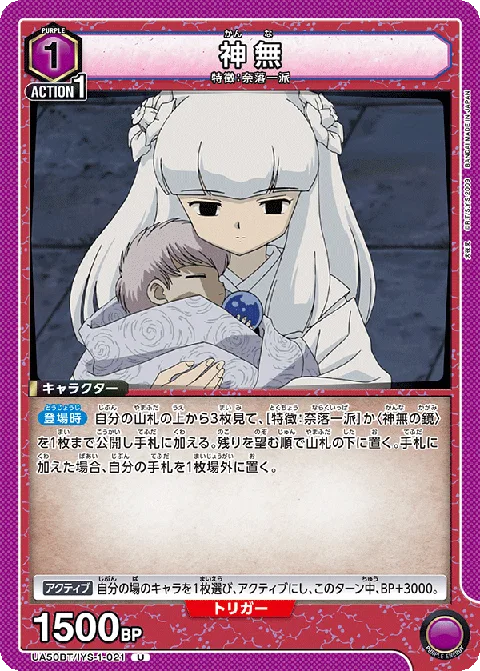 Kanna (UA50BT-021) holds mirror-based disruption effects in the villain package , her SR parallel foil is among the more visually distinct alt-art cards in UA50BT.
Buying Strategy for EN Launch
August 14, 2026 is the EN release date for UE23BT. Here's how to approach launch week based on what JP launch patterns tell us about Union Arena EN sets.
Week one prices are peak. Singles spike at EN launch as the market hasn't fully absorbed supply yet. If you're buying specific SR★★★ cards, waiting 3-6 weeks after EN launch typically drops prices 15-30% as box openers list their hits. The exception: if a character's signed card is genuinely sought after by both collector and competitive audiences, the price floor stays higher.
Pre-order boxes at MSRP if you want the opening experience. The $79.84 display box at MSRP is a reasonable way to get the opening experience and fill out your common/uncommon/rare set. Don't pre-order at above MSRP expecting to profit from pulls.
Identify your target before launch. If Sesshomaru's SR★★★ is the card you actually want, track the JP market price now, set a target buy price, and monitor TCG Player and eBay in the week after EN launch. Don't get caught up in opening your own boxes hoping to pull it.
JP imports as a reference price. JP SR★★★ cards purchased now carry import premium. If you can source a JP copy at $100 and EN copies at EN launch price at $130, the JP copy might be the better deal, with the caveat that EN copies have English text preferred by many EN collectors.
For a full breakdown of the EN release specifics and pre-order options, the Union Arena InuYasha EN pre-order guide covers retailer availability and case pricing.
The Union Arena InuYasha complete guide hub consolidates all deck and collector resources for the set in one place.
If you want to verify what's in the full set before deciding what to target, the Union Arena InuYasha complete set guide has the full card list context.
Related Reading
- Union Arena InuYasha Best Cards to Pull: Which cards carry the strongest competitive and collector value from the full set roster.
- Union Arena InuYasha EN Release Guide: Everything confirmed about the August 14 EN launch, set contents, and what changed from JP.
- Union Arena InuYasha Complete Set Guide: Full card list overview with rarity distribution and set structure breakdown.
- Union Arena InuYasha Pre-Order Guide: Where to buy, MSRP pricing, retailer options, and case vs display vs single pack buying.
- Union Arena Card Rarities Explained: The full rarity system across all Union Arena sets, not just InuYasha.
Frequently Asked Questions
What is the rarest card in Union Arena InuYasha? The SR three-star (SR★★★) cards are the rarest, featuring foil-stamped voice actor signatures from the original Japanese cast. Pull rates sit around 1 per 12-16 booster boxes. Sesshomaru and InuYasha three-stars command the highest demand on the secondary market.
How often does an SR pull in Union Arena InuYasha? Standard SR cards appear roughly once per pack in a booster display. SR two-star parallel foils appear approximately 1 per 3-4 packs. SR three-star signed cards pull around 1 per 12-16 boxes. The Key Card slot appears at its own reduced rate, roughly once per case.
Are Union Arena InuYasha SR three-star cards worth the price? For collectors who value voice actor signatures, yes. Signed SR★★★ cards were trading in the $80-200 range on JP secondary markets as of research, depending on the character; there's no live EN pricing yet since the set hasn't launched in EN. EN launch prices tend to track slightly below JP import pricing before stabilizing 4-6 weeks post-launch.
What is the difference between SR two-star and SR three-star in Union Arena? SR two-star (SR★★) cards feature alternate full-art foil treatment with no signature. SR three-star (SR★★★) cards add a foil-stamped signature from the character's original Japanese voice actor. Three-star rarity is significantly lower, making them the collector top tier.
Should I buy singles or boxes for the InuYasha Union Arena set? For collectors targeting specific cards, singles are almost always more cost-efficient. A booster box at $79.84 MSRP averages roughly 4-5 SR two-star cards and a statistical fraction of an SR three-star. Buying the SR three-star you want as a single saves money unless the pack-opening experience itself is part of what you're after.
Which InuYasha characters have SR three-star cards? The InuYasha set covers the main cast: InuYasha, Sesshomaru, Kagome, Naraku, Miroku, and Sango. Based on JP release data, signed cards exist across these characters, though not every character gets a three-star variant in equal quantity.
When does Union Arena InuYasha EN release? Union Arena InuYasha EN (UE23BT) releases August 14, 2026. The Japanese version (UA50BT) launched May 29, 2026 and is available as an import now, usually at a premium over the $79.84 EN MSRP.
References
Was this guide helpful?
About the author

TCG Deck Analyst
Former card game tournament organiser turned analyst. Covers One Piece TCG meta, deck efficiency, and card valuation. Builds spreadsheets for decks most people just play.
- Regional TCG tournament organiser
- One Piece TCG meta specialist
- Competitive deck analysis
Disclaimer
This article is published for informational and entertainment purposes. It does not constitute professional financial, legal, or technical advice. Game performance, online services, patch schedules, and store listings change. Verify critical details (pricing, system requirements, regional availability) with publishers and storefronts before you buy. Affiliate links, where present, help support our editorial work and are labelled in our affiliate disclosure.