Loading…
Shonen TCG · General
Union Arena InuYasha Deck Guide: How to Build for EN 2026
10 min readBy Michael Riley
Reviewing
Union Arena
This Union Arena InuYasha deck guide covers the EN launch on August 14, 2026, starting with how IP archetypes split across four distinct strategies. The JP meta (UA50BT, released May 29, 2026) ran for six weeks before EN copies hit shelves, giving competitive players a clear picture of what works and what gets left behind. This Union Arena InuYasha deck guide walks through each IP deck, explains the card ratios that matter, and tells you which strategy fits your playstyle.
TL;DR: Inuyasha Red aggro is the easiest to build and the most consistent at launch. Kagome Blue offers the highest ceiling for tournament play through the Jewel Shard mechanic. Sesshomaru Purple rewards experienced players willing to put in reps. All four IP decks run 50 cards with 4x copies of your key SRs, 8-12 event cards, and 10-15 energy generators. Buy 2 boxes plus singles for your IP's chase SR cards.
Union Arena InuYasha Deck Guide: Quick Answer
The Union Arena InuYasha deck guide answer in three sentences: pick one of the four IP archetypes (Inuyasha Red, Kagome Blue, Sesshomaru Purple, Naraku Black), build 4x copies of the IP's key SR characters, and fill the remaining slots with event cards and energy generators that match your game plan. In JP play, Inuyasha Red finished first in early tournament cuts with Kagome Blue close behind. Sesshomaru Purple and Naraku Black are high-skill decks that reward players who invest time in them.
How Union Arena Deck Building Works
Every Union Arena deck is exactly 50 cards. You can run up to 4 copies of any card with the same name. Cards break down into three categories: characters (Front Line attackers and Back Line supporters), events (one-time effects), and energy generators (the land equivalent that fuels plays).
Each character has three stats: AP (Attack Power, how much it deals), BP (Battle Power, how much it can absorb before leaving the field), and SP (Skill Points, which power special abilities). Energy cost sits in the top corner and determines when you can play the card. Low-energy characters come out early and build tempo; high-energy characters are your finishers.
IP decks in the InuYasha set lock you into a character's specific card pool, but that restriction is the point. Every Inuyasha IP card in your deck triggers off Inuyasha-specific traits. Every Sesshomaru IP card synergizes with Sesshomaru's keyword effects. The IP system creates coherent decks rather than piles of individually strong cards.
A standard deck shell for any IP looks like this: 16-20 IP characters (your core), 8-12 event cards (interaction and finishers), 10-15 energy generators (consistent fuel), and 4-6 off-IP utility characters (flexible slots that bridge turns). The exact split depends on how aggressive or controlling your chosen IP plays.
For players who want the full rules picture before picking a deck, the Union Arena rules and how-to-play breakdown covers every mechanic from energy phases to trigger resolution.
GODEEPER: Not familiar with Union Arena's core rules yet? Union Arena How to Play: Rules Explained →
The Four InuYasha IP Decks: Which to Choose
The UE23BT set ships with eight main characters: Inuyasha, Kagome Higurashi, Sesshomaru, Naraku, Koga, Miroku, Shippo, and Sango. Four of them anchor IP archetypes. The other four appear as support cards across multiple decks.
Inuyasha Red is the aggro deck. High AP attackers hit hard from turn two, Wind Scar event cards deal direct damage, and the strategy is to end games before your opponent stabilizes. Best for beginners.
Kagome Blue is the board control deck. Kagome's Jewel Shard mechanic attaches Shikon Jewel Shard cards to friendly units as buff counters, raising their BP or granting effects. You build a wide board of enhanced characters and win through sustained pressure rather than a single burst.
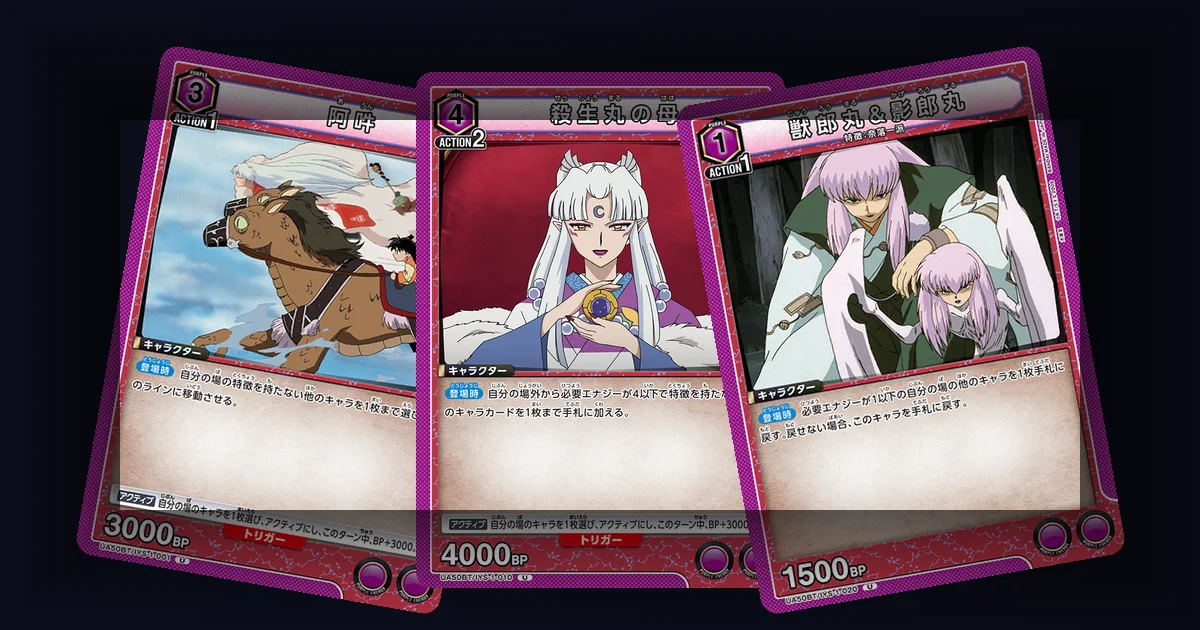
Sesshomaru Purple is the removal-heavy control deck. Tokijin sword effects strip BP from opponent characters. Toukijin event cards remove threats outright. The strategy is to deny your opponent's board until Sesshomaru's high-BP finishers close the game. Hardest to pilot.
Naraku Black is the mill and barrier deck. Naraku's incarnation cards (Kagura, Kanna, Kohaku) generate barrier effects that stop attacks entirely on key turns. The win condition is milling out the opponent's deck through recursive effects while your barriers buy time.
| IP Deck | Style | Difficulty | JP Finish |
|---|---|---|---|
| Inuyasha Red | Aggro | Low | Top cuts early |
| Kagome Blue | Board control | Medium | Consistent top 8 |
| Sesshomaru Purple | Removal control | High | Resilient in midgame |
| Naraku Black | Mill/barrier | High | Specialist picks |
Inuyasha Red Aggro: Building the Deck
The Inuyasha Red deck's game plan is to apply pressure from turn one and not let up. Characters in this IP have above-average AP relative to their energy cost, and the Wind Scar event card punishes opponents who leave low-BP characters in the Front Line.
A working Inuyasha Red shell runs 18-20 character slots split like this: 4x of the IP's highest-AP SR character (your primary attacker), 4x of a mid-cost Front Line character with a "when this attacks" trigger, 4x of a 1-cost Back Line supporter that gives the attacking character +AP for the turn, then 6-8 additional characters filling out the curve.
Event cards for this deck break down into two types: direct damage (Wind Scar and similar) and attack modifiers. Run 8 events total, with at least 4 copies of your best direct-damage option. Wind Scar deals damage when you play it from hand, not from a character's effect, which means it bypasses barrier.
Energy management is straightforward in Red: you want 12 energy generators, prioritizing ones that enter play and immediately add to your energy pool rather than requiring a tap to generate next turn. Getting to 3 energy by turn two is the benchmark.
The deck's weakness is board wipes. If Sesshomaru Purple resolves a Toukijin removal on your key Front Line attacker, you can stall. Protect your key attacker with Back Line BP buffs from Kagome or Miroku support cards even in a mono-Inuyasha build.
Sesshomaru Purple Control: Key Cards
Sesshomaru Purple wins by outlasting everything. The IP's character cards have high base BP, making them difficult to trade into profitably. Tokijin sword effects reduce the BP of opposing characters by a flat number when Sesshomaru attacks, turning your big swings into board control rather than just damage.
Key cards in the Sesshomaru Purple deck:
- Sesshomaru SR★★★: The anchor. High BP, Tokijin effect on attack, and a passive that reduces incoming AP. Run 4 copies. This is the card you buy as singles if you're not box-cracking.
- Toukijin Event: Removes one opposing Front Line character entirely when played at the correct energy threshold. Run 4 copies.
- Jaken Back Line: Reduces the energy cost of your next Sesshomaru character by 1. Two copies is typical; four is correct if you want maximum consistency.
The deck runs 10-12 characters rather than the 18-20 you see in Red. You're not building a wide board, you're building two or three unmovable walls. The remaining card slots go to removal events (8-10) and energy (14-16, higher than other IP decks since your payoff cards cost more energy).
Sesshomaru Purple's skill floor is the reason it's marked as high difficulty. Knowing when to use Toukijin removal proactively versus holding it for the right target is the difference between a player who 2-2s a tournament and one who makes top cut.
Kagome Blue: Balanced Strategy
Kagome Blue's core identity is the Shikon Jewel Shard mechanic. Jewel Shard cards enter play attached to a friendly character as a counter, giving that character +BP (typically +500 to +1000, varies by card) and sometimes a secondary effect like "this character cannot be chosen by opponent's event effects."
The stacking works across multiple turns. A Kagome IP character with two Jewel Shard counters becomes something your opponent cannot remove with standard event removal, since the Jewel Shard effect specifically blocks "chosen by effect" interactions on some card variants.
A Kagome Blue deck runs 16 characters (4x of two or three key IPs), 8-10 Jewel Shard or Jewel Shard-adjacent event cards, 12 energy, and 4-6 cross-IP support characters. Sacred Arrow event cards deal damage in the same turn you attach a Jewel Shard, which creates a two-for-one that makes your character bigger while dealing 1-2 damage to an opposing unit.
In JP play, experienced Kagome Blue pilots went 4-1 or better in Swiss rounds of eight-player locals. The deck rewards knowing which of your characters to buff (prioritize the one with the "cannot be targeted" Jewel Shard effect when you're racing an aggro deck) and which Jewel Shard cards to hold versus play immediately.
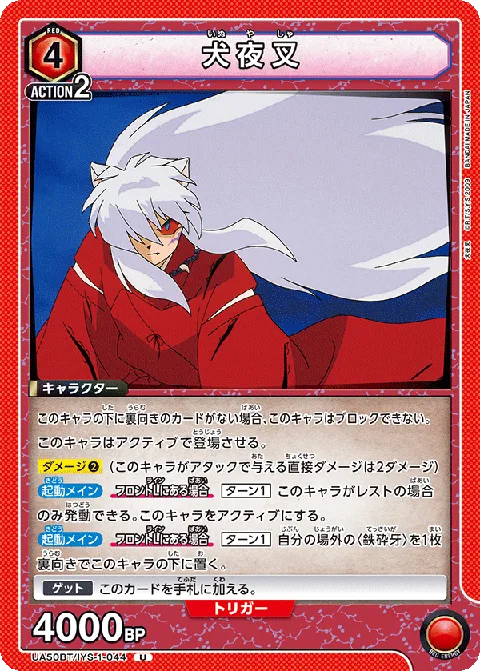 Inuyasha (UA50BT-044) anchors the Red Aggro build as the deck's primary high-AP attacker , the card your entire energy curve is built to deploy on time.
Naraku Black: Mill and Barrier
Naraku Black is the grinder's deck. The strategy involves playing Naraku's incarnations (Kagura, Kanna, Kohaku) as low-cost characters that generate barrier tokens when they enter play. Barrier tokens block one attack per token, buying you turns while your recursive mill effects chip away at the opponent's deck.
The win condition is opponent deck-out rather than damage. When your opponent draws from an empty deck, they lose the next time a draw effect triggers. Naraku's event cards include mill effects that move 2-3 cards from the top of the opponent's deck to their discard.
A Naraku Black build: 12-14 characters (4x Naraku SR, 4x Kagura, 4x Kanna, 2x Kohaku flex), 12 events (4x barrier generator, 4x mill event, 4x removal flex), 12 energy. The deck plays slower than every other IP option and loses hard to Red aggro if you don't draw your barrier cards in the first three turns.
For EN release, Naraku Black is a deck to play after you have reps in Union Arena. The decision trees around when to barrier versus when to mill versus when to use removal are not intuitive until you've played 20+ games.
Step-by-Step: Building Your First InuYasha Deck
Follow this process regardless of which IP you pick:
-
Choose your IP and anchor SR. The IP's key SR★★★ is the card your deck is built around. Confirm you have 4 copies before buying other cards. This is the one card worth buying as singles.
-
Build the character core. Identify your three to four most important character cards. You want 4x copies of each. For Inuyasha Red, that's the main SR attacker, the 2-cost Front Line attacker, and the 1-cost Back Line buff character.
-
Select event cards. Pick 8-10 events that directly support your game plan. For aggro: direct damage and attack modifiers. For control: removal and protection. Do not mix event types trying to cover every scenario, as you'll dilute the deck's focus.
-
Add energy generators. Count how many energy generators you need to hit your turn-two and turn-three energy targets. Typical target: 2 energy by turn one (using a 1-cost generator), 3-4 energy by turn two. Most IP builds need 12-14 energy cards to hit this consistently.
-
Fill flex slots. Any remaining slots go to utility characters (Miroku, Shippo, Sango work as support across all IP builds) or additional copies of your best cards.
-
Check the math. At 50 cards, you want no more than 16 different card names. Spreading too thin means you'll see too few copies of your key cards. Concentration wins games.
-
Test the energy curve. Play 5 solo practice games drawing 5-card opening hands. If you're stuck without energy on turn two in more than two of those hands, add two more energy generators and cut two flex cards.
New to Union Arena deck construction in general? The Union Arena deck building guide covers the fundamentals that apply across all sets, not just InuYasha.
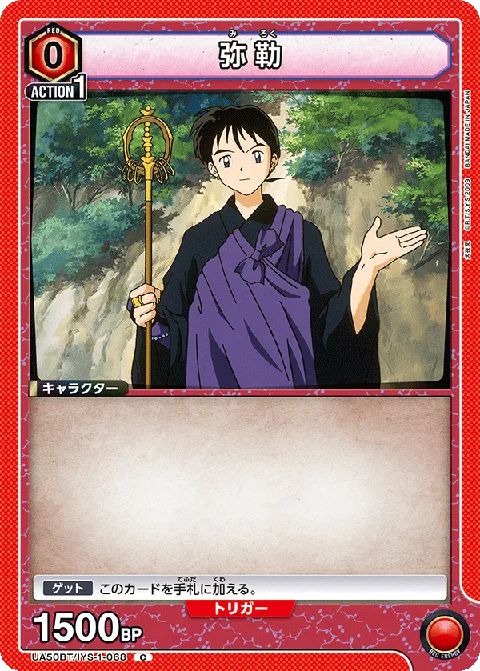 Miroku (UA50BT-068) is a key support character across multiple InuYasha builds, providing counter accumulation that fuels Kagome's Jewel Shard spend engine.
Tips for the EN Release (August 14, 2026)
Buy singles for your SRs. The pull rate for SR★★★ cards in UA sets runs approximately 1 per box. Getting 4x copies of your IP's key SR through box-cracking requires 4 boxes minimum, often more. Buying 2 boxes (32 packs, 320 cards) to get the bulk of your commons and uncommons, then purchasing the SR★★★ as singles, is the correct strategy financially.
Pre-order early. Retailers stocking UE23BT include 88 Cardhouse, Cardboard Collectible, and TCG Corner. Display boxes and booster boxes sell out faster at EN launch than JP launch because the English player base is larger. Pre-order by early August to lock in launch day stock.
Use the JP meta as a map, not a blueprint. JP players ran UA50BT from May 29 to EN launch in August. Their deck lists are public and represent six weeks of optimization. Copy their general card ratios but verify the specific card names when UE23BT card scans release, since EN printing occasionally adjusts effect text.
The signed SRs are collector items. UE23BT includes SR★★ and SR★★★ cards with voice actor signatures. These have the same game effect as unsigned SR cards, so they're optional for competitive play. If you pull one, it's worth holding rather than using in your main deck.
Start with one IP, not two. Splitting your budget across Inuyasha Red and Kagome Blue means you have 2x copies of each SR instead of 4x of one. Two copies of your key SR reduces your consistency sharply. Pick one IP for the first month and build correctly.
The InuYasha best cards to pull guide breaks down exactly which SRs are worth buying as singles versus chasing in packs.
GODEEPER: Deciding between boxes and singles before launch? The full breakdown covers what to prioritize at every budget level. Union Arena InuYasha Best Cards to Pull →
Key Takeaways
- Every Union Arena InuYasha deck is 50 cards with up to 4 copies of each card name
- Four IP archetypes exist: Inuyasha Red (aggro), Kagome Blue (board control), Sesshomaru Purple (removal control), Naraku Black (mill and barrier)
- Inuyasha Red is the best starting point for players new to Union Arena
- The Jewel Shard mechanic in Kagome Blue attaches buff counters to friendly characters, making them difficult to remove
- Buy 2 boxes for bulk cards and purchase your IP's SR★★★ as singles
- EN release is August 14, 2026 (UE23BT); JP set UA50BT launched May 29, 2026
- Use JP meta data for ratio guidance but verify card names when EN scans release
Related Reading
- Union Arena InuYasha Complete Set Guide: Full card-by-card breakdown of UE23BT, covering every character and SR included in the set.
- Union Arena InuYasha Best Cards to Pull: Which SR cards are worth chasing and which you can replace with uncommon alternatives.
- Union Arena Deck Building Guide: Core deck construction principles that apply across all Union Arena sets.
- Union Arena How to Play: Rules Explained: Complete rules reference covering energy phases, trigger resolution, Front Line and Back Line mechanics.
- All Union Arena EN Sets Release Schedule: Every EN set confirmed for 2026, with release dates and what to expect at each launch.
- Union Arena InuYasha Archetypes: Competitive Guide: JP meta breakdown of Counter Rush, Sesshomaru Control, and Naraku Disruption to help you choose which archetype to build first.
- Union Arena InuYasha Sesshomaru Control Deck Guide: Full guide to the A-tier Control archetype including game plan, TRIGGER engine, matchup breakdowns, and upgrade path from the starter deck.
- Union Arena InuYasha EN Singles vs Sealed: Full Math: EV math on whether to buy singles or open boxes for the specific SR cards your deck needs.
- Union Arena InuYasha EN Starter Deck Review: what comes in each starter, which archetype each supports, and whether the starter is worth buying before upgrading.
Frequently Asked Questions
How many cards are in a Union Arena deck? 50 cards total. You can run up to 4 copies of any card with the same name. IP decks center around one character's card pool, but you can mix in cards from broader sets as long as they fit your energy and strategy.
Which InuYasha IP deck is best for beginners? Inuyasha Red aggro. It's the most linear: play high-AP characters, use Wind Scar event damage, and attack consistently. Sesshomaru Purple is the hardest to pilot. Kagome Blue is the best balanced option after Red.
When is Union Arena InuYasha releasing in English? August 14, 2026. The EN set is UE23BT, a direct English-language print of the JP UA50BT set that released May 29, 2026.
How many packs should I buy for Union Arena InuYasha? 2 boxes (32 packs, 320 cards) gives a reasonable chance at the key SRs. For competitive play, buy the 4x copies of your IP's key SR cards as singles rather than box-cracking, since pull rates for SR★★★ are low.
Can I mix InuYasha cards with other Union Arena sets? Yes, if you're building a non-IP deck or a cross-set strategy. However, IP synergy effects often require specific character traits (InuYasha, Demon, Feudal Era), so mixing outside the set dilutes the core synergy. Pure IP builds are more consistent.
What is the Jewel Shard mechanic in Union Arena InuYasha? Shikon Jewel Shard cards attach to friendly units as buff counters, increasing their BP or adding effects. Kagome IP decks use this to make mid-cost characters punch above their weight, building board advantage over two or three turns.
References
Was this guide helpful?
About the author

TCG Deck Analyst
Former card game tournament organiser turned analyst. Covers One Piece TCG meta, deck efficiency, and card valuation. Builds spreadsheets for decks most people just play.
- Regional TCG tournament organiser
- One Piece TCG meta specialist
- Competitive deck analysis
Disclaimer
This article is published for informational and entertainment purposes. It does not constitute professional financial, legal, or technical advice. Game performance, online services, patch schedules, and store listings change. Verify critical details (pricing, system requirements, regional availability) with publishers and storefronts before you buy. Affiliate links, where present, help support our editorial work and are labelled in our affiliate disclosure.