

Shonen TCG · Guides
Union Arena Raid Mechanic: How Raid Works, Cost and Steps
Raid costs what the card costs. What changes is where it lands and what it wipes off the base.
Our callPay the full energy and AP, stack it on a legal base, switch it to active, then decide whether moving to the front line is worth losing any energy-line bonus.
The Union Arena Raid mechanic is a full-price play that stacks a stronger version of a character on top of the one already on your field. You pay the card's normal energy and AP, the Raided character switches to active, it may step up to the front line, and anything that was affecting the base stops applying. That last part is the one to remember.
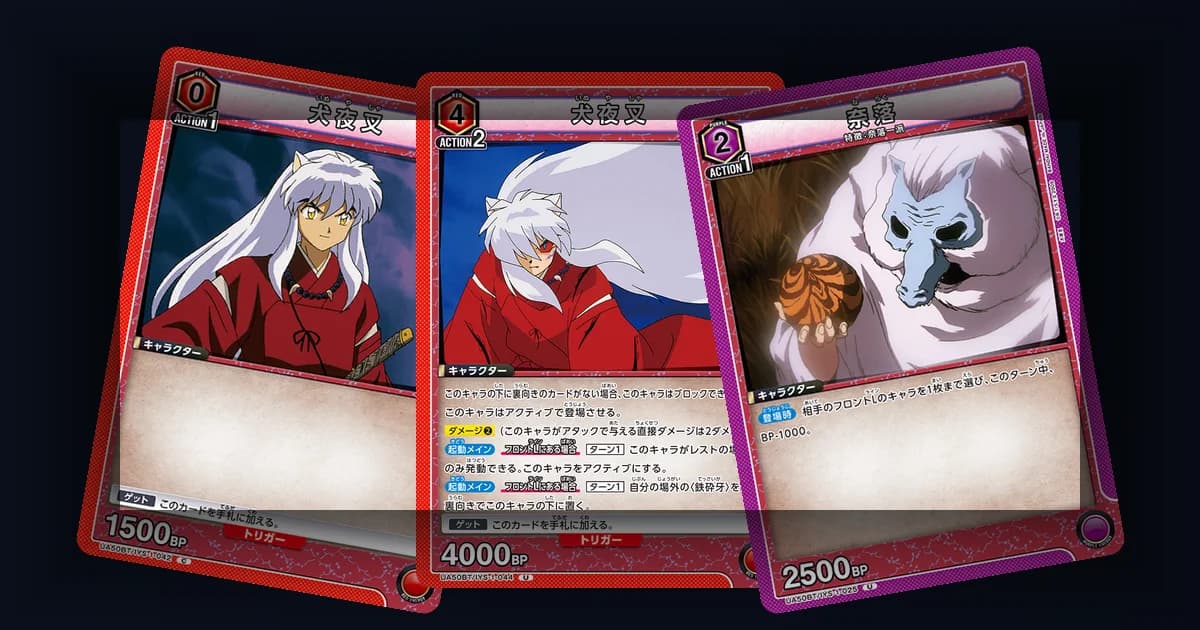
TL;DR: Raid from hand costs the same as playing the card. Put it on a legal base (the name or affinity beside the Raid symbol, and the base can't have Raid itself), switch it to active, optionally move it from the energy line to the front line, then resolve When Played. Effects on the base are wiped. A "play" effect can't Raid; only "perform Raid" can.
Updated October 19, 2026: Rewritten against the official rule manual and Bandai's card FAQs. Added the rulings on mandatory switching to active, the May Chang front-line trade-off and what happens when the top card leaves.
Union Arena Raid: the quick answer
The official rule manual lists five steps once you declare Raid:
- Place the card on top of a specified character.
- Abilities applying to the character underneath no longer apply, and abilities on that character become inactive.
- If the character is resting, switch it to active.
- If it is on the energy line, it may move to the front line.
- When Played abilities on the Raiding card activate.
Before step one, a Raid from hand checks the same two things as any character play: your energy line has to generate the card's required energy, and you rest the AP shown on the card.
GODEEPER: New to energy, AP and the two lines? Start with the Union Arena How to Play guide.
What counts as a legal base
The text beside the Raid symbol names the base. Angle brackets mean a card name, so needs a May Chang on your field. Square brackets mean an affinity, so [XYZ] accepts any character with that affinity. The base also has to be a character without Raid, which is why you can't stack one Raid form on top of another.
A few cards bend this. Bandai's FAQ for the Sakamoto Days Nagumo cards confirms that "Your character cards with Raid can perform Raid on this character" turns that Nagumo into a legal base even when the printed condition doesn't match. Card text beats the default, as usual.
What Raid costs
Nothing extra and nothing less. The manual says that when you perform Raid with a card from your hand, "you must have the required energy for that card and pay its AP cost." A new player on r/UnionArena asked exactly this about a Tanjiro with 1 AP and 4 energy, and the reply was short:
"Yes. Same cost no matter if you raid with it or not." (u/Mihael_M_Keehl on r/UnionArena)
What you gain is tempo. A character played from hand enters resting, so it can't attack that turn. A Raided character switches to active, so it can attack in this turn's attack phase, and an energy-line base can jump to the front line without waiting for your next movement phase.
You can also play a Raid card normally, straight onto a line. The manual warns that you lose every ability written inside its Raid description when you do, so check what that text holds before you hard-play it.
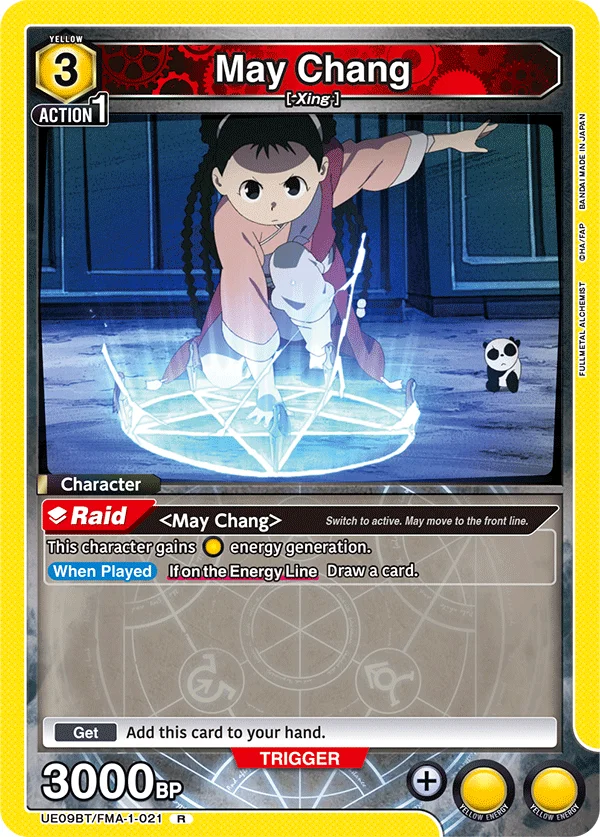 Image: Bandai, UNION ARENA official card list (UE09BT/FMA-1-021)
Step by step: Raid from your hand
- Check the base. Find a character on your field that matches the name or affinity beside the Raid symbol and has no Raid itself.
- Check energy. Your energy line has to generate the Raid card's required energy in its color.
- Pay AP. Rest the number of active AP cards printed on the Raid card.
- Stack it. Put the Raid card on top of the base. Effects on the base stop applying here.
- Switch to active. Not optional: Bandai's FAQ on the Re:ZERO Emilia card answers "Yes, it is" when asked whether switching a resting card to active is required.
- Decide on the move. If the base sat on the energy line, you may move the Raided character to the front line.
- Resolve When Played. It happens after the switch and the move, so "If on the Front Line" conditions see the new position.
The card under the stack still matters later, so keep the cards squared up where your opponent can see both.
The front-line move is a choice
Moving up is the default instinct, but some cards punish it. May Chang (UE09BT/FMA-1-021) has a When Played draw that only works if she stays on the energy line. Bandai's ruling on that card is blunt: "If you perform Raid and move it to the front line rather than leaving it on the energy line, you cannot draw a card."
It works the other way on cards that want the front line. On the BLEACH Rukia Kuchiki (UEX01BT/BLC-2-034), a Raid on an energy-line base followed by the move does turn on her "If on the Front Line" When Played ability, because the ability resolves after the move. And the Sword Art Online Asuna ruling confirms that a Raid move counts as moving "outside of your movement phase," which matters for cards that trigger on movement.
So read the When Played text before you decide. Whether the move helps depends on the card.
Raid Trigger
Some Raid cards carry a Raid Trigger. When one is revealed from your life area, the trigger text on cards such as Leafa (Earth Goddess, Terraria) reads: "Add this card to your hand, or if you have the required energy, perform Raid with it." The text names one condition, the required energy, and you still need a legal base on the field.
Leafa adds a twist: her Raid ability can put one base card face up into your life area. Bandai ruled that if you are on your last life, reveal Leafa, Raid with her trigger and add that base card to your life, you do not lose the game.
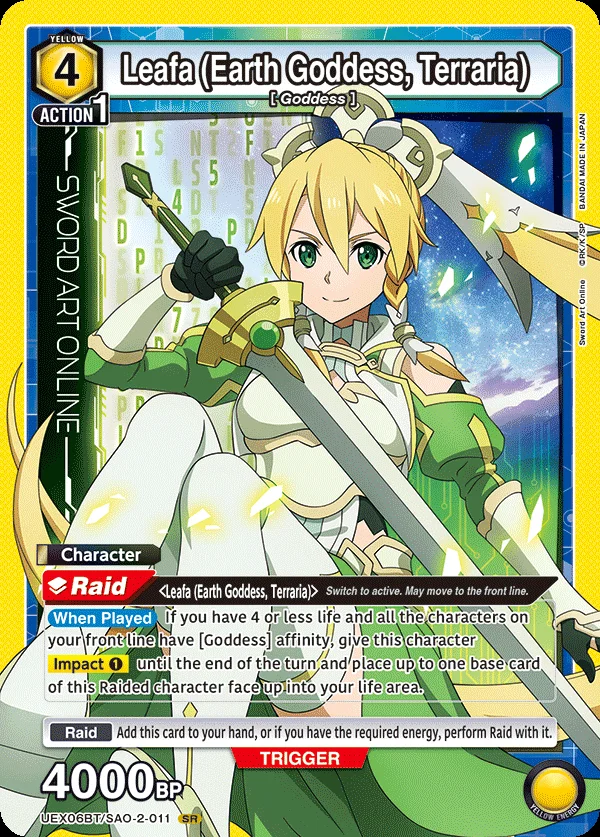 Image: Bandai, UNION ARENA official card list (UEX06BT/SAO-2-011)
GODEEPER: The other trigger types (Get, Draw, Special, Color, Final, Active) are in Union Arena Trigger System Explained.
"Play" effects can't Raid
Plenty of cards say "play up to one character card from your hand." That doesn't let you Raid. The manual says you cannot perform Raid using an ability that instructs you to "play" a card; you can only do it with abilities that tell you to "perform Raid." Some newer cards say both, for example "play up to one character card... or perform Raid with it," and those give you the choice.
What happens to the base card
Raid wipes the slate. Bandai has answered the same question on Shalnark, Yuji Itadori, C.C., Shirley Fenette and Gauche Adlai: if a character is due to be sidelined at the end of the turn and you Raid on top of it, it stays. In the FAQ's words, "When performing Raid, all abilities affecting the card you perform Raid on lose effect."
The reverse case comes up when an effect peels the top card off. Bandai's Sakamoto Days rulings on Taro Sakamoto and Nagumo cover it:
- The base stays on the field.
- It keeps the Raided character's active or resting state.
- Its own When Played doesn't activate, because it wasn't played.
- Abilities that were affecting the Raided character no longer apply to it.
Bandai's official tutorial video walks through a Raid at the 7-minute mark, including a base moving up from the energy line:
Building around Raid
Raid needs bases on the field when the Raid card shows up, so count your bases before you count your Raid cards. If a Raid card names one character, every copy of that character is a base and a dead Raid card risk at the same time.
Energy-line bases are worth more than they look: the Raid gets an active character on the front line in one action. Removal on your opponent's side does the opposite job, since a sidelined base strands the Raid card in hand.
The Union Arena Deck Building Guide covers the 50-card rules and copy limits.
Common mistakes
- Paying less AP or energy for a Raid than for a normal play.
- Skipping the switch to active.
- Treating the front-line move as automatic when it costs a When Played bonus.
- Using a "play" effect to Raid.
- Keeping an end-of-turn sideline effect on the base after Raiding on top of it.
- Hard-playing a Raid card and expecting its Raid text to work.
Our take
Raid isn't a discount. Count it as a normal play at full price that leaves you with an active attacker, and judge each Raid on that. Five of Bandai's FAQ answers cover the same cleanup from step two: once you Raid, whatever was on the base is gone, good or bad. The May Chang draw is the clearest case for leaving a Raided character on the energy line, so read the When Played before you move.
Related Reading
- Union Arena Card Rarities Explained: where Raid cards sit in a set's rarity spread.
- Union Arena Impact Keyword Explained: a separate keyword that shows up on Raid forms.
- Union Arena TCG Beginner Guide 2026: a starting point for new players.
- Union Arena Beginner Deck Tier List: which decks are easiest to learn.
- Union Arena Keywords Glossary: every keyword beyond Raid.
Frequently Asked Questions
How does Raid work in Union Arena?
You place a character card with Raid on top of a character that matches the name or affinity printed beside the Raid symbol and has no Raid of its own. From hand you pay the card's normal required energy and AP cost. Then the Raided character switches to active if it was resting, may move from the energy line to the front line, and its When Played abilities activate.
Does Raid cost less than playing the card normally?
No. The official rule manual says that when you Raid with a card from your hand you must have its required energy and pay its AP cost, the same as a normal play.
Do you have to switch the Raided character to active?
Yes. Bandai's FAQ answers that switching a resting card to active is required when you perform Raid on it. Moving from the energy line to the front line is optional.
What is a Raid Trigger?
A trigger printed on some Raid cards. When it is revealed from your life area, its text reads: add this card to your hand, or, if you have the required energy, perform Raid with it.
Can a card that says play a character perform Raid?
No. The rule manual says you cannot perform Raid using an ability that tells you to play a card. Only abilities that say perform Raid let you do it.
What happens to effects on the base card after Raid?
They stop applying. Bandai's FAQ rules repeatedly that when you perform Raid on a card, all abilities affecting that card lose their effect, so a base that was due to be sidelined at end of turn stays on the field under the Raid card.
References
- UNION ARENA Official Rule Manual: Raid declaration, costs and the five Raid steps
- UNION ARENA official FAQ: card rulings quoted above
- May Chang UE09BT/FMA-1-021 card and Q&A
- Leafa UEX06BT/SAO-2-011 card and Q&A
- r/UnionArena: New to Union Arena and have a raid question!
Was this guide helpful?
About the author
Beginner guides and anime crossover
Pen name for the Shonen TCG desk's beginner guides, starter decks and anime-to-card-game explainers.
- Rules checked against the official rulebook and card text
- Every claim traced to a cited source
- Opinions marked as ours, with the reason
Keep reading
Solo Leveling vs JJK: Which Union Arena Deck to Play
Guides · 8 min
Union Arena Trigger System Explained: All Trigger Types
Guides · 8 min

Union Arena Beginner Mistakes: 8 Errors to Stop Making
Guides · 7 min

Union Arena Impact Keyword: How It Works and How to Stop It
Guides · 6 min
Union Arena How to Play: Setup, a Full Turn and How to Win
Guides · 12 min
Union Arena Deck Building Guide: Build a 50-Card Deck
Guides · 8 min
Union Arena Tournament Guide 2026: Rules and Formats
Guides · 12 min
Union Arena Card Rarities Explained: C, U, R, SR, Parallels
Guides · 5 min
Disclaimer
This article is published for informational and entertainment purposes. It does not constitute professional financial, legal, or technical advice. Game performance, online services, patch schedules, and store listings change. Verify critical details (pricing, system requirements, regional availability) with publishers and storefronts before you buy. Affiliate links, where present, help support our editorial work and are labelled in our affiliate disclosure.