Loading…


Shonen TCG · Guides
Union Arena InuYasha Sesshomaru and Kagome Guide 2026
Reviewing
Union Arena
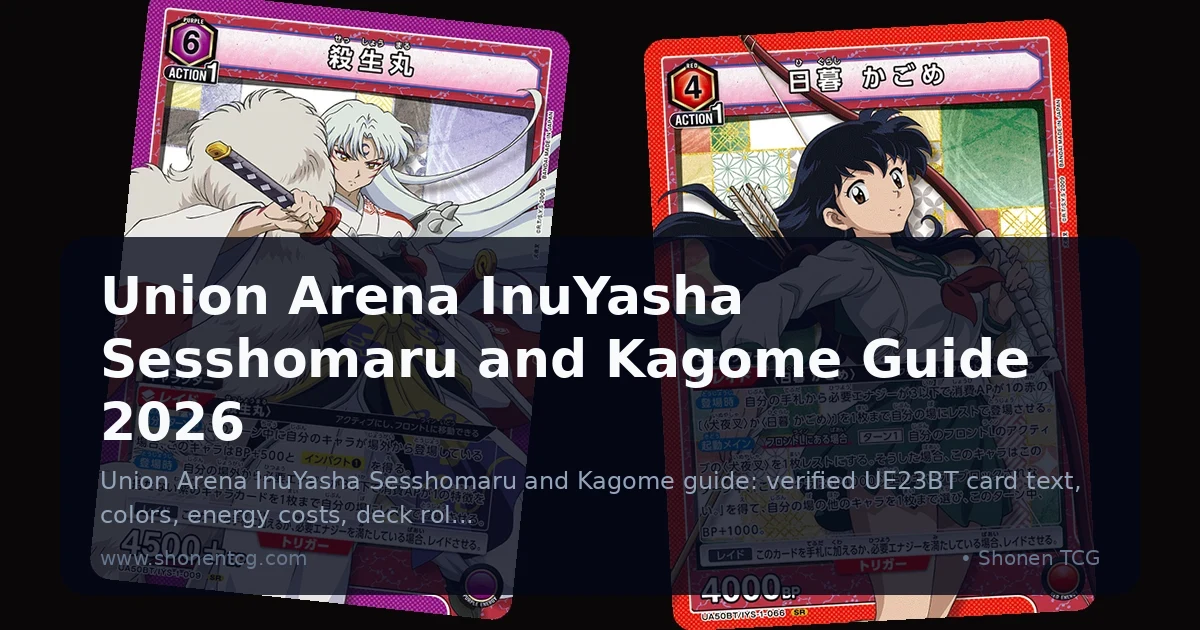
Union Arena InuYasha Sesshomaru and Kagome card roles are easier to evaluate now that the English UE23BT product and card list are live. Sesshomaru is the six-energy Purple Raid payoff, while Kagome is the four-energy Red enabler that deploys a cheap partner and converts an active Inuyasha into pressure. This guide uses the current English records and keeps Japanese reference images labeled as Japanese.
TL;DR: English UE23BT Sesshomaru is a Purple SR at 6 energy and 4500+ BP. It gains 500 BP and Impact (1) when a character was played from your sideline that turn, then can bring a small Purple character from the sideline. English UE23BT Kagome is a Red SR at 4 energy and 4000 BP. It plays a small Red Inuyasha or Kagome from hand and can rest an active Inuyasha to gain evasion and buff another character.
Union Arena InuYasha Sesshomaru and Kagome: quick answer
Sesshomaru and Kagome are not two versions of the same plan. Sesshomaru rewards Purple sideline development and wants a late turn with enough energy to Raid or play a six-cost finisher. Kagome rewards a Red Inuyasha package, using her entry effect and front-line ability to turn one active Inuyasha into a setup cost for evasion and a power boost.
| Card | English UE23BT record | Core role |
|---|---|---|
| Sesshomaru | IYS-1-009, Purple SR, 6 energy, 1 AP, 4500+ BP | Raid finisher and sideline payoff |
| Kagome Higurashi | IYS-1-066, Red SR, 4 energy, 1 AP, 4000 BP | Cheap deployment and Inuyasha-based evasion |
The Japanese UA50BT cards use the same IYS-1 card numbers in the reference images, but the products are not the same sealed configuration. Bandai lists UA50BT at 8 cards per pack and UE23BT at 12. Build or buy from the English card records if your events use UE23BT.
Union Arena InuYasha Sesshomaru and Kagome card roles in UE23BT
The two cards reward different setup patterns, so compare their text before choosing a color.
What Sesshomaru does in UE23BT
The official English record for UE23BT/IYS-1-009 lists Sesshomaru as a Purple Character with 6 required energy, 1 AP, 4500+ BP, and Raid. His During Your Turn effect checks if one of your characters was played from your sideline that turn. If that condition is true, Sesshomaru gains 500 BP and Impact (1).
His When Played effect plays up to one Purple character card with 3 or less required energy, 1 AP cost, and no affinities from your sideline onto your field set to resting. That restriction matters. The effect is not a generic free character from any zone, and it does not ignore the card's color, energy, AP, or affinity requirements.
Sesshomaru's practical role
Sesshomaru asks a Purple list to do two things before he arrives:
- Put useful low-cost characters into the sideline.
- Create a turn where a character can be played from that sideline.
The payoff is a 500 BP increase and Impact (1), plus the extra body from his When Played effect. If you simply play him without a sideline line ready, he is still a 4500+ Raid Character, but you are leaving his printed value unused.
The six-energy cost also changes the curve. A list using Sesshomaru as a finisher needs early Purple plays, a way to reach six energy, and a reason to spend an AP on the turn he enters. Do not treat him as a turn-one plan or as a removal spell. His text develops your field and increases the pressure of a well-prepared turn.
The official card record does not say that Sesshomaru clears the opponent's board. It also does not grant Impact every turn by itself. The condition is checked during the turn in which a character was played from your sideline.
What Kagome does in UE23BT
The official English record for UE23BT/IYS-1-066 lists Kagome Higurashi as a Red Character with 4 required energy, 1 AP, 4000 BP, and Raid. Her When Played effect plays up to one Red Inuyasha or Kagome card with 3 or less required energy and 1 AP cost from your hand onto your field set to resting.
Her front-line Activate: Main effect is once per turn. It switches one active Inuyasha on your front line to resting. If you do, Kagome cannot be blocked by a character with 4000 or more BP for the turn, and you choose up to one other character on your field to gain 1000 BP until the end of the turn.
Kagome's practical role
Kagome is a deployment and combat-sequencing card, not a draw engine. Her entry effect turns one card in hand into a second body, but that body arrives resting and must meet the Red, Inuyasha or Kagome, energy, and AP restrictions printed on the card.
Her front-line effect has a visible cost. Resting an active Inuyasha means that character cannot attack as an active attacker in the same moment. The reward is Kagome's protection from blockers at 4000 BP or more and a 1000 BP boost for another character. The correct sequence depends on the board:
- Use the entry effect when adding a cheap resting body is more valuable than keeping the card in hand.
- Use the front-line effect after deciding which Inuyasha is giving up its active status.
- Choose the 1000 BP target based on the next challenge, not just Kagome herself.
Kagome therefore fits a Red list that can keep an Inuyasha active until the turn her ability matters. She is less useful if the list has too few Red Inuyasha or Kagome cards to deploy and too few meaningful attacks to justify the rest effect.
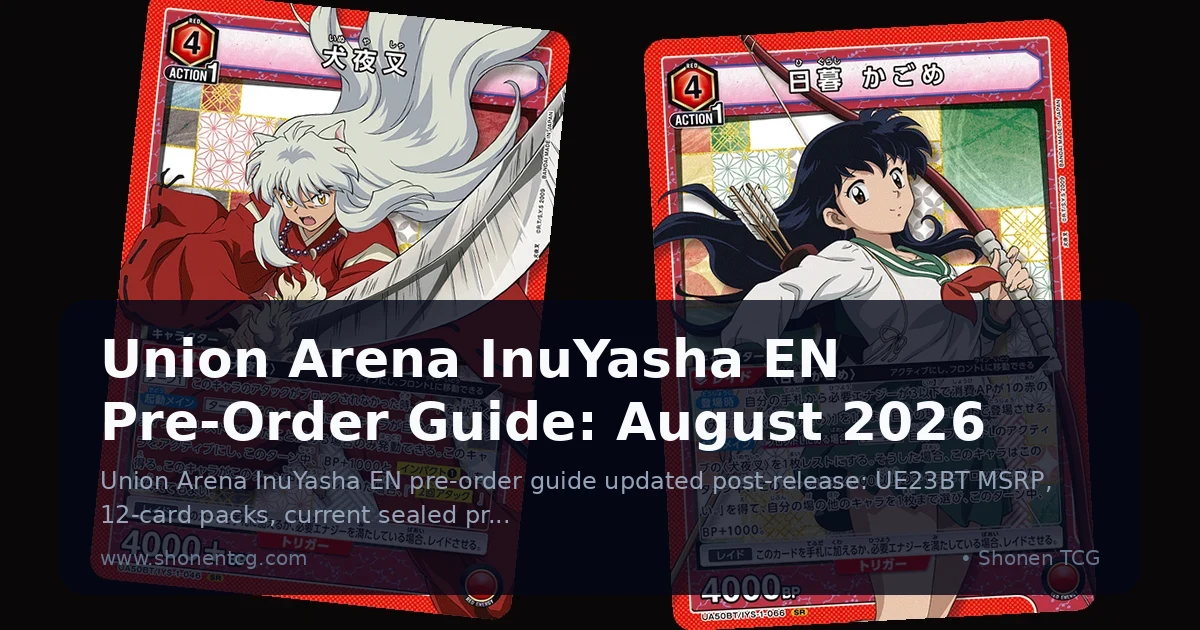
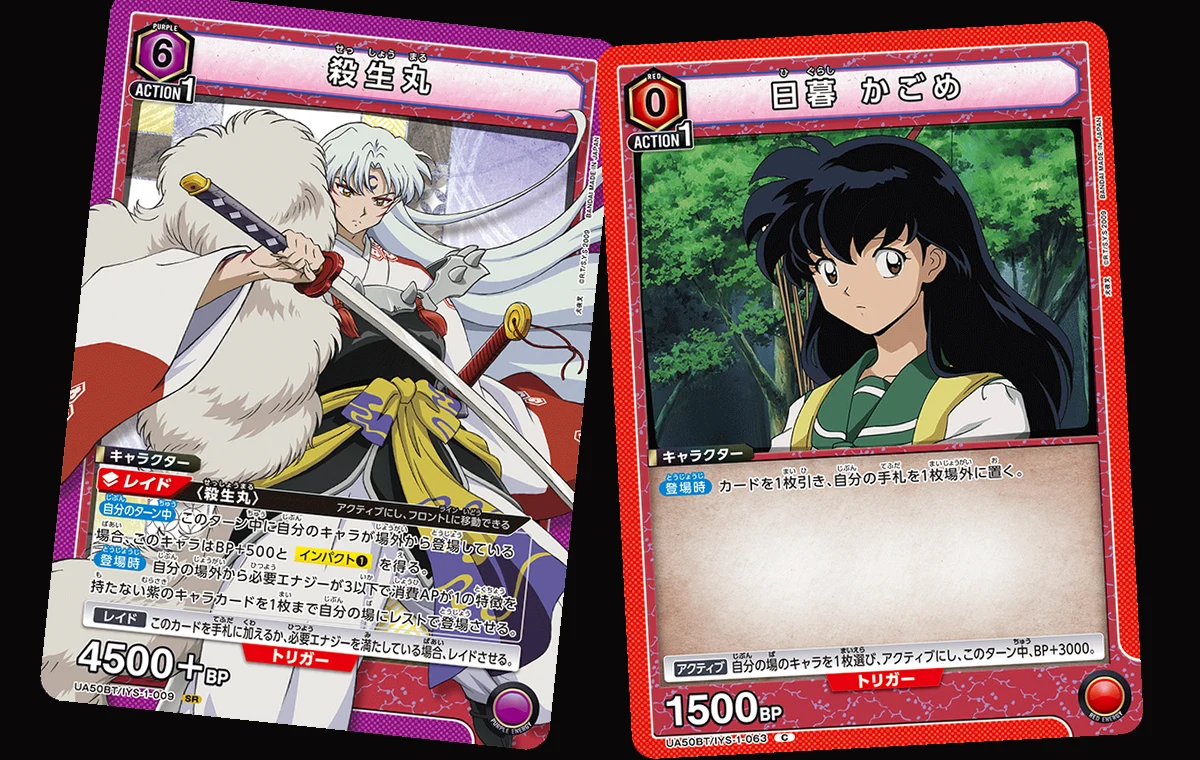 This real Japanese collage shows UA50BT/IYS-1-009 Sesshomaru as an SR and UA50BT/IYS-1-063 Kagome as a Common card. It is a Japanese visual reference, not an English UE23BT product image.
GODEEPER: Want the full regional product comparison before buying cards? Read the Union Arena InuYasha buying guide for pack configuration, legality, and current buying checks.
Do Sesshomaru and Kagome belong in one deck?
They can, but their energy colors make the choice deliberate. Union Arena's rule manual requires all 50 cards in a deck to share the same source material code, and it allows up to four cards with the same card number. It does not require every card in that source-material pool to generate the same color.
That means a UE23BT InuYasha deck can include Red and Purple cards if the list can pay both costs. A mixed list needs enough Red and Purple energy sources, enough early plays that do not strand cards in hand, and a clear reason to use both packages. A deck that draws only Red cards cannot reliably play a six-energy Purple Sesshomaru, while a Purple-heavy list may not activate Kagome consistently.
The two headline effects also use different setup zones:
- Sesshomaru wants a Purple character to be played from the sideline during the turn.
- Kagome wants an active Red Inuyasha on the front line and a cheap Red Inuyasha or Kagome in hand.
For most first builds, starting with one color makes testing easier. Purple lets you study the sideline payoff and late-game Raid turn. Red lets you study the Inuyasha rest decision and Kagome's cheap deployment. Mixing both is a later experiment, not a requirement for using either SR.
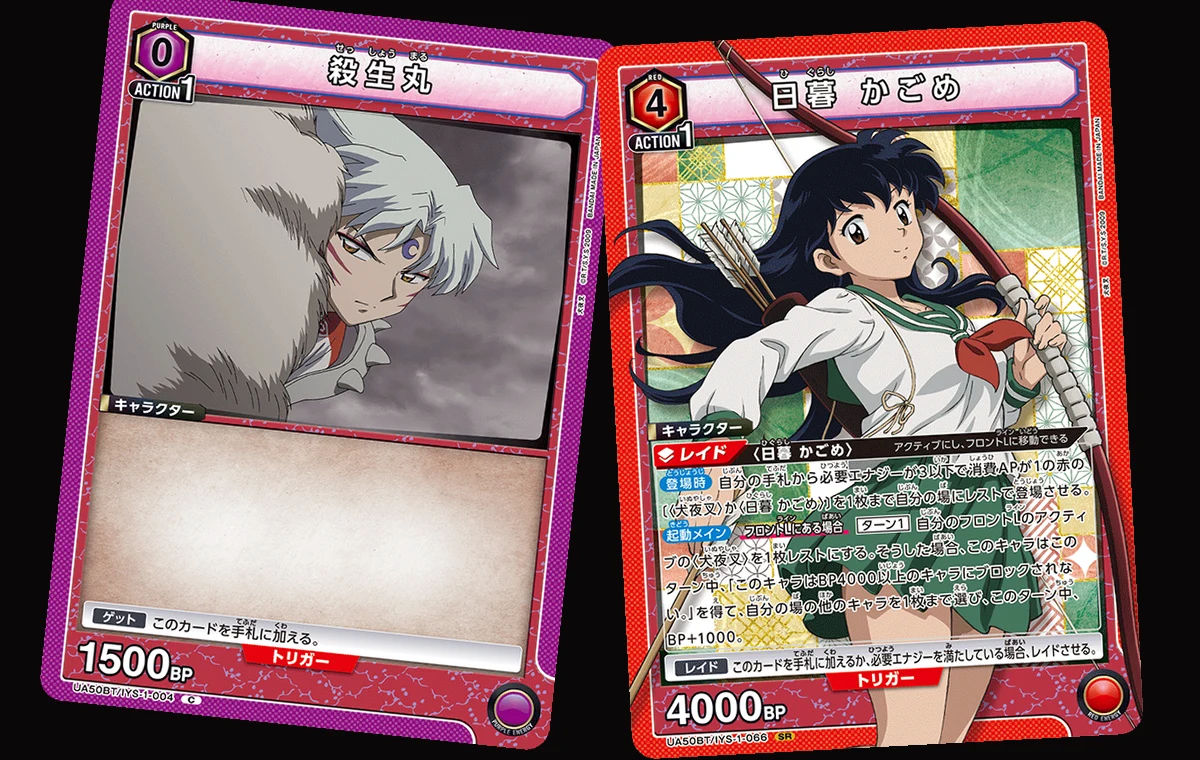 This real Japanese collage shows UA50BT/IYS-1-004 Sesshomaru as a Common and UA50BT/IYS-1-066 Kagome as an SR. It shows the characters and card frames, not a live board state.
English and Japanese product context
The English UE23BT product released on August 14, 2026. Bandai lists $4.99 per pack, 12 cards per pack, and 16 packs per display. The Japanese UA50BT product released May 29, 2026 and lists 8 cards per pack and 16 packs per box.
The related card numbers use the same IYS-1 sequence in the examples above, but regional product details still matter. Bandai warns that products and specifications can differ by region. Confirm the card language, product code, source code, and event legality before buying an import for an English event.
Bandai's English product page also lists foil-stamped voice-cast autograph content, alt-art cards, a low-rate serial-numbered AP, and eight box-topper designs. Those are product-level collector details. The base Sesshomaru and Kagome English card records are normal SR entries. Their SR star parallel records should be checked separately, and the official record should be the source for any claim about a specific signed or promo print.
GODEEPER: Need the wider English release context? The Union Arena InuYasha English Release Guide separates UE23BT facts from older UA50BT assumptions.
Step-by-Step: Choosing a Sesshomaru or Kagome build
1. Choose the color before buying a box. Start Purple if you want a sideline-development finisher. Start Red if you want Inuyasha rest effects, cheap deployment, and Kagome's front-line evasion. This is a playstyle decision, not a confirmed tier ranking.
2. Check the English card records. Use the official UE23BT card list to confirm the exact card number, color, energy, AP cost, BP, and effect. Japanese reference images can help identify the character, but they do not replace the English record for an English deck.
3. Build the early curve first. Sesshomaru needs low-cost Purple characters that can create a sideline line. Kagome needs cheap Red Inuyasha or Kagome cards in hand and an active Inuyasha to rest. A list with only its featured SRs will not demonstrate either plan.
4. Test the setup condition. Play enough games to track how often Sesshomaru has a legal sideline play on his turn or Kagome has an active Inuyasha plus a meaningful attack. If the condition rarely happens, change the supporting cards before adding more expensive finishers.
5. Buy singles for a targeted deck. A display can be a reasonable collection purchase, but it is not a reliable way to find a particular SR or parallel. Price the cards needed for the list against live English listings, shipping, taxes, and seller terms.
6. Separate recommendation from result. Bandai's official recommended-deck page now includes a Red InuYasha sample, but the current top-placing archive does not show an InuYasha result. Treat the former as a starting list and the latter as the current limit on tournament conclusions.
Current evidence and buying advice
This is a released product, so the old question of importing Japanese cards while waiting for English no longer applies to new English purchases. Import UA50BT only for Japanese-language collecting, a specific verified card, or a landed-price reason that survives shipping and tax.
For competitive play, buy the specific English cards that make the chosen color function. For collecting, compare the base SR, SR star, autograph, and box-promotion records by exact card number. Do not use a marketplace title alone to decide which print you are buying.
There is no official top-placing InuYasha deck entry to support a claim that Sesshomaru or Kagome is a proven tournament staple. There is useful card-text evidence and an official recommended Red list. Keep those categories separate in any deck discussion until larger event samples appear.
Frequently Asked Questions
What does Sesshomaru's English UE23BT card do?
Sesshomaru is UE23BT/IYS-1-009, a Purple SR Character with 6 required energy, 1 AP, and 4500+ BP. It has Raid, gains 500 BP and Impact (1) if one of your characters was played from your sideline that turn, and can play a small Purple character from your sideline set to resting.
What does Kagome's English UE23BT card do?
Kagome Higurashi is UE23BT/IYS-1-066, a Red SR Character with 4 required energy, 1 AP, and 4000 BP. Its When Played effect plays a small Red Inuyasha or Kagome from hand set to resting. From the front line, it can rest an active Inuyasha to gain evasion and give another character 1000 BP.
When did the English InuYasha UE23BT set release?
Bandai lists August 14, 2026 for UE23BT and May 29, 2026 for Japanese UA50BT. The English product page lists 12 cards per pack and 16 packs per display, while the Japanese page lists 8 cards per pack and 16 packs per box. Use the region-specific page for current product details.
Is there official tournament or price data for these cards?
Bandai's current top-placing deck archive does not show an InuYasha entry, so neither card has an official result proving it is a winning staple. Bandai's recommended-deck page does include a Red InuYasha sample. Prices are live market data, so check current English listings rather than relying on a fixed forecast.
Can Sesshomaru and Kagome be played in one deck?
Yes, if every card shares the InuYasha source material code. Sesshomaru generates Purple energy and Kagome generates Red energy, so the list must support both colors. Their setup conditions differ, which makes a mixed build legal but less automatic than choosing one package and building around its primary effect.
What is the difference between UA50BT and UE23BT?
UA50BT is the Japanese InuYasha booster and UE23BT is the English product. Bandai lists 8 cards per Japanese pack and 12 per English pack, with different product codes and regional specifications. Confirm language, card number, source code, legality, shipping, and seller terms before treating an import as interchangeable.
Are the Sesshomaru and Kagome SR cards autograph cards?
The base English card records identify both as SR cards. Their parallel records use SR star notation and list Box Promotion Pack information. Bandai separately advertises foil-stamped voice-cast autograph content for UE23BT, so a listing should be checked by exact card record before it is described as an autograph.
Related Reading
- Union Arena InuYasha EN Prerelease Guide: Review the ended Five Pack Battle release event and its confirmed prize structure.
- Union Arena InuYasha EN Singles vs Sealed: Full Math: Compare sealed product with singles after the English release.
- Union Arena InuYasha Sesshomaru Deck Guide: Purple Build: Build around the Purple sideline payoff after checking current card legality.
- Union Arena InuYasha Kagome Deck: Support Guide 2026: Explore the Red support plan and Kagome sequencing in more detail.
References
- Union Arena UE23BT official English product page: release date, MSRP, pack configuration, rarities, autograph content, and regional caveats
- Official UE23BT Sesshomaru card record: English card number, color, energy, BP, and effect
- Official UE23BT Kagome Higurashi card record: English card number, color, energy, BP, and effect
- Official UE23BT card list: current English card database
- Official UA50BT Sesshomaru card record: Japanese product reference used for the local image and card embed data
- Official UA50BT Kagome Higurashi card record: Japanese product reference used for the local image and card embed data
- Union Arena official rule manual: source material and 50-card deck rules
- Union Arena recommended decks by title: official Red InuYasha recommended deck listing
- Union Arena top-placing decks: official result archive checked for InuYasha entries
Was this guide helpful?
About the author
KT
Competitive TCG Analyst
Competitive One Piece TCG player and deck builder with 3 years of tournament experience. Covers meta analysis, tier lists, and leader builds.
- 3 years competitive OPTCG tournament experience
- Regional top 8 finisher
- Deck builder and meta analyst
- Covers every set since OP-01
Disclaimer
This article is published for informational and entertainment purposes. It does not constitute professional financial, legal, or technical advice. Game performance, online services, patch schedules, and store listings change. Verify critical details (pricing, system requirements, regional availability) with publishers and storefronts before you buy. Affiliate links, where present, help support our editorial work and are labelled in our affiliate disclosure.