

Shonen TCG · Guides
Union Arena Beginner Mistakes: 8 Errors to Stop Making
Most early losses come from rules you half-know: energy you never spend, blockers that can't win, and Raids flipped from Life.
Our callFix the energy habit first, then start counting your opponent's triggers. Those two changes win more games than any card you can buy.
Most Union Arena beginner mistakes aren't about card choice. They come from rules new players half-know: treating energy like mana, blocking with characters that can't win, and forgetting that a Raid can flip out of the Life area mid-attack. Each mistake below is checked against Bandai's official FAQ or card text, and each fix costs nothing.
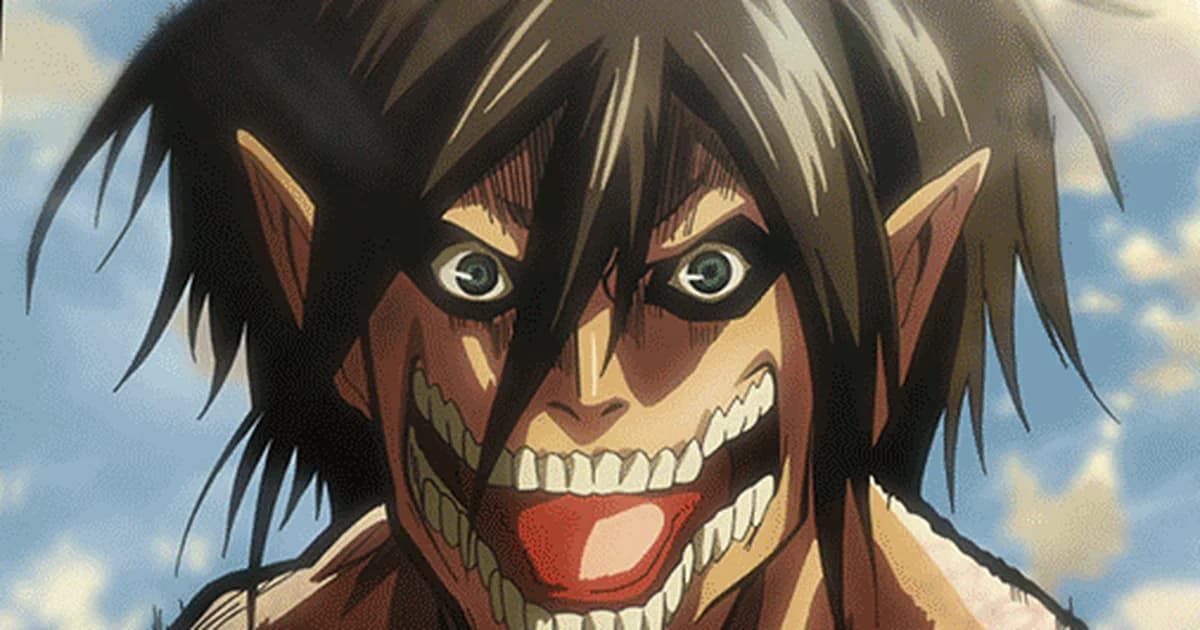
Updated October 22, 2026: We rewrote this list around Bandai's official FAQ. The old version said you "pay" energy and "afford" cards with it; Union Arena doesn't work that way, so that advice is gone. We also added the blocking rules, Raid triggers from Life, the Final trigger timing and the limited-trigger cap, with odds from a small script.
1. Treating energy like mana
This is the big one for players coming from Magic or Riftbound. In Union Arena you pay AP to play cards. Energy is only a requirement you have to meet when you play the card. Bandai's FAQ is direct: using a card "does not" consume generated energy, because "Energy generation is continuous." Resting cards generate energy too.
Fix: stop holding cards back to "save energy." Build an energy line that meets your strongest card's requirement in the right color, then spend your AP every turn. Color matters: a red 4 needs four red energy symbols, not any four.
2. Moving your energy line forward
Only the energy line generates energy, and front-line characters can't walk back. The FAQ says only characters with Step can move from the front line to the energy line. Push your energy characters forward to attack and your next Raid may no longer meet its requirement.
Fix: play attackers straight onto the front line. The FAQ confirms you can. Leave the energy line to do its job.
3. Blocking with a bigger character and expecting a kill
Union Arena combat isn't symmetrical. When BP is tied, the attacker wins and the blocker is sidelined. When the blocker has more BP, the blocker wins, but "neither the attacking character nor the blocking character are sidelined."
Fix: block to stop a hit, not to trade. If you need the attacker gone, you need removal, not a bigger body.
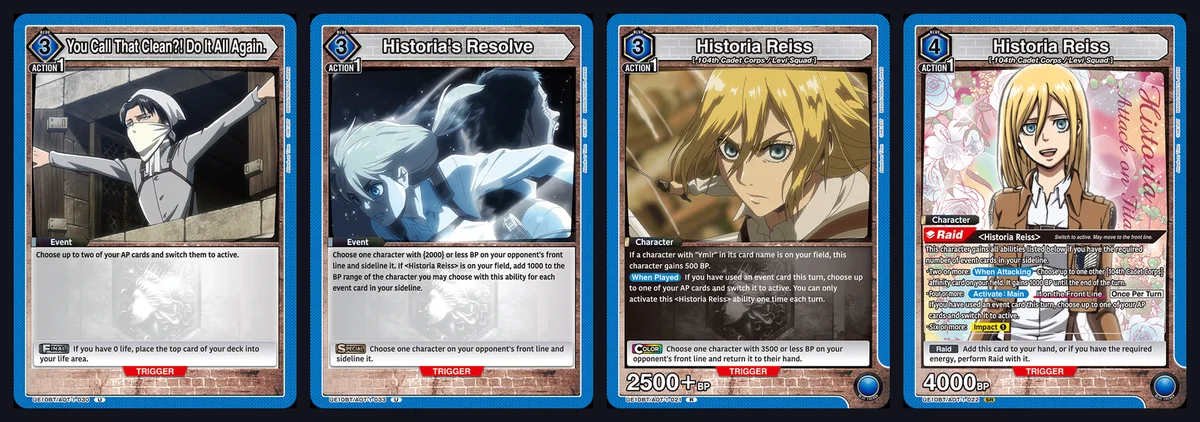 Image: Bandai, Union Arena official card list (UE10BT/AOT-1-030, 033, 021, 022). The trigger sits in the gray bar above each card's BP.
4. Attacking with your best character first
Every Life card you take gets a trigger check. A Raid trigger lets the defender add the card to hand or, "if you have the required energy, perform Raid with it" on the spot. An Active trigger readies a character and gives it 3000 BP. Lead with your best attacker and it can run into a fresh blocker it can't beat.
u/Myriad_Genesis put the habit simply in a new-player thread on r/Union_Arena_TCG: "it could be good to swing with your low BP characters first, just in case they hit a Raid."
Fix: attack small first, then send the big character once you've seen what came off the top.
5. Ignoring how many removal triggers are left
Each deck can run up to four each of Special, Color and Final triggers, twelve in total. Specials remove a character outright. Our script puts the odds at about 46% that at least one of four Specials sits in the seven-card Life area, and 73% if the deck also runs four Colors. Against Specials alone that's close to a coin flip; add Colors and it's more likely than not.
Fix: count the Specials and Colors your opponent has revealed. Once three or four are gone, you can swing harder.
6. Thinking zero Life ends the game instantly
Bandai's FAQ says the zero-Life check happens "after all abilities activated during a trigger check have been resolved." A Final trigger puts the top card of the deck into the Life area, and "If you have one or more life after resolving all abilties, including Final triggers, you do not lose the game." If a Damage 2 attack hits a player at two Life and both cards are Finals, only the first one fires.
Fix: plan one more hit than you think you need when the opponent is low.
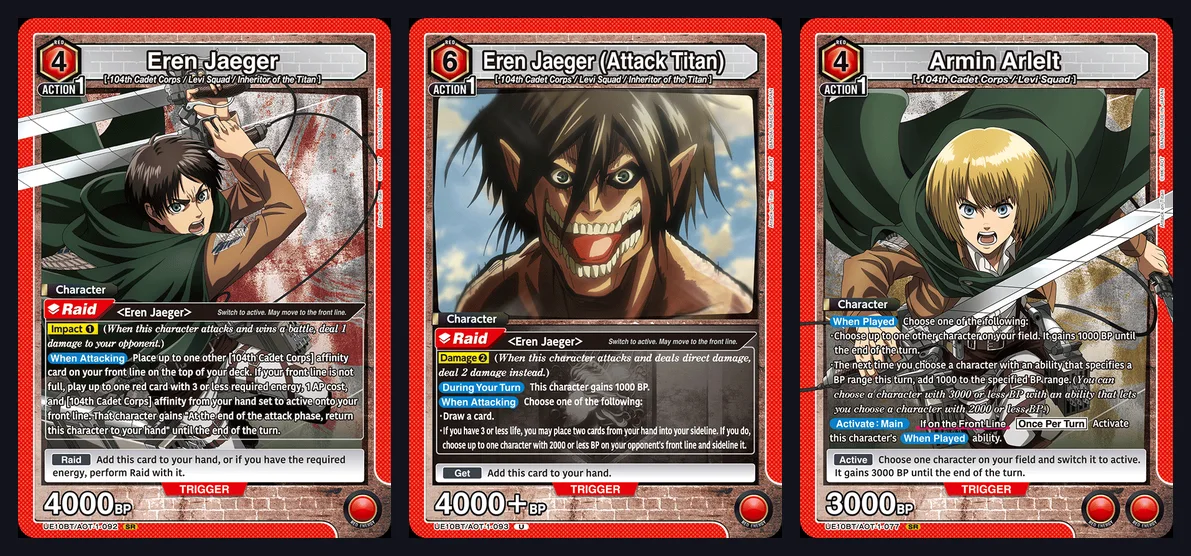 Image: Bandai, Union Arena official card list (UE10BT/AOT-1-092, 093, 077).
7. Playing a big character when you could Raid
Characters come into play resting, so a fresh character can't attack the turn you play it. Raid is the exception. Raid cards read "Switch to active. May move to the front line." Raid onto a base on your energy line or onto one you played earlier this turn, and you get a ready attacker immediately.
Fix: when you want pressure this turn, Raid instead of playing a new body. Keep a Raid base alive for exactly that turn. Our Raid mechanic guide walks through the timing.
8. Skipping the extra draw
You can perform an extra draw once per turn, and Bandai's FAQ confirms Player One can do it on their first turn. New players often skip it to keep AP for a play they don't make.
Fix: at the start of each turn, ask whether the extra draw is worth more than the play you're saving AP for. Early in the game it usually is.
The rules video worth watching
Union Arena Guides covers five rules players forget in about eight minutes:
Our take
The two fixes that matter most are free. Stop treating energy like a resource you spend, and start counting your opponent's triggers. u/SeasonalChatter summed up the rest: "you really need to learn what your opponent can do, and what the key pieces to target and play around." If the core rules still feel shaky, start with our how to play guide, then read the trigger system explainer before your next locals.
How we checked this: every rule above comes from Bandai's official Union Arena FAQ or card text, read on October 22, and the trigger odds come from scripts/sims/ua-life-trigger-odds.py. Header image: Bandai, Union Arena official card list (UE10BT/AOT-1-093, the Raid card in mistake 7).
About the author
Beginner guides and anime crossover
Pen name for the Shonen TCG desk's beginner guides, starter decks and anime-to-card-game explainers.
- Rules checked against the official rulebook and card text
- Every claim traced to a cited source
- Opinions marked as ours, with the reason
Keep reading
Solo Leveling vs JJK: Which Union Arena Deck to Play
Guides · 8 min
Union Arena Impact Keyword: How It Works and How to Stop It
Guides · 6 min
Union Arena Raid Mechanic: How Raid Works, Cost and Steps
Guides · 9 min
Union Arena Trigger System Explained: All Trigger Types
Guides · 8 min
Union Arena How to Play: Setup, a Full Turn and How to Win
Guides · 12 min
Union Arena Deck Building Guide: Build a 50-Card Deck
Guides · 8 min
Union Arena Tournament Guide 2026: Rules and Formats
Guides · 12 min
Union Arena Card Rarities Explained: C, U, R, SR, Parallels
Guides · 5 min
Disclaimer
This article is published for informational and entertainment purposes. It does not constitute professional financial, legal, or technical advice. Game performance, online services, patch schedules, and store listings change. Verify critical details (pricing, system requirements, regional availability) with publishers and storefronts before you buy. Affiliate links, where present, help support our editorial work and are labelled in our affiliate disclosure.