

Shonen TCG · Guides
Union Arena Impact Keyword: How It Works and How to Stop It
Impact punishes blocking, not attacking. Learn when it fires and you'll stop throwing away blockers.
Our callImpact only fires when your attacker wins a battle, and every one of this season's 26 Regional top-four decks plays it, so learn the block math first.
The Union Arena Impact keyword does one thing: when a character with Impact 1 attacks and wins a battle, your opponent takes 1 damage. That sounds small until you notice when it applies. An unblocked attack already deals 1 damage, so Impact only changes anything when your opponent blocks. It's the keyword that makes blocking cost a character and a life card at the same time.
Updated October 19, 2026: we corrected the counterplay advice. The old version said to block with a character that "wins or ties"; a tie goes to the attacker, so a tied block loses your blocker and still takes the Impact damage. We also counted Impact, Nullify Impact and Snipe in every Regional top-four deck Bandai has posted this season.
How the Union Arena Impact keyword works
The rule manual's wording for Impact 1 is short: "When this character attacks and wins a battle, deal 1 damage to your opponent." Two other rules decide when that happens:
- Ties go to the attacker. If the attacking character's BP is equal to or greater than the defender's, the attacker wins and the defender is sidelined.
- A losing attacker isn't sidelined. If the blocker has more BP, the attacker simply loses the battle and stays on the field.
Damage works the same way whatever caused it: for each point, the player dealing it picks one card in the other player's life area, and that card's trigger can go off before it's sidelined. Everyone starts with seven life cards.
Here's what an Impact 1 attacker does in each case:
| Your opponent... | What happens |
|---|---|
| Doesn't block | No battle. The attack deals its normal 1 damage; Impact does nothing. |
| Blocks with equal or lower BP | Your attacker wins: the blocker is sidelined and Impact deals 1 damage. |
| Blocks with higher BP | Your attacker loses (it stays on the field). No damage. |
| Blocks with a Nullify Impact character | Your attacker loses Impact for that battle. If it wins, the blocker is still sidelined, but no damage. |
So the right block against Impact is a bigger blocker or a Nullify Impact one. Anything else is giving away a character for nothing.
Impact 1 vs Impact +1
These look alike and work differently. Impact 1 is the keyword itself, and gaining Impact 1 twice still leaves you at Impact 1: it doesn't add up. Impact +1 is what raises the number. It increases Impact damage by 1, and a character without Impact gains Impact 1 instead.
The promo Yachiru Kusajishi (BLC-2-064) shows both at once. You rest and sideline her to give a Kenpachi Zaraki on your field either Impact +1 or damage +1 for the turn, and her reminder text spells it out: "Increase Impact damage by 1. If the card does not have Impact, it gains Impact (1)." Damage +1 is the other half of that choice, and it's for unblocked attacks, since damage 2 means "deal 2 damage instead" when the attack hits your opponent directly.
Snipe plus Impact
Snipe is the reason Impact isn't purely defensive pressure. A character with Snipe can pick a character on your opponent's front line and attack it, and your opponent can't block. That's still a battle, so if it has Impact and wins, you sideline the character you chose and take a life card in the same attack.
The best-known example right now is Sung Jinwoo (SLG-1-022), the twelve-energy Raid card at the top of Purple Solo Leveling. He has Impact 1 printed, and when he's played he gains Snipe until the end of the turn. Rurouni Kenshin's Hajime Saito (RNK-1-040) does a similar thing: with no affinity cards on your field, he can attack from the energy line and gains Snipe.
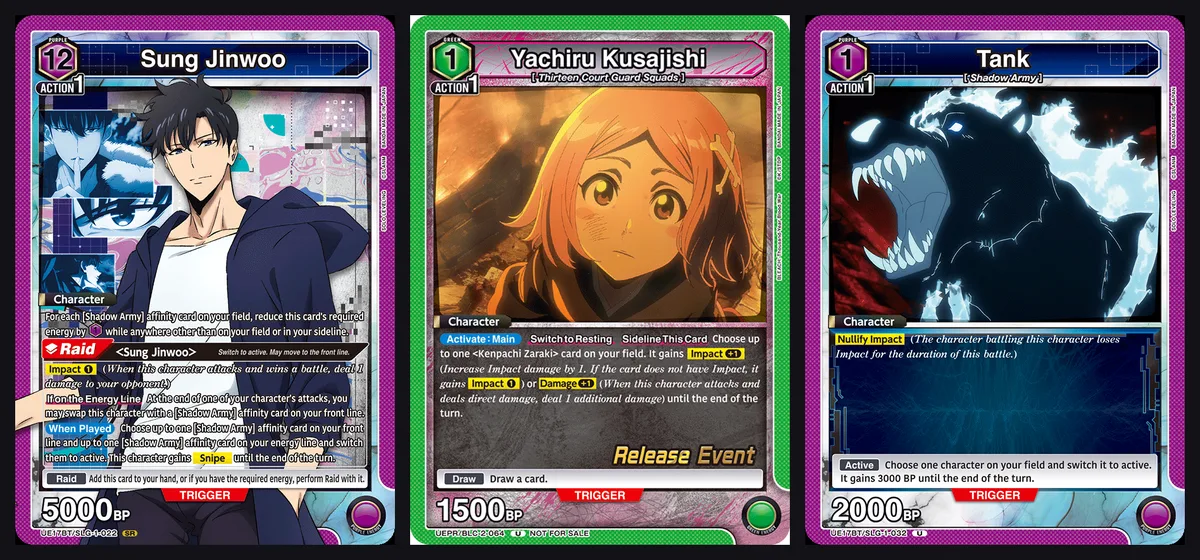 Image: Bandai, UNION ARENA official card list (UE17BT/SLG-1-022, UEPR/BLC-2-064, UE17BT/SLG-1-032).
How much Impact the Regional decks play
We went through the 26 different top-four decklists from this season's seven Championship 26-27 Regionals and checked every card's keyword icons on Bandai's card list. Every single deck runs at least one card that has or grants Impact. The typical deck runs four, the yellow SAKAMOTO DAYS lists run eight, and the KAGURABACHI lists get by on one or two. Nullify Impact is nearly as common: 19 of the 26 lists play it, including every Solo Leveling list: four of the five play four Tank (SLG-1-032), the fifth a Sung Jinwoo (SLG-1-016) that has it.
Snipe shows up in 12 lists and damage 2 in five.
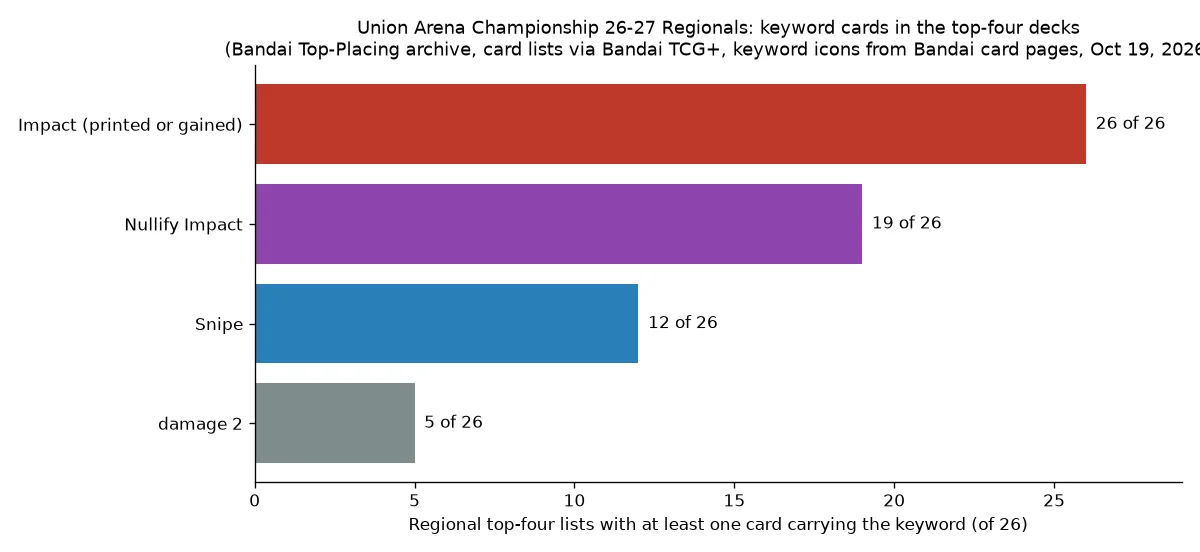 Chart: ShonenTCG. Source: Bandai Top-Placing Decks archive, card lists via Bandai TCG+, keyword icons from Bandai's card list, October 19, 2026.
Playing against Impact
The reflex to block everything is the habit Impact punishes. On r/Union_Arena_TCG, u/GoldFade put the rule plainly: "Impact only triggers when you win a battle, which means the opponent blocks." So before you block an Impact attacker, ask one question: does my blocker have more BP, or Nullify Impact? If not, take the 1 damage and keep the character.
The life card you lose to an unblocked hit and the one you lose to Impact are the same card. The difference is whether a blocker goes with it. Removal still works as normal, and so does dropping the attacker's BP below your blocker's before the battle.
Our take
Learn this one table and you'll stop throwing blockers away. We'd keep Nullify Impact in any deck whose title has a cheap one (Tank is a one-energy, 2000 BP body with an Active trigger; it costs you nothing to run), and we'd skip building around Impact +1 unless your title gives you a card like Yachiru. The Regional lists say the real value is Impact on a big Raid finisher, not stacking it.
How we checked this: on October 19, 2026 we read the Impact, Snipe and battle rules in Bandai's rule manual, then checked the keyword icons on Bandai's card pages for all 190 card numbers in the 26 Championship 26-27 Regional top-four lists (card lists from Bandai TCG+).
Related Reading
- Union Arena Keywords Glossary: every keyword in the rule manual, in one table.
- Union Arena Trigger System Explained: what can happen when Impact flips a life card.
- Union Arena Raid Mechanic Explained: how the big Impact finishers hit the board.
- Union Arena Evangelion Deck Guide: a Regional deck that runs both Impact and Nullify Impact.
References
- UNION ARENA rule manual: Impact, Impact +1, Snipe, damage 2, battle and damage rules
- UNION ARENA official card list: card text and keyword icons
- UNION ARENA Top-Placing Decks archive: Championship 26-27 Regional top fours
Was this guide helpful?
About the author
Beginner guides and anime crossover
Pen name for the Shonen TCG desk's beginner guides, starter decks and anime-to-card-game explainers.
- Rules checked against the official rulebook and card text
- Every claim traced to a cited source
- Opinions marked as ours, with the reason
Keep reading
Union Arena Beginner Mistakes: 8 Errors to Stop Making
Guides · 7 min
Solo Leveling vs JJK: Which Union Arena Deck to Play
Guides · 8 min
Union Arena Raid Mechanic: How Raid Works, Cost and Steps
Guides · 9 min
Union Arena Trigger System Explained: All Trigger Types
Guides · 8 min
Union Arena How to Play: Setup, a Full Turn and How to Win
Guides · 12 min
Union Arena Deck Building Guide: Build a 50-Card Deck
Guides · 8 min
Union Arena Tournament Guide 2026: Rules and Formats
Guides · 12 min
Union Arena Card Rarities Explained: C, U, R, SR, Parallels
Guides · 5 min
Disclaimer
This article is published for informational and entertainment purposes. It does not constitute professional financial, legal, or technical advice. Game performance, online services, patch schedules, and store listings change. Verify critical details (pricing, system requirements, regional availability) with publishers and storefronts before you buy. Affiliate links, where present, help support our editorial work and are labelled in our affiliate disclosure.