Loading…
Shonen TCG · General
Union Arena InuYasha Tier List: JP Meta Archetypes 2026
Union Arena InuYasha tier list based on six weeks of JP community play with UA50BT. Counter Rush leads, with Hybrid and Sesshomaru Control close behind.
Reviewing
Union Arena
The Union Arena InuYasha tier list has taken shape over six weeks of JP community play with UA50BT, and the picture is clearer than most sets at this stage. Three main archetypes separate themselves, with a fourth as a situational meta call. This ranking is built from JP community reports and observed play patterns since the May 29, 2026 JP release, not fabricated win rates or invented placements.
TL;DR: Counter Rush (S-Tier) leads with the most JP play and clear combo line. Hybrid and Sesshomaru Control share A-Tier with different strengths. Naraku Disruption is B-Tier but climbs in InuYasha-heavy metas. EN launches August 14, 2026. Kagome (Rare, 4x) and Miroku (Uncommon, 4x) are in every archetype.
Union Arena InuYasha tier list: quick answer
Counter Rush is the most played and results-backed archetype from JP community data. Sesshomaru Control and Hybrid both hold a solid second position, with different reasons to pick each one. Naraku Disruption is the outlier that performs best when the room is full of InuYasha mirrors.
All four archetypes run Kagome Higurashi as the draw engine and Miroku as the counter accelerator. Those two cards are not tier decisions. They are baseline pieces the tier list is built on top of.
S-Tier: Counter Rush
Counter Rush is the dominant archetype from JP play since UA50BT launched May 29. The game plan is a linear three-piece combo: Miroku stacks Jewel Shard counters on your characters, Kagome Higurashi runs the Purification draw engine to keep your hand full, and 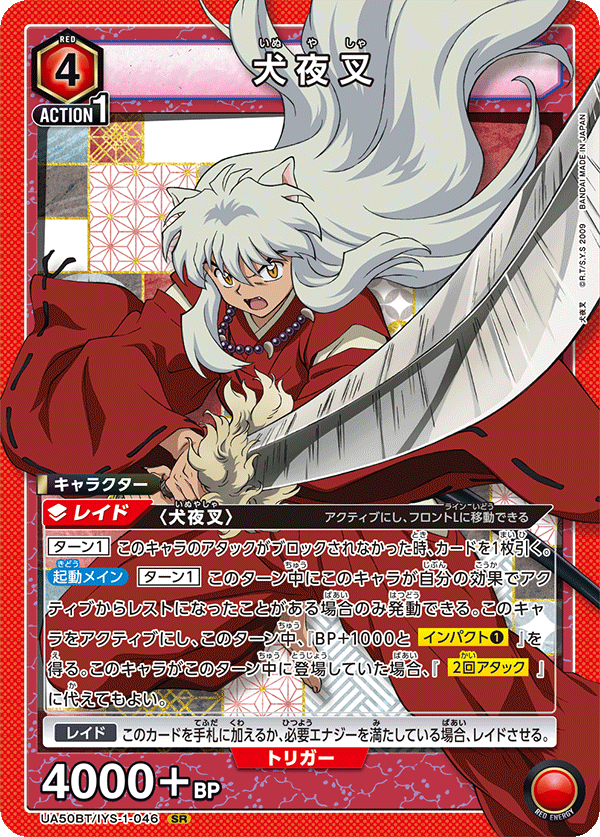 UA50BT-046UA50BT-046Shop on TCGplayer Full Demon InuYasha fires once a character hits counter maximum.
When that sequence lands cleanly, the game ends in two or three turns from any board state. There is no ambiguity in how the deck wins. That clarity is why it sees the most play, the most documented decklists, and the most accessible entry point from JP community resources.
Counter Rush weakness: the InuYasha mirror. Your opponent knows exactly what you are building toward. If they are running Naraku as a tech piece, they can blank your combo turn at the worst possible moment. Counter Rush also struggles against builds with wide blocker setups, because reaching counter maximum requires keeping your character on the field long enough for the stack to accumulate.
For EN players building before August 14: the starter deck ($17 MSRP) gets you 4x Miroku. Add 4x Kagome Higurashi (Rare, $6-10 JP each) as singles. Then add Full Demon InuYasha at 2 copies when the budget allows. The deck functions as a learning build without Full Demon and becomes a genuine closer once he is in.
GODEEPER: Full breakdown of the Counter Rush combo line and how to build it on a budget, including starter deck pieces versus singles. Union Arena InuYasha Deck Archetypes
A-Tier: Sesshomaru Control
Sesshomaru Control runs a different clock. Instead of racing to counter maximum, this archetype builds board presence through 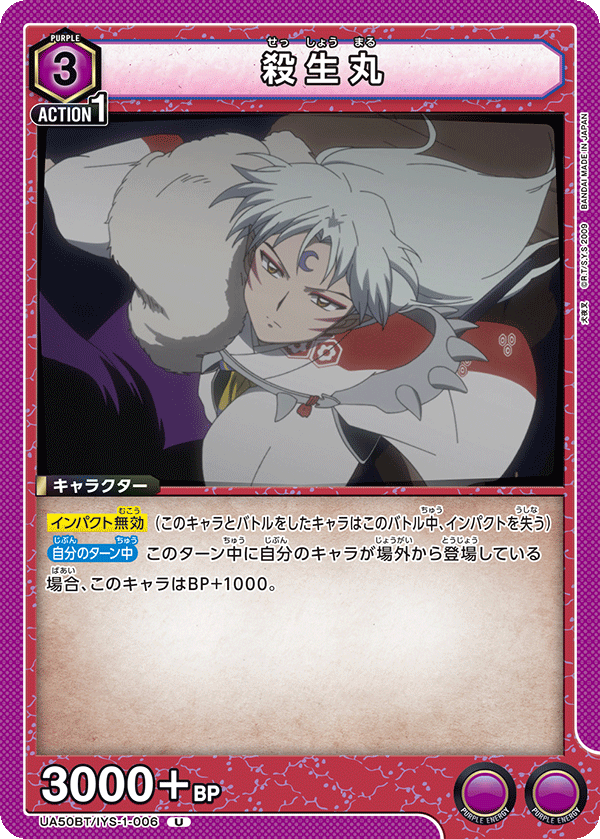 UA50BT-006UA50BT-006Shop on TCGplayer Sesshomaru and grinds out the game through sustained field pressure.
Sesshomaru's flat power level works independently of the Jewel Shard counter system. That means when your opponent spends a Naraku to negate all counter effects, Sesshomaru's power does not change. He just keeps attacking. That counter-independence is the main reason Sesshomaru Control has a favorable position in the InuYasha mirror compared to Counter Rush.
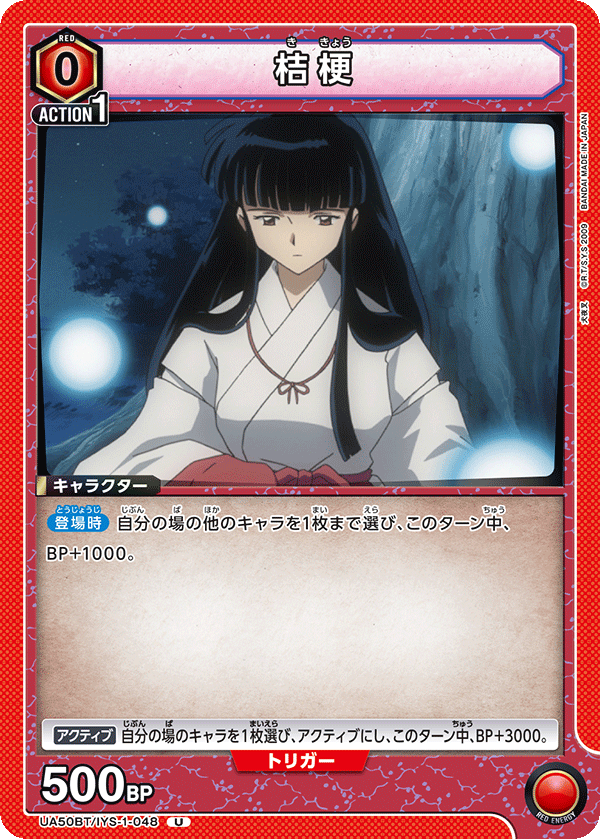 UA50BT-048UA50BT-048Shop on TCGplayer Kikyo is the secondary Purification piece in this archetype. Where Kagome pushes your own board forward, Kikyo spends Jewel Shard counters to debuff opposing character power. She's defensive Purification, and that distinction gives Sesshomaru Control a second axis of play that Counter Rush does not have access to.
The downside is the learning requirement. Sesshomaru Control demands reads on the opponent's hand state. Knowing when to spend Kikyo's Purification versus holding it costs games when mistimed. Players coming from a control background in One Piece TCG or other Union Arena IP sets transfer those instincts cleanly. Players new to control will find Counter Rush easier to learn first.
JP play rate for Sesshomaru Control is lower than Counter Rush, which explains the A-Tier placement despite the strong matchup spread. A deck that fewer players are on produces fewer decklists, which makes it harder to evaluate fairly. From what has been shared in JP community discussion, Sesshomaru Control performs consistently once the pilot understands the counter-spending windows.
A-Tier: Hybrid
Hybrid builds run both UA50BT-046UA50BT-046Shop on TCGplayer Full Demon InuYasha and UA50BT-006UA50BT-006Shop on TCGplayer Sesshomaru as finishers, using the Kagome draw engine to assemble whichever closing line the matchup calls for. If the opponent is disrupting your counter accumulation, close with Sesshomaru. If they have no answer for counter maximum, press Full Demon InuYasha. The adaptability is the appeal.
Slot compression is the cost. Running 2x Full Demon InuYasha and 2x Sesshomaru SR means four finisher slots that are each weaker individually than 3x of a single finisher. The Kagome engine (4x) and Miroku (4x) stay constant, and the remaining space has to balance between the two finisher lines plus utility pieces.
The budget reality deserves a direct statement. Running Hybrid properly means owning both Full Demon InuYasha ($40-60 JP) and Sesshomaru SR ($25-35 JP). Combined with Kagome and supporting cards, the entry cost for a competitive Hybrid list runs $160-200 or more. Players with that budget and some TCG experience will find Hybrid rewarding. Players building their first InuYasha deck should commit to one of the pure archetypes first.
GODEEPER: Naraku's role in InuYasha mirrors, how to time the counter-negation, and the full villain package breakdown. Union Arena InuYasha Naraku Villain Guide
B-Tier: Naraku Disruption
Naraku Disruption does not have a consistent body of JP community tournament results behind it the way Counter Rush does. That is why it sits at B-Tier rather than A.
What it does have is a specific matchup angle that no other archetype in the set exploits as directly. 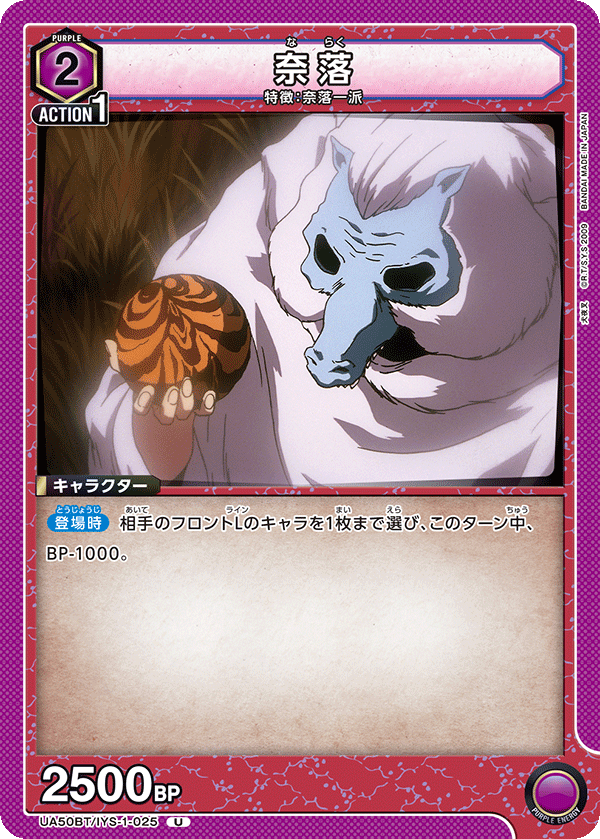 UA50BT-025UA50BT-025Shop on TCGplayer Naraku negates all Jewel Shard counter effects on the field for one turn. In an InuYasha mirror where the opponent is about to close with Full Demon InuYasha at counter maximum, landing Naraku on that exact turn means their entire combo turn collapses. They wasted the counter accumulation. You buy two or three turns to close.
That conditional is powerful enough to warrant building around in the right meta context. At an InuYasha-focused local or community event where most players are on Counter Rush, Naraku Disruption can outperform its general tier placement. At an open regional with diverse Union Arena IPs and mixed archetypes, Counter Rush or Sesshomaru Control are the steadier choices.
Naraku SR (UA50BT-025) trades at $15-22 JP, making him the most affordable Special Rare with genuine competitive upside. Most InuYasha builds outside of this archetype run 1 copy as a flex tech piece. The full disruption build leans on Kagura and Kanna supporting the slow, attrition-based game plan while Sesshomaru SR closes as the counter-independent finisher. For a full look at building around the villain package, the Union Arena InuYasha Naraku disruption deck guide covers the deck construction sequence step by step.
Card investment by tier
The tier list maps closely to card cost. S-Tier (Counter Rush) is accessible with a starter deck plus two singles categories. B-Tier (Naraku Disruption) is the most budget-friendly path to an SR-level archetype. A-Tier Hybrid is the most expensive.
| Archetype | Required SRs | Estimated singles cost |
|---|---|---|
| Counter Rush | Full Demon InuYasha x2 ($80-120) | $130-160 total |
| Sesshomaru Control | Sesshomaru SR x2, Kikyo SR x2 ($90-130) | $150-180 total |
| Hybrid | Full Demon x2 + Sesshomaru x2 + Kikyo x2 ($160-210) | $200-250 total |
| Naraku Disruption | Naraku SR x1-2, Sesshomaru x2 ($55-90) | $100-130 total |
Kagome singles ($6-10 each, 4x needed) are not included above and add $24-40 across all archetypes. Starter deck ($17) provides Miroku and is assumed bought first.
For a full breakdown of each Special Rare's competitive and collector value, the Union Arena InuYasha best cards to pull guide covers all six SRs with JP market prices.
What changes at EN launch
The JP data from UA50BT is directional, not definitive. EN launch on August 14, 2026 introduces new variables: card availability differences, player demographics, print volume changes, and regional meta preferences. Counter Rush's dominance in JP play does not guarantee the same result when Western players bring their game patterns to the EN standard format.
What will not change: the Jewel Shard counter mechanic is central to every viable archetype. The cards that make it run (Kagome, Miroku, Full Demon InuYasha, Sesshomaru SR) retain their competitive function regardless of meta shifts. Building around those pieces is a safe investment regardless of which archetype ends up leading the EN tier list.
The all Union Arena sets EN release schedule covers what else is in the EN format when InuYasha arrives, which shapes what the InuYasha archetypes will face beyond the InuYasha mirror.
Related Reading
- Union Arena InuYasha Jewel Shard Mechanic Explained: How the counter mechanic every archetype in this tier list depends on actually works, turn by turn.
- Union Arena InuYasha Counter Rush Deck: Full Guide: A dedicated build-and-play breakdown of the S-Tier archetype from this list.
- Union Arena InuYasha Sesshomaru Control Deck Guide: The full removal game plan and matchup guide for the A-Tier control pick.
- Union Arena InuYasha EN Buying Guide: Where to buy singles and boxes for the August 14 EN release.
- Union Arena InuYasha EN Launch: What to Buy in 2026: Day-one buying strategy for the August 14 release, using this JP tier list data to decide which archetype to invest in first.
Frequently Asked Questions
What is the best InuYasha archetype in Union Arena? Counter Rush leads the Union Arena InuYasha tier list from six weeks of JP community play. The combo line is clear: Miroku builds counters, Kagome draws, Full Demon InuYasha closes at counter maximum. It has more documented JP decklists than any other InuYasha archetype.
Is Sesshomaru Control better than Counter Rush for experienced players? It can be. Sesshomaru Control's board pressure runs independently of the counter system, which gives it a better position in InuYasha mirrors where your opponent is targeting your counter accumulation. The tradeoff is that the archetype requires more board-reading than Counter Rush's linear combo.
How does Hybrid compare to pure Counter Rush? Higher ceiling, higher cost. Hybrid runs both Full Demon InuYasha and Sesshomaru SR as finishers, which means adapting to what the opponent can answer. The budget requirement ($200+ in singles) makes it impractical as a first InuYasha deck.
Where does Naraku Disruption fit in the tier list? B-Tier overall, but it climbs in InuYasha-heavy metas. Naraku's counter negation is the most direct counter to the set's dominant mechanic, and in events where most players are on Counter Rush, the disruption package earns its slot.
What cards are essential across all InuYasha archetypes? Kagome Higurashi (Rare, 4x in every build) and Miroku (Uncommon, 4x, from the starter deck). These two cards are the engine every archetype builds on top of. Buy them before deciding on a finisher strategy.
When does the EN InuYasha set release? August 14, 2026, as UE23BT. JP released May 29, 2026 as UA50BT. Card functions are identical between versions.
Is the starter deck worth buying? Yes. At $17 MSRP it includes 4x Miroku, which is the counter accelerator used in every competitive InuYasha build. Buy it first before purchasing any singles.
References
- Union Arena UA50BT Official Product Page, Bandai: Set contents and official character list for UA50BT and UE23BT
- Union Arena EN Card Database and Decklists, ExBurst.dev: Community decklists and card database tracking JP and EN builds
- r/UnionArena: JP community discussion and UA50BT play reports since May 29, 2026 launch
Cards in this article
About the author

TCG Deck Analyst
Former card game tournament organiser turned analyst. Covers One Piece TCG meta, deck efficiency, and card valuation. Builds spreadsheets for decks most people just play.
- Regional TCG tournament organiser
- One Piece TCG meta specialist
- Competitive deck analysis
Disclaimer
This article is published for informational and entertainment purposes. It does not constitute professional financial, legal, or technical advice. Game performance, online services, patch schedules, and store listings change. Verify critical details (pricing, system requirements, regional availability) with publishers and storefronts before you buy. Affiliate links, where present, help support our editorial work and are labelled in our affiliate disclosure.