Loading…


Shonen TCG · Guides
Union Arena Red Kagurabachi deck guide: Updated 2026
Reviewing
Union Arena
Union Arena Red Kagurabachi deck lists still have a clear Red game plan, but the current evidence no longer supports calling this the unquestioned number one EN deck. The strongest verified results are historical regional top cuts from May and June, while the newest events listed by the official site show other titles leading the field. This guide keeps the card text precise and treats the matchup advice as a testing framework rather than a guaranteed tier claim.
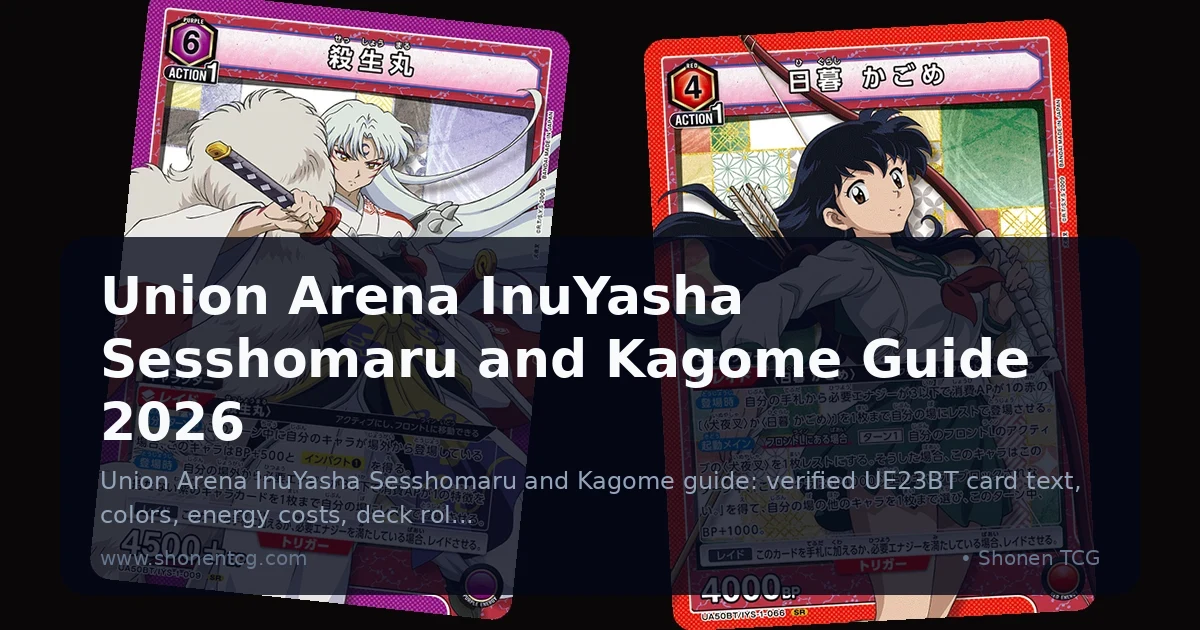
Featured image note: This real Japanese-language InuYasha collage is a cross-title Union Arena visual, not a Red Kagurabachi deck image.
TL;DR: UE16BT: KAGURABACHI contains 82 card types plus 13 Action Point types and released in English on February 27, 2026. The Red shell is built around Chihiro Rokuhira 059 for setup, Chihiro 060 for 4000 BP pressure, removal, and Double Attack, Hakuri Sazanami for a second Raid threat, Togo Shiba 049 and 050 for Step and Color Trigger utility, and Char Kyonagi for sideline recovery. Official results confirm regional top cuts, but current event listings require more caution than the old "second-best deck" label.
Is the Union Arena Red Kagurabachi deck still worth building? (quick answer)
Yes, if you want a proactive Red deck and already own the core. No, if you are choosing solely because an older tier list called it the current number two deck. The official Union Arena top-placing page records Red Kagurabachi in third place at the May 22 Carta Magica regional and twice in the June 12 Top Cut Events listing. That is real tournament evidence.
The same page now also lists later events. Its July 31 CoreTCG top four contains Jujutsu Kaisen, Rurouni Kenshin, Bleach, and Sakamoto Days, while its August 21 Gen Con top four contains Solo Leveling, Sakamoto Days, and Yellow Evangelion. Red Kagurabachi is not shown in those newest top-four groups. That does not prove the deck is unplayable, but it does mean the current article should present it as a tested option with a dated ceiling, not a guaranteed Tier 1 choice.
Union Arena Red Kagurabachi deck: key cards and lines
The official Bandai product page lists 82 card types plus 13 Action Point types, with the English release on February 27, 2026. The Red build is a single-title strategy using KGR-1 cards from UE16BT. Start with the following core:
- Chihiro Rokuhira 059, R, 4 energy, 4000 BP: plays active, draws a card, can place a card from hand into the sideline to either give the Chihiro, Hakuri, and Togo characters on your front line 1000 BP or give itself Impact 1 for the turn.
- Chihiro Rokuhira 060, SR, 5 energy, 4000 BP: Raid character. On play, it can place one card from hand into the sideline to gain an attack effect that sidelines an opposing front-line character at 4000 BP or less. Its main ability places three cards from hand into the sideline to gain Double Attack until end of turn.
- Togo Shiba 049, R, 3 energy, 3000 BP: has Step, which can move it from the front line to the energy line during your movement phase. During your turn, it gives other characters on your field Step. Its trigger is Get.
- Togo Shiba 050, SR, 4 energy, 4000 BP: the Red Color Trigger. Its trigger can sideline an opposing front-line character at 2500 BP or less. Its hand effect can play it active at the start of your attack phase when Chihiro and Hakuri are on your front line and you have at least four Red energy generation.
- Hakuri Sazanami 047, SR, 4 energy, 4000 BP: can Raid only while Chihiro or Togo is on your field. When played, it either builds a face-down stack under Hakuri or moves an opposing front-line character to its energy line.
- Char Kyonagi 043, R, 3 energy: after a Chihiro ability places a Chihiro or Char card from hand into the sideline, Char can rest to return one of those cards to hand. This is the resource loop that makes the three-card Double Attack cost less punishing over multiple turns.
Do not merge the two Togo printings. The 049 card is the cheap Step utility card with a Get trigger. The 050 card is the 4-cost SR with the Color Trigger and the conditional attack-phase hand play. They have different card numbers, costs, rarities, and jobs.
This list is a starting shell, not a claim that every current tournament list uses the same numbers. The official top-placing page confirms results, but it does not publish a universal Red Kagurabachi deck recipe.
For the game system, see the Union Arena Raid mechanic guide in Related Reading. For the exact cards, use the official KAGURABACHI card list.
Step-by-Step: Union Arena Red Kagurabachi deck play sequence
1. Build Red energy and preserve a hand buffer. Your early turns should establish enough Red energy for the 4-cost and 5-cost plays while keeping cards available for sideline costs. A Color Trigger does not fire because you place a card into the energy line. Union Arena's official rules define triggers as effects that activate when a life card is revealed after damage, so do not plan Togo 050 around routine energy placement.
2. Use Chihiro 059 to convert cards into tempo. Its draw-on-play effect helps offset the hand cost. If the board is wide, use the 1000 BP boost for the named Chihiro, Hakuri, and Togo cards on your front line. If a single Chihiro attack is more important, the alternate ability grants Impact 1. The two effects are alternatives because each requires placing a card into the sideline.
3. Raid Hakuri when the condition is live. Hakuri can Raid once Chihiro or Togo is already on your field. Its on-play choice is flexible: stack two cards face down under Hakuri to create future hand access, or move an opposing front-line character to the energy line. The correct mode depends on whether you need pressure or a way to remove a blocker from combat.
4. Prepare Chihiro 060's two costs separately. The 060 version has an on-play sideline cost for its temporary attack removal and a separate three-card sideline cost for Double Attack. Do not assume one discard pays for both. Plan the hand so you can use the removal effect and still have three cards available if the closing attack needs Double Attack.
5. Recycle after the kill turn. Char Kyonagi can recover a Chihiro or Char card that was placed into the sideline by a Chihiro ability. Its once-per-turn restriction makes timing important. Keep Char alive and avoid spending it as the last random discard unless the game is ending.
Early turns: energy and Togo
Togo 049 is a movement tool, not a Color Trigger. During your movement phase it can move from the front line to the energy line, and during your turn it gives other characters on your field Step. Use that mobility to change where a character sits before committing to a later attack.
Togo 050 is different. Its Color Trigger matters when it appears in the life area after damage, while its normal hand effect is a conditional attack-phase play. The normal effect requires Chihiro Rokuhira and Hakuri Sazanami on your front line plus at least four Red energy generation. Because the requirements are specific, treat Togo 050 as a tactical swing card rather than a generic early drop.
Midgame: Chihiro 059 and Hakuri
Chihiro 059 is the stabilizing Raid base. Its draw effect helps keep the hand from collapsing, and its two once-per-turn options let you choose between a broader BP increase and Impact 1. Hakuri adds a second line of pressure, but its Raid condition is not automatic: Chihiro or Togo must already be on your field.
Hakuri's on-play text also gives the deck a noncombat answer. Moving an opposing front-line character to the energy line is not the same as sideling it, so account for what the opponent can do with that energy on a later turn. When the board is already under control, the face-down stack can instead help create a longer resource line.
Late game: Chihiro 060
Chihiro 060 is strongest when its two costs are planned before it enters play. The on-play effect requires one card from hand and gives it a temporary attack ability that can sideline an opposing front-line character at 4000 BP or less. Its Double Attack ability requires three cards from hand and lasts until the end of the turn.
That removal ceiling matters. A character above 4000 BP cannot be chosen by the 060 attack effect, so do not describe the card as unconditional removal. Use combat, Hakuri's energy-line movement, or other list choices for larger bodies. After spending cards, Char Kyonagi is the deck's main way to recover one of the Chihiro or Char cards sent to the sideline.
Related: The Union Arena Impact keyword guide in Related Reading explains how Impact changes damage resolution across attacks.
Tips for piloting the Red shell
Keep three cards available for Double Attack
Chihiro 060 is not a finisher merely because it has 4000 BP. Its most explosive turn needs three cards in hand for Double Attack, and its removal line can require another card. Count the hand before playing the Raid character. If the turn cannot use the ability safely, a smaller development line can be better than exposing an underpowered 060.
Do not call every Togo trigger a Color Trigger
This is the most common card-identification mistake in older deck guides. Togo 049 has a Get trigger and supplies Step utility. Togo 050 has the Color Trigger and the conditional attack-phase hand play. Check the card number before building or buying.
Use Hakuri for the board state you actually have
The face-down stack is the longer-game option. Moving an opposing front-line character to the energy line is the tempo option. The latter does not delete the card, so it is best when the opponent cannot immediately turn that energy into a better board or when moving the character opens a clean attack.
Protect the hand from disruption
This is a strategic inference from the card text, not a current win-rate claim. Decks that reduce your hand make the 060 line harder because Double Attack consumes three cards. Against disruption, prioritize Char and the 059 draw line, and do not spend every spare card on early pressure.
Respect the 4000 BP ceiling
Chihiro 060's attack removal does not answer everything. If the opponent's important character is larger than 4000 BP, plan around it before the attack phase. A list that treats 060 as universal removal will mis-sequence its resources.
Image note: This real card shows Inuyasha from the InuYasha title, not Chihiro from Kagurabachi.
Matchup framework, not a current tier claim
The old version of this guide called several matchups favorable or unfavorable without a current event sample. Use these as practice questions instead:
Against hand disruption: How many cards remain after the 060 on-play cost and the Double Attack cost? Mulligan and early sequencing matter more than a headline matchup label.
Against tall characters: Which card handles a target above 4000 BP? Chihiro 060 cannot sideline it with its attack effect, so build a line using combat or Hakuri's energy movement.
Against wide boards: Can Chihiro 059's BP option create a meaningful attack, or is Hakuri's energy-line move the better way to open the front line? Test both lines instead of assuming the 060 is always the answer.
Against faster Red decks: Preserve life and hand resources until you can create a real two-card threat with Chihiro and Hakuri. The official current top-placing list includes Red Rurouni Kenshin in the July 31 CoreTCG top four, so Red mirrors should be treated as live testing rather than a solved matchup.
Against mill strategies: Keep track of which Chihiro and Char cards are in the sideline. Char only recovers cards placed there by a Chihiro ability, so a mill plan that removes those targets changes the value of the loop. The Solo Leveling mill deck guide is a useful cross-archetype comparison.
Image note: This real card shows Sesshomaru from the InuYasha title, not a Red Kagurabachi card.
Frequently Asked Questions
Is Red Kagurabachi still a top Union Arena deck?
It has verified regional top-cut results from May and June 2026, including third place at Carta Magica and two Red listings in the June 12 Top Cut Events results. The latest official page I checked shows other titles in the July 31 CoreTCG and August 21 Gen Con top fours, so the safest description is a proven option with historical results, not a confirmed current number one.
What is the key card in Red Kagurabachi?
Chihiro Rokuhira 060 is the primary closing threat. It is a 5-cost, 4000 BP SR Raid character with a temporary attack effect that can sideline a front-line character at 4000 BP or less, plus a three-card main ability for Double Attack.
How many Chihiro copies should I run?
Four copies each of Chihiro 059 and 060 is a reasonable starting point for testing. The 059 version draws on play and supports the named Red package, while 060 is the main Double Attack threat. A final list should reflect the event field and the cards you can actually source.
What is the Red Color Trigger in Kagurabachi?
Togo Shiba 050 is the Red Color Trigger, with a trigger that sidelines an opposing front-line character at 2500 BP or less. Togo Shiba 049 is a separate 3-cost Rare with Step and a Get trigger.
What are the hardest matchups?
Hand disruption is a natural pressure point because 060 needs three cards in hand for Double Attack. Tall characters also resist its attack effect above the 4000 BP ceiling. These are card-text-based testing priorities, not a verified current win-rate table.
How much does Chihiro 060 cost?
The normal UE16BT/KGR-1-060 Super Rare was listed at $8.69 in a recent TCGplayer price-guide snapshot. Star-parallel printings were listed far higher, so verify the printing and condition before buying.
Can I mix Red Kagurabachi with other Union Arena sets?
Union Arena uses the source material code on the card number for deck construction. KGR-1 cards belong to the Kagurabachi title; cards from Solo Leveling or InuYasha use different source codes and cannot be mixed into this deck.
What makes Hakuri Sazanami good here?
Hakuri 047 is a 4-cost, 4000 BP Raid character that can Raid when Chihiro or Togo is on your field. Its on-play effect either builds a face-down stack under Hakuri or moves an opposing front-line character to the energy line, giving the deck both pressure and tempo options.
Related Reading
- Union Arena Impact Keyword Explained: The Best Ability: how Impact affects attack damage and why the 059 line matters.
- Union Arena Raid Mechanic Explained: how Raid bases, energy, and front-line timing work.
- Union Arena Deck Building Guide: Build a 50-Card Deck: general deck construction principles for a competitive list.
- Union Arena InuYasha English Release Guide: a separate title guide, included here only for the cross-title image context.
- Best Anime TCG to Play in 2026: how Union Arena compares with other anime card games.
References
- KAGURABACHI UE16BT official product page: English release date, card-type count, MSRP, and product configuration
- Official KAGURABACHI card list: searchable card database
- Chihiro Rokuhira 059 official card page: card text and stats for the 4-cost Red Raid base
- Chihiro Rokuhira 060 official card page: card text and stats for the 5-cost Red Raid finisher
- Togo Shiba 049 official card page: Step and Get trigger text
- Togo Shiba 050 official card page: Color Trigger and attack-phase effect
- Hakuri Sazanami 047 official card page: Raid condition and on-play choices
- Official Union Arena rule manual: trigger timing and deck construction rules
- Official Union Arena top-placing decks: dated regional placements through the August 21 Gen Con listing
- TCGplayer UE16BT KAGURABACHI price guide: recent normal and parallel card price snapshot
Was this guide helpful?
About the author
KT
Competitive TCG Analyst
Competitive One Piece TCG player and deck builder with 3 years of tournament experience. Covers meta analysis, tier lists, and leader builds.
- 3 years competitive OPTCG tournament experience
- Regional top 8 finisher
- Deck builder and meta analyst
- Covers every set since OP-01
Disclaimer
This article is published for informational and entertainment purposes. It does not constitute professional financial, legal, or technical advice. Game performance, online services, patch schedules, and store listings change. Verify critical details (pricing, system requirements, regional availability) with publishers and storefronts before you buy. Affiliate links, where present, help support our editorial work and are labelled in our affiliate disclosure.