

Shonen TCG · Guides
Union Arena vs One Piece TCG: Which Anime TCG to Play
This Union Arena vs One Piece TCG comparison uses the current official rules and product pages checked on September 16, 2026. The short version is not that one game is universally better. Union Arena offers a multi-title system with Energy Line and sideline decisions. One Piece Card Game builds every deck around a Leader, a 50-card deck, and a separate 10-card DON!! deck.
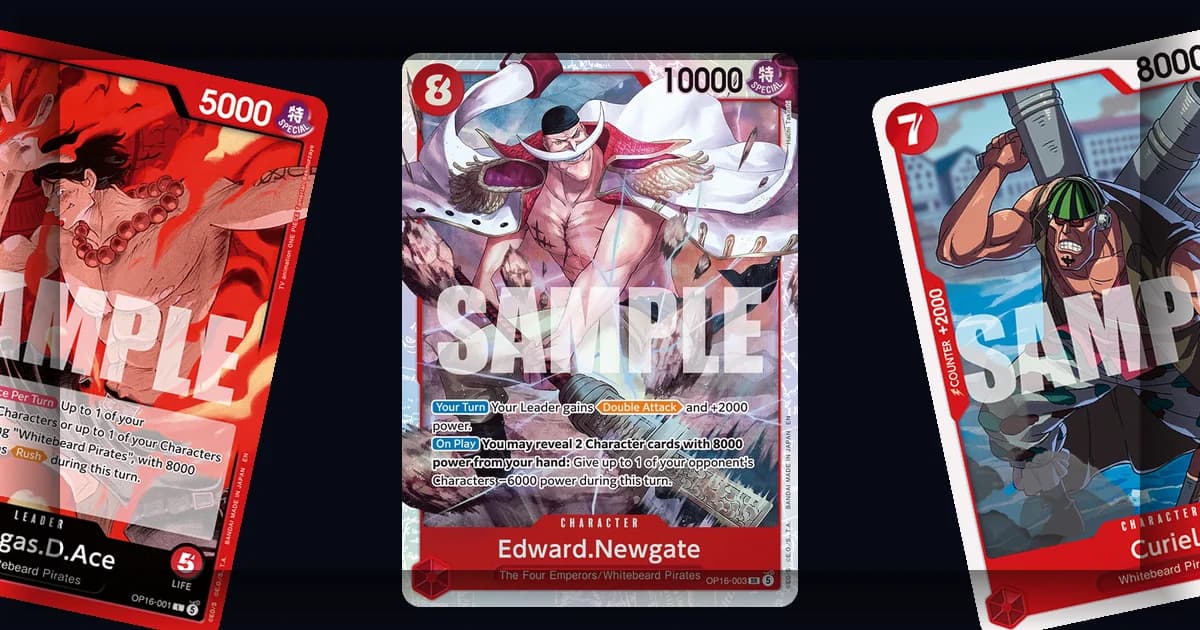
Real OP-16 One Piece cards are shown as one side of this comparison; the article covers two separate games.
TL;DR: Pick Union Arena for multi-IP variety and a board system built around Energy, AP, Front Line, and Sideline zones. Pick One Piece for a single-IP game with a Leader, DON!! resource deck, and a mature official teaching and event structure. Test both with borrowed decks before treating price or scene-size claims as facts.
Union Arena vs One Piece TCG: the short answer
Start with the reason you want to play. If you want to move between Bleach, Jujutsu Kaisen, Solo Leveling, Sakamoto Days, and other titles while keeping one rules engine, Union Arena is the natural fit. If One Piece is the reason you will learn card text, Leaders, and matchup patterns, One Piece Card Game has the stronger license-specific pull.
The rules are not interchangeable. Union Arena asks you to manage cards across an Energy Line, Front Line, Life Area, AP Area, Sideline, and Removal Area. One Piece uses a Leader, Character Area, Stage, Life cards, Trash, Cost Area, and a 10-card DON!! deck. A few practice games are more useful than a generic difficulty ranking.
Key Takeaways
- Union Arena is a multi-title system. One Piece Card Game is dedicated to One Piece.
- Union Arena's official manual uses Start, Movement, Main, Attack, and End phases.
- One Piece's official Play Guide uses Refresh, Draw, DON!!, Main, and End phases.
- One Piece decks use one Leader, a 50-card deck, and 10 DON!! cards, with up to four copies of one card number.
- Union Arena's official rule layout separates the Energy Line and AP Area from the Front Line and Sideline.
- Both games have official rules and organized-play pages, but local availability is the practical measure of community size.
- Current singles and deck costs are too volatile for a permanent price verdict. Compare a current list with live listings.
Union Arena vs One Piece TCG: rules and deck construction
Union Arena's official rule page links the rule manual and current rules notices. The manual's playmat layout has a Front Line for up to four cards, an Energy Line for up to four cards, a seven-card Life Area, an AP Area for up to three cards, a Sideline, and a Removal Area. Its turn reminder is Start Phase, Movement Phase, Main Phase, Attack Phase, and End Phase.
That creates a board-first learning experience. You place cards into the Energy Line, use AP for actions, decide where characters sit, and read each title's affinity and keyword text. The title changes the available cards, but the zones and turn framework remain familiar.
One Piece's official Play Guide says that a player needs one Leader, a 50-card deck, and 10 DON!! cards. The deck must match the Leader's color, and it can include up to four copies of a card number. DON!! cards enter the Cost Area automatically each turn, where they can pay costs or be attached to Leaders and Characters to increase power.
The five One Piece phases are Refresh, Draw, DON!!, Main, and End. The first player receives one DON!! on the first turn, while later turns follow the normal two-card DON!! gain described in the official guide. Combat therefore includes a resource timing decision that is visible on the board: attach DON!! for power now, leave it active for costs, or use it to play a card.
Neither system is simply “easy” or “hard.” Union Arena's separate zones make its state readable once you learn the layout. One Piece's DON!! attachments create a deeper timing puzzle around attack power and future costs. Your preferred type of decision is a better predictor than a universal difficulty label.
IP variety versus single-story depth
Union Arena's North American products page currently lists titles including Solo Leveling, Bleach, Jujutsu Kaisen, Kagurabachi, Tokyo Ghoul, Sakamoto Days, InuYasha, and other properties. The list changes as new products are added, but the design goal is clear: one game lets you follow several licenses.
That variety has two benefits. You can switch to a new anime without learning a completely different rules engine, and a local store can support several fan communities under one tournament system. The tradeoff is that each title has its own card pool, mechanics, and deck research. Buying into every favorite IP can also cost more than choosing one.
One Piece Card Game takes the opposite approach. The official site is built around One Piece products, Leaders, Characters, Events, Stages, and the story's expanding card pool. That single-story focus is a feature if you want to learn how many versions of the same characters and factions work over time.
Choose the game whose content will make you keep testing after the first learning session. Rules familiarity helps, but motivation is what gets a new player through mulligans, timing mistakes, and the first losing streak.
Organized play and community fit
Union Arena has an official 2026-27 Wave 1 Championship page with regional events, registration guidance, regulation, and prize information. Its current Top-Placing Decks archive also publishes title results. This is enough to confirm an active organized-play structure, but it does not tell you how many players attend your local store.
One Piece maintains an official Events page and a Rules page with current manuals, comprehensive rules, tournament rules, and official updates. Its Play Guide also points new players to a teaching app and official shops that host teaching events and tournaments.
That difference is useful. If you want a ready-made learning path, One Piece currently offers more official beginner-facing material in one place. If your local store already runs Union Arena nights and carries several of its titles, that local network may be the more welcoming choice. Check both event finders before deciding from online community impressions.
Do not quote fixed claims such as “Union Arena regionals have 50 to 150 players” or “One Piece events always draw thousands” without an event-specific source. Capacity and attendance change by venue, date, organizer, and country.
Cost and buying strategy
A permanent “cheaper game” verdict is not responsible without a dated deck list, region, condition standard, and live listings. Both games have low-cost entry products and expensive chase cards. A starter MSRP only describes the sealed product on that page. It does not tell you how many singles a competitive list needs.
Use this process instead:
- Choose a game and a play pattern before buying a case or collection.
- Find a current event list or a tested local list, not an old price article.
- Check the publisher's current card list and legality notices.
- Price the repeated cards as singles, including shipping and condition.
- Buy sealed only if opening, collecting, or trading is part of the goal.
The official One Piece decks product page shows current starter products and MSRP examples. Union Arena's products page shows its current booster and starter catalog. Recheck both pages whenever a new release changes the available entry point.
A first-game decision framework
Choose Union Arena when:
- several anime licenses are a major reason you want a TCG;
- you prefer managing Energy, AP, Front Line, and Sideline zones;
- your local store already has Union Arena players;
- you want to explore different title-specific mechanics within one system.
Choose One Piece Card Game when:
- One Piece is the main reason you will keep learning;
- you enjoy planning DON!! attachments around a Leader;
- the official teaching app and established product structure matter;
- nearby stores run One Piece events more regularly than Union Arena events.
Try both before buying deeply when:
- you have access to a demo, teaching event, or borrowed deck;
- you are choosing based on price alone;
- you are unsure whether you prefer board-zone management or attached resources.
A short test session should answer practical questions: Can you explain why your cards are in each zone? Do you enjoy planning the next two turns? Do you want to read more card text after a loss? Those answers are more durable than a ranking written before the next set release.
Common comparison mistakes
The first mistake is treating a similar vocabulary as shared rules. A Union Arena Energy Line is not One Piece's Cost Area, and a One Piece DON!! attachment is not an Energy Line card. Learn each game's official zones before transferring advice from one to the other.
The second mistake is comparing a title to a single deck. Union Arena includes many IPs and several shells within each IP. One Piece has many Leaders and color combinations. “This game is aggressive” is too broad to guide a purchase without naming the current list.
The third mistake is using market price as a proxy for difficulty. A rare card can be expensive because of collector demand, supply, or a temporary tournament result. It does not automatically make its deck easier or stronger.
The fourth mistake is treating online community size as local support. A large subreddit cannot run a weekly event in your town. Look for store calendars, official event finders, and a group willing to teach.
Related Reading
- Union Arena TCG Beginner Guide 2026: learn the Union Arena board and turn flow.
- One Piece TCG Beginner Guide 2026: start with the official game structure and first deck decisions.
- Union Arena Tournament Guide 2026: prepare for organized play and read event results.
- One Piece TCG How to Play: a longer rules walkthrough.
- Best Anime TCG to Play in 2026: compare more current anime-focused games.
Frequently Asked Questions
Which game uses an Energy Line?
Union Arena uses an Energy Line as one of its main board zones, alongside the Front Line, Life Area, AP Area, Sideline, and Removal Area. One Piece Card Game instead uses a separate DON!! deck and Cost Area. The names are not interchangeable, even when both resources pay for card effects.
How many DON!! cards does One Piece use?
The official Play Guide says a game uses a separate 10-card DON!! deck. Two DON!! cards enter the Cost Area automatically each turn, with the first player receiving one on the first turn. DON!! can pay costs or be attached to Leaders and Characters for power.
Does Union Arena use a Leader card?
Union Arena's standard layout is different from One Piece's Leader system. It uses the title's card pool, Energy Line, AP Area, Life Area, Front Line, and Sideline instead of requiring a One Piece-style Leader to define the deck. Check the current Union Arena manual for the exact setup and zones.
Which game has more anime characters?
Union Arena has more license variety because its official product catalog spans many titles. One Piece Card Game has one license, but it can explore a very large cast, factions, eras, and versions of characters inside that story. The better answer depends on variety across worlds or depth within one world.
Are current deck costs easy to compare?
Not honestly without naming a format, event, region, date, rarity, and condition. Prices move after releases and tournament results. Use official product pages for MSRP, then compare a real current deck list with live singles. Avoid treating an old article's price range as a current guarantee.
Can I play both games at the same store?
Sometimes. Store support is local and changes by schedule. Check the store's event calendar, ask whether it runs each game's official format, and bring the correct deck and accessories. A store that teaches one game may not have enough players for the other every week.
References
- UNION ARENA Rules: official rule manual, tournament links, and current rule notices
- UNION ARENA Products: current North American title and product catalog
- UNION ARENA Championship 26-27 Wave 1: official organized-play structure
- ONE PIECE CARD GAME Play Guide: official deck, DON!!, zone, and turn-flow basics
- ONE PIECE CARD GAME Rules: current manuals and official updates
- ONE PIECE CARD GAME Deck Products: current starter products and MSRP examples
- ONE PIECE CARD GAME Events: official event listing
About the author
Pen name for the Shonen TCG desk's tournament coverage, format analysis and cross-game comparisons.
- Results taken from event pages and standings
- Other games checked against their own official rules
- Opinions marked as ours, with the reason
Keep reading

Union Arena JJK Guide: Jujutsu Kaisen Best Decks (2026)
Guides · 14 min

Union Arena Bleach Guide: Best Decks & Cards (2026)
Guides · 13 min
Union Arena vs Dragon Ball Super Card Game: 2026 Guide
Guides · 11 min
Union Arena Beginner Deck Tier List: Four EN Picks 2026
Guides · 11 min
Union Arena Card Rarities Explained: C, U, R, SR, Parallels
Guides · 12 min
Union Arena Tournament Guide 2026: Rules and Formats
Guides · 12 min

All Union Arena Sets: Complete EN Release Schedule (2026)
Guides · 12 min
Union Arena Solo Leveling Guide: Cards and Builds (2026)
Guides · 13 min
Disclaimer
This article is published for informational and entertainment purposes. It does not constitute professional financial, legal, or technical advice. Game performance, online services, patch schedules, and store listings change. Verify critical details (pricing, system requirements, regional availability) with publishers and storefronts before you buy. Affiliate links, where present, help support our editorial work and are labelled in our affiliate disclosure.