Loading…

Shonen TCG · Guides
OP-16 Nami Tech Cards: 7 Verified Picks by Color (2026)
Reviewing
One Piece TCG
OP-16 Nami tech cards are what actually decide this matchup, not which of the format's leaders you happen to be piloting. Looking to build the Blue/Yellow Nami deck itself rather than beat it? The One Piece TCG Nami Deck Guide covers her draw engine directly instead. This page is the opposite angle.
Blue/Yellow Nami (OP11-041) led the archived mid-August OP-16 snapshot at a 23.52% deck share. In the current OP-17 snapshot, One Piece TCG Meta lists her in C tier with three decks and a 45.5% win-rate figure. That is a much smaller and different sample, but Zeus (OP11-106) is still the two-cost engine piece worth knowing whenever you do sit across from her, and Nami remains a matchup worth preparing for rather than a total fringe pick. This guide skips the leader-by-leader strategy already covered in our full matchup breakdown and goes straight to the specific, verified cards worth adding to your list, whichever leader you're already running.
TL;DR: Zeus (OP11-106) is a 2-cost, 2000-power Character. Mahoroba (OP16-101) K.O.s it outright once your trash hits 10 cards, since Zeus is exactly cost 2. Sakazuki (OP16-065) knocks any opposing Character to negative 6000 power for a turn. Black Hole (OP16-117) and Black Vortex (OP16-115) negate Character effects, one proactively on your turn, one off a flipped Trigger. Luffy's Green events (OP16-039, OP16-040) rest or lock down Nami's board instead of removing it. None of these require switching leaders. Nami led the archived OP-16 standings at 23.52% share; the live OP-17 tracker now places her in C tier with a small sample, but these tech cards still matter whenever she shows up across the table.
OP-16 Nami tech cards: what actually works (quick answer)
Color access matters more than leader choice here. Black is the only color on this list with a card that outright K.O.s Zeus, and it's conditional on your trash count. Purple gives you a power-swing tool in Sakazuki that helps your attackers trade into whatever else Nami has in play. Yellow gives you two negate effects that stop a Character's ability from mattering without needing to K.O. it. Green gives you tempo denial through Luffy's Impel Down events, real disruption, but not removal in the strict sense. None of these are Nami-specific tech. All of them are playable cards in decks that already run those colors, and that's the actual test for whether a tech card deserves a deck slot.
Key Takeaways
- Nami (OP11-041) led the archived OP-16 standings at 23.52% deck share; the live OP-17 tracker now places her in C tier with a small sample, so the two snapshots should not be compared as one metric
- Zeus (OP11-106) is a 2-cost, 2000-power Character whose On Play effect banks a Life card and can K.O. an opposing Character with a cost of 5 or less
- Mahoroba (OP16-101) is the one card here that outright K.O.s Zeus, once your trash hits 10 or more cards
- Sakazuki (OP16-065) doesn't remove characters. It drops one to negative 6000 power for a turn, which sets up a combat trade rather than a clean kill
- Black Hole (OP16-117) and Black Vortex (OP16-115) negate effects rather than K.O. the character carrying them, and they fire at different times
- None of the cards covered here are dead outside the Nami matchup, which is the real bar for whether a tech card earns a slot
Where Nami sits in the OP-16 meta right now
Early OP-16 content framed the format around six launch leaders: Ace, Buggy, Luffy, Sengoku, Yamato, and Blackbeard. That framing has aged twice over now. Limitless TCG's points-based standings had Blue/Yellow Nami leading at 23.52% through mid-August 2026, with Green/Blue Luffy and Purple Enel close behind at 22.91% and 22.71%. The post-OP-17 field has moved much further since: the current OP-17 meta tier list places Nami in C tier, while the live tracker table lists only three Blue/Yellow Nami decks and a 45.5% win-rate figure. Those numbers use a smaller and different sample than the OP-16 deck-share standings, but they still show that Nami is less common than she was at launch. She hasn't disappeared, she's just no longer the deck every list needs a dedicated plan for.
That shift is exactly why the tech cards in this guide matter more than a leader-specific plan. If you're building toward the Nami matchup today, you're statistically more likely piloting Enel, Mihawk, or Luffy than one of the original launch six, and you'll see Nami less often than you would have a month ago. Cross-color tech cards, the ones that slot into whatever deck you're already running, hold up better than answers that assume you're specifically on Ace or Sengoku, precisely because Nami is now an occasional matchup rather than the format's defining one.
GODEEPER: Want the leader-by-leader version instead, with a full matchup breakdown for all six OP-16 leaders against Nami? One Piece TCG Nami Counter Guide: Beat Blue Yellow 2026 →
Black tech: Mahoroba and Hallowed Glacier Slash
Black is the only color in the OP-16 pool with a card that K.O.s Zeus outright instead of working around him. 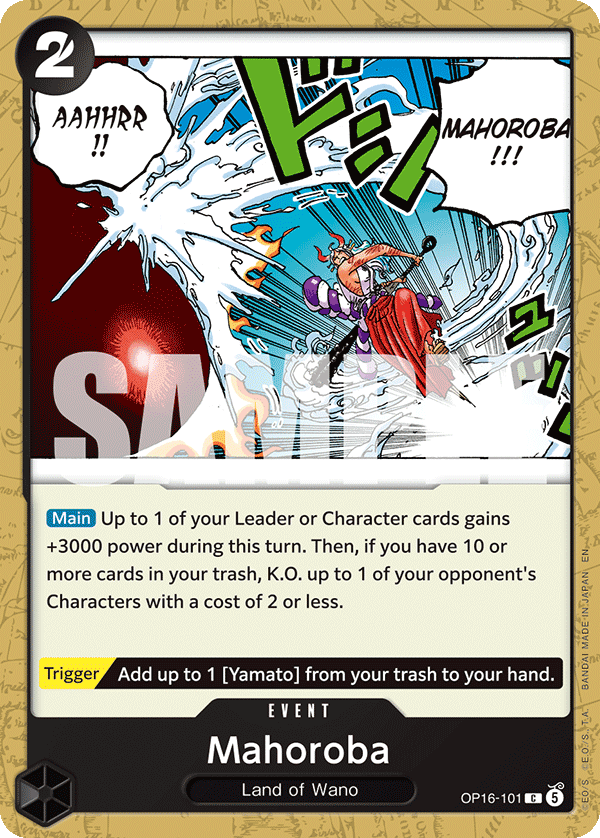 OP16-101OP16-101Shop on TCGplayer Mahoroba costs 2 and carries two effects: it gives a Leader or Character +3000 power for the turn, and if you have 10 or more cards in your trash, it K.O.s an opposing Character with a cost of 2 or less. Zeus costs exactly 2, which makes this a clean answer once your trash count clears that threshold. Early on, before your trash has built up, it's just a combat trick.
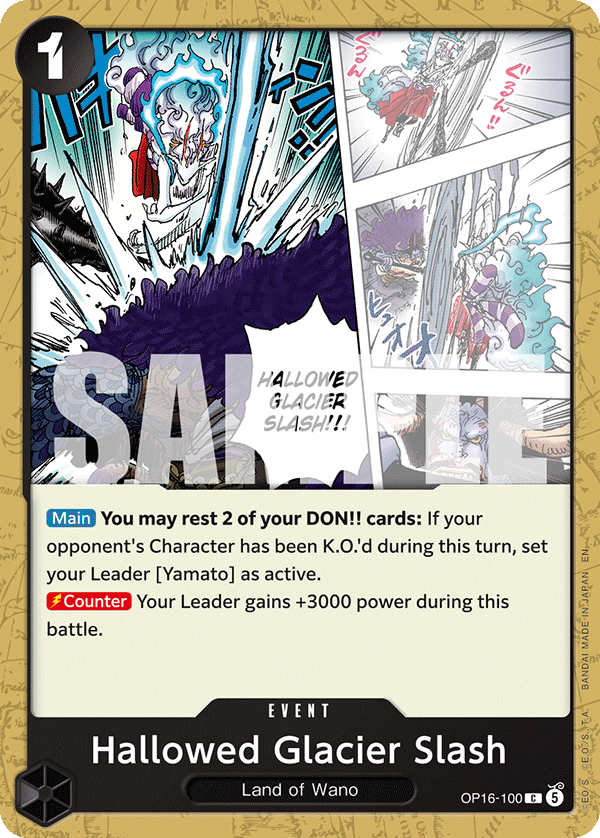 OP16-100OP16-100Shop on TCGplayer Hallowed Glacier Slash is the companion piece. This 1-cost event lets you rest 2 of your own DON!! cards; if an opposing Character has been K.O.'d during the turn, it sets your Leader active again, useful for squeezing a second attack out of a removal play. It also carries a Counter effect that adds +3000 power to your Leader mid-combat.
Both cards come out of the same Land of Wano shell that runs 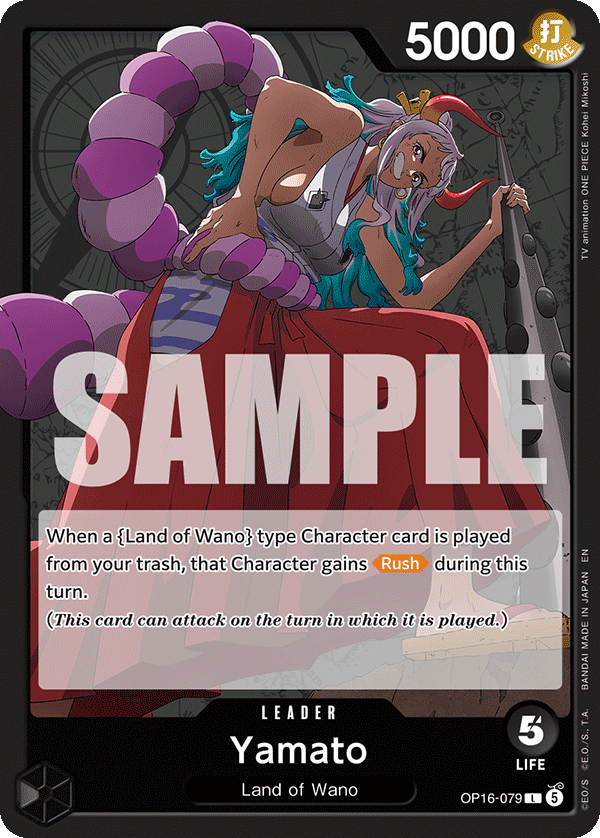 OP16-079OP16-079Shop on TCGplayer Yamato as leader. The OP-16 Yamato Deck Guide covers the full build these two slot into, including how many copies to run alongside Yamato's Rush package, though Yamato's own OP16 tournament share has fallen to 1.37% as of mid-August 2026.
There's a wrinkle worth knowing here. 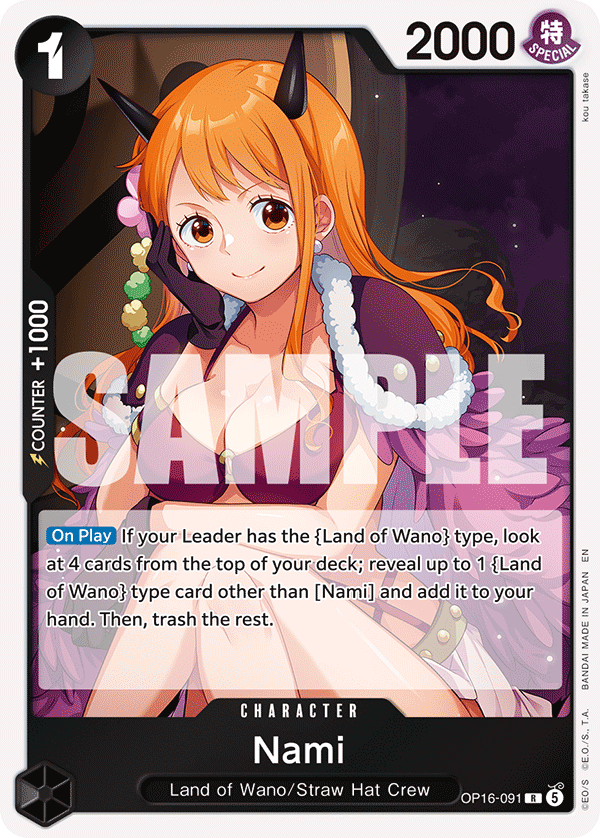 OP16-091OP16-091Shop on TCGplayer OP16-091 is also named Nami, but it's a completely different card from the Blue/Yellow leader this whole guide is about. It's a Black, Land of Wano/Straw Hat Crew Character whose On Play effect lets a Land of Wano Leader look at the top 4 cards for another Land of Wano card. It has nothing to do with the leader's Life-and-draw engine. It just happens to share a name and live in the exact shell that runs Mahoroba and Hallowed Glacier Slash.
 OP16-091 shares a name with the Blue/Yellow leader but is an unrelated Black support Character built for Yamato's Land of Wano deck, the same shell that runs Mahoroba and Hallowed Glacier Slash.
Purple tech: Sakazuki's power swing
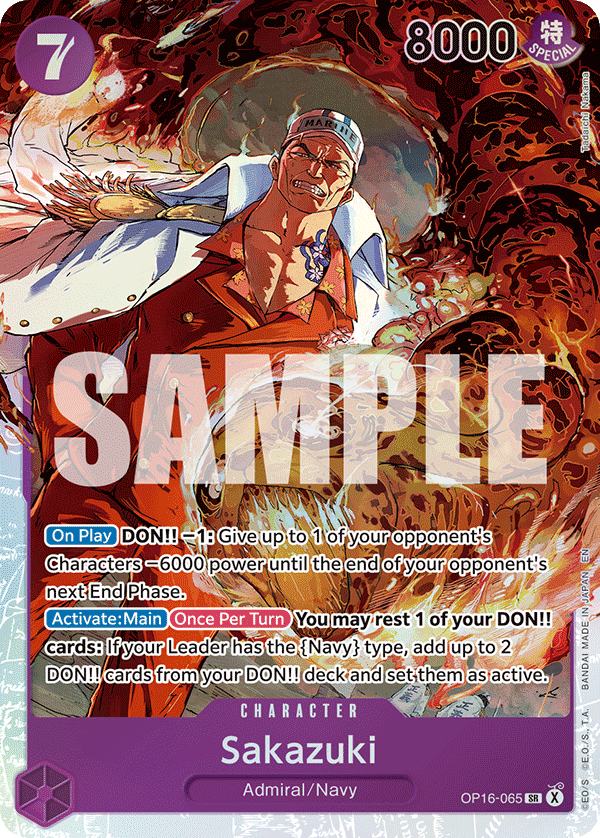 OP16-065OP16-065Shop on TCGplayer Sakazuki is the card most matchup writeups get slightly wrong. His On Play effect doesn't remove anything. For 1 DON, he gives one opposing Character negative 6000 power until the end of your opponent's next End Phase. Against Zeus's 2000 power, that's overkill on its own, a 2000-power body knocked negative doesn't need extra help dying in combat. Where Sakazuki actually earns his slot is against Nami's bigger board pieces: knock a 7000-power blocker down to 1000 and your own attackers suddenly trade favorably.
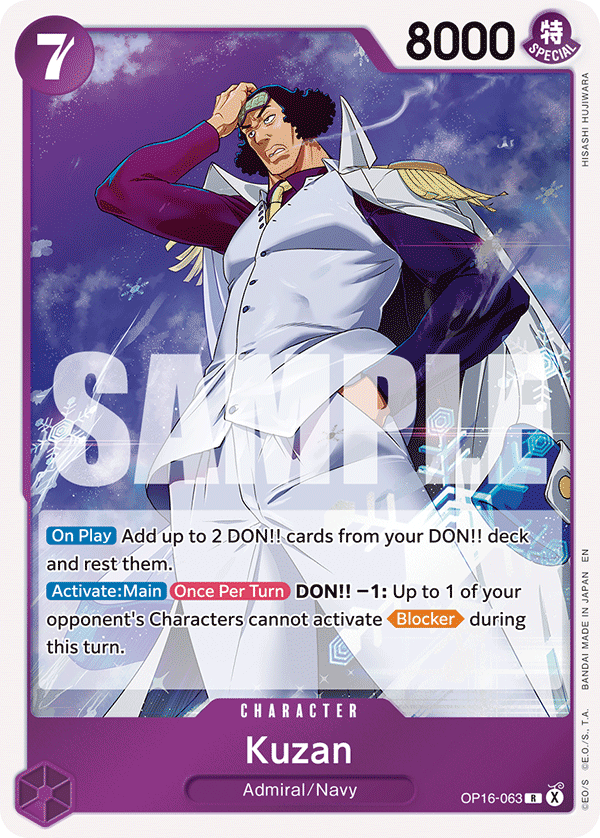 OP16-063OP16-063Shop on TCGplayer Kuzan, Sakazuki's fellow Admiral, is worth naming specifically because it does not answer Nami at all. Its On Play effect ramps 2 DON from your deck, and its Activate ability stops a single opposing Character from blocking for a turn. Neither touches Nami's board or her Life total. If you're building Purple against Nami, Sakazuki is the pickup. Kuzan is a ramp piece that happens to share an archetype, not a counter card.
Sakazuki is a 7-cost, 8000-power Character, so he's a mid-game to late-game play, not an early answer. He fits Sengoku's Admiral shell most naturally; see the OP-16 Sengoku Deck Guide for the full Admiral curve, though Sengoku's own OP16 tournament share sits well behind the current top five.
Yellow tech: Black Hole and Black Vortex
Yellow gives you two negate effects instead of removal, and the distinction matters for how you use them. 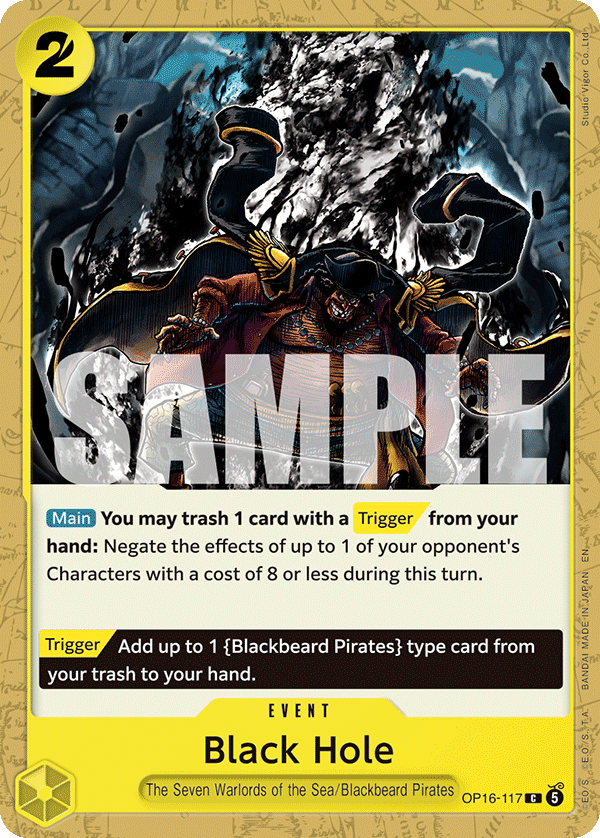 OP16-117OP16-117Shop on TCGplayer Black Hole costs 2 DON: trash a card with a Trigger from your hand, and negate the effects of an opposing Character with a cost of 8 or less during that turn. It's a Main-phase event, so you're playing it proactively on your own turn to shut a Character off before it acts again, not reactively mid-combat.
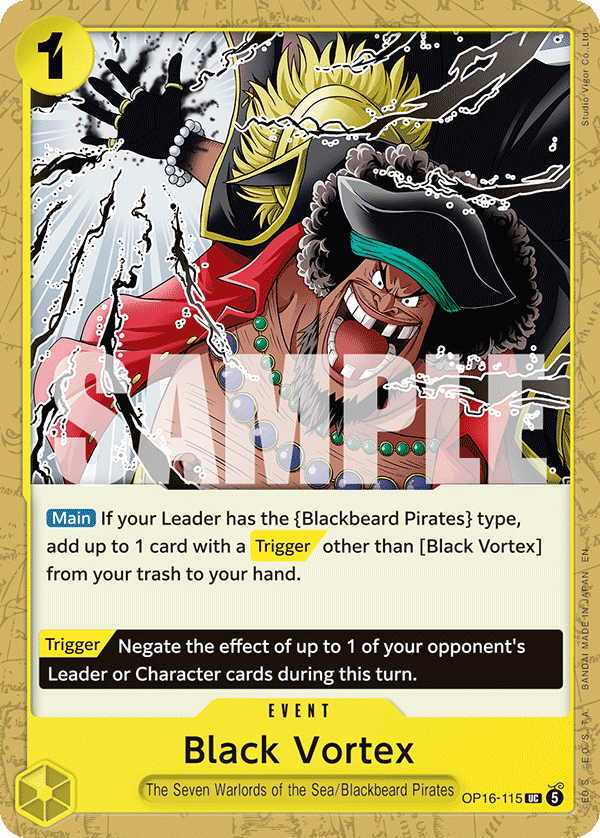 OP16-115OP16-115Shop on TCGplayer Black Vortex costs 1 DON and works differently. Its printed Trigger effect negates the effects of an opposing Leader or Character during that turn when it's revealed as a Life Trigger, which means it can fire defensively straight off your own Life pile when Nami attacks you. Its Main-phase effect only does something if your Leader has the Blackbeard Pirates type, where it recurs a Trigger card from your trash.
Both cards live in Blackbeard's Black/Yellow shell, which held an 8.86% deck share through mid-August 2026. The OP-16 Blackbeard Deck Guide covers the full Trigger package these two support.
Green tech: Luffy's lock-down events
Green doesn't give OP-16 a removal effect against Nami. It gives you two ways to deny board development instead. 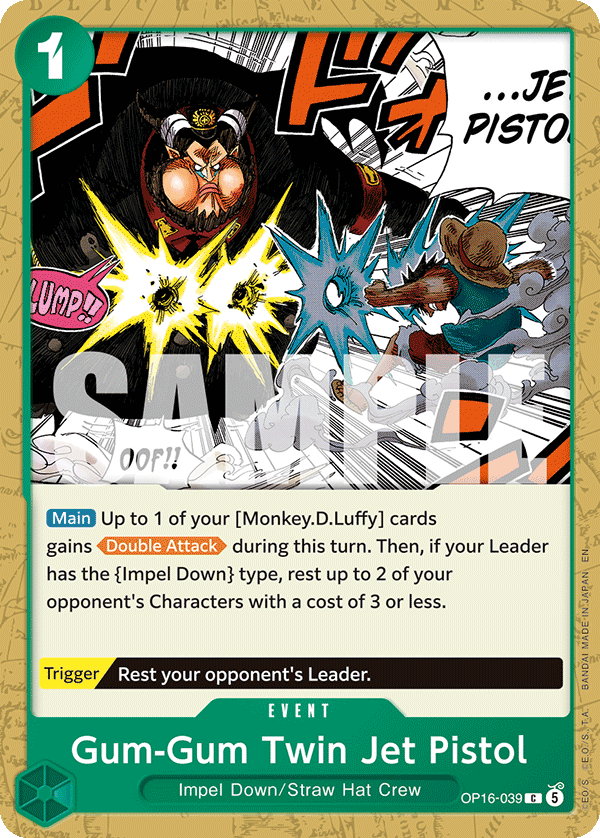 OP16-039OP16-039Shop on TCGplayer Gum-Gum Twin Jet Pistol costs 1 DON. Its main use grants Double Attack to a Monkey.D.Luffy card, and if your Leader has the Impel Down type, it also rests up to 2 opposing Characters with a cost of 3 or less. Its printed Trigger effect rests the opponent's Leader outright when flipped.
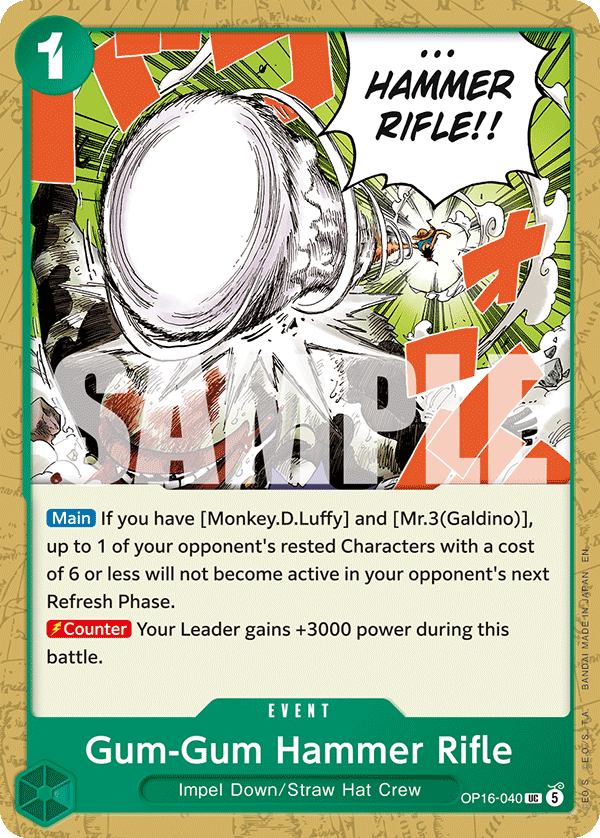 OP16-040OP16-040Shop on TCGplayer Gum-Gum Hammer Rifle costs 1 DON and, if you have both Monkey.D.Luffy and Mr.3 (Galdino) in play, stops one rested opposing Character with a cost of 6 or less from becoming active in your opponent's next Refresh Phase. Its Counter effect adds +3000 power to your Leader.
Neither card K.O.s anything. What they buy is tempo: a rested or locked-down Zeus can't attack, and a locked-down board can't defend Nami's Life cards on your following turn. That's real denial, just not the kind that shows up in a K.O. count. Green/Blue Luffy was one of the format's top decks in the mid-August OP-16 standings, but the current OP-17 tracker places it in C tier with a much smaller sample. For an OP-16 matchup guide, these events remain relevant; do not read that historical standing as a current OP-17 tier claim. The OP-16 Green Blue Luffy Deck Guide has the full build these events plug into.
Board pressure without removal is a real strategy against Nami too, it's just a different lever. 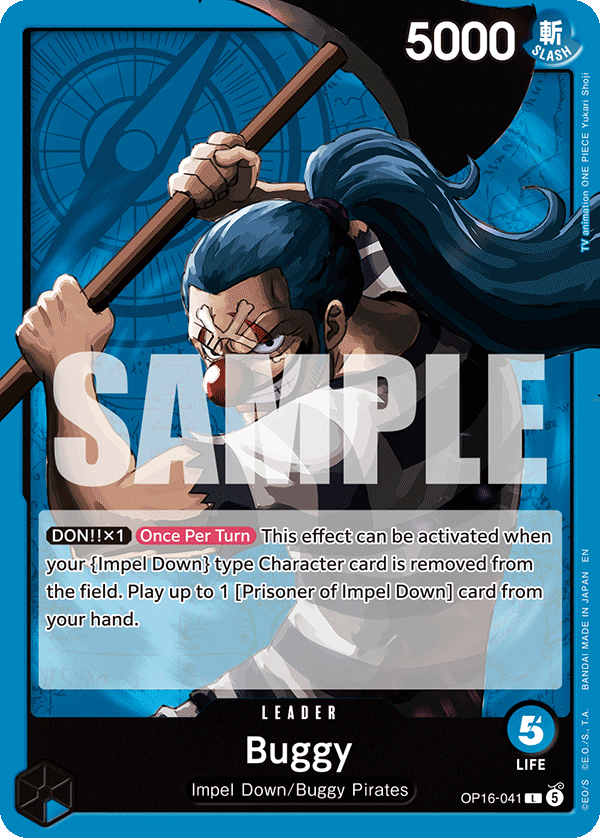 OP16-041OP16-041Shop on TCGplayer Buggy's Blue swarm shell is built entirely around that idea: deploy enough small Characters that Nami has to spend cards defending instead of developing. It works as a racing plan, but it's not the same tool as the K.O. and negate effects above, and it's worth knowing which lever you're actually pulling before you build a tech package around it.
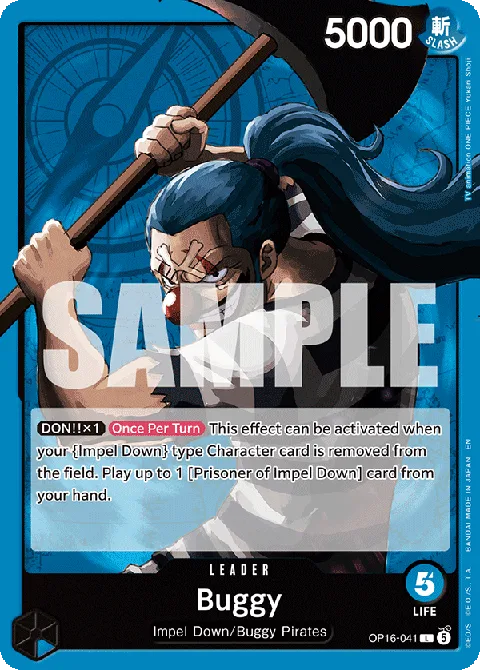 Buggy (OP16-041) runs OP-16's widest swarm plan, board pressure that races Nami's Life total rather than removing her pieces outright.
Step-by-Step: adding OP-16 Nami tech cards to your list
- Check your colors first. Mahoroba and Hallowed Glacier Slash need Black. Sakazuki needs Purple. Black Hole and Black Vortex need Yellow. Twin Jet Pistol and Hammer Rifle need Green plus specific Luffy pieces. Don't splash a third color just to fit one tech card in.
- Count your trash triggers for Mahoroba. It only K.O.s Zeus once you have 10 or more cards in your trash. In practice that's turn 4 or later. A deck that naturally trashes cards through DON cost or discard effects gets there faster.
- Don't over-invest in Sakazuki against Zeus specifically. He's a 7-cost card whose real value is against Nami's bigger threats, not her 2-cost engine piece. Play him for tempo on your own curve and treat the Zeus answer as a bonus.
- Time Black Hole and Black Vortex around your own turn structure. Black Hole is proactive, played on your turn to shut a Character off before its next activation. Black Vortex is reactive; it only fires as a Trigger when Nami's attack hits your Life.
- Run 2 to 3 copies of your color's pick, not 4. These cards are good against Nami but not dead against anyone else, so a moderate count keeps your list balanced instead of narrow.
GODEEPER: Want to see how Nami's win rate and deck share have actually trended since launch, week by week? OP-16 One Month Meta Report: Complete 5-Week Breakdown →
Tips: how many copies to run
Don't build around a single matchup. A card that's dead outside the Nami mirror is a liability against the rest of the field, even back when Nami's 23.52% share was the format's largest, most of your rounds were against someone else. Two copies of a color-appropriate pick is usually enough to shift the matchup without warping your list.
Prioritize cards that do something even when you never see Nami across the table. Sakazuki can trade well against big Purple mirrors. Black Hole is fine against any Character-heavy board. Mahoroba's power buff works on any turn, K.O. or not. That's the actual filter: would you play this card in a deck that never faces Nami? If yes, it's safe to run at a normal count. If no, keep it to a single copy or leave it in the box.
SHOP: Adding OP-16 tech against Nami? Compare current OP-16 singles for the counter cards that fit your matchup plan. Shop TCGplayer →
Common mistakes when teching against Nami
- Treating Kuzan as removal. It ramps DON and stops one Blocker for a turn. Neither ability touches Nami's board or Zeus specifically.
- Expecting Sakazuki to answer Zeus efficiently. He can, technically, since negative 6000 power against a 2000-power body is redundant, but that's not what he's built for. Save him for Nami's bigger pieces.
- Assuming Black Hole works reactively. It's a Main-phase event. You can't play it mid-combat to stop a Character that's already attacking; it has to go down on your own turn.
- Running 4 copies of a Nami-only tech card. If the card is dead against every other matchup, it's a liability in a field this spread out, even at Nami's mid-August peak she was never more than about a quarter of the meta.
- Confusing OP16-091's Nami with the Blue/Yellow leader. They share a name and nothing else. One's a Black support Character in Yamato's shell; the other is the leader this whole guide is about.
Related Reading
- One Piece TCG OP-16 Guide: Set Review & Leaders (2026): Full OP-16 set overview, all leaders, and format context for new and returning players.
- OP-16 Meta Tier List: Pre-Launch Leader Projections: The original leader rankings, useful for comparing against how far the meta has actually shifted.
- One Piece TCG Yellow Deck Guide: Trigger Power 2026: The full Yellow color identity, including the Trigger package that Black Vortex and Black Hole both draw from.
- One Piece TCG Blue Yellow Guide: How the Color Pair Works: Understand Nami's own color pair from the inside before you build tech to answer it.
Frequently Asked Questions
What are the actual tech cards that beat Nami in OP-16?
Mahoroba (OP16-101) K.O.s Zeus outright once your trash hits 10 cards, since Zeus costs exactly 2. Sakazuki (OP16-065) knocks a character to negative power for a turn. Black Hole (OP16-117) and Black Vortex (OP16-115) negate effects on your own turn or off a Trigger. None of these require you to change leaders.
Does Mahoroba actually kill Zeus?
Yes, directly. Mahoroba's second effect K.O.s an opposing Character with a cost of 2 or less once you have 10 or more cards in your trash, and Zeus is exactly a 2-cost Character. Early game, before your trash is stocked, it won't fire, so it's a mid-to-late-game answer, not a turn-2 one.
What does Sakazuki's On Play effect do against Nami?
Sakazuki (OP16-065) spends 1 DON to give one opposing Character negative 6000 power until the end of your opponent's next End Phase. Against Zeus's 2000 power that's overkill, but it's genuinely useful for knocking down a bigger threat on Nami's board so your own attackers can trade into it.
Is Nami still the most-played deck in OP-16?
No. The archived OP-16 standings had Blue/Yellow Nami at a 23.52% deck share. The live OP-17 tracker now places her in C tier with three listed decks and a 45.5% win-rate figure, a much smaller and different sample. She's still a matchup worth preparing for, but no longer the format's defining one.
Do Luffy's Green events actually stop Zeus?
Not directly. Gum-Gum Twin Jet Pistol and Gum-Gum Hammer Rifle rest or lock down opposing Characters rather than removing them, and both need specific Luffy or Mr.3 conditions to fire. They deny Nami's board development, but they won't K.O. Zeus the way Mahoroba can.
How many tech cards should I run for one matchup?
Rarely more than 2 to 3 copies of a single pick, and only if the card is fine outside the Nami matchup too. Mahoroba and Sakazuki both fit naturally into decks that already run Black or Purple, so they're not dead draws against other opponents. Pure Nami-only tech is a trap in a varied field.
References
- Limitless TCG OP-16 Deck Standings - deck share percentages, checked mid-August 2026
- Limitless TCG Card Database - verified effect text for Zeus, Sakazuki, Mahoroba, Hallowed Glacier Slash, Black Hole, Black Vortex, and the Gum-Gum events
- One Piece TCG Meta OP-17 tracker - current OP-17 tier, deck-count, and win-rate snapshot, checked September 16, 2026
- Bandai Official OP-16 Card List - official card numbers, colors, costs, and effect text for the OP-16 cards
- Bandai Official One Piece Card Game Site - official card rulings and set information
Was this guide helpful?
Cards in this article
About the author

Competitive TCG Writer
Competitive One Piece TCG player who topped at regional level. Has strong opinions about leader tier lists and when the meta is being over-hyped.
- Regional One Piece TCG top-8 finisher
- Competitive meta analyst
- Matchup and deck-building specialist

Disclaimer
This article is published for informational and entertainment purposes. It does not constitute professional financial, legal, or technical advice. Game performance, online services, patch schedules, and store listings change. Verify critical details (pricing, system requirements, regional availability) with publishers and storefronts before you buy. Affiliate links, where present, help support our editorial work and are labelled in our affiliate disclosure.