Loading…
Shonen TCG · General
Union Arena InuYasha EN Starter Decks: Full Review
9 min readBy Michael Riley
Reviewing
Union Arena
The Union Arena InuYasha EN starter decks land on August 14, 2026 alongside the UE23BT booster set. Two pre-built 50-card decks cover the two main archetypes from the JP release (UA50BT, May 29, 2026): a Counter Rush build centered on Inuyasha and an aggressive-control build built around Sesshomaru. Both are legal for tournament play on day one, no booster purchases required.
This review is based on JP starter deck analysis from UA50BT. The EN card list may differ slightly in ratios, but the archetype strategies and core units are expected to carry over directly.
TL;DR: Both InuYasha EN starter decks are solid entry points at $15-20 MSRP. The Inuyasha Counter Rush starter is better for beginners because the gameplan is linear and forgiving. The Sesshomaru Control starter has a higher ceiling but requires reading the board more carefully. Neither starter includes SR cards. Buy one starter, then pick up key singles before going to your first event.
Is the Union Arena InuYasha EN starter deck worth buying?
Yes, for any player new to Union Arena or new to the InuYasha set. At $15-20 MSRP, you get a functional 50-card deck that can win games at a local level immediately. The starter decks also teach the core mechanics of each archetype better than any mix-and-match singles purchase could.
Key Takeaways
- Two starter decks for UE23BT: Inuyasha (Counter Rush aggro) and Sesshomaru (Control)
- Both decks are tournament legal on August 14, 2026, with no extra cards required
- Starter decks include common and uncommon rarities only; SRs come from boosters
- $15-20 MSRP makes these the most affordable way to start playing InuYasha Union Arena
- Best upgrade path: buy one starter, add 6-10 key singles from the booster set
- Based on JP data from UA50BT; EN ratios may vary slightly
What comes in the Union Arena InuYasha EN starter deck
Union Arena starter decks follow a consistent format across all IP releases. The InuYasha EN starter is expected to include:
- 50-card pre-built deck (playable out of the box)
- 1 promo card (exclusive to the starter, typically a character tied to the archetype)
- Damage counters (used to track life total during play)
- Quick-start rule sheet
The 50-card deck is divided across the four card types in Union Arena: ENTRY cards (your main units), FINAL events (one-time action cards), TRIGGER events (reactive effects tied to taking damage), and the AP (Action Point) stack that fuels your plays each turn.
Starter decks in Union Arena do not include Super Rare or Super Rare Plus cards. Those are exclusive to booster packs. What you get in a starter is a complete, functional curve of units and events tuned for the archetype, with no gaps that would leave you unable to play the deck.
If you want to check what singles from the full UE23BT set are worth acquiring after getting your starter, the Union Arena InuYasha best cards to pull guide covers the SR tier and which chase cards are actually competitive versus collector targets.
Inuyasha Starter Deck (Counter Rush archetype)
The Inuyasha starter is built around the Counter Rush strategy from JP. Counter Rush in Union Arena means you are trying to place units that generate additional actions when they enter the field or trade favorably in combat, then convert that tempo into a damage lead before your opponent can stabilize.
Inuyasha as a leader character supports this through his Tessaiga-related FINAL events, which provide offensive pressure at low AP cost. The core gameplan:
- Deploy low-cost ENTRY units on turns 1 and 2 to establish field presence
- Use TRIGGER events to deny your opponent favorable trades when you take hits
- Transition into Inuyasha's bigger units mid-game to apply direct damage pressure
- Close out with FINAL events when the opponent's BP defense drops below your attack threshold
The starter includes the supporting cast from Inuyasha's group: Kagome provides AP-efficient draw or search effects in the JP version, Shippo fills a low-cost body role, and Miroku contributes support effects that smooth out the curve. Expect the EN starter to mirror these roles, though individual card ratios may shift.
Difficulty rating: Beginner-friendly. The Counter Rush gameplan rewards proactive play and punishes hesitation. Decisions are clear: if you can attack, you attack. The main skill to develop is knowing when to hold a FINAL event versus spending it immediately.
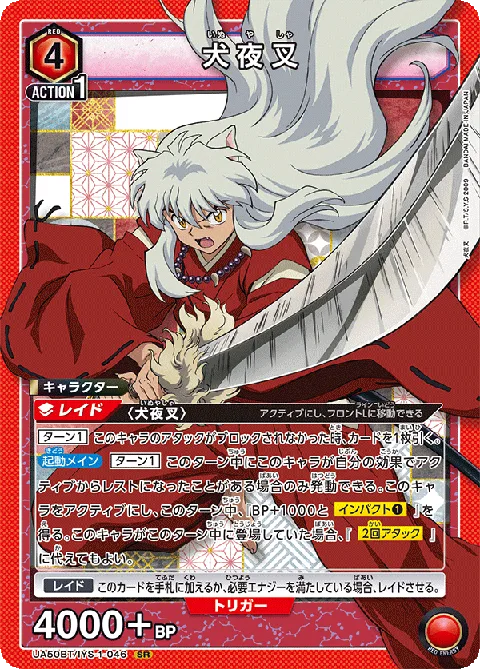 Inuyasha (UA50BT-046) is the primary leader card in the Counter Rush starter , his Tessaiga-related FINAL events are the offensive engine the entire early game is built to fuel.
GODEEPER: Understanding how Union Arena archetypes differ is critical before deciding which starter to upgrade. Union Arena InuYasha Archetypes: Competitive Guide covers how Aggro, Control, and Midrange each approach the JP meta.
Sesshomaru Starter Deck (Control archetype)
The Sesshomaru starter is built around a slower, board-control identity. Sesshomaru's character cards in UA50BT feature high base BP and targeted removal effects that trade efficiently against units your opponent drops. The goal is to never let your opponent maintain field advantage long enough to build a damage lead.
The control plan in Union Arena differs from other card games. Because damage is taken when your units are destroyed in combat (via TRIGGER resolution), controlling the board directly reduces the damage you receive. Sesshomaru Control minimizes incoming hits by removing threats before they can attack.
Supporting characters in this starter include Rin and Jaken in lower-cost slots, with Naraku villain units often appearing as tech pieces that disrupt the opponent's hand or field. The JP version demonstrated that Sesshomaru Control can grind opponents out in longer games even without SR support cards in the starter list.
Difficulty rating: Intermediate. The control starter requires reading your opponent's likely plays and sequencing your removals correctly. Playing into a TRIGGER effect at the wrong time or spending removal on a low-priority target are common early mistakes. The upside: Sesshomaru Control has a higher ceiling once you learn the decision trees.
The Sesshomaru starter also pairs well with Naraku disruption elements. For a deep look at how Sesshomaru and Naraku cards interact at a competitive level, the Union Arena InuYasha deck building guide walks through the core deckbuilding principles.
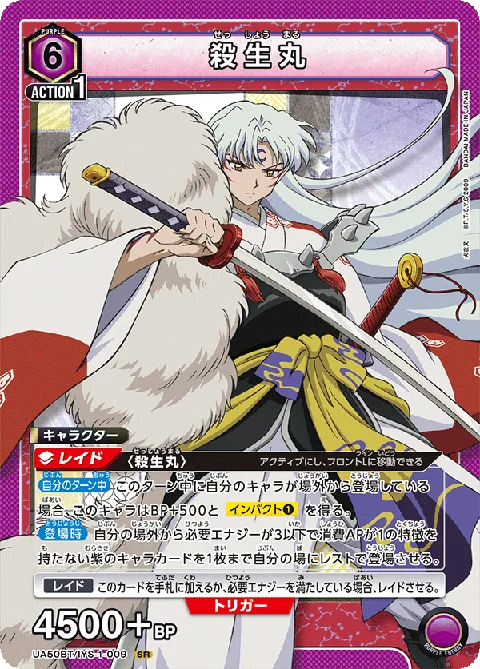 Sesshomaru (UA50BT-009) leads the Control starter , his high-BP characters and targeted removal effects define a playstyle that punishes opponents who over-commit to the board.
How the starter compares to a booster box
At $15-20 for a starter versus the cost of a full booster display, the value comparison is straightforward for new players: buy the starter first.
A booster display in Union Arena typically gives you a wide card pool to work with, but without knowing the set well, pulling from boosters before you have a base deck means you are collecting cards you cannot immediately use. The starter solves this: you have a working deck on day one, and then any singles or booster pulls you make afterward have a home.
For experienced Union Arena players who already know the archetypes from other IPs, booster-first is defensible. You can build around the SRs you pull. But for anyone new to the game or new to InuYasha specifically, the starter deck is the lower-risk starting point.
The Union Arena InuYasha EN singles vs sealed breakdown covers the cost-per-card math in detail if you want to run the numbers before committing to a purchase strategy.
One concrete point: EN boosters for UE23BT are $4.99 MSRP per pack. A starter deck at $15-20 is the equivalent of 3-4 packs, but delivers a tournament-ready 50-card deck instead of a random mix of 10 cards spread across all rarities.
GODEEPER: If you are deciding between spending on the starter, singles, or a booster display, the full breakdown is in the Union Arena InuYasha EN Buying Guide, which covers JP import prices versus EN MSRP and where to pre-order.
How to upgrade from the starter deck
The starter gets you to local-level play. To compete at a higher tier, you need to add SR and high-value uncommon cards from the booster set. The upgrade path differs by starter:
From the Inuyasha Counter Rush starter:
- Add 3-4 copies of the key Inuyasha SR unit (the version with the highest combat BP and an on-attack effect). This replaces weaker top-end units in the starter.
- Pick up additional copies of the core FINAL event if the starter only included 2. Counter Rush wants 3-4 of its primary finisher.
- Consider adding 2-4 Naraku disruption units as a mid-game bridge. They do not need to match the Inuyasha theme to function in this slot.
From the Sesshomaru Control starter:
- The Sesshomaru SR unit is your first priority. High-BP removal units with hand-refill effects are the core of the competitive build.
- Add a playset of the best TRIGGER event in the set. Control decks depend on TRIGGER efficiency to reduce incoming damage while removing threats.
- The promo card from the starter may already be a relevant piece. Keep it in the deck until you have confirmed it is not outclassed by booster set options.
For a full breakdown of which cards in UE23BT are worth targeting as singles versus chasing from packs, see the Union Arena InuYasha best cards to pull guide.
Frequently Asked Questions
How many cards are in the Union Arena InuYasha EN starter deck? Union Arena starter decks are pre-built 50-card decks. The InuYasha EN release follows this standard format. You also receive a promo card exclusive to the starter, damage counters, and a quick-start rule sheet. The 50 playable cards are divided across ENTRY units, FINAL events, and TRIGGER events to form a complete, functional list.
Are Union Arena starter decks tournament legal? Yes, immediately on release. You can take either UE23BT InuYasha starter to a sanctioned local event on August 14, 2026, with no additional purchases needed. The deck comes pre-sleeved-ready and the card list is certified for play in any UE23BT-legal format. This is standard practice for Union Arena starters.
Do the InuYasha starter decks include SR cards? No. Super Rare and Super Rare Plus cards appear only in booster packs. Starter decks include commons and uncommons, plus one exclusive promo card. This keeps the starter price at $15-20 rather than the $50+ a starter would cost if it contained SRs, and it gives you a clear upgrade direction once you are ready for competitive play.
Which InuYasha starter deck should a beginner buy? The Inuyasha Counter Rush starter is the better first pick for new Union Arena players. The aggro gameplan is linear and teaches core game mechanics clearly: deploy units, attack when open, use FINAL events to push damage. The Sesshomaru Control starter rewards more experience with the game's TRIGGER system and requires reading opponent sequencing more carefully before it becomes consistent.
Can I mix cards from both InuYasha starter decks in one deck? Yes, and this is actually a recommended upgrade path. Both starters share the InuYasha IP, so their cards combine freely within deckbuilding rules. A common mid-tier build takes the Inuyasha Counter Rush core and adds 6-8 Sesshomaru or Naraku units from the control starter to add mid-game staying power without losing the aggressive early curve.
When do the InuYasha EN starter decks release? August 14, 2026, alongside the full UE23BT booster set. The Japanese version (UA50BT) released May 29, 2026. Pre-orders for the EN version opened at authorized retailers in June 2026. Check local game stores and major online TCG retailers for availability closer to the release date.
How much do the Union Arena InuYasha EN starter decks cost? The $15-20 MSRP range is consistent with other Union Arena EN starter deck releases. At that price point, you are getting a functional 50-card tournament-ready deck. Compared to the $4.99 per-pack booster price, the starter is one of the most cost-efficient ways to enter a new Union Arena set, especially as a first purchase.
Related Reading
- Union Arena InuYasha EN Buying Guide: covers where to pre-order, JP import costs versus EN MSRP, and whether waiting for EN makes financial sense.
- Union Arena InuYasha Best Cards to Pull: the SR tier list for UE23BT, including which chase cards are competitive versus collector-focused.
- Union Arena InuYasha Deck Building Guide: how to build a 50-card deck in Union Arena, with InuYasha-specific ratio guidelines.
- Union Arena InuYasha Archetypes: Competitive Guide: JP meta breakdown for Aggro, Control, and Midrange archetypes in UA50BT.
- Union Arena InuYasha EN Singles vs Sealed: cost-per-card math comparing starter, booster display, and targeted singles buying.
- Union Arena InuYasha Tier List: All Leaders Ranked: which leader to build first based on 7 weeks of JP meta data and what to expect in EN.
References
- BANDAI NAMCO TCG official product page for Union Arena UE23BT: https://www.unionarena-en.com/
- Limitless TCG Union Arena card database for UA50BT set data: https://ua.limitlesstcg.com/
Was this guide helpful?
About the author

TCG Deck Analyst
Former card game tournament organiser turned analyst. Covers One Piece TCG meta, deck efficiency, and card valuation. Builds spreadsheets for decks most people just play.
- Regional TCG tournament organiser
- One Piece TCG meta specialist
- Competitive deck analysis
Disclaimer
This article is published for informational and entertainment purposes. It does not constitute professional financial, legal, or technical advice. Game performance, online services, patch schedules, and store listings change. Verify critical details (pricing, system requirements, regional availability) with publishers and storefronts before you buy. Affiliate links, where present, help support our editorial work and are labelled in our affiliate disclosure.