

Shonen TCG · Guides
Lorcana Attack of the Vine Deck Building Guide 2026
Reviewing
Disney Lorcana
Lorcana Attack of the Vine deck building is more forgiving than it looks once you understand the rules. When I first tried to build a deck, I dumped every card I loved into a pile and called it done. Sixty cards, two colors, problem solved. Two games later, I had no ink on my early turns, my hand was full of 7-cost characters I couldn't play, and my opponent hit 20 Lore before I got started. That experience is what this guide is designed to save you from.
Attack of the Vine (Set 13) brings fresh IP to the game: Monsters Inc., Up, and Turning Red characters distributed across the ink colors, alongside returning classics like Winnie the Pooh, The Little Mermaid, and the Mickey Mouse Gang. If you're coming from a prerelease or just cracked your first packs, this guide walks you through everything you need to put together a playable deck.
TL;DR: A legal Lorcana deck is exactly 60 cards, max 2 ink colors, max 4 copies of any card. Aim for 30-40 characters, 8-16 actions, 4-12 items. Keep 12-16 low-cost inkable cards in the deck so you never miss an ink drop early. Set 13's new Pixar IPs open up Emerald/Sapphire as a fresh pairing worth exploring, while Turning Red gives Ruby's established pairings a boost.
Updated October 2, 2026: Hyperia City has an official prerelease date of October 16, 2026 and an everywhere release date of October 23, 2026. Disney Lorcana's rotation notice says Core Constructed uses Fabled and later cards from Attack of the Vine onward, subject to exact-name and version reprint exceptions, so check older staples before registering this shell.
How do you build a Lorcana Attack of the Vine deck?
Choose 2 ink colors, collect 60 cards with a curve that covers costs 1 through 7, and make sure at least 12 of those cards are low-cost inkables. Your characters quest and fight; your actions and items support them. First player to 20 Lore wins.
Key Takeaways
- 60 cards exactly, 2 ink colors max, 4 copies max per card
- Characters are your main Lore engine; run 30-40 of them
- 12-16 low-cost inkable cards keeps your early turns functional
- Attack of the Vine opens up Emerald/Sapphire as a new pairing and adds Turning Red aggro tools to Ruby
- Your prerelease pulls are a real starting point; buy singles to fill gaps
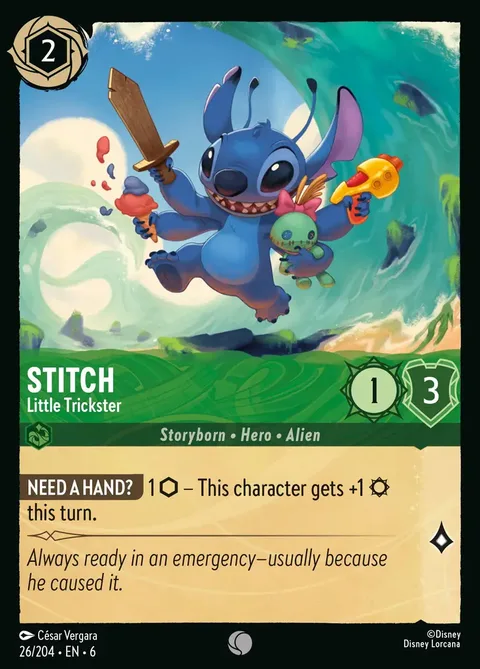 Stitch - Little Trickster is one of the key characters in this Lorcana format.
Lorcana Deck Building Basics
Before touching Set 13 cards, I want to make sure the foundation is clear. If you've played card games before, some of this will sound familiar. If you're coming purely from anime fandom, slow down here because these rules actually matter for everything else.
Every Lorcana deck is exactly 60 cards. That number never changes for constructed play. You pick 2 ink colors, and every card in your deck must belong to one of those two colors (or have no color restriction). You can't mix 3 or more inks. You can run up to 4 copies of any single card.
The game ends when one player reaches 20 Lore. Lore comes from questing: you tap (exhaust) a character card to gain Lore equal to its Lore value. Characters can also challenge (attack) opposing characters to remove threats from the board.
The ink system is Lorcana's version of a resource. Each turn you can place 1 card face-down into your Inkwell as an ink resource. You can only do this with cards that have the inkable diamond symbol. Cards without that symbol are called uninkable. They're usually your most powerful cards, but they'll never work as ink.
If you want the full rules walkthrough, the Disney Lorcana beginner guide covers every phase of the turn.
Attack of the Vine Ink Pairings
Set 13 distributes its new franchises across different inks, so the pairing you choose decides which characters you can access.
Emerald plus Sapphire is the fresh pairing to test in Attack of the Vine. Monsters Inc. characters land primarily in Emerald while Up characters appear in Sapphire. If you went into the prerelease hoping to build a Sully and Mike deck alongside Russell and Carl, Emerald/Sapphire is your home. This pairing has a history in control-leaning builds, so Pixar fans may find it suits a slower, grindier playstyle.
Turning Red in Ruby is the other addition worth planning around. Meilin and friends bring aggressive, tempo-focused tools into an ink that already leans that direction. Rather than opening a brand-new pairing on its own, Turning Red slots into Ruby's existing options: pair it with Sapphire for an items-and-tempo build, or with Amber for a straightforward aggro shell.
Established pairings still work if you already have cards from earlier sets. Amber/Steel powers the Steelsong archetype and remains one of the friendliest pairings for newer players. Amethyst/Sapphire is a proven evasive deck option. Ruby/Sapphire built around items continues to see play.
The Attack of the Vine ink changes guide goes deeper on which specific characters land in which colors.
GODEEPER: Not sure which ink pairing fits your style? Disney Lorcana Attack of the Vine Best Decks and Meta Guide →
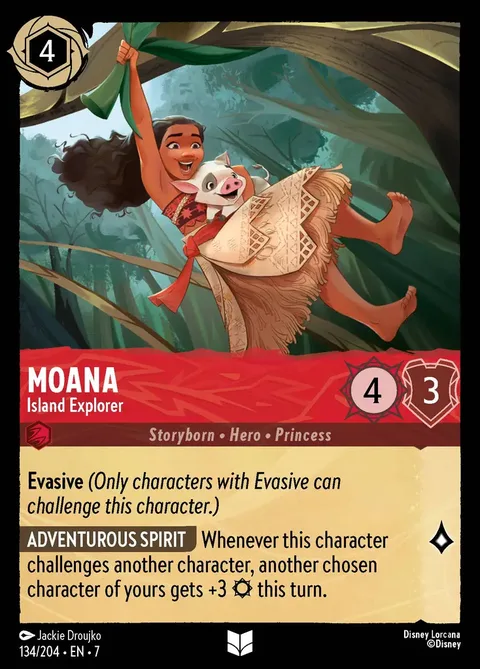 Moana - Island Explorer brings unique abilities to the Lorcana card pool.
Card Ratios: Characters, Actions, Items
This is the part that tripped me up the most early on. I kept running too few characters and too many songs. My board was always empty because I spent all my ink on actions instead of putting characters into play.
Here's a starting ratio that works across most strategies:
Characters (30-40 cards) are how you quest for Lore and interact with your opponent's board. Fewer than 30 and your hand routinely fills with actions but has no one to do anything. More than 40 and you're short on support tools.
Actions (8-16 cards) are your one-time effects. Songs are a subtype that characters can "sing" (play for free if you exert a character with a high enough cost). They're strong but purely situational. If you're going Song-heavy, make sure you have characters who can sing them and enough ink to back it up.
Items (4-12 cards) stay in play and provide ongoing effects. They're slower to pay off but generate consistent value over multiple turns. Item-centric decks, like Ruby/Sapphire builds from earlier sets, sit toward the higher end of that range.
These ratios flex depending on your strategy. An aggro deck running small characters and burn actions might go 38 characters, 14 actions, 8 items. A control deck might trim characters to 30 and run heavier on actions and items that deny the opponent's board.
Building From Prerelease Pulls
A prerelease kit gives you 6 booster packs plus a promo card, roughly 72 cards to work from. In sealed format at the prerelease event itself, you build a 40-card deck from whatever you opened. After the event, you're building constructed, which means 60 cards.
My approach after prerelease: count which 2 ink colors you pulled the most of. That's your color identity. Take all the playable cards from those colors and lay them out on a table. You almost certainly won't have 4 copies of your key cards, but you may have 2-3 of some important ones.
Treat that as your skeleton. A prerelease pool might give you something like:
- 15 characters in Emerald (various costs)
- 12 characters in Sapphire
- 6 actions
- 4 items
- Scattered singles in other colors you're not using
That's 37 cards in your two chosen colors before you even look at buying singles. Pull from the remaining pool to fill your character count toward 30, add your best actions and items, then identify what's missing.
The Attack of the Vine prerelease guide has sealed-specific tips on navigating the event itself, including what to prioritize when your pulls go sideways.
Step-by-Step: budget upgrade path from prerelease to playable deck
You don't need to spend a lot right away. Here's the realistic path from prerelease pulls to a fully playable deck.
1. Build a starter deck foundation. If your prerelease pulls were spread across 3-4 colors and you don't have a clear 2-color base, a current starter deck is the fastest fix. Starters are designed as complete 60-card decks with a consistent curve. The Disney Lorcana starter decks 2026 guide breaks down which ones are worth buying now.
2. Identify your top 5 missing cards. After playing a few games with your current deck, note what you keep wishing you had. Usually it's a key 3-cost character you only have 1-2 copies of, or a powerful action you see other players using. Search TCGPlayer for Attack of the Vine singles and sort by most played.
3. Complete playsets of commons and uncommons first. Common and uncommon singles are usually the lower-cost way to fill a list, but prices move with demand and availability. Check current listings before assuming a playset fits your budget. That's usually better value than chasing a single rare before the shell works.
4. Invest in 1-2 key rares. Once your commons and uncommons are solid, identify 1-2 rare or super rare cards that define your strategy. These are the cards opponents might struggle to answer. Set a spending cap, then check current listings before buying.
GODEEPER: Trying to decide between Core Set and Infinity format before committing to card purchases? Disney Lorcana Core vs Infinity Format Guide →
Inking Targets and Curve Management
This is the single piece of advice I wish someone had given me clearly at the start: have 12-16 inkable cards at 1-2 cost in your deck. Every turn you go without inking is a turn you fall behind on resources.
Uninkable cards are typically your strongest characters, your win conditions. They're designed that way precisely because they're powerful. That's fine. But if half your deck is uninkable, you'll regularly find yourself holding a hand full of cards you can't ink and can't afford to play yet. I've been there. It's a frustrating place to be.
The curve matters too. You want cards at cost 1 or 2 (early ink drops and early questers), cost 3 or 4 (mid-game board presence), and cost 5 through 7 (late-game threats and closers). A deck that's all cheap cards runs out of steam; a deck heavy on expensive cards never gets started.
A practical check: count your inkable cards at cost 1-2. If it's below 12, you'll have dead turns early. If it's above 20, you might run out of power in the late game. Most solid decks sit in that 12-16 window.
The Disney Lorcana complete guide has additional deckbuilding theory if you want to go deeper on curve construction.
Related Reading
- Disney Lorcana Attack of the Vine Week 1 Meta Report: First-weekend results and which decks are winning early in the Set 13 format.
- Lorcana Attack of the Vine: Temporary Shift and Hunny Guide: All three new Set 13 mechanics explained, with deckbuilding implications.
- Lorcana Attack of the Vine Enchanted Cards Guide 2026: Pull rates and collector value for Set 13's Enchanted rarity.
- Attack of the Vine Print Run: How Many Packs to Open: Pack math for competitive players, casual collectors, and full-set completionists.
- Disney Lorcana Attack of the Vine Best Cards to Pull: Which Set 13 Iconics, Enchanted prints, and competitive singles are worth chasing.
Frequently Asked Questions
How many cards are in a Lorcana deck? A legal Lorcana deck contains exactly 60 cards. You can run a maximum of 4 copies of any single card, and you cannot use more than 2 ink colors in one deck.
What are the best ink pairings for Attack of the Vine? Emerald and Sapphire is the standout new pairing in Set 13, connecting Monsters Inc. characters with Up characters. Turning Red gives Ruby a fresh aggro boost within its established pairings. Amber/Steel and Amethyst/Sapphire remain strong as well.
How many inkable cards should I have in my deck? Aim for 12 to 16 inkable cards at 1 or 2 cost. That way you can reliably put ink into your Inkwell on your early turns without burning a card you actually want to play. Uninkable cards should be your most powerful pieces, not every card in the deck.
What is the recommended character to action to item ratio? Start with 30 to 40 characters, 8 to 16 actions, and 4 to 12 items. Aggro decks run character-heavy; control decks shift toward more actions and items. These ratios flex with your strategy.
Can I use my prerelease pulls to build a real deck? Yes. Identify the 2 ink colors you pulled the most of, use those cards as your base, and buy singles to fill gaps. A current starter deck is a good supplement if your pulls were spread thin across multiple colors.
What does inking a card mean in Lorcana? Inking means placing a card face-down in your Inkwell zone as a resource. You can only ink cards with the inkable diamond symbol. Each inked card produces 1 ink you can spend on your turn.
How do I know which cards to include in my Attack of the Vine deck? Decide on your win condition first: fast questing, board control, or a combo finish. Then fill your curve with characters and support cards that push toward that goal, making sure you have enough inkable low-drops to hit your resource marks every turn.
References
- Disney Lorcana official site: official card database and rules documents
- Disney Lorcana Hyperia City product page: official prerelease and everywhere release dates
- Disney Lorcana 2026 rotation notice: Core Constructed legality from Attack of the Vine onward
- TCGPlayer Disney Lorcana singles: pricing and availability for Attack of the Vine singles
- r/DisneyLorcana: community decklists, prerelease reports, and meta discussion
Was this guide helpful?
About the author
Beginner Guides & Crossover Writer
Anime fan turned TCG content creator. Bridges the gap between anime fandom and card game strategy. Covers beginner guides, anime-to-TCG crossover content, and Union Arena.
- TCG content creator since 2022
- Specializes in onboarding new players
- Covers Union Arena multi-IP content
- Bridge between anime fandom and TCG community
Keep reading

Disney Lorcana Attack of the Vine Ink Colors Guide
Guides · 8 min

Disney Lorcana Iconic Rarity: Set 13 Collector Guide
Guides · 7 min
Attack of the Vine Print Run: How Many Packs to Open
Guides · 9 min

Disney Lorcana Emerald Aggro Upgrade Attack of the Vine
Guides · 11 min
Attack of the Vine Up Sapphire Guide: Carl and Dug
Guides · 10 min
Lorcana Wilds Unknown Set Championship Meta Decoded
News · 4 min
Lorcana Amethyst Ruby Deck Guide: Bounce Tempo 2026
Guides · 18 min
Attack of the Vine Turning Red Ruby Full Deck Guide
Guides · 11 min
Disclaimer
This article is published for informational and entertainment purposes. It does not constitute professional financial, legal, or technical advice. Game performance, online services, patch schedules, and store listings change. Verify critical details (pricing, system requirements, regional availability) with publishers and storefronts before you buy. Affiliate links, where present, help support our editorial work and are labelled in our affiliate disclosure.