Loading…
Loading…
Shonen TCG · Guides
Reviewing
Disney Lorcana
Carl Fredricksen has finally made it to Lorcana. Attack of the Vine Up Sapphire slots Pixar's most determined adventurer into the ink color that suits him best. On launch day of Set 13, complete card text is still being verified across the community, but Sapphire's identity is consistent enough that we can map exactly how Carl, Dug, and Russell fit into existing shells and where they open new angles.
TL;DR: Up characters debut in Sapphire ink in Attack of the Vine (Set 13, July 24, 2026). Carl Fredricksen likely serves as a mid-to-high cost value generator, Dug as a loyal support body, and Russell as a low-cost tempo piece. They slot into Amethyst/Sapphire and Steel/Sapphire shells already performing well in Core format. No fabricated card stats in this guide: analysis is based on Sapphire's established character design patterns and Up's thematic identity.
Up characters give Sapphire access to a coherent Pixar Adventure theme for the first time. Sapphire has historically rewarded patient, card-advantage-focused strategies. Carl, Dug, and Russell each fill a distinct slot in that style of play. Carl brings stubborn persistence, which in TCG terms almost always translates to hard-to-remove mid-range value. Dug brings unconditional loyalty, the design signal for support abilities. Russell brings youthful resourcefulness, which maps onto cheap bodies with quest bonuses. Together they fill the roles Sapphire wants without stepping on each other.
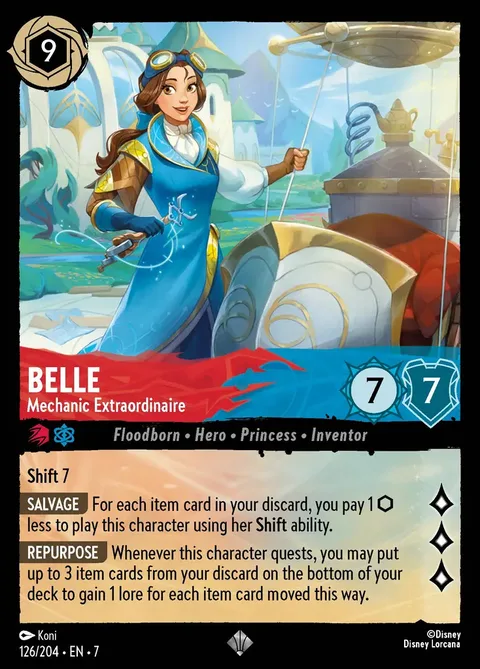 Belle - Mechanic Extraordinaire is one of the key characters in this Lorcana format.
Carl is the emotional center of the Up franchise. An elderly man who ties thousands of balloons to his house rather than give up on a promise, he represents exactly what Sapphire rewards: patience and long-term planning over short-term aggression.
In Lorcana, Sapphire's high-cost characters tend to arrive with significant Willpower, passive card draw, and either a self-protection keyword or a Lore bonus that rewards staying on the board. Look at how Sapphire has handled similar "stubborn survivor" archetypes before. Characters who mirror Carl's thematic profile land in the 5-to-6 Ink range with 4 or more Willpower, and their abilities generate value over multiple turns rather than triggering immediately.
For Carl specifically, the most likely design outcome based on Sapphire precedent is either a tap-for-card-draw ability (requiring him to be ready, which rewards not attacking), or a "when this character quests" trigger that generates Ink or additional cards. Both fit the Pixar narrative: Carl isn't a fighter, he's a planner.
Where Carl slots in an existing shell: any Sapphire deck running 5-to-6 cost payoffs has room for him as a top-end anchor. In a Steel/Sapphire control shell, Carl would pair with Steel's stall effects to keep the board stable while he generates card advantage. In Amethyst/Sapphire Evasive, which holds around 19% meta share in Core format, Carl fills the top of the curve where you want a body that survives and draws.
GODEEPER: Wondering which Set 13 cards to target when opening packs? Disney Lorcana Attack of the Vine Best Cards to Pull
Was this guide helpful?
About the author

TCG Reviews & Guides Editor
TCG reviews and guides editor specialising in set reviews, deck builds, and beginner content across One Piece TCG, Union Arena, Disney Lorcana, and Dragon Ball Fusion World. Known for step-by-step guides that actually work at the local game store level.
Disclaimer
This article is published for informational and entertainment purposes. It does not constitute professional financial, legal, or technical advice. Game performance, online services, patch schedules, and store listings change. Verify critical details (pricing, system requirements, regional availability) with publishers and storefronts before you buy. Affiliate links, where present, help support our editorial work and are labelled in our affiliate disclosure.
Dug is the golden retriever who loves unconditionally, gets distracted by squirrels, and follows Carl with zero conditions. His thematic identity in Lorcana terms: a Support character whose ability is tied to a named character being in play, or a triggered ability that fires when another character quests.
Sapphire handles loyalty-theme characters by giving them low-to-mid costs with abilities that reward building around them. A Dug card at 2 to 3 Ink with a triggered draw or a stat bonus for friendly characters fits Sapphire's existing pattern. His Willpower would be modest, which is accurate to the character: Dug is not a tank, he's an eager companion.
The most interesting design space for Dug is a "named character bonus" ability. If his ability reads something like "while Carl Fredricksen is in play, Dug gets +2 Willpower" or "when Dug quests, if you control a character named Carl Fredricksen, draw a card," that creates a clear incentive to run both. Sapphire has done this pattern before with family-themed characters who reward grouping related cards.
For deck building, Dug likely fits at two or three copies in any Up-focused Sapphire build. He may be less relevant in pure Amethyst/Sapphire Evasive shells where the Evasive synergy matters more than named-character triggers. But in a dedicated Up shell or a Steel/Sapphire build that wants cheap bodies to generate value, Dug performs the role efficiently.
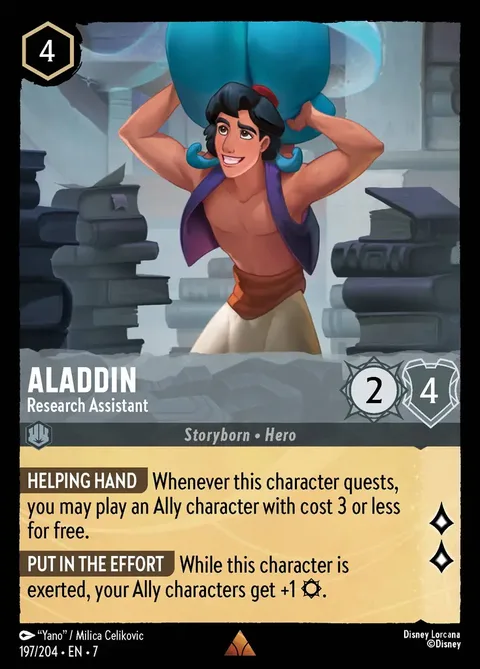 Aladdin - Research Assistant brings unique abilities to the Lorcana card pool.
Russell, the Wilderness Explorer who tags along and ends up holding the adventure together, maps onto Sapphire's low-cost early bodies. Sapphire's 1-to-3 Ink characters historically do one of three things: draw a card on quest, reduce costs for specific card types, or generate Lore bonus when conditions are met.
Russell's scout/explorer theme suggests he might carry a bonus for entering play (a drawn card, a cost discount on the next action), or a quest trigger that scales with how many Up characters you control. This kind of synergy count is common in Sapphire's thematic character groups where the payoff builds as the family assembles on board.
As a 1-to-2 Ink body, Russell would likely have 1 Lore and 2 Willpower at baseline, similar to other early-game Sapphire characters. The interesting version of Russell has 2 Lore but comes with a condition, such as requiring another Up character in play to quest for the second Lore. That would make him a late-drop in aggro matchups but a consistent generator in the right build.
If Russell costs 3 Ink with a meaningful ability, he becomes a replacement for mid-cost Sapphire filler that currently lacks thematic coherence. Replacing a generic 3-cost quester with Russell gives the same curve but adds synergy potential with Carl and Dug.
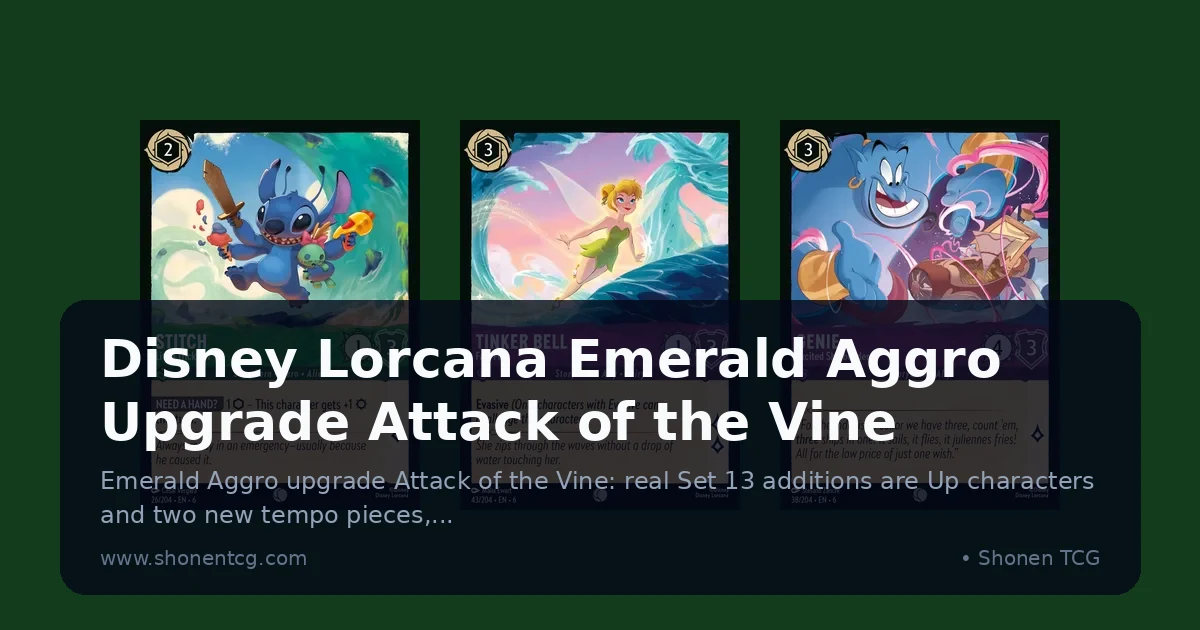
GODEEPER: Comparing Up Sapphire's control approach against Emerald's aggro upgrade? Disney Lorcana Emerald Aggro Upgrade Attack of the Vine
Sapphire currently performs best in two configurations in Core format. Amethyst/Sapphire Evasive runs a high density of Evasive characters to avoid blockers and quest freely. Steel/Sapphire runs protective Steel effects with Sapphire draw to generate sustained advantage.
Up characters fit Steel/Sapphire more naturally than Amethyst/Sapphire Evasive. Here is why:
The Evasive shell depends on Evasive keyword for its core mechanic. Until we confirm which Up characters carry Evasive, adding them to an Evasive shell risks diluting the deck's consistency. Carl almost certainly does not have Evasive given his character profile. Dug possibly does not. Russell might, which could make him relevant in that shell.
Steel/Sapphire works differently. It protects characters with Steel's defensive tools while Sapphire generates card advantage. Carl fits this shell immediately as a top-end value generator. Dug fits as a support body that draws cards while Carl stays ready. Russell fills the early curve.
The third option is a dedicated Up shell, which combines all three characters with other Pixar Adventure characters already in the card pool. As of Set 13, the viability of a pure IP theme deck depends heavily on how many Up cards the set includes and whether their abilities are costed competitively. A 6-card Up package in a 40-card deck is enough for theme synergy but requires the surrounding 34 cards to carry weight.
1. Start from an existing Steel/Sapphire skeleton, not a blank deck. Keep the 8 to 10 Steel protective actions and 6 to 8 Sapphire draw effects that already make the shell function; you're modifying a proven Core format list, not designing from scratch.
2. Slot Carl in as your top-end anchor. Run 2 copies minimum in the 5-to-6 Ink range. His durability and card-draw profile fits the same top-of-curve role a generic Sapphire value character already fills in this shell.
3. Add Dug as mid-range support. Run around 3 copies at 2-to-3 Ink. He draws cards or buffs friendly characters while Carl stays ready, which is exactly the kind of support body Steel/Sapphire wants in the middle of its curve.
4. Fill the early curve with Russell. Run 3 to 4 copies at 1-to-2 Ink for board presence in the first few turns, replacing generic early Sapphire fillers with a character that has upside if he shares synergy with Carl or Dug.
5. Verify every card's exact text and cost before finalizing counts. Check the official Lorcana card portal or Lorcast against the assumptions above; adjust copy counts once real stats replace the thematic projections used here.
These are starting frameworks based on Sapphire's established roles. Adjust card counts after verifying actual card text from the official Lorcana portal.
Steel/Sapphire Up Control shell (estimated 40 cards): Start with the existing Steel/Sapphire skeleton from Core format: 8 to 10 Steel protective actions, 6 to 8 Sapphire draw effects, and 4 to 6 Steel characters at the low end for early board presence. Replace 4 to 6 of the mid-range Sapphire characters with Up characters. Carl goes in at 2 copies minimum as a top-end anchor. Dug at 3 copies as the mid-range support. Russell at 3 to 4 copies at the low end.
Amethyst/Sapphire with selective Up additions: Only include Up characters who carry the Evasive keyword (confirm from official sources). Carl is likely out unless he arrives with Shift or another keyword that synergizes with the shell. Russell has the highest chance of fitting here given his young adventurer profile. Add 2 to 3 Russell and reassess after seeing full card text.
Pure Up theme build: Wait for the complete Set 13 card list before attempting this. Pixar Adventure decks need at least 8 to 10 on-theme characters across multiple cost points to function as a coherent strategy. If Set 13 delivers 4 to 5 Up cards with good cost coverage, the theme shell becomes viable as a casual build. Competitive viability depends on whether the synergy payoffs are costed efficiently.
For any of these shells, verify each card's exact text and cost from the official Lorcana card portal or Lorcast before building. Launch day analysis based on thematic fit is a planning tool, not a substitute for confirmed stats.
Are Up characters in Sapphire ink in Attack of the Vine? Yes. Carl Fredricksen, Dug, and Russell all receive their Lorcana debut in Sapphire ink in Attack of the Vine (Set 13, July 24, 2026). This marks the first time the Up franchise has appeared in Disney Lorcana. Sapphire ink was confirmed as the home for these characters ahead of the set launch.
What does Sapphire ink do in Disney Lorcana? Sapphire ink focuses on card draw, card advantage, and resource management. It plays slower than aggressive colors like Emerald or Amber, generating extra cards and Lore through questing rather than combat. Sapphire pairs naturally with control strategies and mid-range builds that want to out-card the opponent over several turns.
What is the best Sapphire color pair for Up characters in Set 13? Steel/Sapphire is the strongest natural fit based on thematic alignment. Carl's patient, durable profile suits Steel's protective mechanics. Amethyst/Sapphire Evasive already holds around 19% meta share in Core format and could include Up characters who carry the Evasive keyword, but that requires confirming exact card text before committing.
Is Carl Fredricksen likely a high-cost Sapphire character? Based on thematic fit and Sapphire's history, Carl likely costs 4 to 6 Ink with meaningful Willpower and an ability tied to card draw or Lore generation. Sapphire has consistently designed high-cost characters who generate value over multiple turns rather than trading efficiently in combat. Carl's stubborn, planful persona fits that mold closely.
Does Russell fit into aggressive or control Sapphire builds? Russell fits better into mid-range or control builds as a low-cost early body with a quest or draw trigger. His young adventurer theme suggests support-type abilities that reward building around Up characters. He could work in Amethyst/Sapphire Evasive if he carries the Evasive keyword, but confirm actual card text before adding him to an Evasive shell.
How does the Up theme fit Sapphire's existing identity? The Up franchise centers on perseverance, loyalty, and strategic adventure rather than direct confrontation. These themes map onto Sapphire's core identity: slow buildup, card advantage, and planning over brute force. Carl's determination, Dug's loyalty, and Russell's resourcefulness each translate cleanly into existing Sapphire archetypes without forcing the color into unfamiliar design territory.
Related
Union Arena Fullmetal Alchemist Deck Guide: Blue 2026
8 min read
Union Arena Attack on Titan Vol.2: New Yellow Color
8 min read
OP-17 Mihawk Deck Guide: Green Dracule Mihawk 2026
13 min read
Dragon Ball Fusion World FB11 Leaders: All 5 Revealed
8 min read
OP-17 Mihawk Matchup Guide: All 6 Leaders Explained
14 min read