Loading…
Loading…
Shonen TCG · Guides
Reviewing
Disney Lorcana
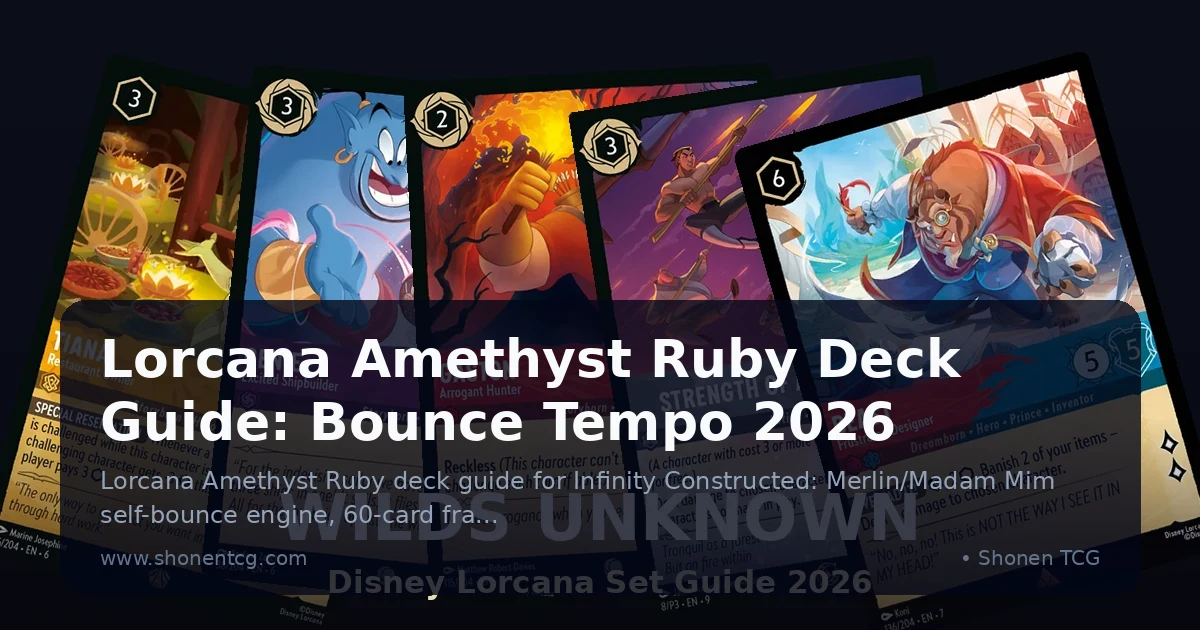
This Lorcana Amethyst Ruby deck guide covers an Infinity Constructed shell built around cards that were established during the Wilds Unknown era. Amethyst/Ruby has been a Lorcana fixture since the earliest competitive seasons, built around self-recursion rather than opponent disruption. Because Infinity keeps older cards available, the strategy still pairs Amethyst's Merlin/Madam Mim loop with Ruby's early pressure to close games on lore.
Correction (2026-07-29): an earlier version of this guide described Madam Mim's bounce effects as targeting the opponent's board. Verified against lorcana-api.com, both Madam Mim Snake and Madam Mim Fox read "banish her or return another chosen character of yours to your hand," meaning they bounce your own characters, not the opponent's. That changes the deck's identity from a tempo-disruption archetype to a self-contained recursion engine: you bounce your own Merlin Goat or Rabbit with Mim, then replay them to fire their enter-play triggers again. The sections below have been corrected to reflect the real mechanic.
This guide covers the Merlin/Madam Mim recursion engine, how to complete the 60-card shell, the win condition, and how the deck approaches two common matchup patterns.
TL;DR: Amethyst/Ruby is a self-recursion deck, not a disruption deck. Madam Mim Snake and Fox bounce your own Merlin Goat or Rabbit back to hand so you can replay them and fire their enter-play triggers a second time. Ruby provides early lore pressure; Amethyst's Merlin/Mim loop adds extra lore and card draw on top. It does not interact with the opponent's board at all, so both key matchups below come down to a straight lore race.
Amethyst/Ruby is a recursion-tempo deck that generates extra lore and cards by replaying its own characters rather than by disrupting the opponent's board. Its core loop: play Madam Mim (Snake or Fox), use her enter-play ability to bounce your own Merlin Goat or Rabbit back to hand, then replay that Merlin next turn to trigger his ability again. Ruby's early questers keep lore pressure on while this loop runs in the background. It's a genuinely different deck than a Bounce-control archetype that targets the opponent, so playing it well means leaning on your own recursion value, not trying to deny board presence.
Amethyst/Ruby gets lore from card actions, not just questing. Most Lorcana decks accumulate lore by having characters quest each turn. This deck does that too, but it also earns lore and draws cards whenever certain characters enter or leave play, on its own side of the board.
Merlin Goat (4 cost, 4/3/1) earns 1 lore when you play him and another 1 lore any time he leaves play, whether that's a bounce, a discard, or getting banished in combat. Play him, bounce him with your own Mim, replay him, bounce him again. Two plays of the same card can generate up to 3 lore across the cycle (1 on the first play, 1 on the leave, 1 on the replay) plus whatever quest lore he protects along the way.
Merlin Rabbit (4 cost, 2/3/1) is the draw piece. He may draw a card when played and again when he leaves play, including from a bounce. Cycling him through the same Mim loop nets extra cards instead of extra lore.
Madam Mim's Snake and Fox forms are the engine, not disruption. Madam Mim Snake (2 cost, 3/3/1): "When you play this character, banish her or return another chosen character of yours to your hand." Madam Mim Fox (3 cost, 4/3/1, Rush): the same self-bounce text, with Rush added so she can challenge the turn she's played. Both target your own board, never the opponent's. Play a Mim, choose to bounce your own Merlin Goat or Rabbit instead of banishing Mim herself, and you've just re-armed that Merlin's trigger for a second play next turn.
Flynn Rider (Frenemy, Ruby, 2 cost, 2/2/1) and Sisu (Emboldened Warrior, Ruby, 3 cost, 1/4/2) do the blunt early work. Flynn's "Narrow Advantage" gains 3 lore at the start of your turn if you have the single strongest character in play; Sisu gets +1 strength per card in the opponent's hand, so she's a bigger body against a slow-playing control opponent and a smaller one against an empty-handed aggro deck. Neither interacts with the bounce package directly; they're just early Ruby bodies that push lore and hold the board in the first three turns, before the Merlin/Mim loop comes online. Without that Ruby pressure, the deck turns purely reactive and loses the lore race.
Friends on the Other Side (Amethyst, 3-cost Song, draw 2 cards) refills the hand when you're waiting on Merlin or Mim pieces. Don't sit on it; the deck collapses when the hand runs low.
GODEEPER: The best decks to compare against, including Amber/Steel Steelsong and Amethyst/Sapphire Evasive, are ranked and explained in the full meta overview. Disney Lorcana Wilds Unknown Best Decks Meta 2026 →
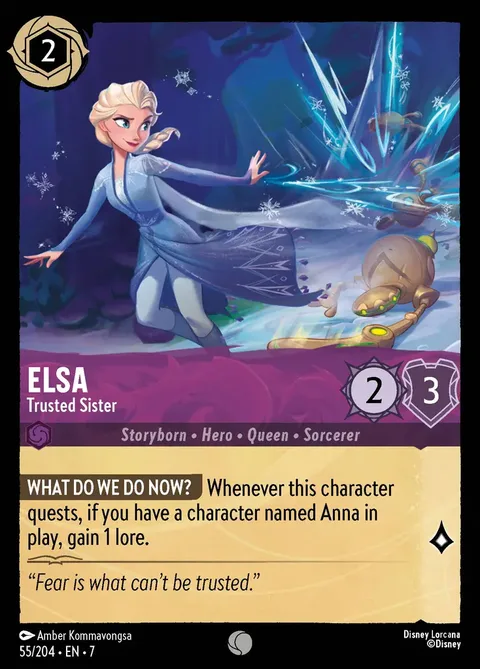 Elsa - Trusted Sister is an Amethyst character card from the Lorcana card pool.
A competitive Amethyst/Ruby Bounce shell runs roughly as follows. The exact counts shift by format, event, and regional preference, but this is a starting skeleton rather than a fixed tournament list:
Characters (38)
Run 4 copies of both Merlin forms (Rabbit and Goat). These are the non-negotiable core and shouldn't be cut under any build theory. Madam Mim Snake and Fox come in at 3-4 each depending on whether you're seeing more aggro or control locally. Flynn Rider (Frenemy) is 4 copies: 2 cost, and he gains 3 lore at the start of your turn whenever you hold the single strongest character on the board, so he rewards curving out rather than doing anything on turn one specifically. Sisu (Emboldened Warrior) fills 3-4 early quester slots at 3 cost; her strength scales with the opponent's hand size, so she's better against decks that hold cards than against decks that dump their hand fast.
Correction (2026-07-29): an earlier version of this section listed Maleficent (Sorceress) as a "late-game body with board control upside" and Lady Tremaine (Imperious Queen) as a card that "discourages challenges." Both were wrong. Maleficent - Sorceress is a cheap 3-cost, 2/2/1 body that may draw a card when played, closer to a curve-filler than a late-game piece; run 2-3 copies for the early draw, not for board control. Lady Tremaine - Imperious Queen is a 6-cost, Shift 4 character whose enter-play ability forces each opponent to choose and banish one of their own characters, one-time forced removal rather than an ongoing deterrent; run 2-3 copies as a Shift target off an earlier cheap Lady Tremaine if the format needs a removal answer. Fill the remaining 6-8 character slots with the strongest 1-3 cost Ruby options available in the current format, prioritizing anything that quests for 2 or has Evasive.
Actions and Songs (12)
Friends on the Other Side (draw 2 cards) gets 3-4 copies. Correction (2026-07-29): Be Prepared was previously described here as targeted removal; it isn't. Be Prepared is a 7-cost Ruby Song that reads "Banish all Characters" with no targeting, a full symmetric board wipe that also banishes your own Ruby questers and Merlin/Mim pieces. In this deck it's better treated as a rare reset when you're clearly behind on tempo, not a tool to protect a lore lead. The remaining action slots are flex: additional card draw, search pieces, or whatever Songs are strongest in the chosen format.
The two sections above account for 50 cards, leaving 10 flex slots in a complete 60-card list. Use those slots for additional characters, Songs, actions, Items, or Locations that fit the event's format and your local field. Do not treat the 38-character and 12-action figures as a complete decklist.
Aim for 45+ inkable cards total. The early turns depend on having something to ink on turns one and two, and the deck stumbles badly when turn-two isn't a play plus an inkable card.
On curve, you want a 1-cost Ruby character on turn one. Turn two is a 2-cost play with an inkable on the side. Mim Fox and the Merlin engine come online turns four and five. Don't stack the high end of the curve. This deck wins through repeated low-cost plays, not single large threats.
Was this guide helpful?
About the author

TCG Reviews & Guides Editor
TCG reviews and guides editor specialising in set reviews, deck builds, and beginner content across One Piece TCG, Union Arena, Disney Lorcana, and Dragon Ball Fusion World. Known for step-by-step guides that actually work at the local game store level.
Disclaimer
This article is published for informational and entertainment purposes. It does not constitute professional financial, legal, or technical advice. Game performance, online services, patch schedules, and store listings change. Verify critical details (pricing, system requirements, regional availability) with publishers and storefronts before you buy. Affiliate links, where present, help support our editorial work and are labelled in our affiliate disclosure.
Primary win condition: Push lore with Ruby questers through the midgame, then use one or two Merlin Goat play/bounce/replay cycles to add the extra lore needed to close. The deck's main plan is its own lore engine, not interaction with the opponent's board.
Correction (2026-07-29): the lore math below was rewritten. Merlin Goat gains 1 lore when played and 1 lore any time he leaves play, so a single play-bounce-replay cycle (play Goat for 1 lore, bounce him with Mim for another 1 lore on the leave, replay him next turn for 1 more) nets 3 lore across two turns, not "1 lore on the return plus 2 lore if he quests." Because it takes both a Mim and a spare turn to run the loop, it's a lore accelerant on top of questing, not a standalone finisher.
Two decisions come up constantly:
Bounce Merlin Goat or Merlin Rabbit? Madam Mim can only bounce one character per play. Bounce Goat when you need the extra lore point and can afford to replay him next turn; bounce Rabbit when you need the card more than the lore. Since the ability only ever targets your own board, there's no early-game "hit their board" mode; it's always about which of your own triggers you want to fire again.
Protect the Goat in combat. Merlin Goat has low Strength (4/3, willpower 3) and will attract challenges. His leave-play trigger fires even if he's banished in combat, so a combat death still nets the 1 lore, just without the option to replay him. Either way it's not a wasted card, but replaying him yourself via Mim is worth more than letting the opponent choose the timing.
Games from behind are recoverable, but only with Friends on the Other Side. Three cards or fewer in hand means that Song is the next play after inking, no exceptions. The deck folds when it can't find plays.
GODEEPER: If you're testing against an established Infinity matchup, the full Amber/Steel Steelsong guide covers its lines of play and how it builds board advantage. Disney Lorcana Amber Steel Steelsong Deck Guide →
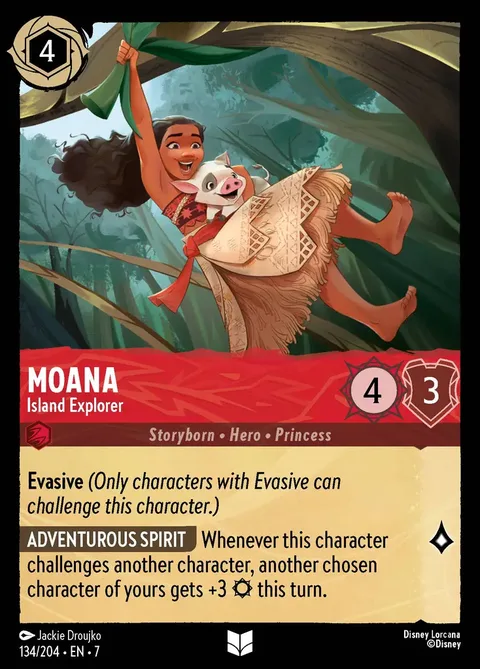 Moana - Island Explorer brings unique abilities to the Lorcana card pool.
1. Open with a 1-cost Ruby character on turn one. Get an inkable card down alongside it if your hand allows. Turn two should be a 2-cost play plus another inkable; the deck stumbles badly when it can't hit that pattern early.
2. Keep Ruby questers attacking every turn from turn three onward. Flynn Rider and Sisu hold the board and push lore while you wait for Mim Fox and the Merlin engine to come online around turns four and five. Don't hold characters back looking for a bigger play; this deck wins on repeated small plays, not one large threat.
3. Land Madam Mim and choose your bounce target. When Mim Snake or Fox resolves, bounce Merlin Goat if you need the extra lore point and can afford to replay him next turn, or bounce Merlin Rabbit if you need the card more than the lore. The ability only ever targets your own board, so there's no "hit their board" mode.
4. Replay the bounced Merlin the following turn. Replaying Merlin Goat nets another lore point on top of the one he earned leaving play; replaying Merlin Rabbit nets another card. A full play-bounce-replay cycle on Goat adds roughly 3 lore across two turns on top of normal questing.
5. Refill with Friends on the Other Side once your hand drops to three cards or fewer. This Song is the next play after inking whenever your hand gets that low, no exceptions; the deck folds when it runs out of plays.
6. Track the race, not the board. Neither Madam Mim form can interact with the opponent's characters, so don't spend turns looking for a way to disrupt them. Every turn spent chasing interaction that doesn't exist in this list is a turn not spent questing or running the recursion loop.
Correction (2026-07-29): this matchup section previously described bouncing Steelsong's characters. Madam Mim only ever targets your own board. The matchup is therefore a lore race for the core engine; if Be Prepared is included, it is a costly symmetric reset rather than selective interaction.
Steelsong floods the board fast with multiple small characters and keeps questing through them. The Merlin/Mim package cannot target or slow those characters. The deck's practical levers are efficient Ruby questing, the extra lore from Merlin Goat, and Be Prepared only when a full reset is worth losing your own board.
Points for navigating this matchup:
Because the core bounce engine can't touch the opponent's board, this matchup is decided almost entirely by who gets ahead on lore first. Treat any specific win-rate percentage for this matchup with caution: it wasn't independently re-verified against a live tracker in this pass.
Correction (2026-07-29): this section previously claimed Mim's bounce "slows" an Items opponent's characters. Since Mim only targets your own board, that's not accurate; the matchup is decided by speed alone.
Ruby/Sapphire Items generates value through Items sitting on the table that compound turn over turn. Amethyst/Ruby has no targeted answer to those Items, and Be Prepared does not remove them; if that Song is included, its character wipe is still symmetric. The main plan is to be faster.
Items decks need time for their item engine to compound. Ruby questers pushing lore on turns one through four, plus whatever extra lore the Merlin Goat/Mim loop contributes, creates a race that a slower Items build has to work to keep up with. Don't hold back questers waiting for a disruption play that doesn't exist in this list; every turn spent not questing is a turn given to their engine to compound further.
Treat any specific win-rate percentage for this matchup with caution: it wasn't independently re-verified against a live tracker in this pass.
If you're newer to Lorcana, the Disney Lorcana ink colors explained guide covers the full picture, but here's the short version for this deck:
Amethyst's return-to-hand effects and card draw give the deck a higher average card count than most Ruby aggro builds. Pure Ruby aggro runs out of cards. Pure Amethyst control is too slow to pressure anything. Together, Ruby covers the early lore push that Amethyst can't provide, and Amethyst covers the hand size that Ruby sacrifices for speed. It's genuinely complementary rather than two inks awkwardly sharing 60 cards.
The real tension is ink slot management. Both colors have strong 4-of candidates, and with 60 cards you can't run everything. Current published lists are useful starting points, but counts for the Merlin and Mim core and the remaining Ruby characters vary by event and pilot preference.
For context on what Wilds Unknown added to support this archetype specifically, the Disney Lorcana Wilds Unknown set guide covers the new cards with meta relevance.
Amethyst/Ruby is an accessible Infinity shell. The most important cards (both Merlin forms, both Madam Mim forms, Flynn Rider, Sisu) are ordinary card-pool pieces rather than required premium variants. The budget pressure comes from the Songs package, specifically Friends on the Other Side, so check current singles prices before buying a full playset.
Cutting one or two copies of the higher-value Songs and running additional character redundancy instead still works in casual and mid-level Infinity play. The engine doesn't depend on one expensive finisher, which makes this one of the better "build up gradually" shells if you're starting from scratch.
Before buying in, the Disney Lorcana complete guide 2026 has a deck building fundamentals section covering inkable ratios and curve distribution that applies directly to decisions about where to spend here.
What is the Lorcana Amethyst Ruby bounce deck?
Amethyst/Ruby is a self-recursion deck: Madam Mim's Snake and Fox forms bounce your own Merlin Goat or Rabbit back to hand, not the opponent's characters, so you can replay them for a second enter-play trigger. Ruby's early questers add lore pressure while the loop runs. It doesn't disrupt the opponent's board at all.
What are the key cards in the Amethyst Ruby bounce deck?
The core is Merlin Rabbit and Goat, Madam Mim Snake and Fox, Flynn Rider (Frenemy), and Sisu (Emboldened Warrior). Merlin Goat gains 1 lore on play and 1 more on any leave-play; Merlin Rabbit may draw a card on both. Mim's bounce targets your own board only. Friends on the Other Side refills your hand.
How does the Merlin/Madam Mim bounce package work?
Madam Mim Snake (2 cost) and Fox (3 cost, Rush) both read "banish her or return another chosen character of yours to your hand," a self-bounce, not opponent removal. Bounce your own Merlin Goat or Rabbit to fire the leave-play trigger, then replay him next turn for a second hit.
How does Amethyst Ruby bounce fare against Amber/Steel Steelsong?
This deck can't bounce Steelsong's board, only its own, so the matchup is primarily a lore race. Quest every turn and run the Merlin Goat/Mim recursion loop as early as possible for the extra lore. If Be Prepared is in the list, reserve it for a position where a symmetric reset is worth losing your own characters.
Is Amethyst Ruby bounce good in Core Constructed?
This specific Merlin and Madam Mim shell is an Infinity Constructed build. After the Attack of the Vine rotation, Core generally uses cards from Fabled onward, so these older engine cards are not a current Core foundation unless an eligible reprint applies. Check the official card gallery or current tournament rules before porting the list to Core.
What is the win condition for Amethyst Ruby bounce?
Lore from questing, plus extra lore from cycling Merlin Goat through the Mim bounce loop, is the deck's main win condition. Each full play/bounce/replay cycle on Goat nets roughly 3 lore across two turns on top of normal questing.
How do you play against Ruby/Sapphire Items with Amethyst Ruby bounce?
Mim's bounce only hits your own board, so it does nothing against an Items opponent's Items. Push lore early with Ruby questers before their item effects compound, and use the Merlin/Mim recursion loop for the extra lore needed to close the race before their value engine takes over.
Related
Union Arena Fullmetal Alchemist Deck Guide: Blue 2026
8 min read

Union Arena Attack on Titan Vol.2: New Yellow Color
8 min read
OP-17 Mihawk Deck Guide: Green Dracule Mihawk 2026
13 min read
Dragon Ball Fusion World FB11 Leaders: All 5 Revealed
8 min read
OP-17 Mihawk Matchup Guide: All 6 Leaders Explained
14 min read