Loading…
Loading…
Shonen TCG · Guides
Reviewing
Disney Lorcana
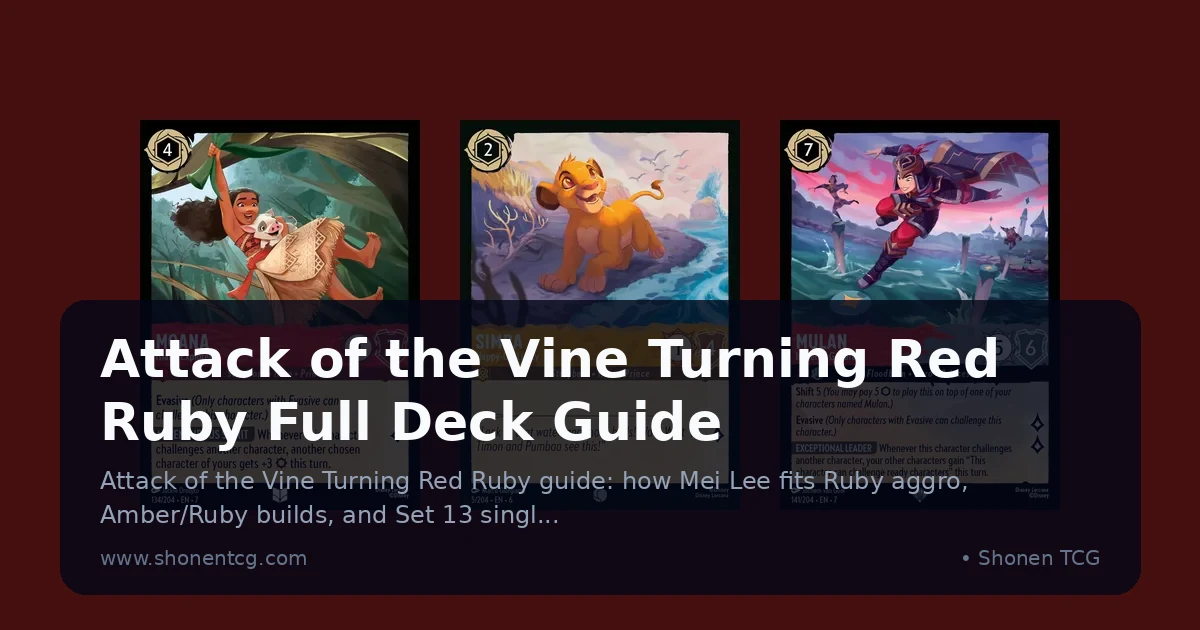
Attack of the Vine Turning Red Ruby content was always coming. The 2022 Pixar film follows a teenager who transforms into an enormous red panda when her emotions run high: loud, overwhelming, impossible to ignore. That's Ruby ink in a sentence.
Attack of the Vine Turning Red Ruby content marks the franchise's debut in Disney Lorcana, and the Set 13 timing puts Mei Lee and her friends into a Ruby pool that already has a competitive backbone. The question isn't whether Turning Red fits Ruby. The question is where exactly it fits and how much it changes existing builds.
TL;DR: Turning Red characters launch in Ruby ink in Attack of the Vine (Set 13, July 24, 2026). Mei Lee's transformation mechanic aligns naturally with Ruby's dual-form aggro cards. Amber/Ruby aggro is the primary home for Turning Red additions, with Ruby/Sapphire Items as a secondary option for slower Ruby players. Wait 24 to 48 hours after the July 17 prerelease before buying singles. Confirmed Pixar IP with Ruby ink makes Turning Red one of the higher-value additions from this set.
Attack of the Vine Turning Red Ruby cards slot most naturally into Amber/Ruby aggro. Ruby ink's identity is aggressive early-game pressure: flood cheap characters, quest fast, close before control stabilizes. Mei Lee fits that pattern. Her transformation mechanic from teenager to red panda suggests she has both a cheap early-game form and a shifted version with higher stats or a relevant ability. That's exactly what Amber/Ruby aggro needs in the two-to-four cost slot.
The secondary landing spot is Ruby/Sapphire Items, which plays slower but still wants Ruby's tempo characters to bridge the early game while Sapphire draws cards and builds item value. Turning Red's supporting cast (Miriam, Priya, Abby) are the kind of two-to-three cost characters that fit that role cleanly.
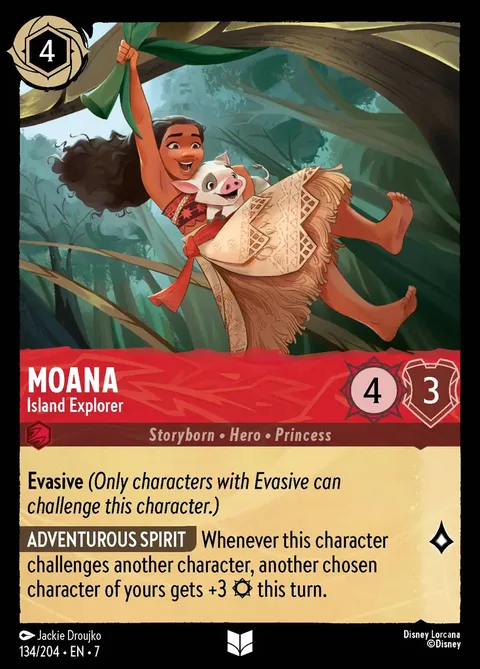 Moana - Island Explorer is one of the key characters in this Lorcana format.
Turning Red joining Ruby ink is one of the better IP-to-ink matchups in Lorcana's history. The film is about emotion running hot: Mei Lee's transformation happens when she can't contain her feelings, her friend group is loud and chaotic, and the entire third act is a kaiju-scale musical showdown. Ruby ink's flavor is fire, passion, and aggression. The fit is thematic and functional.
Mei Lee (Meilin Lee) is the character most likely to define the franchise's Lorcana presence. As a Pixar protagonist with a clear transformation hook, she's a natural candidate for two printings in one set: a base version representing her teenager self and a shifted version representing the giant red panda. In Lorcana, Shift lets you pay a reduced cost to play a card on top of an existing copy, keeping board presence while upgrading. A two-cost Mei Lee shifting into a five-cost red panda version at a two or three Don reduction is a clean, efficient curve.
Her friends from the film (Miriam Mendelsohn, Priya Mahadeshwar, Abby Park) round out the supporting cast. These are the kind of characters who work best as low-cost two-to-three-quester bodies. In Amber/Ruby aggro, those slots matter: you need consistent curves and the deck runs best with redundant cheap characters so you can flood multiple bodies early and apply pressure from two different angles.
The exact card text for Turning Red characters isn't published as of this writing. Set 13 launches July 24. But the thematic mapping is clear: Mei Lee will be Ruby's new centerpiece character at the franchise's debut set, the friends will fill supporting roles, and the transformation hook will express as either Shift or a triggered ability tied to emotion or transformation flavor text.
GODEEPER: See which cards from all six inks have the highest competitive and collector value heading into Set 13. Disney Lorcana Attack of the Vine Best Cards to Pull →
Was this guide helpful?
About the author

TCG Reviews & Guides Editor
TCG reviews and guides editor specialising in set reviews, deck builds, and beginner content across One Piece TCG, Union Arena, Disney Lorcana, and Dragon Ball Fusion World. Known for step-by-step guides that actually work at the local game store level.
Disclaimer
This article is published for informational and entertainment purposes. It does not constitute professional financial, legal, or technical advice. Game performance, online services, patch schedules, and store listings change. Verify critical details (pricing, system requirements, regional availability) with publishers and storefronts before you buy. Affiliate links, where present, help support our editorial work and are labelled in our affiliate disclosure.
Lorcana has handled transformation characters before, and the pattern tends to follow one of two models.
The first is Shift: Mei Lee's base version costs two or three ink, quests for one lore, and has a body size appropriate for early curve. Her shifted version sits at five or six ink, quests for two or three lore, and has a combat ability or passive that rewards the transformation timing, something like "When you play this using Shift, she gets plus two strength until end of turn" or "this character has Evasive."
The second is a triggered ability on a single card: "When this character is challenged and survives, transform: this character gets plus three strength until end of turn." This plays more like a conditional buff than a mechanical transformation, but it captures the feel of Mei losing control.
The thematic detail that matters for speculating here: Mei Lee's red panda transformation in the film is tied to strong emotions and happens involuntarily at first. That maps more naturally to a triggered ability on a single card than to a clean Shift. She doesn't choose to transform; something sets her off. But Shift is the more mechanically efficient design for competitive play, and Lorcana's card team tends to favor functional playability over pure flavor accuracy.
What this means for deckbuilders: don't build around a specific assumption about her mechanics until the card text is confirmed. Build around the type of role she'll fill: an aggressive character that rewards early play and scales into a stronger late-game form, then adjust the supporting pieces once text is out.
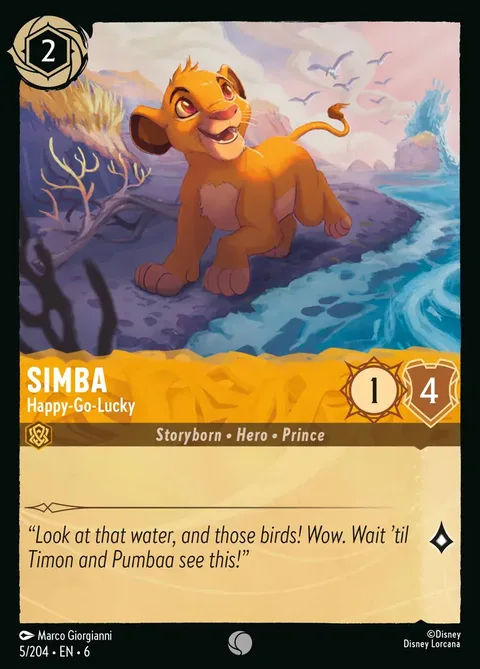 Simba - Happy-Go-Lucky brings unique abilities to the Lorcana card pool.
Amber/Ruby aggro is the most natural home for Turning Red additions. The archetype's plan is straightforward: play cheap characters in the first two turns, quest immediately, and maintain enough board presence that the opponent can't remove everything efficiently.
The core Amber/Ruby build heading into Set 13 runs characters in the one-to-three cost range as the primary engine, with Amber contributing stronger two-cost bodies and some evasion-based characters, and Ruby handling early three-cost tempo plays. Mei Lee's friends slot into that three-cost range cleanly. They provide the bodies the deck needs without disrupting the existing curve.
Mei Lee herself, depending on her stats, likely competes with the existing three-to-four cost Ruby characters for slots. If she enters as a two-cost, she pushes into the Amber side of the mana curve and frees up Ruby slots for more impactful three-drops. If she's a three-cost with a shifted five-cost version, both forms can fit the same deck with minimal restructuring.
The key question for Amber/Ruby aggro is how many Turning Red cards the deck actually wants versus how many it should play to remain consistent. New-set additions to established archetypes tend to look more impactful in the first week than they prove to be by week three. Add one or two Turning Red cards to test. Don't rebuild the whole deck for IP excitement at launch.
Ruby/Sapphire Items plays differently from Amber/Ruby aggro, and Turning Red fits that shell in a different way. This archetype held around 12 percent of Core format share heading into Set 13, making it the third-most-played archetype in the format.
The strategy pairs Ruby's early-game characters with Sapphire's card draw and item synergy. Items in Lorcana are persistent cards that provide ongoing effects: extra lore per turn, stat buffs, draw triggers. Ruby contributes tempo bodies that hold the board while Sapphire builds value through items and card draw. The deck closes slower than Amber/Ruby aggro but has more staying power in longer games.
Turning Red's supporting characters fit here as consistent two-to-three cost bodies that smooth the early game. The distinction from Amber/Ruby is that Ruby/Sapphire Items doesn't flood as aggressively. It needs two or three bodies on board, not five. So Turning Red additions in this shell should be characters with abilities that add value beyond raw questing: card draw on play, item synergy, or a passive that triggers when items are played.
Mei Lee herself is probably too aggressive-leaning for this shell unless her shifted form has a passive ability that synergizes with the item package. Watch for text like "when you play an item, this character gains one lore" or similar triggers that cross-reference items. If her kit has that hook, she becomes more than a Ruby/Sapphire add-on. She becomes a reason to play the archetype.
GODEEPER: For the full picture of which decks are strongest at Set 13 launch, including how all four new Pixar IP additions reshape the meta. Disney Lorcana Attack of the Vine Best Decks Guide →
The buying strategy for Turning Red singles in Attack of the Vine is the same as any launch-week purchase: wait, then move quickly once the data is in.
1. Hold off before the prerelease (before July 17). Mei Lee's speculation price will be elevated. New Pixar IP in a confirmed high-demand ink (Ruby) with a transformation hook is exactly the kind of combination that inflates pack prices and single prices before anyone's actually played the card. Don't buy here.
2. Track the prerelease window (July 17 to 23). Prerelease players start cracking Set 13 product and posting results. This is when you get real information: which Turning Red cards saw play, which looked strong in practice, which disappointed. Watch the community reports rather than buying based on speculation.
3. Buy in the 24 to 48 hour launch window. Single prices on cards that performed at prerelease will spike, and cards that disappointed will drop. The optimal buy window for most competitive singles is 24 to 48 hours after the prerelease event day, when community consensus starts forming but before the launch-week demand spike hits.
4. Budget around Mei Lee's expected premium. Expect her chase print (either the shifted form or an Enchanted version if she has one) to open at a premium. Based on comparable Pixar protagonist cards from recent sets, a strong competitive version of a lead character from a newly introduced IP franchise starts between $8 and $20 and settles within two to three weeks based on actual meta performance.
5. Fill in with the supporting cast if you're on a budget. Miriam, Priya, and Abby are almost certainly cheaper commons or uncommons. Ruby aggro runs a lot of copies of cheap bodies, and those tend to be affordable even from a set with high chase demand. Reserve budget for one or two copies of Mei Lee once her price stabilizes.
For the broader Set 13 deck-building picture, the Disney Lorcana Attack of the Vine best decks guide has the full meta breakdown and which archetypes absorb new cards best.
Is Turning Red in Ruby ink for Disney Lorcana Attack of the Vine? Yes. Confirmed ahead of Set 13's July 24 launch, the Turning Red characters appear in Ruby ink. Mei Lee is the franchise's primary card. Ruby ink's aggressive, fast-flooding identity matches the film's overwhelming teen-energy themes, making this one of the stronger IP-to-ink fits among Set 13's four new Pixar franchises.
What is Ruby ink's core strategy in Disney Lorcana? Ruby ink builds pressure through low-cost characters and fast lore racing. The plan is to quest on turn two or three and keep the opponent reacting rather than building. Ruby doesn't grind well in the late game, so the strategy is to close games before control setups stabilize at turns six or seven.
Which Ruby deck archetypes exist in Set 13 Lorcana Core format? The main Ruby shells in Core format heading into Set 13 are Amber/Ruby aggro and Ruby/Sapphire Items. Amber/Ruby floods cheap characters and rushes lore. Ruby/Sapphire Items pairs Ruby's early bodies with Sapphire's card draw and item synergy for a slower, more resilient game plan. Both can absorb Turning Red additions.
Why does Mei Lee's red panda transformation fit Ruby ink mechanics? Ruby rewards explosive tempo swings. Mei Lee's transformation mirrors that: a cheap early form followed by a high-impact shifted version. Dual-form cards in Lorcana let you play the base version early then pay the Shift cost to upgrade, maintaining board presence. That pattern fits Ruby's curve and tempo goals precisely.
Should I buy Turning Red Ruby singles before or after the Set 13 prerelease? Wait 24 to 48 hours after the July 17 prerelease events. Early copies are priced at speculation. Once players crack packs and report results, prices adjust to reflect actual playability. Mei Lee's opening price will likely drop 20 to 40 percent in the first week unless she proves immediately essential to a top-tier deck.
Does Attack of the Vine release in both Core and Infinity formats? Yes. Attack of the Vine (Set 13) became legal in both Core Constructed and Infinity format on July 17, 2026, the same day Core Constructed rotation took effect. Sets 5 through 8 rotated out that date. Check the official Lorcana site for the current Core rotation boundaries before purchasing older support cards for your build.
What other Pixar franchises join Turning Red in Set 13? Monsters Inc (Emerald) and Up (Sapphire) appear alongside Turning Red in Ruby as Set 13's three new Pixar franchises. Monsters Inc gains the most raw aggro tools. Up adds to Sapphire's draw package. Turning Red in Ruby is the most thematically clean pairing of the three new franchises added in Attack of the Vine.
Related
Union Arena Fullmetal Alchemist Deck Guide: Blue 2026
8 min read

Union Arena Attack on Titan Vol.2: New Yellow Color
8 min read
OP-17 Mihawk Deck Guide: Green Dracule Mihawk 2026
13 min read
Dragon Ball Fusion World FB11 Leaders: All 5 Revealed
8 min read
OP-17 Mihawk Matchup Guide: All 6 Leaders Explained
14 min read