

Shonen TCG · Guides
Attack of the Vine Ruby Steel Upgrade: Full 2026 Guide
The Attack of the Vine Ruby Steel upgrade is one of the more straightforward transitions in Set 13. Ruby gets faster with Turning Red additions. Steel gets a couple of useful options. The Items engine that earned the archetype 12% Infinity meta share stays the same. You're patching two holes, not rebuilding a deck.
TL;DR: Attack of the Vine Ruby Steel upgrade adds 5 to 7 new cards. Ruby gains Turning Red 2-cost characters that fix the deck's early-game speed problem. Steel gains 1 or 2 protection flex options. The Items engine is unchanged. Most competitive builds are a 5-card swap from the Wilds Unknown version, and those 5 cards specifically address the gaps that cost you games before Set 13.
Attack of the Vine Ruby Steel upgrade: quick answer
The upgrade is a 5 to 7 card swap. Ruby adds faster 2-cost characters from Turning Red that improve turns 1 through 3. Steel adds 1 or 2 flex protection options. The Items synergy package doesn't change. Cut your slowest Ruby characters and your weakest single-use Items to make room.
Key Takeaways
- Ruby Steel Items held 12% Infinity meta share in Wilds Unknown and remains competitive in Set 13
- Ruby gains more than Steel: Turning Red 2-cost characters fix a known curve weakness
- Steel adds 1 or 2 useful flex cards but the core protection package stays intact
- The upgrade is 5 to 7 cards replaced, not a rebuild: roughly 50 Wilds Unknown cards carry over
- Cut slow Ruby characters at 5+ cost and single-use Items that underperformed
- Add Turning Red Ruby 2-cost characters (2 to 3 copies), Steel flex options (1 to 2 copies), Items upgrades if Set 13 brings a better version of something you already run
- Budget path: buy Ruby Turning Red additions first, they're reasonably priced at Set 13 launch; assess Steel flex in week 2
 Mulan - Imperial General is one of the key characters in this Lorcana format.
Why Ruby Steel Items survived Set 13
Ruby Steel Items doesn't depend on cards that rotated or got countered into irrelevance. The Items engine is format-stable: persistent card types that generate repeatable value aren't easily disrupted by a new IP set. Attack of the Vine brings Pixar characters with new franchise flavor, but nothing that specifically answers the Items-plus-protection structure the deck runs.
The Wilds Unknown version had two weak points. Ruby's early game was slightly slow: the 2-cost Ruby slot was functional but not dominant, which meant turns 1 through 3 were more passive than an aggro-capable deck should be. Steel's flex options were limited: once you committed to the core protection package, the 57th through 60th card slots didn't have strong Steel candidates.
Set 13 addresses both of those without touching the core. Your established pieces stay correct, new cards fill specific gaps, and there's no tradeoff forced on the proven engine. That's not common for mid-set upgrades.
If you want context on how the Items archetype works and what the Ruby challenge engine does turn-by-turn, the Disney Lorcana Ruby Sapphire Items deck guide covers the core mechanics in detail.
What Attack of the Vine adds to the Ruby side
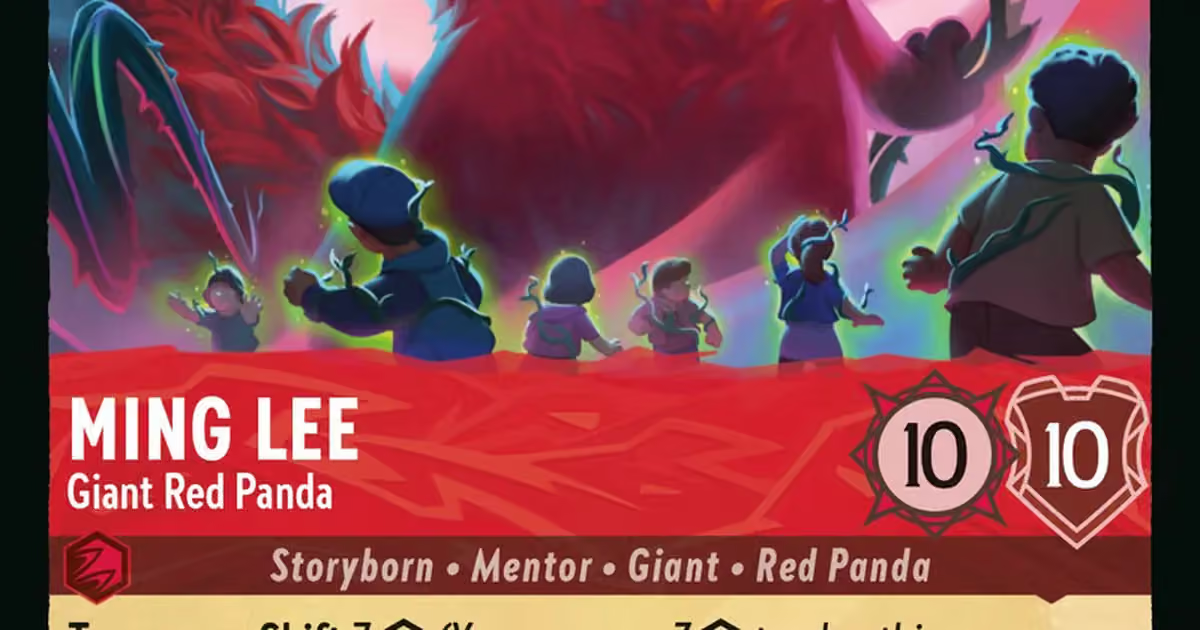
Ruby's Set 13 additions center on Turning Red characters. Meilin Lee variants appear at the 2-cost range with challenge-oriented effects: characters that trade up in combat, return to hand after a successful challenge, or enter with Rush to apply immediate pressure.
Before Set 13, the Ruby 2-cost slot had adequate options but nothing that created actual turn-2 threat density. The Meilin characters fill that gap. One or two copies make turns 2 and 3 more active: you're threatening challenges before opponents have removal online rather than building passively toward turns 4 and 5.
The Turning Red characters suit challenge-heavy play, which is exactly how Ruby Steel operates. Ruby characters that return to hand after winning a challenge are the deck's most efficient pieces: they trade once and reload. At 2 cost, those pieces arrive earlier in the curve than what the deck previously ran. That's not a minor tweak. Getting a meaningful board presence a full turn earlier changes how opponents have to sequence their own plays against you.
Ruby's 4-cost and 5-cost challenge pieces from Wilds Unknown remain the core. Set 13 doesn't introduce Ruby characters at those cost points that clearly outperform what you already have. The additions slot into the 2-cost range specifically. Trying to add Turning Red cards at higher cost points to chase more Ruby density is over-building: the curve already works once you fix the early game.
Two to three copies of the right Turning Red 2-cost character is the target. More than that dilutes the Items package, which is what actually wins late games.
GODEEPER: See which Attack of the Vine cards are showing up in early competitive builds and which archetypes gained the most from Set 13. Disney Lorcana Attack of the Vine Best Decks Guide →
 The Return of Hercules brings unique abilities to the Lorcana card pool.
What Attack of the Vine adds to the Steel side
Steel's Set 13 additions are modest for Ruby Steel Items specifically. The new Steel characters skew toward larger cost points (5 to 6 ink) and protection effects. Most of those slots in the Wilds Unknown list are already covered by Ward-granting characters that performed well, so there's no obvious replacement to make.
One or two Set 13 Steel cards do offer a secondary protection angle: an effect that stacks with existing Ward characters or protects Items specifically rather than just your characters. If your local meta starts running targeted Item removal (which gets more common as players prepare for Steelsong matchups), these secondary pieces give you answers without changing the core structure.
Watch out for the Steel cards designed for Steelsong or Steel-heavy archetypes. Those need Steel ink density to trigger their effects correctly. Ruby Steel Items runs roughly 60% Steel support and 40% Ruby characters. Cards with "if you control 4 or more Steel characters" requirements rarely fire in this build, so don't let a flashy effect on a new Steel card fool you into slotting something that won't actually trigger.
Steel protects what Ruby sets up. That role is the same in the upgraded list as it was in Wilds Unknown. The 1 or 2 flex additions don't change the function; they give you more options when the protection type the meta requires shifts from Ward-granting characters toward Item protection or something adjacent.
The full upgrade path: what to cut and what to add
This is a 5 to 7 card swap.
What stays:
- Your full Items package from Wilds Unknown: Items with repeatable activations are the non-negotiable engine pieces
- Core Steel protection characters with Ward effects: still the best available at those cost points
- Ruby challenge pieces at 3 to 5 cost: these are what generated the meta share and they didn't get replaced
- Any Steel Shift chain you're running: Shift efficiency is format-stable across transitions
What to cut (2 to 4 cards):
- Ruby characters at 5+ cost that consistently arrived one turn too late against fast matchups: these were always the weakest slots in the Wilds Unknown list
- Single-use Items that activated once and sat as dead resources after: if you ran any Items with one-time abilities rather than repeatable ones, Set 13 may bring a better version
- Redundant Ruby counts at any cost point where you're running 4 copies but realistically drawing 2 per game: trimming from 4 to 3 on one Ruby character creates room for the Turning Red additions
What to add (5 to 7 cards):
- 2 to 3 Turning Red 2-cost Ruby characters: these go in immediately, no testing phase required
- 1 to 2 Steel flex protection cards from Set 13: check your local meta first, then decide which one applies
- 1 to 2 Items if Set 13 introduces an upgraded version of one you already run: Items upgrades are direct replacements, not additional slots
The remaining 53 or so cards from your existing list carry over. That's the practical upside of playing an archetype whose engine is Item card types rather than specific characters. You don't get punished by a single rotation or a single pushed card that invalidates your pieces.
GODEEPER: Track buy, hold, and sell verdicts for the specific Set 13 singles that affect Ruby Steel pricing and availability. Disney Lorcana Attack of the Vine Buy Hold Sell Week 1 →
Step-by-Step: upgrading Ruby Steel Items for Set 13
1. Confirm your Items package and core protection pieces stay untouched. Your full Items engine, core Steel Ward characters, Ruby challenge pieces at 3-5 cost, and any Steel Shift chain don't move regardless of what Set 13 offers. These generated the archetype's 12% meta share and nothing in Set 13 replaces them.
2. Cut 2-4 underperforming cards to make room. Drop Ruby characters at 5+ cost that consistently arrived a turn too late, single-use Items that activated once and sat dead afterward, and any redundant Ruby count where you're running 4 copies but realistically drawing 2 per game.
3. Add 2-3 Turning Red 2-cost Ruby characters. These go in immediately with no testing phase required; they fix the deck's known early-game speed problem by giving you turn-2 threat density the Wilds Unknown list never had.
4. Add 1-2 Steel flex protection cards based on your local meta. Check whether your area is trending toward targeted Item removal before committing a slot; these secondary protection pieces don't replace your core Ward characters, they cover a gap your existing package doesn't.
5. Swap in any Set 13 Items only as direct replacements. If Attack of the Vine introduces an upgraded version of an Item you already run, replace that specific card rather than adding a new slot; the Items count itself shouldn't grow.
6. Re-test against Bounce and Steelsong specifically after the swap. Favor Items with reactivation abilities over one-time effects if Bounce is common locally, and track your lore totals against Steelsong to know when to shift from challenging to questing before their lore lead closes.
Matchup adjustments in Set 13
The matchup spread shifts slightly. Set 13 improves some of the decks you were already struggling against, while the new aggro builds actually work in your favor.
Versus Steelsong (19% Infinity). This doesn't get easier. Steelsong's upgrade (covered in the Attack of the Vine Amber Steel upgrade guide) keeps the singer protection structure intact. Ruby challengers still struggle to reach protected singers before lore totals get out of range. Your win condition is Items advantage: more persistent value sources than Steelsong can remove in a single turn. That's been true since Wilds Unknown and it's still true in Set 13.
Versus Bounce (16% Infinity). Bounce gets new Amethyst tools in Set 13, which means the deck now has more ways to return your characters mid-board development. That's specifically disruptive to Ruby Steel's plan of building an Items board and challenging from behind protection. The adjustment: favor Items with reactivation abilities rather than one-time effects. Items that generate value on the turn they come back from a bounce maintain pressure even when the board gets reset around them.
Versus new Emerald Aggro builds. This is actually your improved matchup. Monsters Inc additions give Emerald real turn-1 and turn-2 threat density, which looks scary on paper. But Ruby challengers can reach non-Evasive Emerald characters, and the Turning Red 2-cost additions you're adding let you contest their board earlier rather than letting Emerald go wide before your removal comes online.
Budget path for new players
Players starting Ruby Steel Items after Set 13 have a real budget advantage over Steelsong builders. Wilds Unknown is the older set now, which means singles prices have stabilized. You're not paying launch-week premiums on the core.
Start with the Items package. Go to inkdecks.com, filter to Infinity, Ruby, Steel, and look for the 8 to 10 Items that appear across multiple lists. Those are the pieces every pilot agrees on. They also don't rotate when Sets 5-8 leave Core, so you're not buying into cards that disappear from the format in a few months.
Next, add the Ruby challenge pieces at 3 to 5 cost. Then grab the Turning Red 2-cost additions from Set 13. These are freshly released and reasonably priced in launch week compared to what peak-demand Wilds Unknown Ruby pieces cost when that set was new.
Steel comes last. Run 7 or 8 Steel pieces instead of a full count at first. The Set 13 Steel additions are flex cards, not necessities. The deck functions fine with the Wilds Unknown Steel core while you figure out which flex options actually matter for your local meta.
For context on what Attack of the Vine singles cost at launch and which ones are worth prioritizing, the Disney Lorcana Attack of the Vine best decks guide (linked above) breaks down which archetypes gained meaningfully and which stayed flat.
Tips for the upgraded Ruby Steel list
Ruby challengers that return to hand after winning a challenge are your most important pieces. A 3-cost Ruby character that removes a 5-cost opposing character and reloads to your hand is effectively a 2-for-1. Playing around that specific pattern dictates challenge sequencing for the whole game. Don't burn those characters on challenges they can't win cleanly.
Don't over-extend Items. Three Items in play by turn 3 is usually too many. One Item is a resource. Two Items are a resource engine. Three Items in turns 1 through 3 means your Ruby challenge pieces haven't arrived yet and your board is all support with no threat. One Item turn 2, one Ruby challenger turn 3 is the pattern that makes turns 4 and 5 actually work.
In Bounce matchups, play Items that activate the turn they enter whenever possible. "When you play this" triggers are harder to punish with a bounce than Items that need a separate activation turn. If you get bounced after setting up an Item, you want the value already banked, not sitting on a trigger you haven't used yet.
Against Steelsong specifically: count lore totals. Steelsong generates lore at a pace that outpaces challenge-based board control if you let it. Your win condition is Items advantage reaching a point where you generate more lore per turn than their singers quest. Know when that crossover happens so you can decide whether to keep challenging or shift to questing with your own characters before the lore gap closes.
Frequently Asked Questions
How many Attack of the Vine cards does Ruby Steel Items need? Most competitive builds add 5 to 7 new Set 13 singles. Ruby gains the most from Turning Red additions at the 2-cost slot. Steel adds 1 or 2 flex cards. You're swapping existing underperformers rather than rebuilding from scratch: roughly 50 cards from the Wilds Unknown version carry over untouched.
Is Ruby Steel Items still viable after Attack of the Vine releases? Yes. The archetype held 12% Infinity meta share entering Set 13 and the core engine, Ruby challenge removal backed by Steel protection and Items synergy, remains intact. Early Set 13 results show Ruby Steel maintaining top-tier local placings with the right Turning Red additions and one or two Steel flex swaps.
What does Attack of the Vine add to the Ruby side of the deck? Ruby gains the most from Turning Red characters. Meilin-based 2-cost options bring faster early-game threat density that the deck previously lacked. Before Set 13, the Ruby package was consistent but slightly slow on turns 1 and 2. The Turning Red additions fix that gap directly.
What does Attack of the Vine add to the Steel side of the deck? Steel gains modestly. The most useful additions are 1 or 2 protection-oriented characters in the 4-5 cost range. These don't replace your core Steel pieces but give you more options when the meta shifts toward disruption-heavy matchups. Steel's role in the deck doesn't fundamentally change.
Is Ruby Steel Items worth building for new players after Set 13? Yes, particularly if your local meta includes non-Evasive midrange decks that Ruby challengers can reach efficiently. The Wilds Unknown core is widely available as the second or older set, which keeps singles prices reasonable. Picking up 5 to 7 Set 13 additions on top of a pre-built core is a low-cost entry path compared to building Steelsong from scratch.
What should I cut from the Wilds Unknown Ruby Steel list for Set 13? Target the 2 to 4 spots that performed least consistently: over-costed Ruby characters that arrived too late to have combat impact, and any Items with single-use effects that generated less ongoing value than expected. Don't cut your core Items package or Steel protection pieces regardless of what Set 13 adds.
Related Reading
- Attack of the Vine Turning Red Ruby Guide: Deeper look at the Meilin Lee cards this upgrade leans on for its 2-cost Ruby additions.
- Lorcana Attack of the Vine: Temporary Shift and Hunny Guide: How Set 13's new mechanics interact with existing Shift chains in decks like this one.
- Disney Lorcana Attack of the Vine Prerelease Guide 2026: If you're building this shell from prerelease pulls instead of upgrading an existing list.
- Disney Lorcana Complete Guide 2026: Full Lorcana hub covering ink colors, formats, set history, and how Attack of the Vine fits into the game's competitive landscape.
References
Was this guide helpful?
About the author
Reviews and guides
Pen name for the Shonen TCG desk's set reviews, deck builds and beginner guides across One Piece TCG, Union Arena, Disney Lorcana and Dragon Ball Fusion World.
- Prices read from TCGplayer and Cardmarket listings, dated
- Pull rates tied to a stated sample
- Opinions marked as ours, with the reason
Keep reading
Attack of the Vine Amethyst Ruby Upgrade Full Guide
Guides · 11 min

Attack of the Vine Lore Rush Guide: Win Fast in Set 13
Guides · 9 min
Attack of the Vine Amber Steel Upgrade: Full Guide
Guides · 10 min
Attack of the Vine Monsters Inc Characters Card Guide
Guides · 13 min
Attack of the Vine Amethyst Hunny Full Deck Guide 2026
Guides · 11 min

Attack of the Vine Turning Red Ruby Full Deck Guide
Guides · 11 min
Attack of the Vine Up Sapphire Guide: Carl and Dug
Guides · 10 min

Disney Lorcana Emerald Aggro Upgrade Attack of the Vine
Guides · 11 min
Disclaimer
This article is published for informational and entertainment purposes. It does not constitute professional financial, legal, or technical advice. Game performance, online services, patch schedules, and store listings change. Verify critical details (pricing, system requirements, regional availability) with publishers and storefronts before you buy. Affiliate links, where present, help support our editorial work and are labelled in our affiliate disclosure.