Loading…
Shonen TCG · Guides
Union Arena Keywords Glossary: Every Term Explained
Reviewing
Union Arena
This Union Arena keywords glossary exists because the game throws a lot of terminology at new players in the first few games. AP, BP, Raid, Impact, trigger types. I remember getting stuck on exactly one of these for way too long, because the same two-letter term meant two completely different things depending on which set I was reading about. This glossary puts every confirmed keyword in one place so you're not hunting across five different articles mid-game.
TL;DR: Union Arena's core terms: AP (Action Points) is your resource for building the energy line, and confusingly, "AP" is also a top rarity-tier name on some sets, unrelated to the resource. BP (Battle Points) is combat power. Raid stacks a stronger form onto a character. Impact deals extra Life damage on a battle win, even through a block, the strongest keyword in the game. Triggers (Get, Draw, Special, Color, Final, Active) fire when a Life card is taken. Snipe lets an attacker reach an otherwise unreachable character, and Nullify Impact is the direct counter to Impact.
Union Arena keywords glossary: quick answer
The one term that trips up more new players than anything else is AP, because it means two unrelated things. Everywhere else, Union Arena's keywords stay consistent across sets: Raid, Impact, and the six trigger types work the same way whether you're playing Bleach, Solo Leveling, or the newest IP release. Learn these once and they carry over to every set you pick up.
GODEEPER: Want the full turn structure these keywords plug into? Start here. Union Arena How to Play: Rules & Turn Flow
Resource and Board Terms
AP (Action Points), the resource
AP is what you spend on your turn to place cards onto your energy line. You can hold up to four cards on your energy line, and resting them generates energy in their color, the fuel you spend to deploy Characters onto your front line. AP is the very first system a new player touches every single turn.
AP, the rarity tier (a completely different thing)
Here's the trap that got me the first time I saw it: on certain sets, "AP" is also the name of a collector rarity tier sitting above standard Super Rare, and it has nothing to do with the resource above. It first showed up as a hand-signed, serial-numbered chase tier on the 100 Girlfriends set, and the Chainsaw Man set reuses the same two letters for its own rare chase cards. If you see "AP cards" in a community post, check whether they mean the resource or the rarity before you assume, because both readings are correct depending on context.
Energy Line
The zone where AP-funded cards sit and generate energy when rested. Capped at four cards. Building this early is how you ramp toward bigger Characters later in the game.
Front Line
Where your Character cards actually fight, up to four at a time. Front-line Characters attack and block; an unblocked attack takes a Life card from the defender.
BP (Battle Points)
A character's raw combat power, printed directly on the card. When two characters battle, higher BP wins, full stop. It's the single number you compare in almost every combat decision.
Life Cards
Each player starts with 7 Life cards face down. An unblocked attack takes one into the defender's hand. Take all 7 and you win. Because Life cards refill your hand and can carry triggers, taking damage isn't purely bad, which is exactly why the losing player can still claw back a game.
GODEEPER: Ready to put these terms into a real 50-card list? Union Arena Deck Building Guide
Combat Keywords
Raid
Union Arena's transformation mechanic. You play a stronger Character on top of an existing base character (representing a power-up or transformation), pay the Raid card's AP and energy cost, and the character keeps fighting as the upgraded form in the same front-line slot, now with higher BP and a new ability. Raid is efficient because it upgrades a body you already have instead of spending a fresh slot, but it needs the base character alive and in play first.
Impact
The strongest keyword in the game, and honestly, once you understand why, half of Union Arena's deckbuilding logic clicks into place. When a character with Impact wins a battle, the opponent takes Life anyway, even if they blocked. Most combat lets a defender trade a blocker to keep their Life safe. Impact removes that safety net entirely. The notation looks like Impact (+1), meaning the opponent takes 1 extra Life card on a win; some effects push that number higher. Nearly every competitive deck runs at least one Impact attacker, because it's the keyword that most directly converts board advantage into the actual win condition.
Nullify Impact
The direct counter to Impact. A card with this ability stops an opponent's Impact from taking Life when it wins a battle. Outside of Nullify Impact, the other counterplay is simpler: block with a character that wins or ties, remove the Impact attacker before it connects, or just don't feed it a favorable fight.
Snipe
Lets an attacker reach a character it normally couldn't target. On its own it's a targeting tool, but paired with Impact it becomes one of the most efficient combat plays in Union Arena: you remove a specific problem character AND still take Life in the same swing, a two-for-one that hits both the board and the Life total at once.
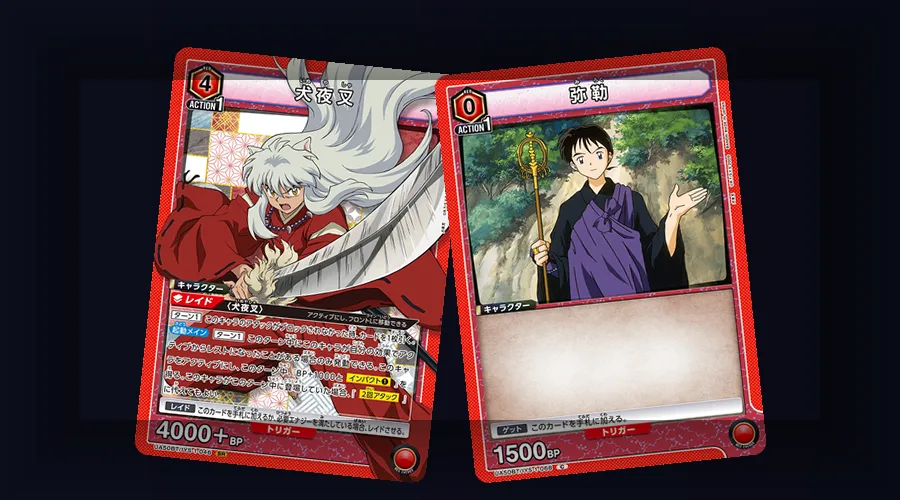 Inuyasha's real card (left) prints both the Raid keyword and an Impact value directly on the card; Miroku's card (right) shows a Get trigger icon at the bottom, three of this section's keywords on two real cards.
The Six Trigger Types
Triggers fire when a Life card is taken by an attack, never when drawn normally. Reveal the card, check its icon, and you may resolve the effect before it joins your hand.
- Get: a card-specific effect; read the printed text since there's no single universal rule for it
- Draw: draw an extra card, pure card advantage on top of the Life card itself
- Special: a card-specific, usually powerful effect, the high-impact trigger type
- Color: an effect tied to your deck's color, common and reliably stabilizing
- Final: a comeback-oriented effect, strongest when you're down to your last few Life cards
- Active: switches a character to active with a temporary boost
Special, Color, and Final are "limited triggers": a deck can run at most 4 copies of each, and 12 total across all three combined. Get, Draw, and Active carry no such cap. This matters at deckbuilding time, since it hard-caps how much a list can lean on the flashiest, most game-swinging trigger types.
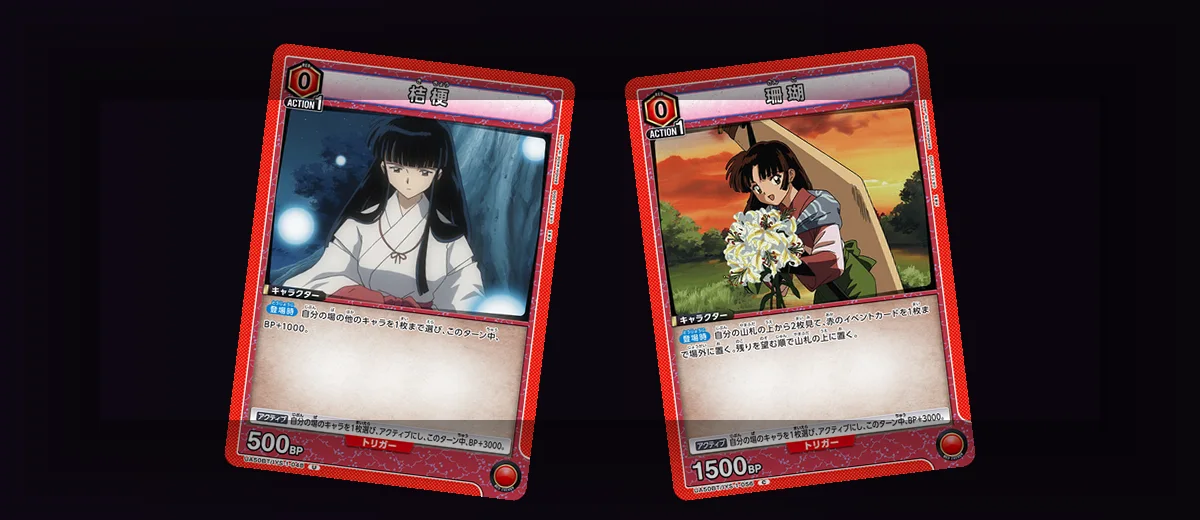 Kikyo (left) and Sango (right) both carry a printed Active trigger, the icon and text you'd actually see revealed off a Life card during a game.
GODEEPER: Want the full breakdown of how each trigger type actually plays out mid-game? Union Arena Trigger System Explained
Step-by-Step: How These Keywords Play Out in a Turn
Reading definitions in isolation only gets you so far. Here's the actual sequence these terms follow during a real turn, so you can see how they connect.
1. Spend AP to build your Energy Line. You place cards onto your four-slot Energy Line using AP, the resource system every turn starts with. This is the AP-the-resource meaning, not the rarity tier.
2. Rest Energy Line cards for energy in their color. Resting a card on the Energy Line generates the energy you spend to deploy Characters. This is the fuel that pays for everything in your Front Line.
3. Deploy Characters to the Front Line, sometimes using Raid. Play a fresh Character with energy, or Raid a stronger form onto a base character already on the field. Either way, the goal is Front Line pressure.
4. Attack and compare BP. When your Character attacks, its BP is compared against any blocker's BP. Higher BP wins. If the attacker has Impact, the opponent takes Life even on a successful block.
5. Reveal the Life card and check its trigger. An unblocked attack forces the defender to take a Life card. They reveal it, check the icon (Get, Draw, Special, Color, Final, or Active), and may resolve the effect before it joins their hand.
6. Repeat until someone's Life cards run out. Both players cycle through this loop turn after turn. Nullify Impact and Snipe are the counterplay and targeting tools that show up along the way, not separate phases of their own.
Deck Construction Terms
A 50-card Union Arena deck is built from three card types: Characters (your board, blockers, and attackers, the majority of any deck), Events (removal, combat tricks, and value effects), and Fields (persistent effects, when a set supports them). Most formats require a single-IP deck, meaning every card comes from one anime set, with a max of 4 copies of any card by name.
Rarity Terms (Not to Confuse With Keywords)
Union Arena's card rarities run Common, Uncommon, Rare, Super Rare, then a special parallel or alternate-art tier above SR that varies by set and drives collector value. These are cosmetic only; a parallel card plays identically to its standard version. This is where the AP-rarity naming collision from earlier lives, some sets label their top chase tier "AP," which has nothing to do with the Action Point resource.
GODEEPER: Want the complete rarity breakdown with pull rates and what to actually chase? Union Arena Card Rarities Explained
Tips
Write down the AP distinction the first time you see it confuse you. Every new player hits the AP-resource-versus-AP-rarity wall at least once. Once you've mentally separated them, it never trips you up again.
Track the opponent's likely triggers before pushing their Life low. A deck heavy on Special or Final triggers can punish careless attacks, since Union Arena's whole trigger system exists to keep the losing player dangerous.
Build at least one Impact attacker into any competitive list. A deck with zero Impact has no clean way to convert board advantage into an actual win, since blocking otherwise fully protects Life.
Don't assume a community-coined nickname is an official term. Union Arena content across the web sometimes labels a deck or line with a catchy name that isn't an official Bandai term, only the printed card text and the keywords in this glossary are official.
Key Takeaways
- AP means two unrelated things: the Action Point resource, and a rarity tier on some sets, context decides which
- BP (Battle Points) is combat power; higher BP wins a battle
- Raid stacks a stronger Character on top of an existing base, paid with AP and energy
- Impact deals Life damage on a battle win even through a block, the game's strongest keyword
- Nullify Impact counters Impact directly; Snipe reaches otherwise-untargetable characters
- Six trigger types exist (Get, Draw, Special, Color, Final, Active); Special/Color/Final are capped at 4 each, 12 total
Related Reading
- Union Arena Raid Mechanic Explained: Everything about the transformation system.
- Union Arena Impact Keyword Explained: Why Impact is considered the strongest keyword in the game.
- Union Arena TCG Beginner Guide 2026: The starting point if these keywords are your first exposure to the game.
- Union Arena Beginner Mistakes: 8 Errors to Stop Making: Common early misplays once you know what these terms mean.
- Union Arena Tournament Guide 2026: Where these keywords matter most, competitive format and prep.
Frequently Asked Questions
What does AP mean in Union Arena? It depends on context. AP (Action Points) is the resource spent on your energy line every turn. Separately, some sets (100 Girlfriends, Chainsaw Man) name their top collector rarity tier "AP" too, unrelated to the resource.
What is the strongest keyword in Union Arena? Impact. It deals Life damage on a battle win even through a block, converting board advantage directly into the win condition.
What is Raid? Union Arena's transformation mechanic: play a stronger Character on top of an existing base, pay AP and energy, and it fights on as the upgraded form.
How many trigger types are there? Six: Get, Draw, Special, Color, Final, and Active. Special, Color, and Final are capped at 4 copies each, 12 total in a deck.
What does BP mean? Battle Points, a character's combat power. Higher BP wins a battle between two characters.
What is Snipe? An ability that lets an attacker reach a character it couldn't normally target, especially strong paired with Impact.
References
- Union Arena Official Rules: official rules hub and rule manual
- Union Arena Official FAQ: confirms trigger types and deckbuilding caps
- Union Arena Card List: official card database showing keyword text on real cards
- r/unionarena: community rules and terminology discussion
Was this guide helpful?
About the author
RN
Beginner Guides & Crossover Writer
Anime fan turned TCG content creator. Bridges the gap between anime fandom and card game strategy. Covers beginner guides, anime-to-TCG crossover content, and Union Arena.
- TCG content creator since 2022
- Specializes in onboarding new players
- Covers Union Arena multi-IP content
- Bridge between anime fandom and TCG community
Disclaimer
This article is published for informational and entertainment purposes. It does not constitute professional financial, legal, or technical advice. Game performance, online services, patch schedules, and store listings change. Verify critical details (pricing, system requirements, regional availability) with publishers and storefronts before you buy. Affiliate links, where present, help support our editorial work and are labelled in our affiliate disclosure.