Loading…


Shonen TCG · Guides
Union Arena Card Grading Guide: Is It Worth It in 2026?
Reviewing
Union Arena TCG
Union Arena card grading is worth it for a much smaller slice of the card pool than most grading guides for anime TCGs assume.
Two things work against Union Arena here that don't apply the same way to a game like One Piece TCG. First, the card pool is split across more than 20 separate single-IP booster sets, so collector demand for any one character never concentrates the way it does in a game with one continuous card pool. Second, PSA closed its cheapest submission tiers in June 2026, which raised the real-dollar floor a card needs to clear before grading makes sense at all. Put those together and grading Union Arena cards is a much narrower opportunity than it looks.
TL;DR: Union Arena card grading clears PSA's cost math (now $79.99 minimum per card) only for SR*** chase cards worth roughly $250 or more raw, a group limited to the most popular characters in the most popular IP sets: Sung Jinwoo (Solo Leveling), Reze (Chainsaw Man), Tanjiro Kamado (Demon Slayer), and Asta (Black Clover) have all traded above $1,400. CGC's $17-20 tiers lower the practical floor to roughly $50-60. Nearly every Common, Uncommon, and standard SR in the game, which is most of what's printed, doesn't clear either threshold.
Union Arena card grading: quick answer
Grading means submitting a card to PSA, CGC, or BGS, which authenticate it and assign a numeric condition grade before sealing it in a tamper-proof slab. For Union Arena, it only makes financial sense on the handful of SR*** parallel cards from the game's most in-demand characters, roughly $700 raw and up. Everything below that, which covers the vast majority of cards printed across Union Arena's 20-plus English sets, doesn't clear grading fees once shipping and insurance are added.
Key Takeaways
- PSA's cheapest current tier is $79.99 per card (Regular), following a June 2026 pause on everything under $80
- CGC remains far cheaper: $17/card Bulk and $20/card Economy, both well under PSA's floor
- Only Union Arena's SR*** chase cards from top-demand characters clear a realistic grading threshold; most sit at $700-2,250 raw
- Star count doesn't reliably predict price. A single-star SR from Demon Slayer has traded above $1,300, higher than some triple-star cards from less popular sets
- Union Arena's 20-plus separate IP sets spread collector demand thinner than a single-continuity game like One Piece TCG
- No Union Arena-specific centering defect pattern has surfaced in community discussion; use PSA's universal 55/45 centering standard as your baseline
What Actually Sells High in Union Arena (and What Doesn't)
Union Arena's base rarity ladder runs Common, Uncommon, Rare, then Super Rare, and commons and uncommons sell for close to nothing individually, per the site's own Union Arena card rarities guide. Above standard SR sit the special parallel treatments, marked with one, two, or three stars (SR*, SR**, SR***), which is where essentially all of the game's real secondary-market value lives.
Real examples confirm the pattern, and they also complicate the assumption that more stars automatically means more money. Sung Jinwoo (022), the SR*** signature parallel from UE17BT Solo Leveling, has traded around $2,000-2,038. Reze (031), SR*** from UE22BT Chainsaw Man, has traded around $2,100. Tanjiro Kamado (008), SR*** from UE05BT Demon Slayer, has been reported between roughly $1,400 and $1,900 depending on the listing source. Asta (075), SR*** from UE08BT Black Clover, has traded around $1,633.
Here's the part that surprised me pulling this data together: Nezuko Kamado (021), a single-star SR* from UEX05BT Demon Slayer Vol.2, has traded around $1,324, higher than plenty of triple-star cards from less popular sets. Star count tells you print scarcity within a set. It does not tell you demand. Character and IP popularity drive Union Arena prices more than the rarity marker does, which is a genuinely different pattern from how OPTCG's Manga Rare tier works.
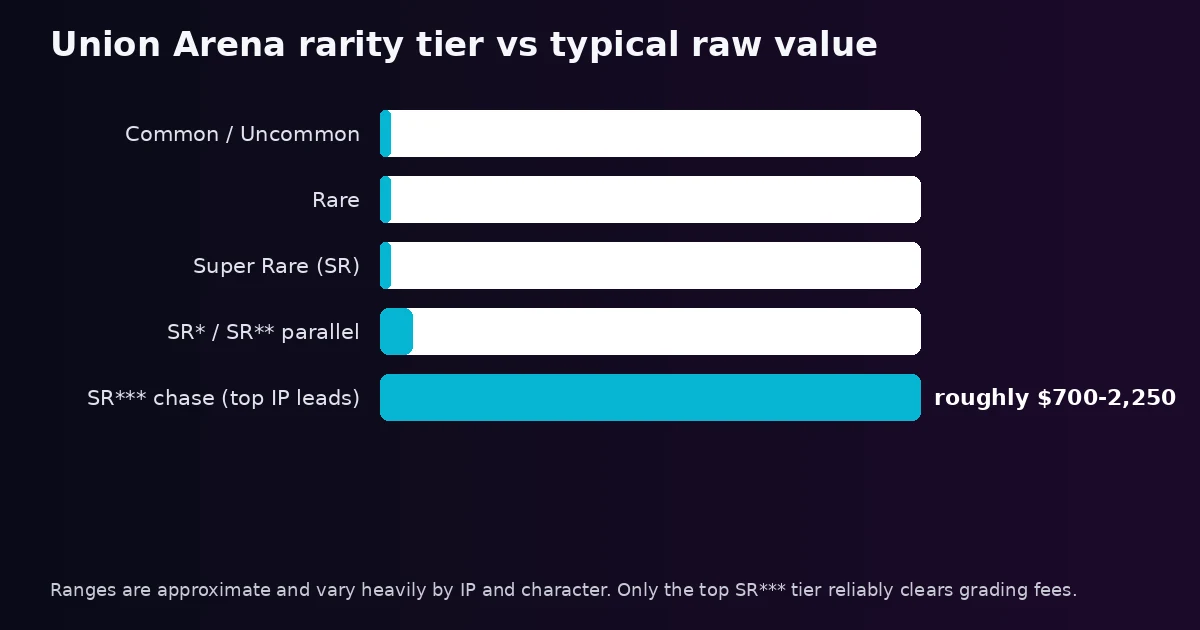 The jump from standard SR to SR** parallel is where nearly all of Union Arena's grade-worthy value concentrates. Everything below it sits well under any viable grading floor.*
Above even the SR*** tier sit serial-numbered and tournament-promo cards that were never sold at retail: a serialized Solo Leveling AP print has traded around $6,500, and Championship-promo cards like a regional Ichigo Kurosaki have sold around $1,500. Those aren't buyable through normal channels, so they don't belong in a practical grading discussion, the same way tournament promos don't belong in a Fusion World or One Piece TCG price list.
GODEEPER: Want a game-by-game comparison of where anime TCG grading actually makes financial sense? The Fusion World grading guide walks through the same math for a different, mid-priced game. Dragon Ball Fusion World Card Grading Guide →
Union Arena Card Grading: PSA vs CGC
| Service | Cheapest current tier | Turnaround | Card value it fits |
|---|---|---|---|
| PSA Regular | $79.99/card | 40-60 days | Roughly $250+ raw to make financial sense |
| PSA Express | $150/card | 15-20 days | Roughly $450+ raw |
| CGC Bulk | $17/card (25-card minimum) | 150 days | Roughly $50-60+ raw |
| CGC Economy | $20/card | 90 days | Roughly $60-75+ raw |
| CGC Standard | $55/card | 10 days | Roughly $180+ raw if you need it fast |
PSA closed its Value Bulk, Value, Value Plus, and Value Max tiers, all previously under $80 per card, on June 2, 2026, after a submission spike pushed its backlog toward 14 million cards. Regular, at $79.99, is what's currently open, and PSA has tied reopening the paused tiers to bringing the backlog down to 5 million. That single change moved the realistic minimum grading candidate for a lower-priced game like Union Arena from roughly $80 to roughly $250.
Both services genuinely offer Union Arena card grading. PSA 10 and CGC-slabbed Union Arena singles are already selling on eBay and TCGPlayer, spanning sets from Code Geass to Solo Leveling, which confirms this isn't a hypothetical submission category. Worth knowing before you pick a side: PSA's parent company now owns BGS too, our PSA vs BGS vs CGC comparison covers what that ownership shift actually means for submitters.
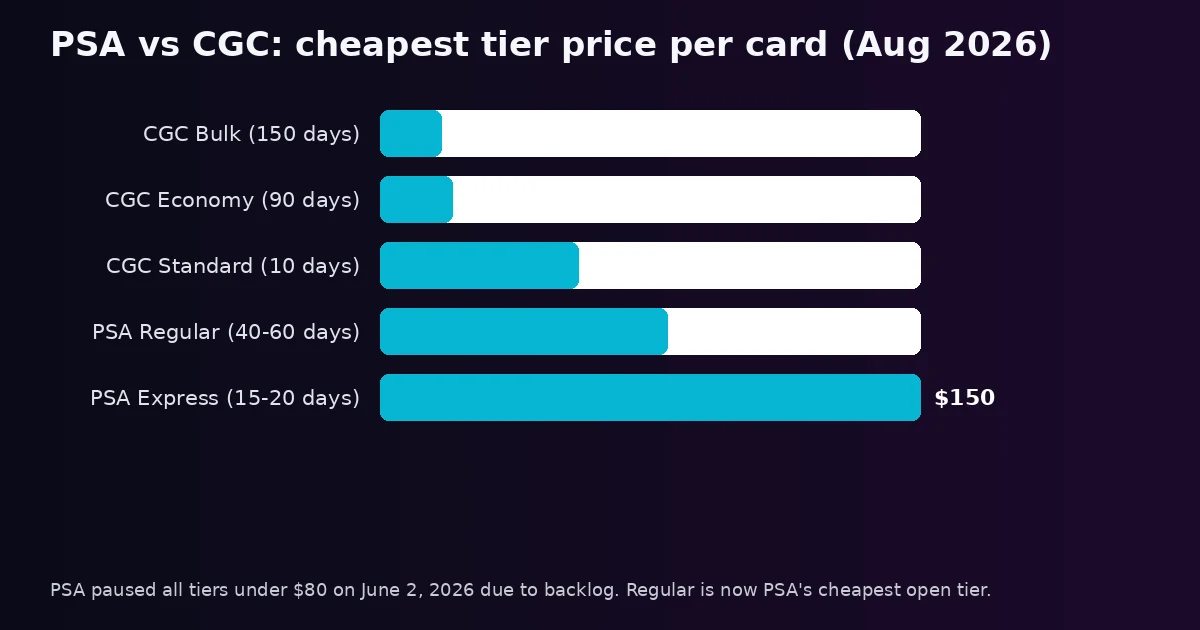 The same PSA tier pause that reshaped grading math for every TCG in 2026 hits a lower-priced game like Union Arena hardest, since fewer cards clear the new floor.
Condition Factors: What Makes a Union Arena Card Grade Well
Foil and parallel treatment. SR* through SR*** cards carry increasingly heavy foil stamping, and Precious-tier booster packs give even low-rarity cards a holographic finish. Foil surfaces show fine scratches under angled light that are invisible under normal indoor lighting, so inspect every foil card at a low angle under a bright source before deciding to submit it.
Centering. PSA's standard is roughly 55/45 on both axes for a 10. No widely reported Union Arena-specific centering issue has turned up in research for this guide, unlike, say, early OP-16 pull reports that flagged a specific skew. Treat each card individually: check all four border widths under bright light rather than assuming a set-wide pattern either way.
Corners and edges. The same standard as any TCG applies: visible corner whitening caps a card around PSA 9, and rough or nicked edges (usually from careless pack-pulling or a low-quality sleeve) dock the grade further. Sleeve every card immediately after pulling it if you think it might be a submission candidate.
Which Union Arena Cards to Actually Grade
The short version of Union Arena card grading decisions: only a small tier of cards clears the bar, and star count alone won't tell you which ones.
Grade: SR*** parallels of a set's headline character, if raw value is at or above roughly $700-1,000. Sung Jinwoo, Reze, Tanjiro Kamado, and Asta are the clearest current examples, all trading well above PSA's $250 realistic floor with real premium room left over.
Consider CGC only: SR* or SR** parallels in the roughly $60-300 range, where CGC's cheaper tiers still make sense but PSA's fees would eat most of the upside. Nezuko Kamado's SR* is the clearest example that a lower star count doesn't disqualify a card from this tier.
Skip entirely: any Common, Uncommon, Rare, or standard (non-parallel) SR. Per the game's own rarity structure, these sit at or near zero individual value regardless of condition, and no grading tier recovers that math.
Step-by-Step: Submitting a Union Arena Card for Grading
Once a card actually clears the cost math above, here's the real submission sequence.
1. Inspect the card under raking light first. Angle a bright light source across the foil surface before committing to a submission fee. Scratches in SR* through SR*** foil layers are invisible under normal indoor lighting and are one of the more common reasons a Union Arena submission returns below Gem Mint.
2. Check all four border widths for centering. Use PSA's roughly 55/45 standard on both axes as a baseline, since no Union Arena-specific centering defect has turned up in community research. Measure each card individually instead of assuming a set-wide pattern.
3. Match the card's raw value to the right service tier. A card in the $250-450 range fits PSA Regular at $79.99; above $450, PSA Express at $150 is worth the faster turnaround. A card at $50-180 raw fits CGC's Bulk, Economy, or Standard tiers instead. Sending a $150 card to PSA when CGC's Economy tier would have covered it profitably is the most common cost mistake in this hobby.
4. Sleeve and pack the card exactly to the service's current guidelines. Use a rigid card saver, not just a penny sleeve, and follow PSA's or CGC's published packaging instructions. Both services have delayed or bounced submissions over improper packaging.
5. Plan around the turnaround window before submitting more cards. PSA Regular runs 40-60 days; CGC Bulk can run up to 150 days. Factor that wait into whether selling raw now beats locking up a card, and your money, for months.
Submission Tips
A few practical notes for anyone actually going through with Union Arena card grading this year.
Buy singles, not packs, if you're grading speculatively. Union Arena's SR*** pull rates are low enough that chasing a specific card through boxes is a poor way to acquire a grading candidate compared to buying a known-condition single.
Match your service to your card's value tier, not habit. A collector used to PSA from other TCGs will lose money defaulting to PSA on a $150 Union Arena card that CGC's Economy tier would have handled profitably.
Track which IP set a card belongs to before assuming its value. Because Union Arena splits its card pool by anime IP, a card's home set matters as much as its rarity marker. A Solo Leveling or Chainsaw Man SR*** carries more built-in demand than the same star count from a less popular IP set.
Don't submit foil cards you haven't checked under raking light. Scratches in the star-parallel foil layer are one of the more common reasons a Union Arena submission returns below Gem Mint.
Related Reading
- Union Arena TCG Beginner Guide: How to Start (2026): Rules, energy system, and starter deck picks for new players.
- Union Arena vs One Piece TCG: Which to Play: How the two games compare on cost, complexity, and collector market depth.
- All Union Arena Sets: Complete EN Release Schedule: Every English Union Arena set and its release date, for context on how spread out the card pool is.
- One Piece TCG Card Grading Guide: The same PSA vs CGC cost breakdown for a game with a deeper collector market and higher grading ceiling.
Frequently Asked Questions
Is grading Union Arena cards worth it? Only for a narrow slice of the game's highest-demand SR*** chase cards, roughly $700 and up raw. PSA's cheapest tier is now $79.99 per card, which puts the realistic PSA floor around $250 raw. Below that, CGC's $17-20 tiers work down to roughly $50-60 raw, but the overwhelming majority of Union Arena cards, including nearly every Common, Uncommon, and standard SR, never approach either number.
Which Union Arena cards are worth grading? The SR*** parallel chase cards of the most popular characters in the most popular IP sets: Sung Jinwoo (Solo Leveling), Reze (Chainsaw Man), Tanjiro Kamado (Demon Slayer), and Asta (Black Clover) have all traded above $1,400 raw. Star count alone does not predict price; character and IP popularity drive Union Arena's collector market more than rarity tier does.
Which grading service is best for Union Arena? CGC is the more accessible option given how few Union Arena cards clear PSA's current $79.99 floor tier. PSA still carries more resale trust for the handful of cards worth $250 or more raw, evidenced by real PSA 10 Union Arena sales already on the secondary market.
What is the minimum card value worth grading in Union Arena? Roughly $250 raw for PSA at its current cheapest open tier, and roughly $50-60 raw for CGC's bulk and economy tiers. Most Union Arena cards, across every IP set, sell for far less than either number.
Do PSA and CGC actually grade Union Arena cards? Yes. Both services grade Union Arena, and graded PSA 10 and CGC-slabbed Union Arena singles already sell on eBay and TCGPlayer, including cards from Code Geass, Solo Leveling, and Demon Slayer sets.
Why is Union Arena grading harder to justify than One Piece TCG grading? Union Arena's card pool is split across 20-plus separate single-IP sets, which spreads collector demand thin instead of concentrating it the way a single ongoing game like One Piece TCG does. Combined with PSA's higher 2026 cost floor, only a small number of top-character SR*** cards clear the grading math.
References
- PSA Card Grading: Official PSA submission pricing, turnaround estimates, and backlog tracker
- CGC Trading Cards: CGC submission tiers and grade scale
- Union Arena official product page: Official rules and set information
- TCGIndex Union Arena most valuable cards tracker: Secondary-market pricing reference used for grading candidates above
Was this guide helpful?
About the author
MS
TCG Collector & Value Analyst
TCG collector and value analyst covering anime card games since 2021. Specializes in pull rates, card values, and market trends across One Piece TCG and Union Arena.
- TCG collector since 2021
- Tracks card values across TCGPlayer and CardMarket
- Pull rate analysis across 100+ boxes opened
- Covers One Piece TCG and Union Arena collector market

Disclaimer
This article is published for informational and entertainment purposes. It does not constitute professional financial, legal, or technical advice. Game performance, online services, patch schedules, and store listings change. Verify critical details (pricing, system requirements, regional availability) with publishers and storefronts before you buy. Affiliate links, where present, help support our editorial work and are labelled in our affiliate disclosure.