

Shonen TCG · Guides
Union Arena Attack on Titan Armin Deck Guide: Red Vol.2
Decklist · 50 cards
- 4Armin Arlelt UE10BT-075
- 4Mikasa Ackermann UE10BT-085
- 4Eren Jaeger UE10BT-090
- 3Mikasa Ackermann UEX07BT-066
- 3Eren Jaeger UEX07BT-070
- 4Mikasa Ackermann UE10BT-088
- 4Dedicate Your Heart!! UE10BT-097
- 4Armin Arlelt UE10ST-104
- 3Mikasa Ackermann UEX07BT-067
- 3Armin Arlelt UE10BT-077
- 4Mikasa Ackermann UE10BT-089
- 4Eren Jaeger UE10BT-092
- 4Omni-Directional Mobility Gear UE10BT-099
- 2Eren Jaeger UEX07BT-071
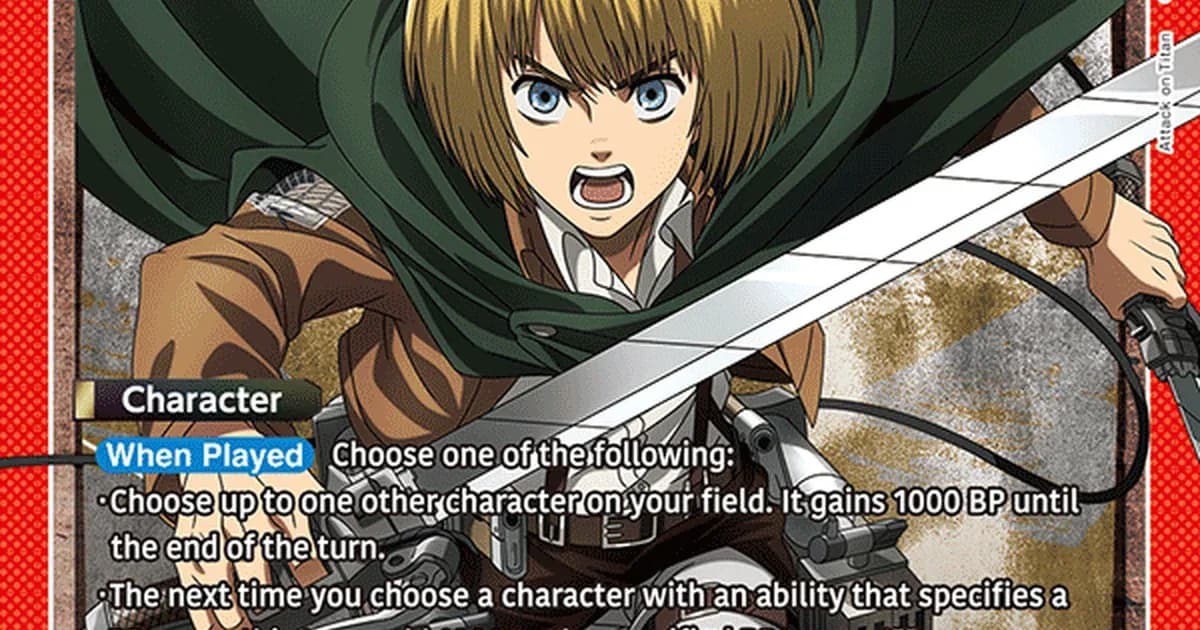
TL;DR: This Union Arena Attack on Titan Armin deck guide starts with the Red 104th Cadet Corps shell that has the clearest public evidence: Armin Arlelt and Eren Jaeger are tied at 78 public lists on the dated Attack on Titan hub. The plan is simple: develop cheap Red bodies, use the sideline as a resource, then turn returned cards into Raid pressure. Vol.2 adds a 1-cost Eren searcher, a 3-cost Mikasa Raid, and a 4-cost Eren that trades Life for Impact or card selection. Those are strong testing tools, not proof of a tournament tier.
Last checked: September 18, 2026. The public list snapshot is dated through September 10, the same date shown on Bandai's recommended recipe page. Attack on Titan Vol.2's official English release date is September 18, 2026. The official top-placing archive did not show an Attack on Titan result in the snapshot checked.
Union Arena Attack on Titan Armin deck guide: quick answer
Armin is the right first Red build to test because the public evidence is tied for the highest visible character-hub volume, and the list itself has a coherent curve. The Attack on Titan hub shows 78 public 50-card Standard lists for Armin Arlelt, 78 for Eren Jaeger, and 74 for Mikasa Ackermann. That does not prove a win-rate difference between those three. It does show that Red 104th Cadet Corps is the most established starting lane in the available English data.
The deck is not an Armin-only pile. Union Arena builds cards around color, affinity, Raid names, and the way characters move between the field, hand, and sideline. Armin is the identity used by the public hub and the guide's starting point, while Mikasa and Eren provide the pressure. The list wants low-cost bodies early, a full enough front line to attack, and enough hand or sideline space to make the return effects profitable.
Why this Red build is the safest first test
The split between known and unknown is fairly simple.
- The public Attack on Titan hub shows 78 Armin lists and is dated through September 10, 2026.
- Bandai's recommended-deck page shows two Red Attack on Titan recipes dated September 10, alongside two recipes for each of Yellow, Blue, and Green.
- The official product page confirms that UEX07BT released in English on September 18, 2026 and introduces Yellow as a new color for this title.
- Bandai's top-placing archive did not show an Attack on Titan entry in the snapshot checked on September 18.
That combination favors a Red guide over a confident Yellow tier claim. Red has an existing UE10BT foundation, a public list sample, and a Vol.2 package that can be tested without pretending that a new color already has tournament conversion data. The lack of an official placement is not a reason to ignore the deck. It is the reason to describe the list as a starting framework and leave room for the first post-release results to change it.
Union Arena Attack on Titan Armin deck guide: core engine
The engine has four connected jobs: find 104th Cadet Corps cards, create active attackers, return those attackers to hand, and use the sideline as a second hand. When a card returns to your hand at the end of the attack phase, you get more than a surviving body. You also get a card to replay, discard for a cost, or hold for a later Raid line.
1. Start with cheap affinity bodies
 UEX07BT-070
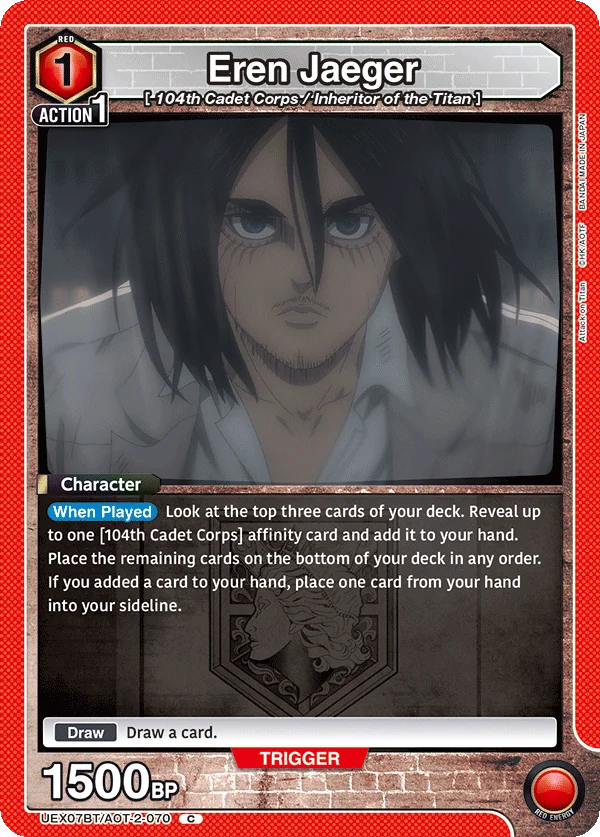 UEX07BT-070Shop on TCGplayer is the cleanest Vol.2 opener. Its When Played effect looks at the top three cards, adds up to one 104th Cadet Corps card, then puts a card from your hand into the sideline if the search succeeded. That is exactly the kind of small exchange this deck wants. You turn the top of the deck into a known card while keeping the sideline stocked for later recovery.
 UE10BT-075
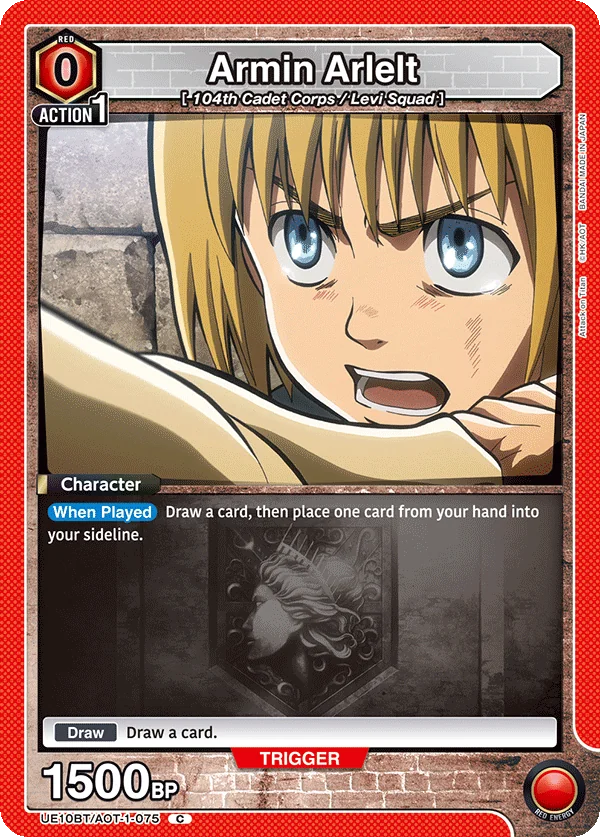 UE10BT-075Shop on TCGplayer performs a similar job without asking for a card in the top three. It draws one, then moves one card from your hand into the sideline. Use the pair to smooth the first two turns rather than treating either one as a disposable 1500 BP body.
The other useful low-cost cards are not there to win fights. They are there to generate Red energy, satisfy affinity conditions, create Raid bases, and leave behind a hand or sideline that your 3 and 4-cost plays can use. A hand with one cheap body and one search effect is often better than a hand with three flashy Raid characters.
2. Turn the sideline into a resource
The sideline is the center of the Armin version. It holds cards placed there by the 1-cost searchers, cards moved out of hand to pay for removal, and low-cost bodies that your Raid cards can recover. Do not fill it randomly. Ask what you want to retrieve with the next Mikasa, and what you can safely leave there if the opponent pressures your front line.
 UEX07BT-067
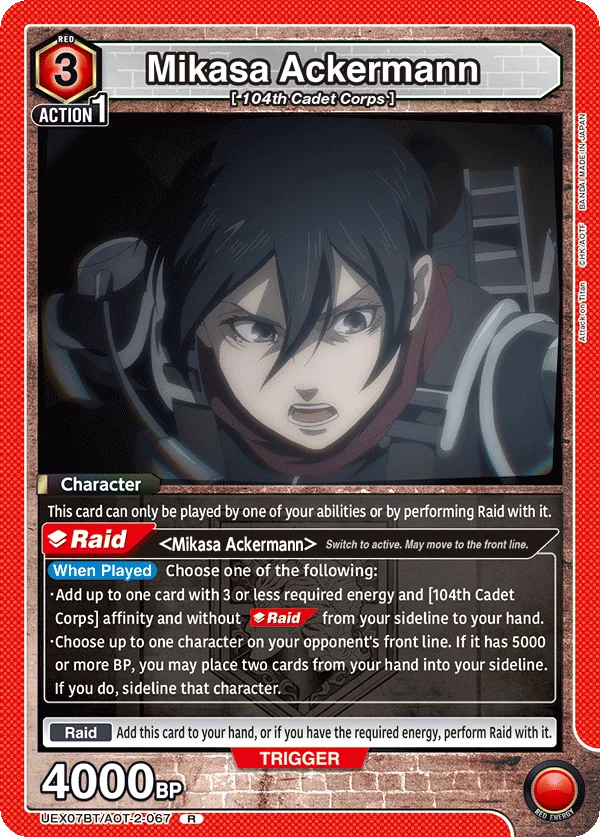 UEX07BT-067Shop on TCGplayer gives the deck a particularly useful choice. Its 3-cost Raid Mikasa can return a 3-cost-or-less 104th Cadet Corps card without Raid from your sideline to your hand. If you need interaction instead, it can put two hand cards into the sideline to sideline an opposing Character with 5000 BP or more. The first mode rebuilds your hand. The second mode converts excess cards into removal.
That choice is why the deck should not empty its hand just to make the first attack wave look large. Keep enough cards to make Mikasa's second mode real, but use the first mode when the sideline already contains a card that restarts your curve.
3. Raid for active attacks and damage
 UE10BT-089
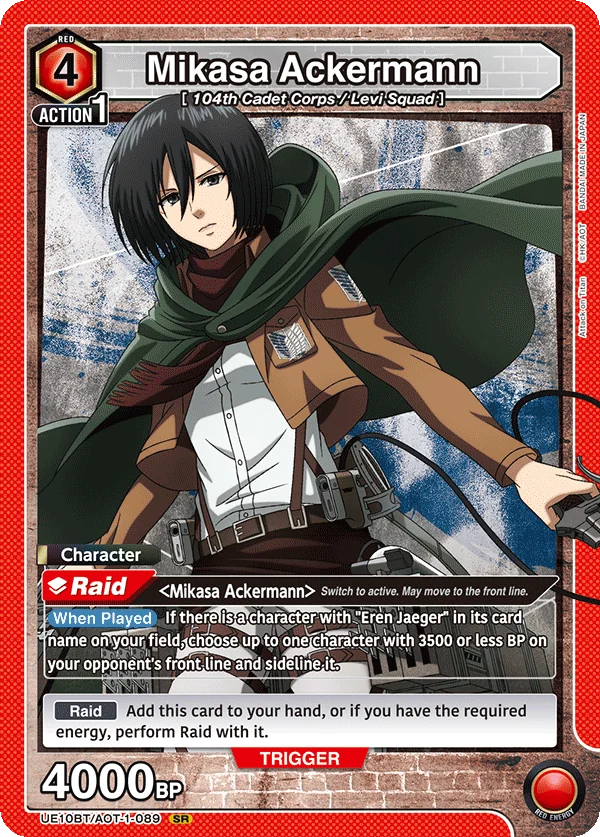 UE10BT-089Shop on TCGplayer and
 UE10BT-092
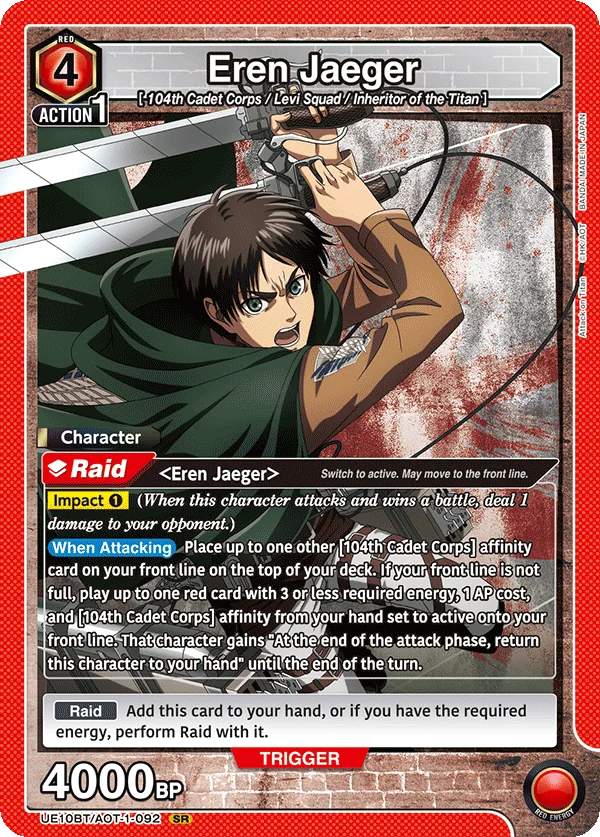 UE10BT-092Shop on TCGplayer are the older Red Raid anchors. Mikasa switches active and can sideline an opposing Character with 3500 BP or less when Eren is on your field. Eren switches active, carries Impact (1), and can place an affinity card from the front line on top of the deck before playing a small Red affinity card from hand active. That new body returns to hand at the end of the attack phase.
The return effect is the point. A Raid attack can create pressure, put a card back in hand, and open a front-line slot for another attack or a later replay. Plan the attack phase as a sequence instead of playing one large body and passing. The first attack can win and still leave you with a bad next turn, so aim to finish with your hand, sideline, and front line ready to build again.
4. Use Armin as a scaling combat tool
 UE10BT-077
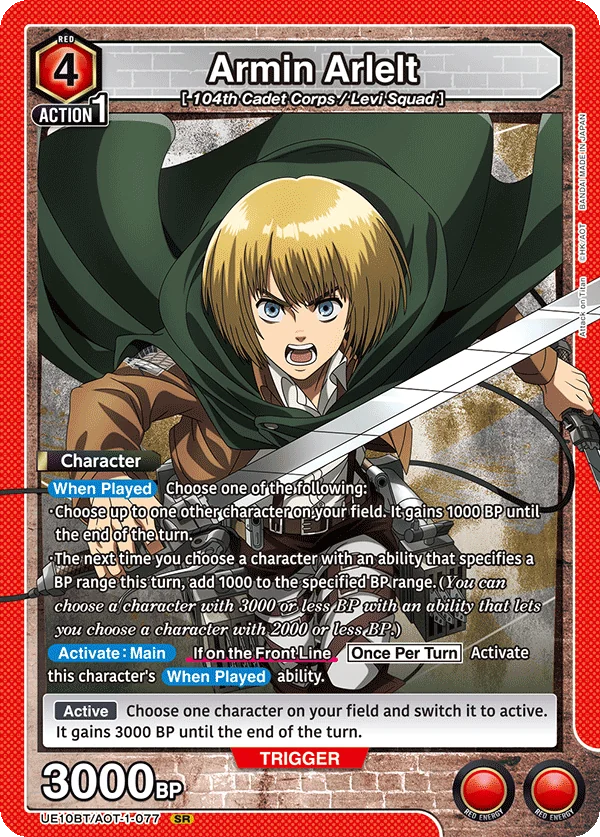 UE10BT-077Shop on TCGplayer is a 4-cost Armin with two useful When Played modes. It can give another Character 1000 BP for the turn, or add 1000 to the next BP range you choose that turn. Its front-line Activate: Main ability can repeat that When Played effect once per turn. The second mode is especially important when a removal effect would otherwise miss a 2000 BP or 3000 BP threshold.
 UE10ST-104
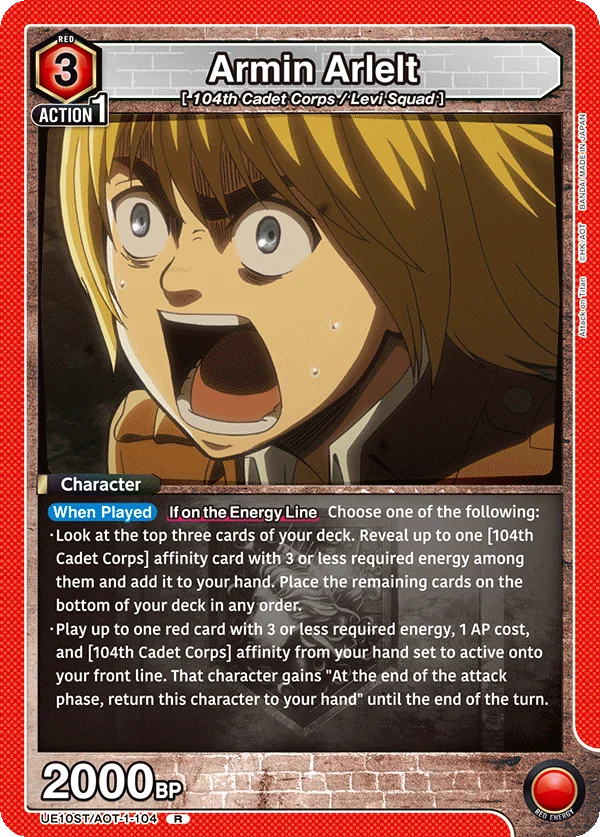 UE10ST-104Shop on TCGplayer covers a different part of the same curve. Its When Played choice either checks the top three for a 3-cost-or-less 104th Cadet Corps card or plays a small Red affinity card from hand active with a return-to-hand clause. It is a bridge from setup to pressure. The card does not replace your larger Raid characters, but it can turn a quiet turn into two bodies and a useful attack order.
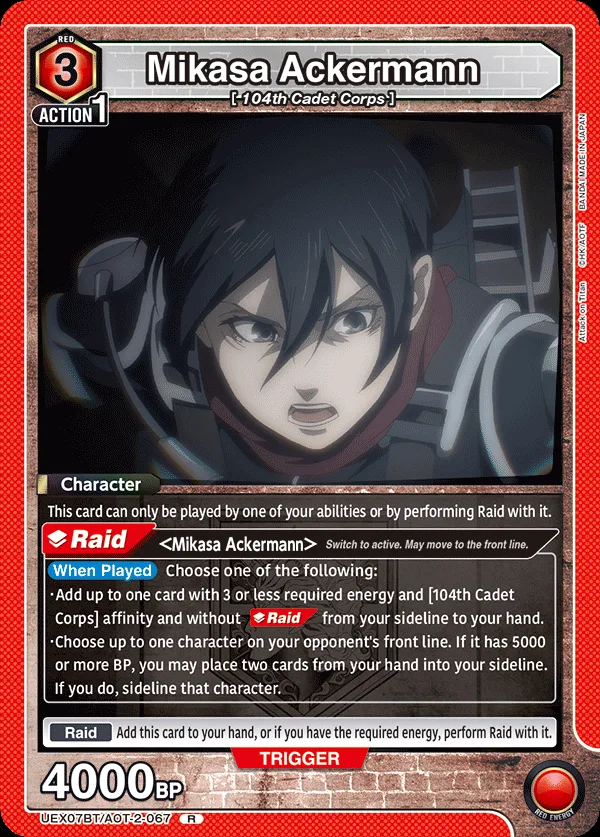 Mikasa's 3-cost Raid line either recovers a low-cost 104th Cadet Corps card from the sideline or trades two hand cards to sideline an opposing 5000 BP or larger Character.
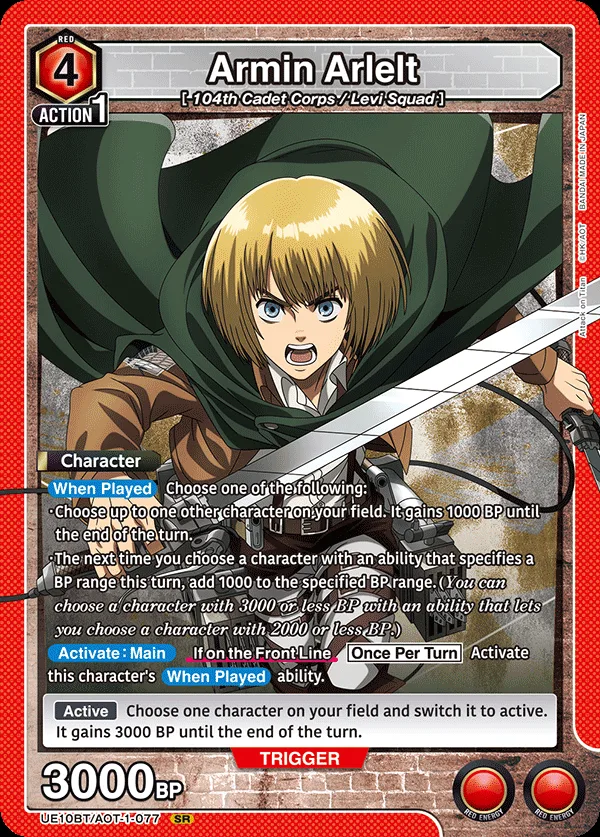 Armin's 4-cost When Played effect either gives another Character 1000 BP or extends the next BP range by 1000, and its front-line Main ability can repeat that effect once per turn.
Starting 50-card framework from the September 10 public list
The table below transcribes the newest public Armin-hub list visible when this guide was researched. It is a reproducible starting point, not an official winning list and not a claim that every count is final. The list contains 50 cards and uses the Red 104th Cadet Corps core with 18 Vol.2 cards.
| Count | Card | Role |
|---|---|---|
| 4 | UE10BT-075UE10BT-075Shop on TCGplayer Armin Arlelt | Draw and sideline setup |
| 4 |  UE10BT-085 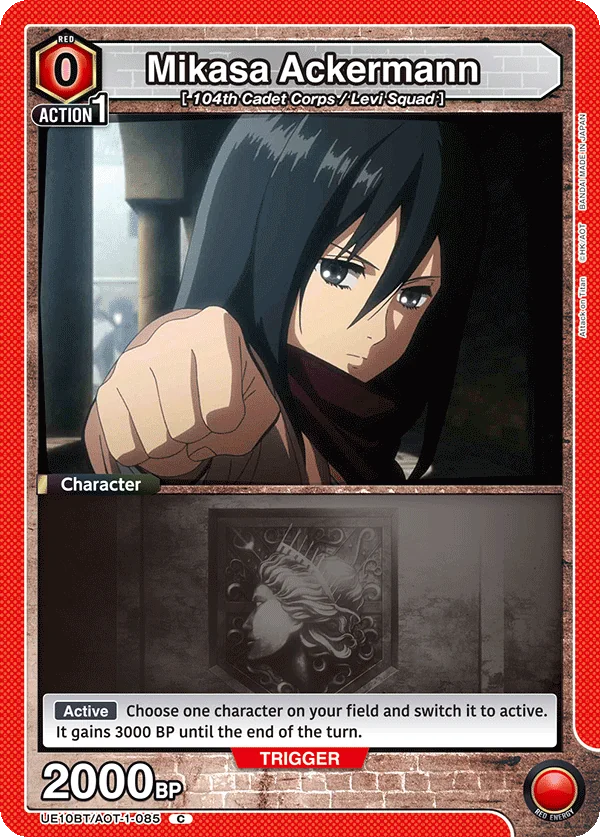 UE10BT-085Shop on TCGplayer Mikasa Ackermann | Low-cost body with a defensive Trigger |
| 4 |  UE10BT-090 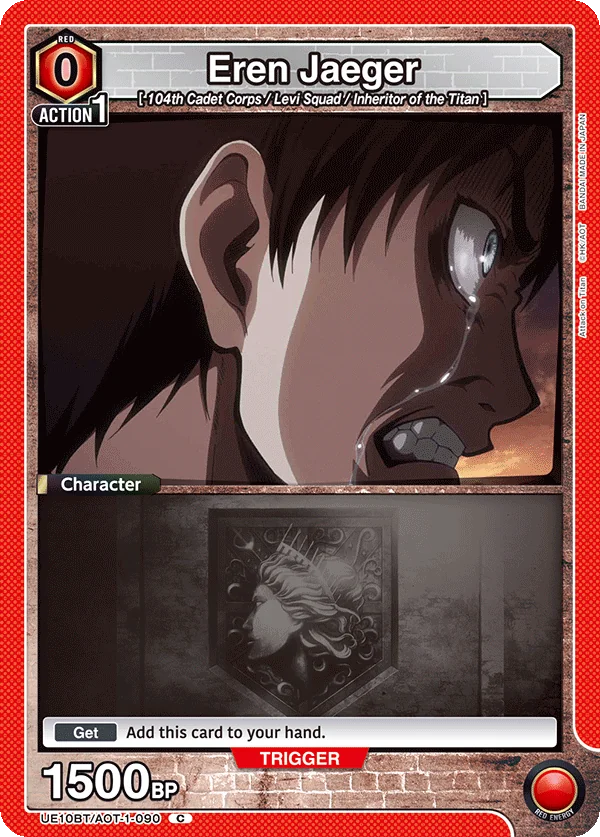 UE10BT-090Shop on TCGplayer Eren Jaeger | Low-cost affinity body and hand Trigger |
| 3 |  UEX07BT-066 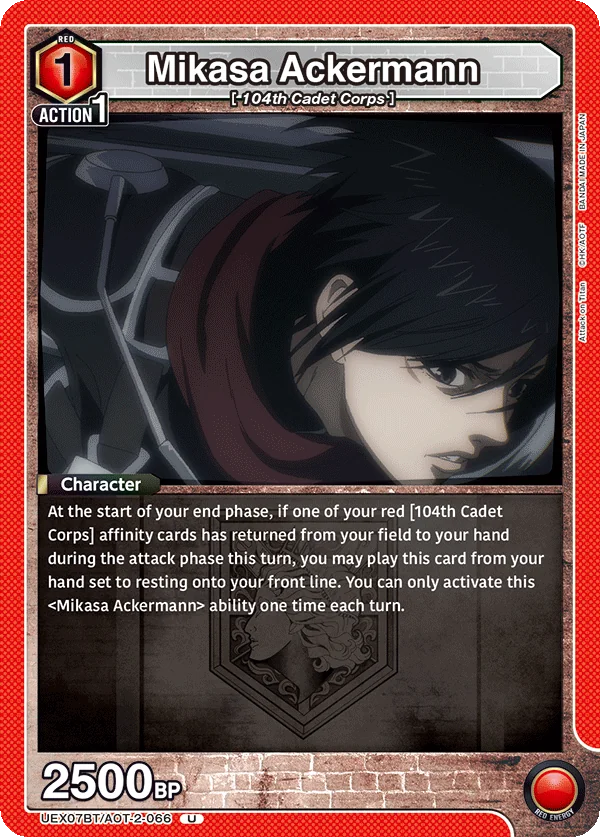 UEX07BT-066Shop on TCGplayer Mikasa Ackermann | End-phase recovery after a card returns |
| 3 | UEX07BT-070UEX07BT-070Shop on TCGplayer Eren Jaeger | Top-three 104th Cadet Corps search |
| 4 |  UE10BT-088 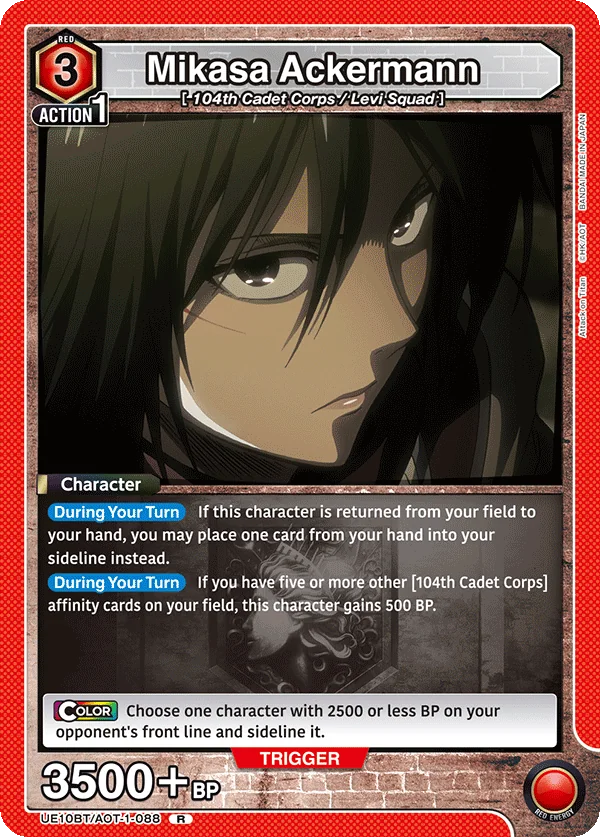 UE10BT-088Shop on TCGplayer Mikasa Ackermann | Red 3-cost body and Trigger removal |
| 4 |  UE10BT-097 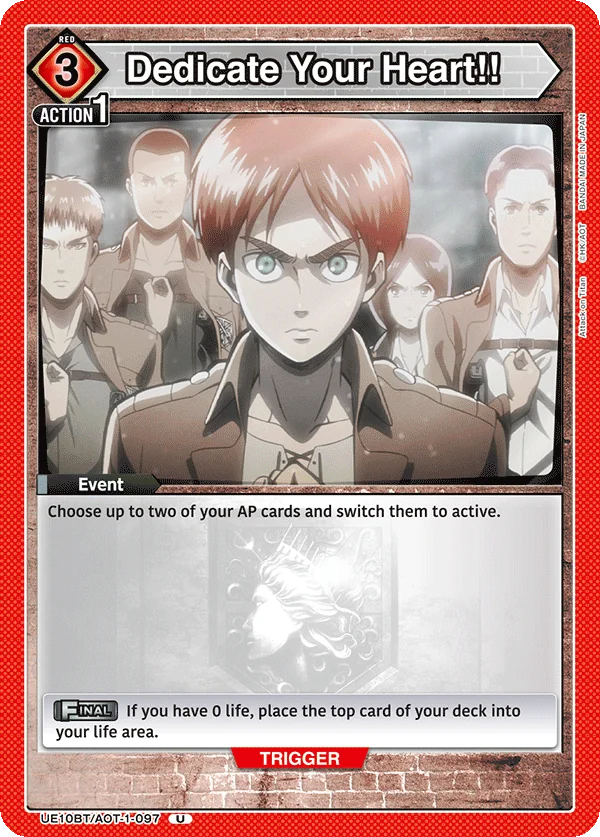 UE10BT-097Shop on TCGplayer Dedicate Your Heart!! | Refresh up to two AP cards |
| 4 | UE10ST-104UE10ST-104Shop on TCGplayer Armin Arlelt | Search or play a small body active |
| 3 | UEX07BT-067UEX07BT-067Shop on TCGplayer Mikasa Ackermann | Raid recovery or 5000 BP removal |
| 3 | UE10BT-077UE10BT-077Shop on TCGplayer Armin Arlelt | BP boost or range extension |
| 4 | UE10BT-089UE10BT-089Shop on TCGplayer Mikasa Ackermann | Raid removal with Eren present |
| 4 | UE10BT-092UE10BT-092Shop on TCGplayer Eren Jaeger | Raid Impact and hand-recycling attack |
| 4 |  UE10BT-099 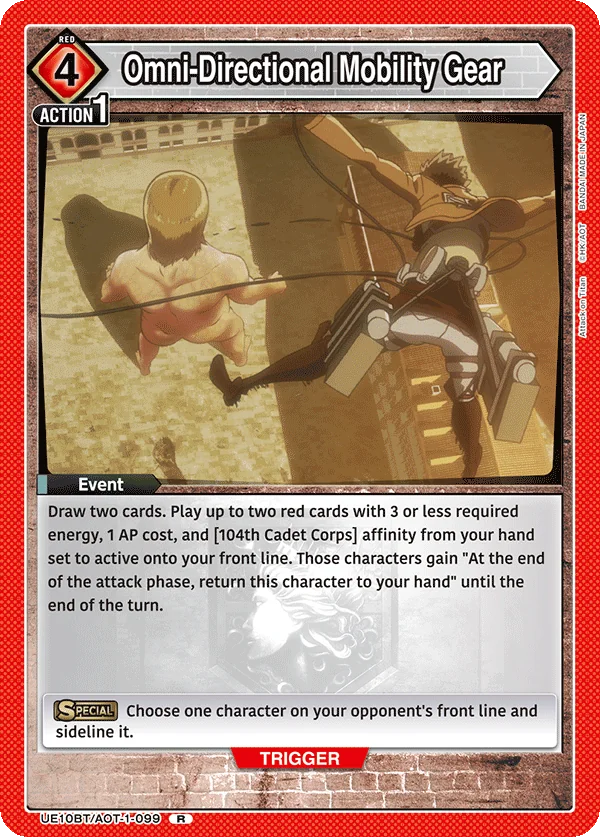 UE10BT-099Shop on TCGplayer Omni-Directional Mobility Gear | Draw two and play two small bodies |
| 2 |  UEX07BT-071 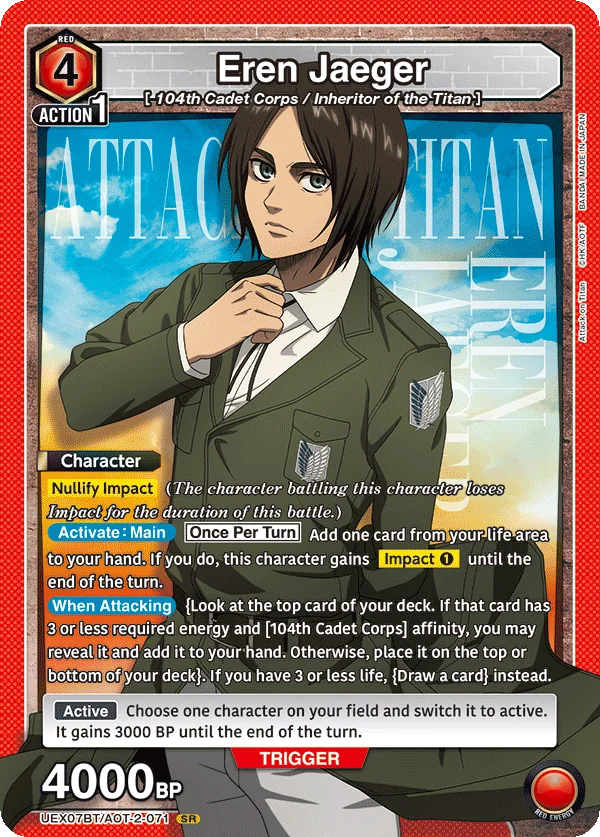 UEX07BT-071Shop on TCGplayer Eren Jaeger | Life-for-Impact and top-card selection |
The most important feature of this recipe is not the exact split between 3 and 4 copies. It is the density of low-cost 104th Cadet Corps cards that make the Raid and replay effects function. If you change the counts, preserve the deck's ability to make a real first turn, find a body by turn two, and put enough small cards in hand for Eren or Mobility Gear to convert into active attacks.
What the Vol.2 cards add to the old Red core
The new set does not ask you to abandon the original plan. It gives that plan more ways to start and more ways to turn a card advantage exchange into pressure.
Mikasa 066 is an end-phase refund
UEX07BT-066UEX07BT-066Shop on TCGplayer does not look like an attacker. It is a 1-cost 2500 BP Character that can play itself from hand set to resting at the start of your end phase if one of your Red 104th Cadet Corps cards returned from the field to your hand during the attack phase. That condition naturally follows the older Eren and Mobility Gear lines.
The important sequencing rule is to return a card before the end phase, not after. If the return happened during the attack phase, 066 can become a free extra body. It enters resting, so do not treat it as an additional attack that same turn. Treat it as a way to preserve field presence without spending another action next turn.
Mikasa 067 is the flexible three-cost Raid
When you have a valid Raid base, 067 is the card that lets the deck choose between rebuilding and interacting. Recovering a low-cost non-Raid card from the sideline is usually the safe line. The removal mode is better when the opponent has a 5000 BP or larger Character that blocks your next attack and your hand has two cards you were already willing to move away.
Do not pay two random cards for a removal target that does not change the combat math. The second mode is strongest when it removes a large front-line Character, creates a lane for Eren or Armin, and leaves your next search still live.
Eren 070 makes the opening more consistent
The 1-cost Eren checks three cards and can find any 104th Cadet Corps affinity card. If it finds one, it moves a card from your hand into the sideline. That makes it both a searcher and a way to pre-load your later recovery effects.
The best targets depend on your hand. Find a missing Raid base if you already have a payoff. Find a low-cost body if your hand is too expensive. If the top three miss, do not force a line that empties your hand. A 1500 BP Character that fails to find a card still generated information about the top of your deck, and you can use the next setup effect to reset the bottom cards.
Eren 071 is a stabilizer, not an automatic finisher
UEX07BT-071UEX07BT-071Shop on TCGplayer costs four and has 4000 BP. Its Main ability can take a Life card to gain Impact (1), while its When Attacking effect checks the top card for a low-cost 104th Cadet Corps card. At three Life or less, that check becomes a draw instead. It also has Nullify Impact during its battle.
That package is useful when you need a second attack after a Raid line, but do not spend Life automatically. Taking Life is a cost and can change what the opponent can threaten next turn. Use 071 when the Impact attack matters, when the extra card keeps your next turn alive, or when the opponent's Impact would otherwise make a battle dangerous.
Step-by-Step: Piloting the Red Armin build
1. Map the first two turns before you mulligan. Identify the cheapest body, the card that finds a 104th Cadet Corps card, and the first Raid payoff. If the hand contains only 4-cost and 7-cost cards, ship it back even if the cards are powerful individually.
2. Establish one body and one resource line. Play Armin 075 or Eren 070 when the hand supports it. Put a card into the sideline with purpose. A low-cost card that can be recovered by Mikasa 067 is a better sideline card than a random expensive card you cannot cast soon.
3. Preserve a Raid base. Do not move every small Character into the sideline or trade every 104th Cadet Corps body for a short-term attack. Your 3 and 4-cost Raid cards need a legal base and enough field space to create pressure.
4. Sequence the first attack wave. Attack with the body that is least valuable to keep on the field before using Eren 092 or Mikasa 089. If a card will return to your hand, attack with it before the Raid body when the order matters. This lets the return effect create the next hand resource without losing the main payoff.
5. Choose the Mikasa 067 mode from the board state. Recover a sideline card when you need another searcher or Raid base. Use the removal mode only when the 5000 BP threshold is met and moving two cards into the sideline creates a real opening.
6. Use Armin 077 after you know the target. The 1000 BP mode is straightforward when it wins a battle. The BP-range mode is better before a targeted removal effect that would otherwise miss. Because the front-line ability can repeat the When Played effect once per turn, do not spend it before you know whether the next attack needs power or a larger removal range.
7. Finish the turn with a next-turn hand. Before passing, count the cards in hand, the sideline, and the number of low-cost affinity bodies remaining. A Red turn that deals damage but leaves no Raid base or searcher is often weaker than a smaller turn that returns two useful cards to hand.
Mulligan priorities
The opening hand should represent a curve, not a collection of rare cards.
- Keep one setup body: Armin 075, Eren 070, or another low-cost 104th Cadet Corps card.
- Keep one bridge: Armin 104 is a strong keep when you have a small body to play, while Eren 070 is better when you need to find a specific affinity card.
- Keep one payoff: Mikasa 067, Mikasa 089, Eren 092, or Eren 071 gives the hand a destination.
- Keep Mobility Gear only with enough small targets: Draw two is attractive, but the event is much weaker if the hand cannot provide two legal 3-cost-or-less Red affinity Characters.
- Ship hands that are all payoffs: A hand full of Raid cards can look powerful and still lose to an empty first two turns.
If you have a setup body plus a payoff but no bridge, keep the hand when your first draw can reasonably find the missing piece. If you have a bridge but no body, be more cautious. This deck wants an actual Character on the field before it starts asking its larger effects to do work.
Common mistakes with the Red Armin shell
Treating the sideline as a discard pile
The sideline is an active part of the deck. A card moved there may be the exact 3-cost-or-less target Mikasa 067 can recover. Track which cards are safe to leave there and which cards you need to keep in hand for a later cost.
Playing Eren 092 before you have a return target
Eren's Raid effect is strongest when the front line has a small affinity body that can go on top of the deck and another legal small body is ready in hand. If the hand is empty and the field is not full, the attack can still be correct, but do not assume every Raid line produces the same value.
Spending Armin 077's range extension on a low-value target
The range mode matters because it changes what your next BP-based effect can choose. If the opponent has no meaningful target at the boundary, take the 1000 BP mode or save the ability. The card is more than a generic power boost, but only if the threshold changes the board.
Taking Life with Eren 071 automatically
071's Impact mode is a tool, not a requirement. The card can be a 4000 BP attacker with a top-card check without paying the Life cost. Take Life when the extra damage or follow-up card is worth exposing your life total, and remember that the alternate draw clause is stronger when you are already at three Life or less.
Calling the list proven because the hub is large
The 78-list Armin count is a public-interest signal. It is not a win rate, a unique-deck count, or a regional result. The hub can contain overlapping lists, and the newest list is dated September 10. Revisit the ratios when the first transparent post-release event lists appear.
What to test after the English release
Start with the dated public framework for several games before changing it. Track three things separately: how often the opening hand produces a 1-cost or 0-cost body, how often Mikasa 067 has a useful sideline target, and whether Eren 071 creates enough value to justify its Life cost. Those measurements tell you more than a single good game with an SR card.
The first flex slots should come from the Vol.2 package, not from the entire Red engine. If 071 is too slow in your local field, trim it before cutting the 1-cost searchers. If 067's removal mode is frequently live, keep the hand density high enough to pay for it. If the opponent repeatedly blocks the smaller bodies, consider whether the list needs more timing around Raid rather than simply more expensive Characters.
This guide should also be revisited when Bandai's top-placing archive shows the first Attack on Titan result. A placement would not automatically prove Armin is the best Red build, but it would provide a better basis for changing the article from a public-list framework into a results-backed deck guide.
Key Takeaways
- Armin and Eren are tied at 78 public Attack on Titan lists in the dated September 10 snapshot, making Red the clearest first testing lane.
- The deck uses cheap 104th Cadet Corps bodies, a stocked sideline, and Raid attacks that return cards to hand.
- Vol.2 adds Eren 070 as a searcher, Mikasa 067 as a flexible Raid, Mikasa 066 as an end-phase recovery body, and Eren 071 as a Life-for-Impact stabilizer.
- Armin 077 changes either a combat number or the next BP range, so choose its mode after identifying the target.
- The published 50-card framework is a dated public list, not a tournament-winning list or a permanent final build.
- No verified Attack on Titan placement was visible in Bandai's official archive on September 18, 2026. Recheck after post-release events.
GODEEPER: The broader launch evidence is in the Union Arena Attack on Titan Vol.2 EN Tier List, while the set article explains why Yellow is new and why its competitive ceiling is still unverified. Union Arena Attack on Titan Vol.2: New Yellow Color
Related Reading
- Union Arena Current Meta: Which Deck Is Strongest Right Now: Official tournament results and the limits of Union Arena meta data.
- All Union Arena Sets: Complete EN Release Schedule (2026): The release calendar for UEX07BT and other English sets.
- Union Arena Attack on Titan Vol.2 Buying Guide: What to Buy: How to price this dated framework as singles instead of chasing random sealed pulls.
- Union Arena Attack on Titan Vol.2 Eren Deck Guide: Red Vol.2: Compare Armin's Red framework with the separate Eren-centered Raid loop.
- Union Arena Deck Building Guide: Legal 50-card construction and practical testing advice.
- Union Arena TCG Beginner Guide 2026: Rules and format context before you build a Red list.
Frequently Asked Questions
Is Armin the best Attack on Titan Vol.2 build in Union Arena? Armin is tied with Eren Jaeger at 78 public lists on the dated hub, so it is the best-supported place to start, not a proven best deck. Bandai's official archive had no verified Attack on Titan placement in the snapshot checked.
What is the main plan of the Red Armin deck? Develop cheap 104th Cadet Corps cards, use the sideline as a resource, and turn returned bodies into Raid pressure. Armin and Eren smooth the curve, while Mikasa and the larger Eren cards create active attacks and removal windows.
How many Vol.2 cards are in the framework? The dated public list uses 18 Vol.2 cards: three each of Mikasa 066, Mikasa 067, and Eren 070, plus two Eren 071. It is a verified snapshot for testing, not a locked deck recipe.
What should I keep in my opening hand? Keep a cheap 104th Cadet Corps body, a search or bridge card, and one payoff. Eren 070 and Armin 075 start the curve, Armin 104 finds or plays a small body, and Mikasa 067 or Eren 092 gives the hand a destination.
Do I need every Vol.2 card to test the deck? No. The UE10BT Red core already has the attack and return-to-hand plan. Vol.2 adds consistency and flexible pressure, so proxies or the dated public framework are reasonable ways to test before committing to every card.
Has this Attack on Titan deck won a regional yet? No verified placement was visible in Bandai's official top-placing archive when this guide was researched on September 18, 2026. Public list volume is not tournament evidence, so recheck the archive after the English release.
References
- Union Arena Attack on Titan Vol.2 official product page: English release date, MSRP, pack configuration, and the new Yellow color.
- Bandai Recommended Decks by Title: Red, Yellow, Blue, and Green Attack on Titan recipes dated September 10, 2026.
- Bandai Top-Placing Decks: official result archive checked for an Attack on Titan placement.
- Union Arena Decklists Attack on Titan hub: public 50-card Standard counts and the September 10 freshness date.
- Union Arena Decklists Armin Arlelt page: the 78-list hub and the dated public framework transcribed above.
- Official Mikasa Ackermann UEX07BT/AOT-2-067 card page: Red Raid text and removal choice.
- Official Eren Jaeger UEX07BT/AOT-2-071 card page: Red 4-cost ability, Life cost, and Trigger.
- Official Armin Arlelt UE10BT/AOT-1-077 card page: BP boost, BP-range extension, and repeatable front-line ability.
- Official Omni-Directional Mobility Gear UE10BT/AOT-1-099 card page: draw two and play two small Red affinity Characters.
Was this guide helpful?
Cards in this article
About the author
Pen name for the Shonen TCG desk's tournament coverage, format analysis and cross-game comparisons.
- Results taken from event pages and standings
- Other games checked against their own official rules
- Opinions marked as ours, with the reason
Keep reading

Union Arena Re:ZERO Buying Guide: Box, Deck, or Singles
Guides · 6 min
Union Arena Attack on Titan Vol.2 Buying Guide: What to Buy
Guides · 14 min
Union Arena Re:ZERO Rem Deck Guide: Yellow Build 2026
Guides · 10 min
Union Arena Re:ZERO Emilia Deck Guide: Purple Build 2026
Guides · 6 min
Union Arena Attack on Titan Eren Deck Guide: Red Vol.2
Guides · 8 min
Union Arena Attack on Titan Vol.2 EN Tier List: Snapshot
Guides · 6 min
Union Arena Re:ZERO EN Tier List: 7-Leader Snapshot
Guides · 7 min
Union Arena Kaiju No. 8 Deck Guide: Kafka Hibino 2026
Guides · 8 min
Disclaimer
This article is published for informational and entertainment purposes. It does not constitute professional financial, legal, or technical advice. Game performance, online services, patch schedules, and store listings change. Verify critical details (pricing, system requirements, regional availability) with publishers and storefronts before you buy. Affiliate links, where present, help support our editorial work and are labelled in our affiliate disclosure.