Loading…


Shonen TCG · Guides
Union Arena Fullmetal Alchemist Deck Guide: Blue 2026
8 min readBy Kai Tanaka
Reviewing
Union Arena
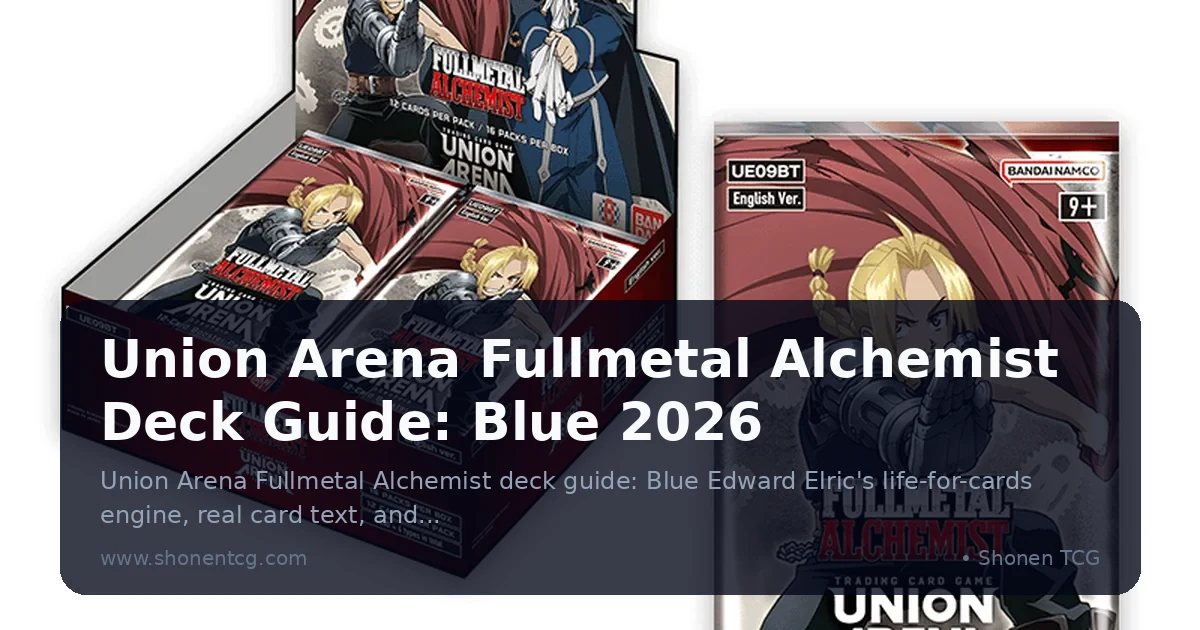
Union Arena Fullmetal Alchemist deck guide time: while newer franchises have grabbed recent tournament headlines, Edward Elric's Blue build has quietly stayed a real, currently-competitive archetype since UE09BT launched, tied for the format's third-deepest track record. This guide covers the actual printed card text behind the deck's life-for-cards engine, Alex Louis Armstrong's finisher role, and where the honest gaps in tournament data currently sit.
TL;DR: Blue Fullmetal Alchemist runs on Edward Elric (UE09BT/FMA-1-040, 4-cost, 4000 BP), a Character whose When Played ability lets you pull a card from your own life area back to hand, at the cost of that life permanently gone. Alex Louis Armstrong (UE09BT/FMA-1-037, 5-cost, 4500 BP) backs him up as the deck's finisher, doubling unblocked damage and drawing two cards on a combat win. Bandai's official results archive credits Fullmetal Alchemist with 5 cumulative top-placing finishes since December 2025, tied with Kagurabachi and Solo Leveling for the format's third-deepest track record behind Evangelion and Rurouni Kenshin.
What does the Union Arena Fullmetal Alchemist deck actually do? (quick answer)
Trade your own life cards for hand cards with Edward Elric, then close games with Alex Louis Armstrong's doubled direct damage and card draw. It's a resource-conversion deck built around the franchise's own equivalent-exchange theme: nothing comes free, and the real skill is knowing how much life you can safely spend before it becomes a liability.
Overview: Edward's life-for-cards engine
Edward Elric (UE09BT/FMA-1-040, SR) is a 4-cost Blue Character with 4000 BP. His When Played ability lets you add one card from your life area to your hand, and if you do, switch him to active immediately. That's a genuine resource conversion, not a free roll: your life area doubles as your health total in Union Arena, so every card you pull back is a permanent reduction to how much punishment you can absorb before losing.
That tradeoff is the whole deck's identity. Early in a game, spending a life card or two to dig for a key piece is usually safe. Late in a game, or against an aggressive opponent already pressuring your life total, the same play can be the difference between stabilizing and losing outright. Reading that line correctly turn to turn is most of what separates a strong Edward pilot from a weak one.
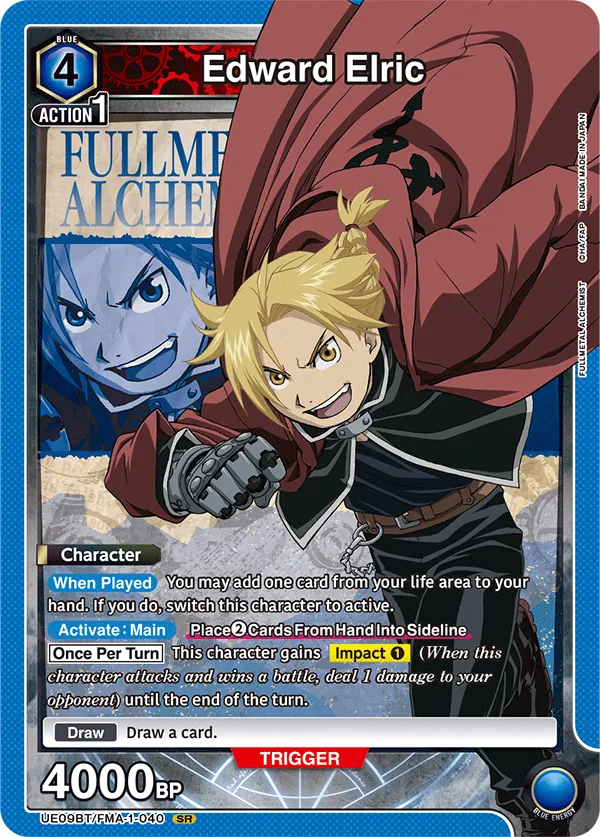 Edward Elric's When Played ability: pull a card from your own life area to hand and switch to active, a real resource trade rather than a free effect.
His Activate: Main ability adds a second layer once he's already on the field: once per turn, sideline 2 cards from hand to grant him Impact for the turn, meaning a won battle deals bonus damage straight to the opponent. That's a real cost too, 2 cards from hand is not nothing, but it turns a favorable combat into extra reach when you need to close a game out.
GODEEPER: New to Union Arena's sideline and life-area mechanics entirely? The full rules breakdown covers how every zone interacts, not just this deck. Union Arena How to Play: Rules & Turn Flow Explained →
Alex Louis Armstrong: the finisher piece
Not every threat in this deck comes from the Elric brothers directly. Alex Louis Armstrong (UE09BT/FMA-1-037, R) is a 5-cost Blue Character with 4500 BP built to close games rather than grind them.
His Damage 2 keyword means that whenever he attacks and deals direct damage, he deals 2 instead of the usual 1, doubling his reach against an already-low opponent life total. Once per turn, winning a battle with him also draws two cards outright, real card advantage layered on top of the damage output. His Trigger effect, choosing a character on your field to switch to active with a 3000 BP boost until end of turn, gives the deck a way to reset a resting attacker or push through a combat it would otherwise lose.
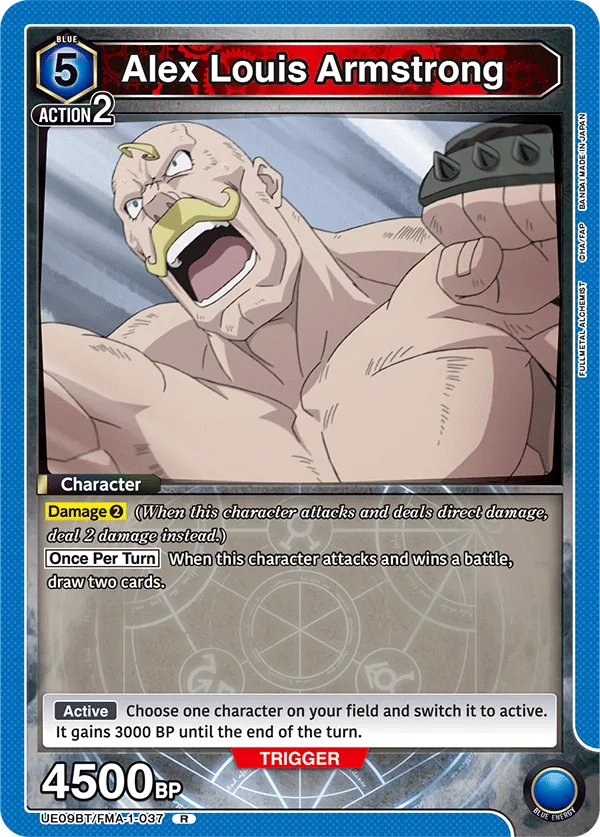 Alex Louis Armstrong's Damage 2 keyword and once-per-turn draw-two on a combat win make him the deck's real closer.
Between Edward digging for pieces and Armstrong closing the game out, the deck's overall shape is a slower, resource-trading plan rather than a fast aggro list, one that wants full games where its card-advantage tools have time to compound.
Step-by-Step: piloting Blue Fullmetal Alchemist
1. Track your life total before every Edward Elric activation. Since his When Played ability permanently removes a card from your life area, know your exact life count before committing, not just a rough sense of it.
2. Use the early game to dig, not to close. Spending life cards in the first few turns to find your key pieces is usually correct. Doing the same on turn 8 against an aggressive board is how games get lost.
3. Save Armstrong's Damage 2 for a real kill window. He's strongest when your opponent's life total is already low enough that the doubled direct damage actually matters, not as an early-game attacker.
4. Bank the 2-card sideline cost for Edward's Impact ability for a genuine close, not routine turns. That's a real card investment, so reserve it for a turn where the extra damage actually ends the game or forces a bad trade.
Tips
Read Edward's ability text carefully before assuming it's a free draw effect. Community discussion sometimes frames "life for cards" engines as pure upside; the life you spend is genuinely gone, not a renewable resource.
Community deck-tech coverage has generally kept this build as a mid-tier value pick rather than a top-tier aggro deck, useful context if you're deciding between franchises to invest in first. It rewards patient, precise play over a fast, low-decision plan.
If you're building around Armstrong specifically, prioritize any support that helps you win combats outright rather than just adding raw stats, since his card-draw trigger only fires off a won battle, not just an attack.
Where Fullmetal Alchemist actually stands right now
Bandai's official top-placing decks archive shows Fullmetal Alchemist with 5 cumulative finishes since December 2025, tied with Kagurabachi and Solo Leveling for the format's third-deepest track record, behind only Evangelion (12) and Rurouni Kenshin (11). That's a real, currently-active competitive presence rather than a launch-era deck that's since fallen off, even without a headline-grabbing recent regional finish of its own.
GODEEPER: Curious how Fullmetal Alchemist's placements stack up against the rest of the current Union Arena field? Union Arena Current Meta: Which Deck Is Strongest Right Now →
Key Takeaways
- Edward Elric (UE09BT/FMA-1-040, SR, Blue, 4-cost) is the deck's core engine: his When Played ability trades a life card for a hand card, a real resource cost, not a free effect
- Alex Louis Armstrong (UE09BT/FMA-1-037, R, Blue, 5-cost) is the deck's finisher, doubling direct damage via Damage 2 and drawing two cards on a won battle
- Fullmetal Alchemist has 5 cumulative official top-placing finishes since December 2025, tied with Kagurabachi and Solo Leveling for third-deepest behind Evangelion and Rurouni Kenshin
- The deck's core skill is life-total math: knowing when spending life for cards is safe versus when it's a liability
- Edward's Activate: Main ability sidelines 2 cards to grant Impact for the turn, a real cost best saved for a genuine closing turn
Frequently Asked Questions
Is Blue Edward Elric a good deck in Union Arena? Yes. It's tied for the format's third-deepest track record: 5 cumulative official top-placing finishes since December 2025, level with Kagurabachi and Solo Leveling, per Bandai's official results archive cited in the site's own current meta report.
What does the Edward Elric card actually do? Edward Elric (UE09BT/FMA-1-040, SR, 4-cost, 4000 BP) is a Character. When Played, you may add one card from your life area to your hand and switch him to active. His Activate: Main ability, once per turn, sidelines 2 cards from hand to grant him Impact for the turn.
What is Alex Louis Armstrong's role in the deck? Alex Louis Armstrong (UE09BT/FMA-1-037, R, 5-cost, 4500 BP) is Blue's finisher piece. His Damage 2 keyword doubles direct damage on unblocked attacks, and winning a battle draws him two cards once per turn, real reach and card advantage in one body.
What does spending life cards for hand cards actually cost you? Your life area doubles as your health total in Union Arena, so Edward's When Played ability trades a real resource, remaining life, for card advantage and tempo. It's a genuine risk that rewards careful math on how far you can safely go before a life total gets dangerously low.
Is this a good deck for new Union Arena players? It's playable but the life-for-cards trade takes real judgment to use well. A newer player can easily overextend the ability and find their life total dangerously thin. A simpler top-tier deck is generally friendlier for a first Union Arena deck.
Related Reading
- Union Arena Rurouni Kenshin Deck Guide: Red Build 2026: Another franchise with a deep cumulative placement count and a resource-management core.
- Union Arena Card Rarities Explained: Every Tier in 2026: What SR and R rarity actually mean for cards like Edward's and Armstrong's prints.
- Union Arena TCG Beginner Guide: How to Start (2026): The full ruleset for players building their first Union Arena deck.
- Union Arena Deck Building Guide: Build a 50-Card Deck: The construction rules to apply once you're piloting this build past the starter deck.
References
- UNION ARENA STARTER DECK Fullmetal Alchemist [UE09ST] official product page: Bandai's official starter-deck listing and character lineup
- UNION ARENA Card List, official card database: Source for Edward Elric's and Alex Louis Armstrong's verified card text used in this guide
- TCGPlayer Union Arena: Fullmetal Alchemist: Card pricing reference
Was this guide helpful?
About the author
KT
Competitive TCG Analyst
Competitive One Piece TCG player and deck builder with 3 years of tournament experience. Covers meta analysis, tier lists, and leader builds.
- 3 years competitive OPTCG tournament experience
- Regional top 8 finisher
- Deck builder and meta analyst
- Covers every set since OP-01


Disclaimer
This article is published for informational and entertainment purposes. It does not constitute professional financial, legal, or technical advice. Game performance, online services, patch schedules, and store listings change. Verify critical details (pricing, system requirements, regional availability) with publishers and storefronts before you buy. Affiliate links, where present, help support our editorial work and are labelled in our affiliate disclosure.