Loading…


Shonen TCG · Guides
Union Arena Solo Leveling Mill Deck Guide: Jinwoo/Cha (2026)
15 min readBy Mika Santos
Reviewing
Union Arena
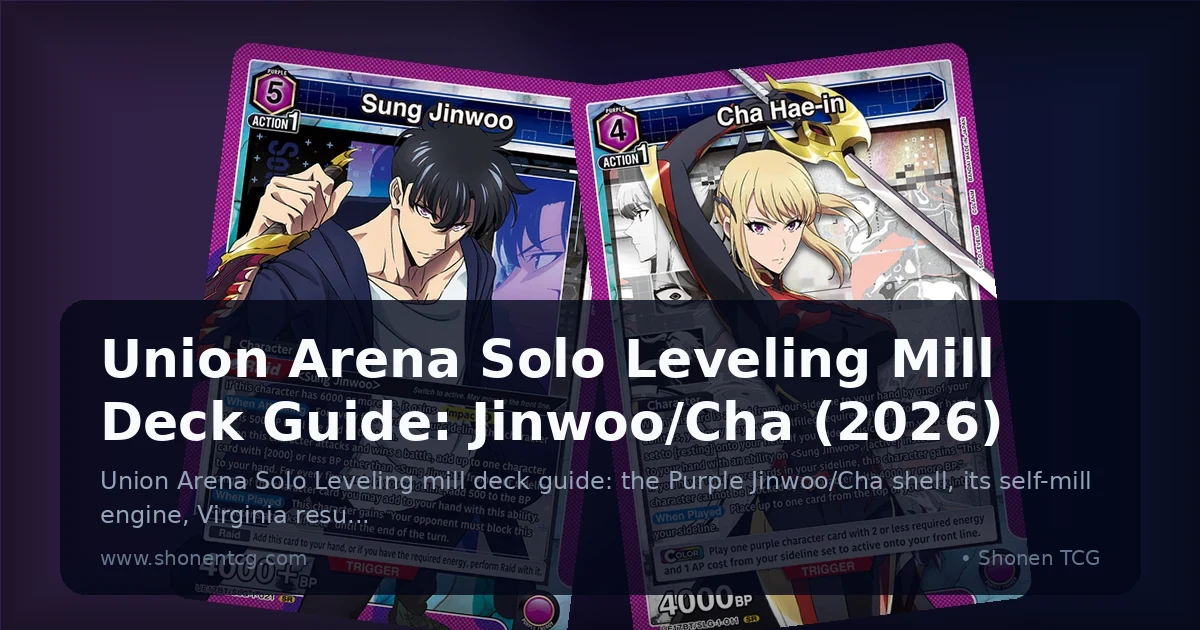
Union Arena Solo Leveling mill deck lists are real, but the word mill needs one important clarification. The Purple Jinwoo/Cha build does not rely on a single card that throws the opponent's deck into the discard pile. Its printed plan is self-mill: move cards from your deck and hand into your sideline until the sideline becomes a second resource zone. The payoff is a long game built around Raid Sung Jinwoo, Cha Hae-in free plays, forced blocks, Impact, and removal.
TL;DR: The Purple Jinwoo/Cha mill deck uses UE17BT/SLG-1-016, UE17BT/SLG-1-017, Esil, Han Song-yi, and I Want to Catch Up to Him to fill your sideline. At 20 cards, Demon's Castle turns the resource into a repeatable Elixir of Life line. Five-cost Sung Jinwoo and Cha Hae-in then turn that setup into pressure. It is a different deck from Purple Shadow Army, and its historic Virginia win is more secure than its current tier label.
Union Arena Solo Leveling Mill Deck Guide: Quick Answer
The list in this guide is the 50-card Purple Cha/Jinwoo Mill deck identified by Joseph Writer Anderson as the first-place deck from the Virginia Regionals 26-27, piloted by Nick. Bandai's official top-placing archive independently shows Purple Solo Leveling winning the May 8 Wave 1 event and appearing again in later Wave 1 results. That gives the archetype a real competitive record, not just a community theory label.
The deck's printed mechanics explain why the list earned that result. UE17BT/SLG-1-016 Sung Jinwoo places the top two cards of your deck into your sideline. UE17BT/SLG-1-020 and UE17BT/SLG-1-021 become larger for every five cards in the sideline, and UE17BT/SLG-1-011 Cha Hae-in can enter play from the sideline with fulfilled energy. The deck is trying to make the sideline count matter every turn.
Key Takeaways
- The community name is mill, but the official card text is mostly self-mill into your own sideline.
- The 10-card threshold turns on extra value for Han Song-yi and Cha Hae-in, while Demon’s Castle requires 20 cards.
- The 5-cost Sung Jinwoo is the main closer: it can Raid, force blocks after winning an attack, grow with the sideline, and retrieve a small Character from the sideline.
- Cha Hae-in is the best free-play target because Sung Jinwoo can bring it back active when the required condition is met.
- Esil and Han Song-yi make the sideline a usable hand extension rather than a one-way discard pile.
- Mutilation gives the deck a clean answer to an opposing front-line Character, with a higher BP ceiling when Sung Jinwoo is in play.
- The Virginia win is confirmed history. The exact current tier label is not confirmed, so test the list against the current room instead of importing an old ranking.
Why This Mill Build Is Different From Shadow Army
The existing Purple Shadow Army guide is about building a wide board of Shadow Army Characters and using free plays to snowball pressure. This build is narrower and stranger. It wants certain cards in the sideline, not necessarily on the field, because Sung Jinwoo, Cha Hae-in, Elixir of Life, and Demon’s Castle all become better once that zone is full.
That distinction matters when you mulligan. A Shadow Army hand can prioritize early bodies and affinity density. The Jinwoo/Cha list wants a path to the 10-card and 20-card sideline thresholds while keeping at least one meaningful Character in hand for the next Raid. If you fill the sideline without a way to retrieve value from it, you have milled yourself without building an engine.
GODEEPER: If you want the aggressive alternative first, the Union Arena Solo Leveling Guide: Best Cards and Decks → covers Shadow Army and the wider UE17BT card pool.
The 50-Card Purple Jinwoo/Cha Mill List
This is the public Virginia list attributed to Nick in Joseph Writer Anderson's regional breakdown. The list is a tested tournament recipe, not a claim that every local build must use these exact counts.
| Count | Card |
|---|---|
| 4 | UE17BT/SLG-1-002 Han Song-yi |
| 4 | UE17BT/SLG-1-015 Sung Jinwoo |
| 4 | UE17BT/SLG-1-008 Esil |
| 4 | UE17BT/SLG-1-017 Sung Jinwoo |
| 2 | UE17BT/SLG-1-003 Han Song-yi |
| 4 | UE17BT/SLG-1-016 Sung Jinwoo |
| 4 | UE17BT/SLG-1-011 Cha Hae-in |
| 2 | UE17BT/SLG-1-023 Sung Il-hwan |
| 4 | UE17BT/SLG-1-020 Sung Jinwoo |
| 4 | UE17BT/SLG-1-021 Sung Jinwoo |
| 4 | UE17BT/SLG-1-038 Arise |
| 2 | UE17BT/SLG-1-036 I Want to Catch Up to Him |
| 2 | UE17BT/SLG-1-037 Elixir of Life |
| 4 | UE17BT/SLG-1-040 Mutilation |
| 2 | UE17BT/SLG-1-034 Demon's Castle |
There is no separate Leader row in the public list because Union Arena uses the deck's Character and Event recipe format for this archetype. The 50-card package is the important part to preserve while you test. If you change counts, change one threshold at a time so you can tell whether the sideline is filling too slowly or your payoff cards are arriving too late.
The Union Arena Solo Leveling Mill Deck Engine
UE17BT/SLG-1-016 Sung Jinwoo is the first card to understand. It stops the opposing Character it battles from using Impact for that battle, then places the top two cards of your deck into your sideline. That is not flashy removal, but it advances the exact resource the rest of the deck measures.
UE17BT/SLG-1-017 Sung Jinwoo does the same job from a different angle. When you have no cards on your field, its required energy is reduced while it is in hand. Its When Played effect looks at the top card of your deck and either leaves it on top or sends it to the sideline. That makes it a useful early stabilizer and a clean way to decide whether the next card belongs in the engine.
UE17BT/SLG-1-002 Han Song-yi gives you the choice this deck wants most: draw a card, then place a card from hand into the sideline, or buff another Character during your turn. UE17BT/SLG-1-003 Han Song-yi rewards being returned from the sideline by an ability, gives energy generation at 10 or more cards, and lets you decide whether the top card stays on the deck or joins the sideline.
Esil is the bridge between self-mill and hand quality. When UE17BT/SLG-1-008 Esil is added from the sideline by one of your abilities, it draws one, places one card from hand into the sideline, and looks at the top four cards for Sung Jinwoo or Demon's Castle. If it finds one, another card from hand goes into the sideline. Esil is more than a body. It is a way to keep the deck moving after the sideline has started filling.
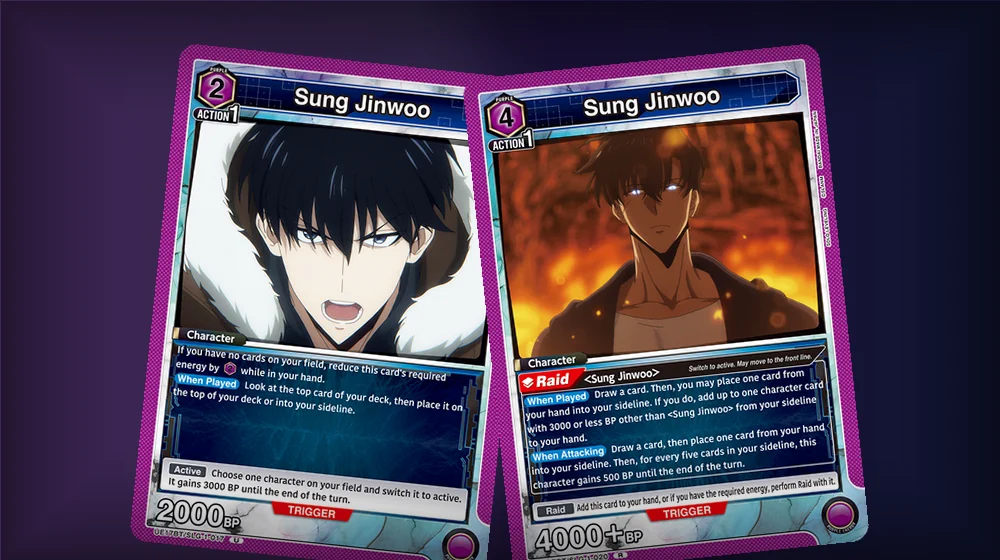 The early Sung Jinwoo cards build the sideline, while the Raid version turns that count into power and retrieval.
Reaching 20 Cards Without Losing the Game
The first milestone is 10 cards. Cha Hae-in's UE17BT/SLG-1-011 text becomes much more threatening there: if it has been added from the sideline by an ability, Sung Jinwoo can bring it in active, and at 10 or more cards it cannot be blocked by a Character with 4000 or more BP. Cha also puts the top card of your deck into the sideline, so the payoff piece continues the engine instead of ending it.
The second milestone is 20 cards. UE17BT/SLG-1-034 Demon's Castle plays as a Site and puts the top card of your deck into your sideline. It can only activate once you have 20 or more cards there, but when it does, it pays the AP cost for UE17BT/SLG-1-037 Elixir of Life from the sideline and moves the used card to the removal area. Elixir of Life returns a Character with 4000 or less base BP from the sideline and draws a card.
That loop is why you should not rush every card into the sideline. Demon’s Castle is strongest when the zone contains a useful Character rather than twenty anonymous cards. Put low-impact cards there early, keep a payoff or a way to find one in hand, then use the 20-card threshold to convert the zone into real board presence.
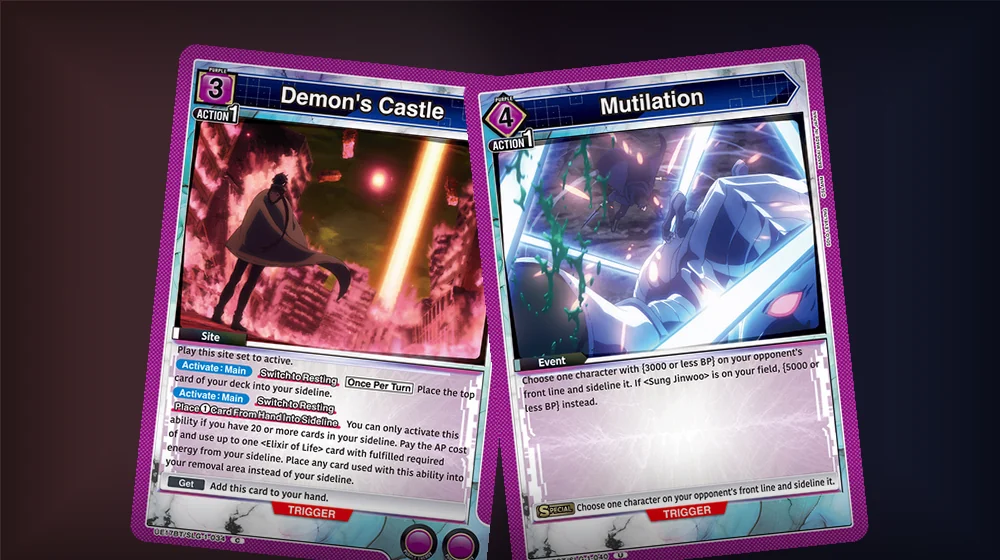 Demon's Castle rewards a full sideline, while Mutilation protects the turn where the engine finally becomes active.
Step-by-Step: How to Pilot the Solo Leveling Mill Deck
1. Mulligan for a sideline route. Keep UE17BT/SLG-1-002 Han Song-yi, UE17BT/SLG-1-016 Sung Jinwoo, UE17BT/SLG-1-017 Sung Jinwoo, or I Want to Catch Up to Him. A hand full of late Raid cards without a way to fill the sideline is not a keep.
2. Use the first turns to establish the zone, not to imitate Shadow Army. Place cards from the top of the deck or your hand into the sideline when the effect is profitable. The goal is to reach 10 cards with enough hand quality left to start the Raid line.
3. Treat Esil as a reload button. Do not spend Esil only as an early body if you can reasonably return it from the sideline later. Its draw, hand-to-sideline, and top-four search effects are the pieces that keep self-mill from becoming self-disadvantage.
4. Reach the Cha Hae-in breakpoint before forcing the big attack. At 10 or more sideline cards, Cha Hae-in can enter active through a Sung Jinwoo ability and attack through larger blockers. That creates the pressure window that lets you spend the opponent's removal before the 20-card engine comes online.
5. Use Demon’s Castle after the sideline contains a target worth retrieving. The Site is not a reason to blind-mill faster. At 20 cards, use it to access Elixir of Life, turn that into a Character, and keep AP for the action that actually changes the board.
6. Close with the 5-cost Sung Jinwoo, not with an empty deck. UE17BT/SLG-1-021 Sung Jinwoo grows for every five sideline cards, and when it attacks and wins it can add a small Character from the sideline to your hand. It also gains the forced-block line for the turn. Use the mill count to make attacks unavoidable, then let the opponent's hand and board collapse under the pressure.
Mulligan Priorities and Common Mistakes
The best opening hand usually has one low-cost self-mill card, one way to find or recycle a Sung Jinwoo, and one payoff you can leave in hand. Do not throw back every hand without Cha Hae-in. You have four copies in the sample list, and the early game is more about reaching the threshold than drawing the exact finisher immediately.
The most common mistake is placing every card into the sideline without tracking what the 5-cost Sung Jinwoo can retrieve. His attack can return a Character at 2000 BP or less at the first breakpoint, then expands its BP range for every additional five sideline cards. Keep that retrieval line in mind before you trade away a small Character for one more card of self-mill.
The second mistake is firing Mutilation before Sung Jinwoo is in play when you could wait one turn. UE17BT/SLG-1-040 Mutilation sidelines an opposing front-line Character at 3000 BP or less, or 5000 BP or less if Sung Jinwoo is on your field. That extra ceiling is often the difference between spending a second card on removal and opening a clean Raid attack.
The third mistake is treating the deck as passive. You are not trying to sit behind twenty sideline cards forever. Once Cha Hae-in can enter active and the 5-cost Sung Jinwoo can force blocks, attack. The sideline is a pressure engine, not a reason to pass turns.
What the Virginia Win Proves, and What It Does Not
Joseph Writer Anderson's April 20 event breakdown labels Purple Cha/Jinwoo Mill as the first-place Virginia Regionals 26-27 deck piloted by Nick. His deck list and commentary are the clearest source for the specific 50-card recipe. Bandai's official top-placing archive supplies a separate check on the archetype's event presence: Purple Solo Leveling won the May 8 Wave 1 event and appears again in the June 12, June 26, and August 21 result rows.
That is enough to call the archetype proven. It is not enough to claim that the old A+ or S-tier label still describes the deck on September 15. The current site meta snapshot says community trackers now name Shadow Army rather than Jinwoo/Cha Mill, and Bandai's archive does not publish a public win-rate percentage. Treat this as a real tournament-backed build that deserves testing, not as a guaranteed best deck.
GODEEPER: The cross-IP Union Arena current meta snapshot explains why one result should be read as evidence of a deck's ceiling, not as proof that it still dominates today's field.
Related Reading
- Union Arena EN Meta Tier List 2026: the earlier tier snapshot that records the Virginia result and its current caveat.
- Union Arena TCG Beginner Guide 2026: rules, zones, and starter-deck context before learning a threshold-heavy build.
- Union Arena Bleach Ichigo Deck Guide: another guide with a real mill-to-removal engine, useful for comparing resource-zone pacing.
Frequently Asked Questions
What is the Union Arena Solo Leveling mill deck? It is the Purple Sung Jinwoo and Cha Hae-in build from UE17BT. It fills your sideline through self-mill and hand-to-sideline effects, then turns that resource into Raid turns, forced blocks, Impact, and value. The printed engine mills your own deck, not the opponent's, even though players call the strategy a mill deck.
Is the Solo Leveling mill deck the same as Purple Shadow Army? No. Shadow Army is summon-focused, while this list prioritizes sideline thresholds, recursion, and a slower Raid plan. Both are Purple Solo Leveling decks, but they ask for different mulligans and closing turns. The mill label should not make you mulligan for the Shadow Army game plan.
How many cards should be in the sideline before the mill deck turns on? The key threshold is 20 cards in the sideline for Demon's Castle. Several other cards become better at 10 or 20 cards, so the first objective is to fill the sideline without losing the Characters and Events needed for the closing turn.
What are the core Solo Leveling mill cards? The tested Virginia list uses Han Song-yi, Esil, several Sung Jinwoo cards, Cha Hae-in, Demon's Castle, I Want to Catch Up to Him, Elixir of Life, Arise, and Mutilation. The 5-cost Sung Jinwoo and 4-cost Cha Hae-in are the central Raid and free-play payoff pair.
Did the Union Arena Solo Leveling mill deck win a real event? Yes. Joseph Writer Anderson's event breakdown identifies Purple Cha/Jinwoo Mill as Nick's first-place Virginia Regionals 26-27 deck. Bandai's official archive also lists Purple Solo Leveling first at the May 8 Wave 1 event, plus later placements. The archive does not expose the pilot name in its visible text.
Is the Solo Leveling mill deck still top tier today? Its earlier win is confirmed, but its current tier position is not. The latest site meta snapshot says current community trackers list Shadow Army rather than Jinwoo/Cha Mill by name, so treat the deck as a real, proven option that still needs local testing rather than assuming the old ranking held.
References
- Union Arena official Solo Leveling card list: Bandai's live UE17BT card database and card-detail links.
- Sung Jinwoo UE17BT/SLG-1-049 official card detail: official card-detail format and text reference for the set.
- Union Arena official top-placing decks archive: Bandai's event results for Purple Solo Leveling across Wave 1 and Wave 2.
- 6 Top UNION ARENA Decks from the Virginia Regionals, Joseph Writer Anderson: Virginia placement, pilot attribution, and the exact 50-card recipe.
- UNION ARENA: Every Solo Leveling Deck, Ranked, Joseph Writer Anderson: independent explanation of the Purple Jinwoo/Cha strategy and its self-mill potential.
Was this guide helpful?
About the author
MS
TCG Collector & Value Analyst
TCG collector and value analyst covering anime card games since 2021. Specializes in pull rates, card values, and market trends across One Piece TCG and Union Arena.
- TCG collector since 2021
- Tracks card values across TCGPlayer and CardMarket
- Pull rate analysis across 100+ boxes opened
- Covers One Piece TCG and Union Arena collector market
Disclaimer
This article is published for informational and entertainment purposes. It does not constitute professional financial, legal, or technical advice. Game performance, online services, patch schedules, and store listings change. Verify critical details (pricing, system requirements, regional availability) with publishers and storefronts before you buy. Affiliate links, where present, help support our editorial work and are labelled in our affiliate disclosure.